Western logistics stocks endured a turbulent twelve months shaped by two distinct shocks. The first came in April 2025, when the announcement of sweeping US reciprocal tariffs triggered a broad sell-off across the sector.
Prolonged tariff uncertainty weighed heavily on manufacturers, retailers, and logistics operators alike, with levies disrupting cost structures across much of the year.
The major listed companies in Saudi Arabia's logistics sector, however, have attracted growing investor attention, with some delivering share price gains that meaningfully outpaced both regional and global benchmarks over the past twelve months.
To assess the Saudi logistics sector's equity performance, this analysis draws on three listed companies on the Tadawul:
1) Bahri — The National Shipping Company of Saudi Arabia (NSCSA) (Tadawul: 4030) 2) Saudi Logistics Services Co. (SAL) (Tadawul: 4263) 3) Saudi Ground Services Co. (SGS) (Tadawul: 4031)
It is too early to draw firm conclusions about how the ongoing war between Iran, Israel and the US will ultimately affect logistics stocks.
Market reactions in the immediate aftermath of geopolitical shocks are typically driven by sentiment and uncertainty rather than fundamentals, meaning initial price movements often overshoot in both directions before correcting.
Supply chain adjustments, insurance repricing, and shifts in trade routing all take weeks or months to fully materialise — making any analysis conducted during the opening phase of the conflict necessarily incomplete.
That said, higher oil prices increase the revenue per cargo for energy shippers like NSCSA, since freight rates for crude oil tankers typically rise alongside the commodity price, directly boosting earnings. (Brent increased briefly to more than at $85 a barrel on March 3).
Higher oil prices increase the revenue per cargo for energy shippers like NSCSA, since freight rates for crude oil tankers typically rise alongside the commodity price, directly boosting earnings.
From Freefall to Recovery: Global Logistics Equities in 2025
The BlueStar Global Logistics Index tracks large logistics companies from around the world, though most of its holdings are based in Western markets.
Despite this bias, the variety of companies it includes makes it a useful and practical benchmark for measuring how global logistics stocks have performed on average.
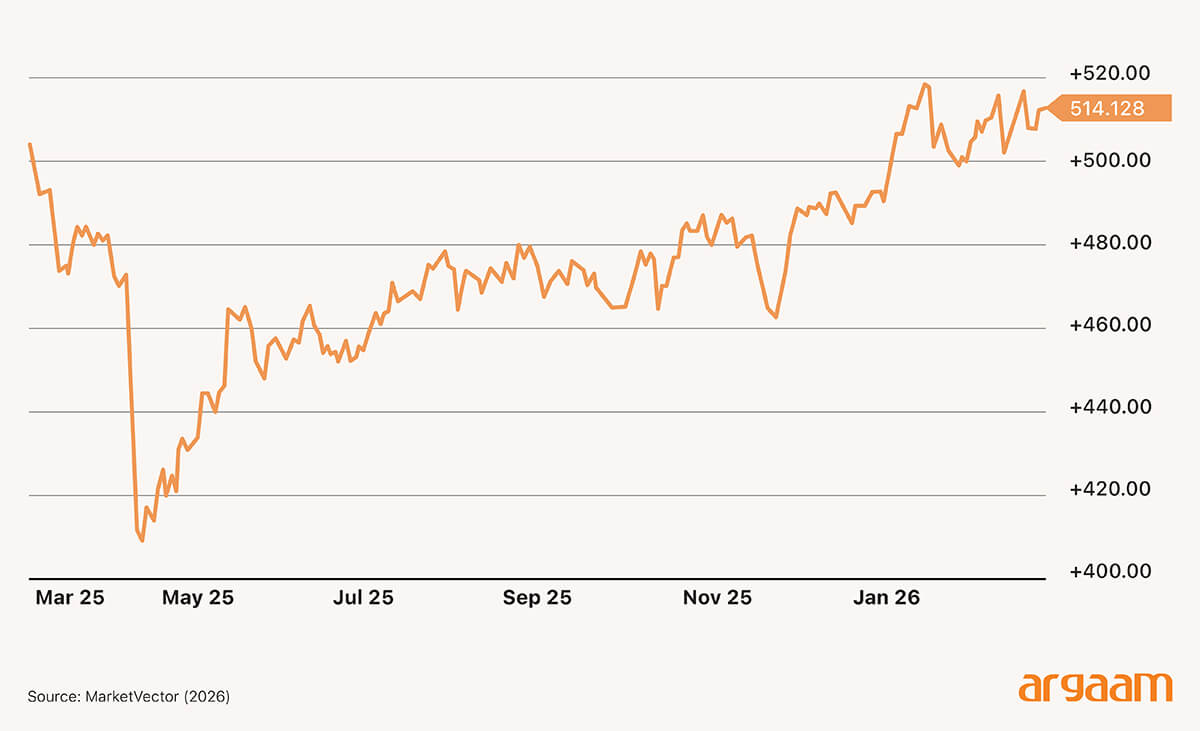
The chart tracks the BlueStar Global Logistics Index from March 2025 to early 2026, and tells a story of sharp correction followed by a sustained recovery.
The index opened the period under significant selling pressure, falling from roughly 480 in late March to a trough of around 415 by late April — a decline of approximately 14% in under two months.
This likely reflects the broader market turbulence of that period, including tariff escalation fears and global trade uncertainty.
From May onwards, however, the index entered a steady and broadly uninterrupted recovery phase, climbing through the summer and accelerating into the final quarter of 2025.
By late November it had reached a new peak above 520, before consolidating around 514 heading into early 2026.
The overall message is one of resilience: despite a turbulent year marked by tariff shocks, AI-driven sell-offs, and sharp swings in both directions, global logistics equities ultimately recovered, closing the period meaningfully higher than where they started — though the journey there was far from smooth.
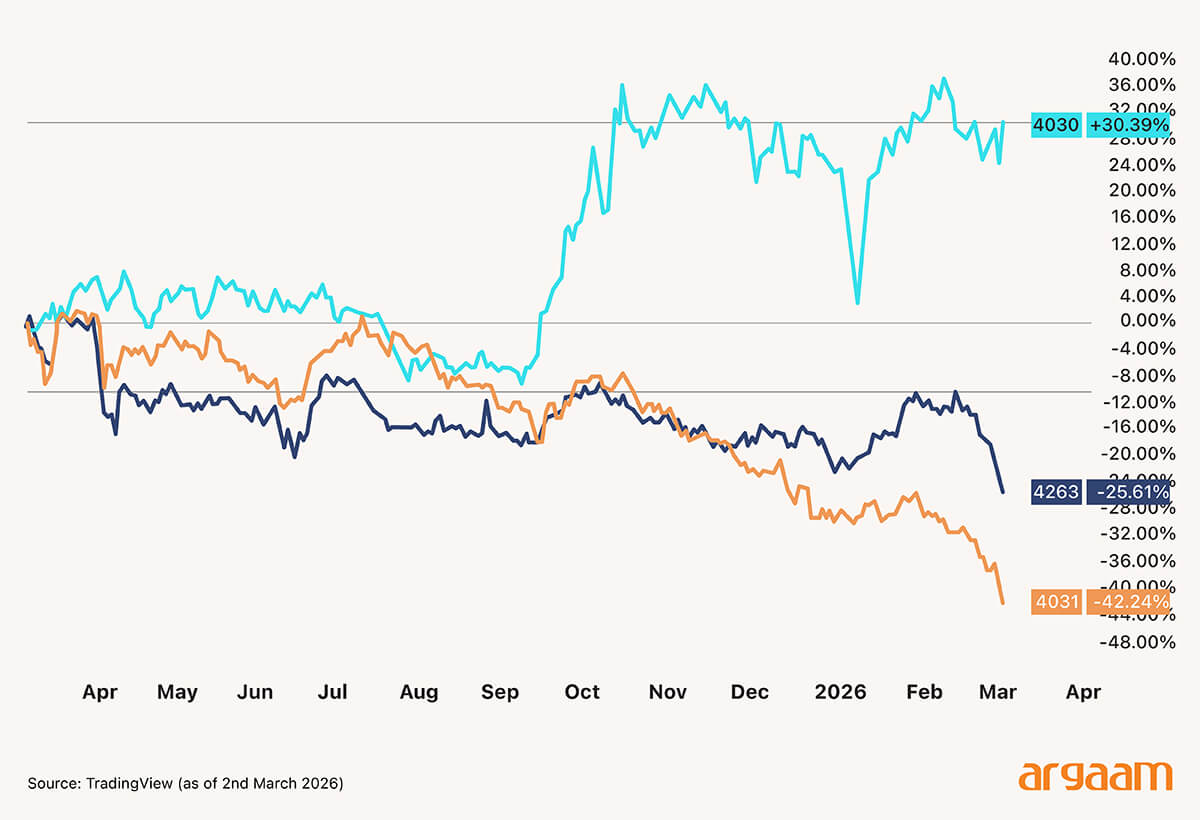
For visual comparison, the chart below plots the daily price percentage change for each of the three Saudi logistics firms over the same period. NSCSA is represented by the blue line, SGS by the green, and SAL by the red.
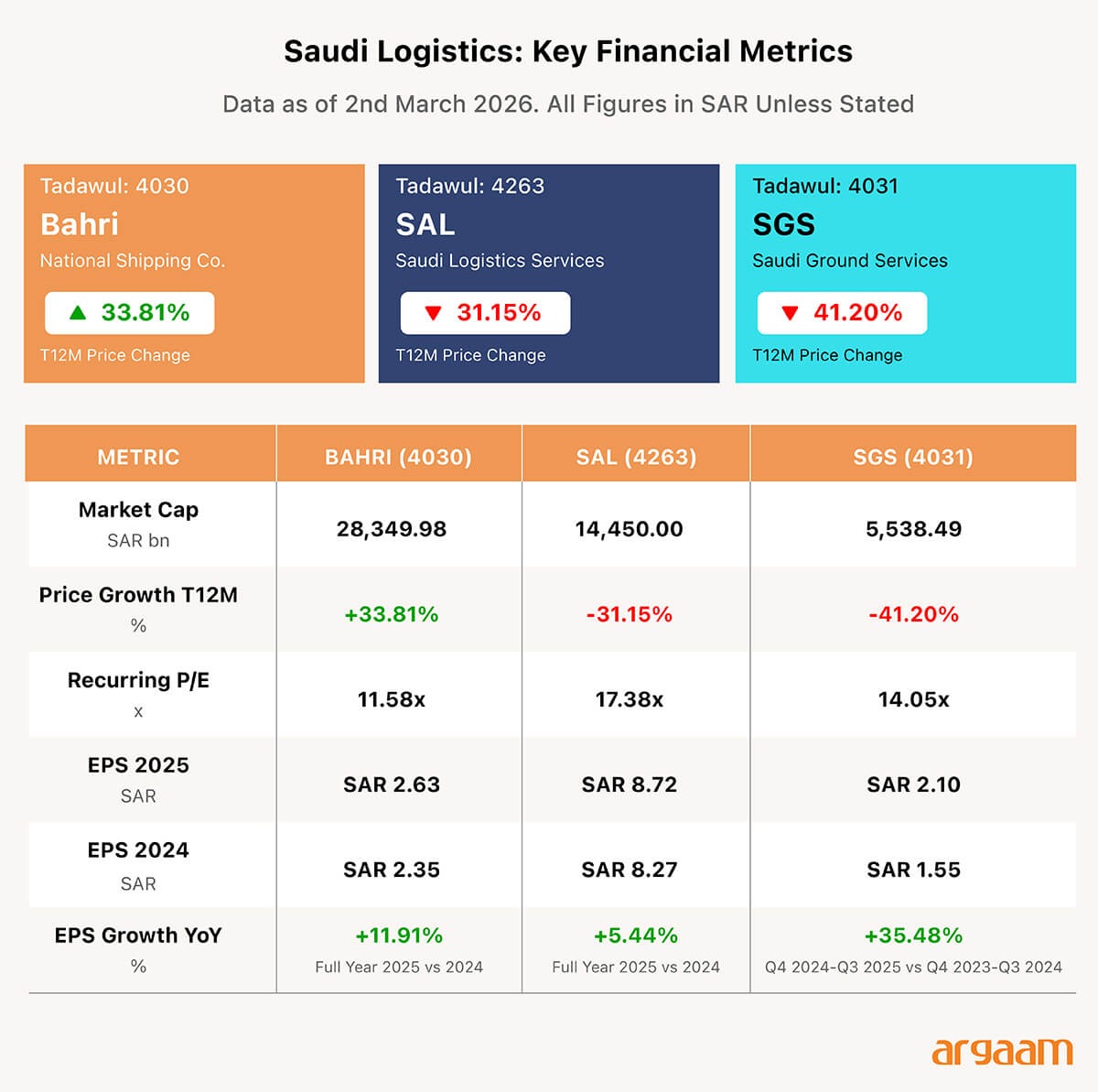
Turning to the fundamentals, the table below presents a range of key financial metrics for all three Saudi firms, drawn from the most recent data available. It is worth noting that for SGS, the latest available figures are as of Q3 2025, placing it one reporting period behind NSCSA and SAL.
In summary, the BlueStar Global Logistics Index posted roughly a decline of −1% over 2025 but recovered to a trailing twelve-month return of nearly +2%. Against this global benchmark, the picture across the three Saudi firms is mixed.
NSCSA has meaningfully outperformed in terms of share price, while SAL and SGS have declined. On the earnings side, however, all three firms report positive EPS — with SGS standing out for particularly strong year-on-year EPS growth.
On valuation, SAL's P/E ratio sits close to the S&P 500's historical average, while both SGS and NSCSA trade at a discount to that benchmark.
Before examining these financials further, it is worth stepping back to consider the structural similarities and differences between the Saudi and global markets — context that is essential for interpreting these numbers accurately.
The Oil Shield: How Saudi Firms Weathered What Others Couldn't
Trump's reciprocal tariff announcement in early April 2025 rattled global markets broadly. The FTSE All-Share fell around 10% in the days that followed, and the BlueStar Global Logistics Index lost roughly 13% of its value.
Global ocean container bookings dropped sharply as traders pulled back. But the impact on Saudi logistics stocks was uneven — and the divergence is instructive.
NSCSA fell only around 4% following the announcement and recovered quickly. SAL and SGS dropped further, around 13% and 12% respectively.
The reason lies in what each company actually does. Energy products were exempted from reciprocal tariffs within a week of the announcement, meaning crude oil shipments — and NSCSA's core business — were largely unaffected.
SAL and SGS, which handle general cargo and air freight, had no equivalent protection and remained exposed to the broader slowdown in trade.
This is not a coincidence — it reflects a structural feature of the Saudi economy. Oil is an inelastic commodity that major importers, including the United States, cannot easily restrict.
Saudi logistics firms tied to energy shipping therefore carry a natural buffer against certain types of foreign policy shocks.
A similar dynamic played out when fears that AI could automate core freight brokerage functions triggered sharp sell-offs in US logistics stocks. C.H. Robinson and Landstar each fell more than 14% in a single session. Saudi firms were untouched — freight brokerage is not a significant standalone business in the Kingdom.
Notably, diversified global operators like DHL and FedEx were also largely unaffected, for the same reason: breadth of business model provides insulation.
What is equally notable is that the US freight brokers that sold off most sharply recovered much of their losses within days, suggesting the initial reaction was driven by sentiment rather than fundamentals — a pattern of overselling and rapid reversal that points to a broader question about how differently Western and Saudi equity markets behave under pressure.
ℹ︎
Who Owns the Stock Shapes How It Moves
Western equities are dominated by passive funds and institutions. Saudi firms are backed by retail investors and PIF — and that changes everything.
Passive Ownership Amplifies Panic When sentiment shifts, passive fund mechanics exaggerate the move in both directions. The result is stocks that overshoot on the way down and on the way up.
PIF Is a Stabiliser, Not Just a Shareholder PIF invests for decades, not quarters. Its mandate is Vision 2030 — not quarterly returns — which makes it a fundamentally different kind of owner.
A Smaller Float Means Less Volatility PIF's large stakes reduce the shares available for daily trading. Fewer shares in circulation mechanically dampens price swings.
Saudi Logistics Stocks Carry Structurally Lower Risk The combination of patient sovereign ownership and a reduced free float makes firms like Bahri a calmer, more predictable investment than their Western peers on paper.
The Paradox of Saudi Logistics in 2025
After its sharp drop in April 2025, the BlueStar Global Logistics Index has gradually recovered to roughly where it started. This suggests that globally, the logistics sector has largely returned to normal — the main disruption was the tariff announcement, and with those tariffs since reversed, prices have followed suit.
The three Saudi firms, however, tell very different stories. NSCSA has been a standout performer. Its EPS grew by 11.91% in 2025, and its share price has risen 33.81% over the past twelve months.
The fact that its market value has grown faster than its earnings suggests investors are expecting even more growth ahead — likely pricing in its government backing, its close relationship with Aramco, and its scale as a global operator.
SAL and SGS paint a different picture. SAL grew its EPS by 5.44%, yet its share price fell 31.15% over the same period. The market appears to be signalling that it does not expect that earnings growth to continue.
SGS is a similar case, though more striking: despite EPS growth of around 35%, its share price has fallen 41.20%.
Legal disputes and slowing revenue growth seem to be weighing heavily on investor sentiment, even though the business itself remains profitable. It is also worth noting that SGS's most recent financial data is from Q3 2025, so its current position may have shifted since then.
This pattern is not limited to these three firms. Several smaller Saudi logistics companies — including United International Transportation, Saudi Public Transport, and Sustained Infrastructure Holding — have also seen significant share price declines and weaker earnings. Bahri's strong performance, in other words, is not representative of the sector as a whole.
What the market seems to be doing is drawing a clear line between firms that benefit directly from government support and PIF's strategic backing, and those that do not.
Bahri also stands apart from its Saudi peers in a more fundamental way — its revenues are largely tied to energy shipping, which gives it a different risk profile entirely.
When conflict in Iran disrupted flight operations and weighed on SAL and SGS, Bahri's share price actually rose 5%, carried up by the same oil price spike that the conflict triggered.
More this Weekend
Saudi Arabia's Petrochemical Base Is a Biodegradable Advantage Waiting to Be Activated
The biodegradable materials sector is no longer a story about environmental conscience. It is becoming a story about industrial economics — and Saudi Arabia has compelling reasons to pay close attention. Global demand for bioplastics and biodegradable materials is projected to exceed $40 billion by 2030, growing at nearly 10% annually.
Financialization of GPUs in Saudi Arabia: The Missing Market at the Heart of the AI Economy
Saudi Arabia could find itself in a rare position to create the financial infrastructure that transforms raw computing power into something markets can trade and investors can own. Graphics processing units drive the economics of artificial intelligence, yet the financial system has never properly absorbed them.