The biodegradable materials sector is no longer a story about environmental conscience. It is becoming a story about industrial economics — and Saudi Arabia has compelling reasons to pay close attention.
Global demand for bioplastics and biodegradable materials is projected to exceed $40 billion by 2030, growing at nearly %10 annually.
For Saudi Arabia, the significance of this shift goes well beyond packaging materials. The kingdom's economic transformation under Vision 2030 is fundamentally a bet on diversifying away from hydrocarbon revenues by building competitive manufacturing and technology sectors.
Biodegradable materials manufacturing sits precisely at the intersection of those ambitions — it is a capital-intensive, technology-driven, intellectual-property-rich sector that rewards exactly the kind of industrial capabilities Saudi Arabia is trying to develop.
Countries that move early into the production systems, processing technologies, and patents that underpin this sector will capture long-term licensing revenues and manufacturing value that late movers will have to pay for.
The economics of scaling are also highly relevant here. Like semiconductors, advanced chemicals, and precision manufacturing before it, biodegradable materials production follows a well-documented learning curve: unit costs fall as cumulative production expands, equipment becomes standardised, and process automation deepens.
Saudi Arabia's access to petrochemical feedstocks — the raw material base from which many bioplastics are derived — gives it a structural cost advantage at the input stage that few other countries can match.
SABIC, Saudi Aramco, and the broader petrochemical ecosystem already possess the industrial infrastructure and chemistry expertise that biodegradable materials production builds directly upon.
The question is not whether Saudi Arabia has the foundation to enter this sector seriously. It clearly does. The question is whether it moves before the technology and intellectual property concentrated in this space becomes controlled by a small number of dominant players in Europe, North America, and East Asia.

Predictable Demand Changes Everything
Demand signals are also becoming more predictable, which matters enormously for investment planning. Regulatory restrictions on single-use plastics are now active across the European Union, the United Kingdom, and a growing number of Asian markets.
Large multinational corporations — the global consumer goods and packaging companies that represent the most significant procurement volumes — are making multi-year ESG commitments that create structured, forward-looking demand pipelines rather than unpredictable policy-driven spikes.
This kind of demand visibility is what transforms a volatile emerging sector into a bankable industrial investment, and it is arriving precisely as global bioplastics production capacity is projected to roughly double between 2025 and 2030.
That doubling of capacity is the most important single data point in this picture. Manufacturers do not invest in doubling production capacity unless they have credible forward demand and improving unit economics.
Saudi Arabia's strategic window is therefore a function of timing as much as capability. The sector is entering its industrial scaling phase now. The intellectual property is not yet consolidated.
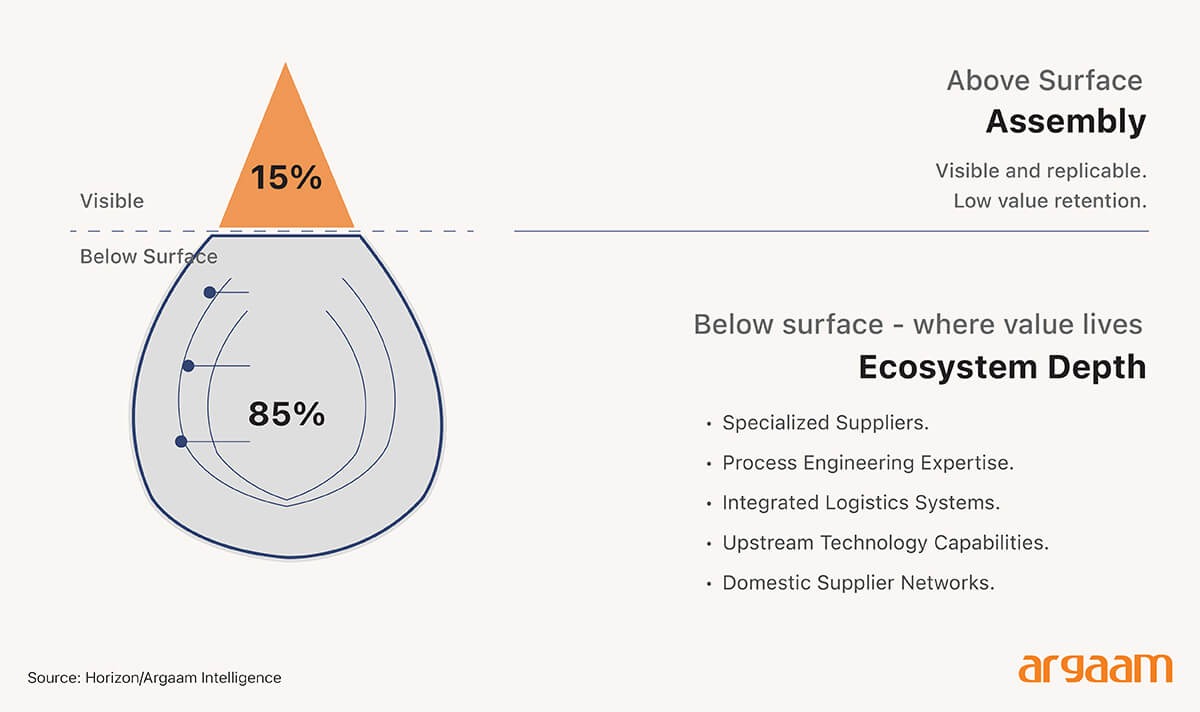
In the figure above, we explain how kingdom could enter the biodegradable materials sector at the assembly end — importing technology, importing components, putting things together locally.
That would create jobs and activity, but it would leave Saudi Arabia permanently dependent on foreign suppliers and foreign technology owners, paying licensing fees rather than collecting them, and capturing a fraction of the value that flows through the sector.
Or Saudi Arabia could invest in building the ecosystem — developing domestic specialised suppliers, training process engineers, acquiring or developing intellectual property, integrating logistics systems.
That takes longer and costs more upfront. But it is the path that transforms a country from a customer of an industry into an owner of one. And ownership, in manufacturing economics, is where the durable, compounding, long-term value accumulates.

Plastic's Price Tag Is Missing Most of the Price
Conventional plastic is one of the most distorted priced products in the global economy. Its sticker price covers only what it costs to make — not what it costs the world.
The remainder is quietly offloaded onto governments, communities, and ecosystems in the form of waste infrastructure, environmental damage, and ecological harm that accumulates across generations. The product appears cheap because someone else is paying the rest of the bill.
Economists call this a negative externality: a cost that is real, measurable, and significant, but that falls outside the transaction between buyer and seller and is therefore systematically ignored by private production decisions.
It is a subsidy paid not by governments in cash but by the environment in damage — and it has been compounding silently for decades.
For Saudi Arabia, understanding this pricing distortion is strategically important for two distinct reasons. The first is related to the petrochemical sector. It is one of the most significant in the world, and conventional plastic is among its most important downstream products.
For decades conventional plastic was priced without accounting for its environmental impact — those costs fell on governments and ecosystems instead. Regulation is now reversing that.
Plastic taxes, producer responsibility laws, and border carbon adjustments are systematically pushing those hidden costs back into the price producers and consumers actually pay. The gap between plastic's market price and its true cost is closing — by design and by law.
The second reason has to do with the fact that biodegradable materials have always been priced closer to their true cost.
As regulation forces conventional plastic to do the same, the price gap between the two narrows — not because biodegradables got cheaper, but because the competition finally got honestly priced. The problem for one becomes the opportunity for the other.
Saudi Arabia's ambition to build a significant biodegradable materials manufacturing sector is therefore not simply an environmental positioning exercise.
It is a calculated bet that the economics of the materials market are being permanently repriced, and that getting into the right side of that repricing early is worth considerably more than waiting for the market to fully adjust before acting.

One Factory Is Not an Industry
Building a competitive biodegradable materials industry is not simply a matter of building factories. It requires developing a set of interconnected capabilities simultaneously.
The ability to process raw materials into usable inputs, the technologies to convert those inputs into finished biodegradable products, the quality control systems to ensure consistency at scale, and the high-throughput manufacturing platforms that make large-volume production economically viable.
These are not independent investments that can be made one at a time. They form an integrated system, and the system only works when all its parts are in place and functioning together.
The upfront cost of building this kind of ecosystem is significant. But industrial policy research consistently shows that the investment pays for itself over time in a specific and measurable way: as ecosystem components develop and interact, production costs fall faster, productivity rises more quickly, and the sector becomes more competitive at a pace that isolated individual investments cannot replicate.
The learning and efficiency gains that come from having specialised suppliers, process engineers, material scientists, and manufacturing platforms operating in proximity and coordination compound over time in ways that no single factory operating alone can achieve.
The 9% rise in Saudi Arabia's industrial production index in 2025 is not simply a headline number — it signals that the kingdom's manufacturing base is absorbing capital and expanding capacity at a pace that creates genuine conditions for ecosystem development in advanced materials sectors like biodegradables.
The critical analytical insight here is the distinction between margin-driven and capability-driven investment logic. Early-stage biodegradable manufacturing will not generate the immediate returns that conventional petrochemical processing delivers.
But industrial policy research across South Korea, Taiwan, and Germany consistently demonstrates that countries willing to absorb thin early margins in exchange for accumulated process knowledge, supplier depth, and proprietary technology ultimately capture the commanding positions in emerging sectors — positions that become structurally difficult for late entrants to challenge.
Saudi Arabia's National Industrial Strategy provides exactly the institutional framework that transforms isolated manufacturing investments into a coherent capability-building programme — converting production growth into compounding industrial advantage rather than simply adding output.
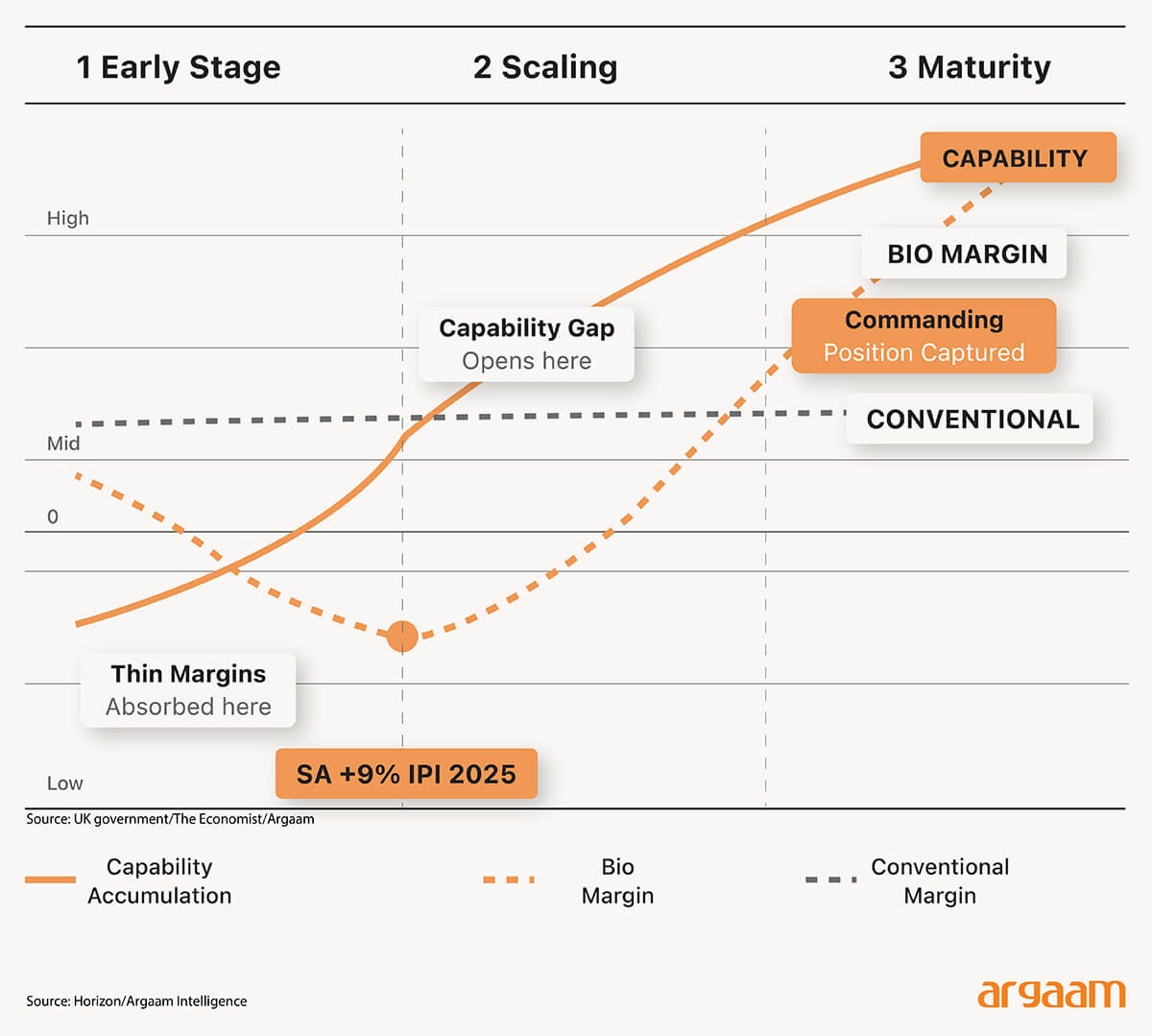
The chart tells the analytical story across three phases:
➢ Phase 1: Biodegradable margins dip below zero while capability accumulation begins. Saudi Arabia's +9% marks this entry point.
➢ Phase 2: The capability gap opens as ecosystem depth compounds faster than conventional competitors can replicate.
➢ Phase 3 : Margins recover sharply as the commanding position is captured — a position late entrants structurally cannot access.
Three lines do all the work: capability accumulation rising steeply, biodegradable margin dipping then surging, conventional margin flattening.
ℹ︎
Note Bio margin in the chart refers to the profit margin generated from producing and selling biodegradable materials — the difference between what it costs to make them and what the market pays for them.
Right now, companies that license biodegradable material formulations to other manufacturers typically earn a royalty of four to 5% on whatever those manufacturers produce.
That is a reasonable income stream, but it reflects a relatively modest position in the value chain — you are licensing a recipe, not controlling a kitchen.
The significantly more valuable position is owning the manufacturing platform itself — the robotic systems, the digital production environments, the process controls and quality frameworks that manufacturers need to operate efficiently at scale.
When you own the platform rather than just the recipe, the royalty rate climbs to 10% to 15% , because the manufacturer cannot replicate what you have built and cannot operate competitively without access to it. This is how the semiconductor industry works.

Concluding thoughts:
Countries that build the ecosystem capture the industry. Countries that build isolated projects remain dependent on ecosystems located elsewhere — and pay the price for that dependence in perpetually higher costs and narrower margins.
The window for establishing platform ownership is open now and will not stay open indefinitely — early platform owners set the standards that everyone else pays to use, while late entrants pay rather than collect.