Saudi Arabia could find itself in a rare position to create the financial infrastructure that transforms raw computing power into something markets can trade and investors can own.
Graphics processing units drive the economics of artificial intelligence, yet the financial system has never properly absorbed them. No reliable pricing mechanism exists, banks will not accept them as loan collateral, and there is no instrument available to protect against their value swings.
Unlike gold, computing power cannot be easily measured in standardised units or tracked through transparent markets.
This means that before liquidity and trading can develop, someone must first bring together the technology industry, investment capital, and regulatory frameworks to agree on the basic rules. Getting that coordination right matters far more, at this stage, than how deep or active the eventual market becomes.
Most analyses and news about AI investment focus on software valuations, chip manufacturers, or data centres — the financial architecture underneath compute itself has received surprisingly little serious attention.
Argaam Intelligence thinks that gap is worth examining closely, and that Saudi Arabia's specific combination of capital, infrastructure ambition, and governance flexibility makes it the most interesting place to start that conversation about the financialization of these computing assets.
High-end graphics processors have become the single most critical and contested resource inside artificial intelligence investment: without guaranteed access to sufficient capacity, the timelines for training new models stretch out, the cost of running them in real-time climbs, and the expensive data centre infrastructure built to house them sits idle and unproductive.
This is why the largest players in artificial intelligence no longer discuss hardware the way a company discusses office equipment or server upgrades.
They are now committing hundreds of billions of dollars to securing computing capacity through the end of this decade, treating it with the same strategic seriousness that an energy company treats oil reserves or a semiconductor firm treats fabrication capacity — as the foundational input without which nothing else in their business model functions.
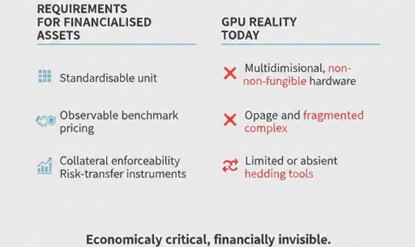
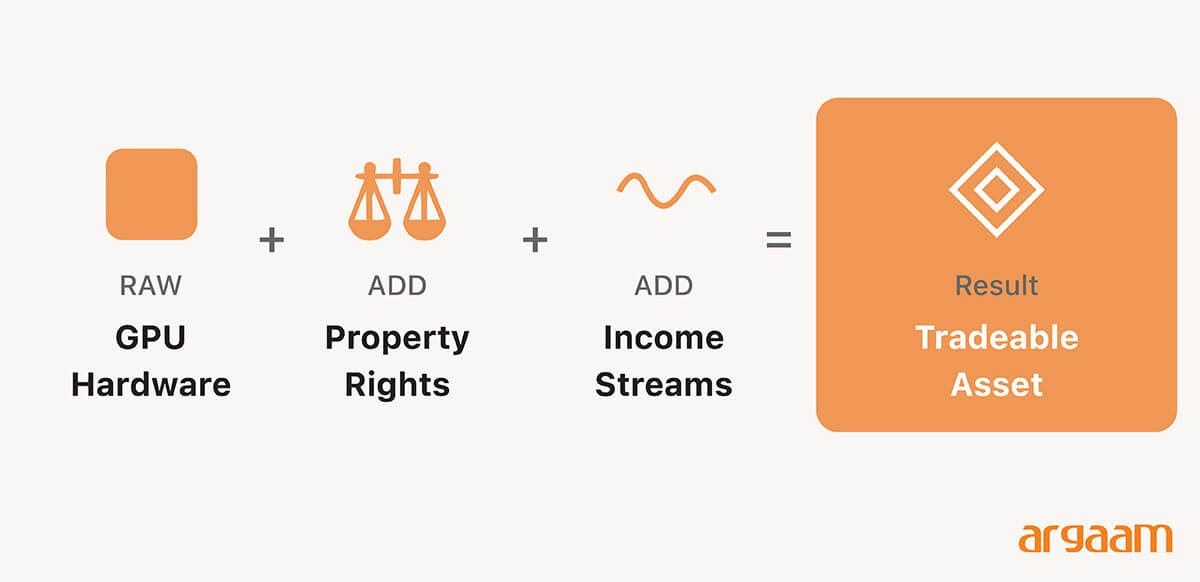
Yet despite their enormous strategic value, graphics processors remain difficult to convert into formal financial assets in the way that term is understood by economists and finance scholars who study how resources become investable: an asset is not simply something valuable.
But something valuable that has been wrapped in legally enforceable ownership rights and generates income streams reliable and transparent enough to be valued by a buyer, traded between parties, and pledged to a lender as security.
Making that conversion work in practice demands several things simultaneously. The underlying resource needs a standardised unit of measurement that different market participants can agree on. Prices need to be observable and consistent enough that buyers and sellers can transact with confidence.
Contracts governing ownership, transfer, and use need to be legally robust across jurisdictions. And the surrounding market infrastructure — the platforms, intermediaries, clearing mechanisms, and risk management instruments — needs to exist and function reliably before serious institutional capital will engage at scale.

Why Riyadh Is the Right Room for the financialization of GPUs
Compute financialisation is a coordination problem before it is a trading problem. Financialisation in this sense is less about marshalling liquidity and more about building the infrastructure of comprehension, enforcement, and shared meaning.
This is the formative stage of turning a resource into an asset, and it is a coordination problem at its heart — a task for institutions, not just markets.
What makes Saudi Arabia's position distinctive is the combination of factors it brings simultaneously. Capital alone does not create the coordination that GPU financialisation requires — but capital combined with an active infrastructure build-out and a government willing to act as a strategic convenor is a different proposition entirely.
Because compute is as much an industrial challenge as a financial one, the ability to sit at the intersection of money, hardware deployment, and policy gives Saudi Arabia a rare and genuinely useful role in bringing together the industry players, technology firms, and financial institutions whose agreement is the prerequisite for everything else.
A Saudi-led initiative would not need to set prices or dictate how much compute gets bought and sold. Its value would come from something more foundational — establishing the common definitions and shared rules that allow compute to function as a recognisable and tradeable asset within the financial system.
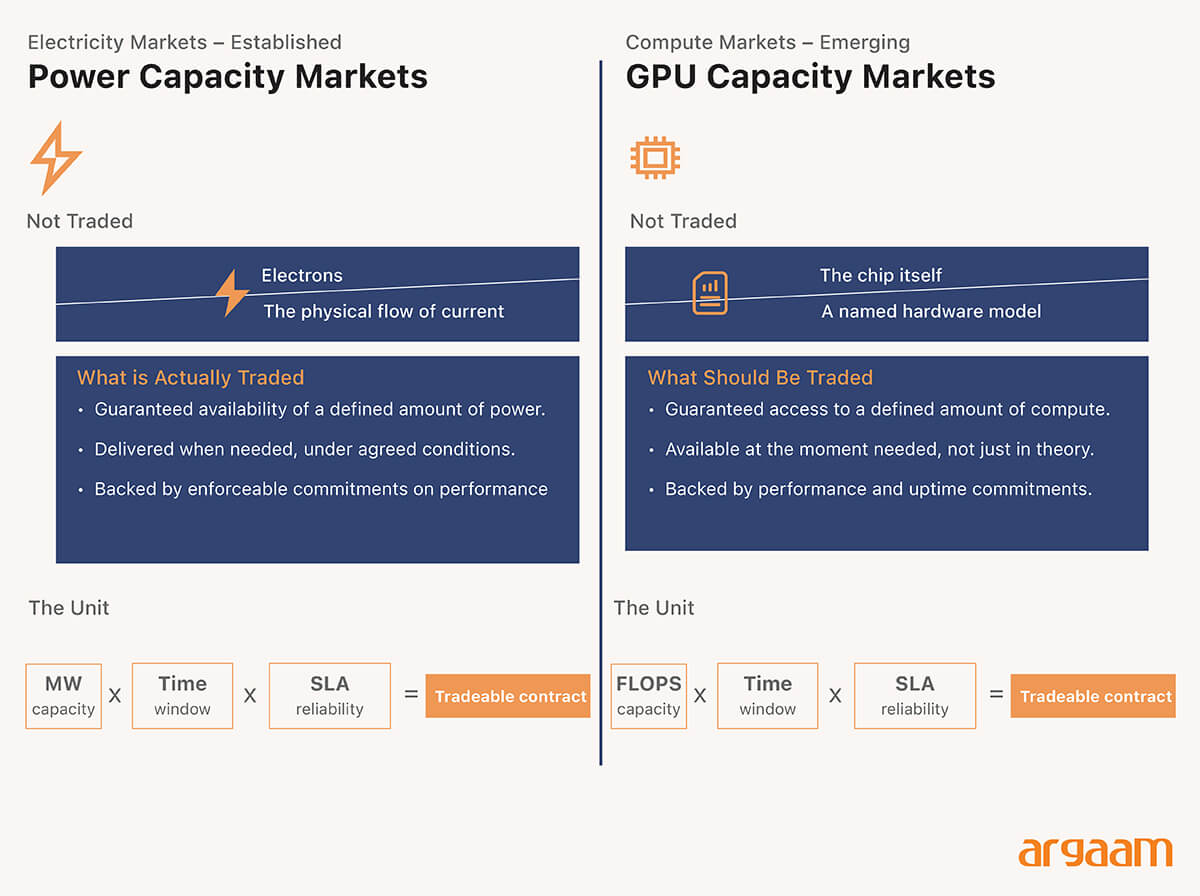
The most important practical step in that direction is moving away from pricing chips by their hardware label — this specific GPU model, in this specific configuration — and toward pricing what the chip actually delivers: a guaranteed amount of computing capacity, available over a defined period, with clear commitments on performance and reliability.
The unit becomes capacity multiplied by time multiplied by a service standard, rather than a piece of named hardware. This kind of abstraction already exists and works in electricity markets.
When grid operators and utilities trade capacity, they are not buying electrons — they are buying a contractual guarantee that a certain amount of power will be available when needed, under agreed conditions.

The need for a unit of pricing
There is no agreed standard for measuring a unit of GPU computing power in a way that works reliably for pricing. What cloud providers actually charge varies enormously — not just because some GPUs are faster than others, but because price reflects memory, location, availability, and contract terms all bundled together.
The same class of high-end chip, an H100, can cost anywhere between under one dollar and six dollars per hour depending on which provider you use and where their data centre sits.
Until the market separates these variables and prices them individually, there is no clean number that a buyer, a lender, or an investor can point to and say: this is what a unit of compute is worth.
The wide gap in GPU prices exists because these chips are not a single uniform product — they differ meaningfully in what they can do, and markets price those differences.
The problem is that finance needs something simpler: not a price for this specific chip in this specific data centre, but a price for what the chip actually delivers — the raw computing work performed. Think of it like electricity: you do not pay for the turbine, you pay for the kilowatt-hour.
GPU markets have not reached that point yet. Today you are still buying a named piece of hardware rather than a standardised unit of computing output, which means the financial system has nothing clean enough to value, trade, or build contracts around.