Saudi Arabia’s selection as the host for the 2034 FIFA World Cup signals a bold step in its efforts to establish itself as a key player on the international sporting stage. Anticipated to draw millions of visitors from around the globe for 30 days, the event promises significant economic opportunities and increased global visibility.
Yet, the latest World Cup hosted by Qatar provides cautionary lessons: large-scale sporting events could coincide with implications for the real estate markets.
Our analysis explores key economic metrics in Saudi Arabia’s real estate sector to argue that the upcoming event will not impact the residential and hospitality property market in a similar manner as it happened in Qatar.
The latest available economic and demographic data suggests that the Kingdom’s real estate dynamics will respond differently.
We are concentrating on the residential properties and hospitality sectors out of the wider real estate sector to assess their specific resilience, providing a clearer understanding of how the upcoming World Cup could cope with the market upheavals seen in the last tournament.
Qatar’s oversupply challenge
Qatar's decade-long preparation for the 2022 FIFA World Cup (WC) supported its diversification strategy, involving a US$200–300 billion investment in infrastructure. The construction of stadiums cost around US$6.5 billion, according to a detailed study by the International Monetary Fund (IMF).
The Qatari real estate market has experienced ongoing pressures over the past decade, largely influenced by the extensive expansion efforts undertaken in anticipation of the 2022 FIFA World Cup.
Data from the official Real Estate Regulatory Authority (Aqarat) indicates that the peak year for property sales volume was 2013, recording QAR 46.7 billion with a growth of 12.2% YoY, reflecting strong demand and active market conditions at that time.
However, subsequent years have revealed a gradual slowdown, with 2021 sales decreasing sharply by 42.9% YoY to QAR 27.9 billion.
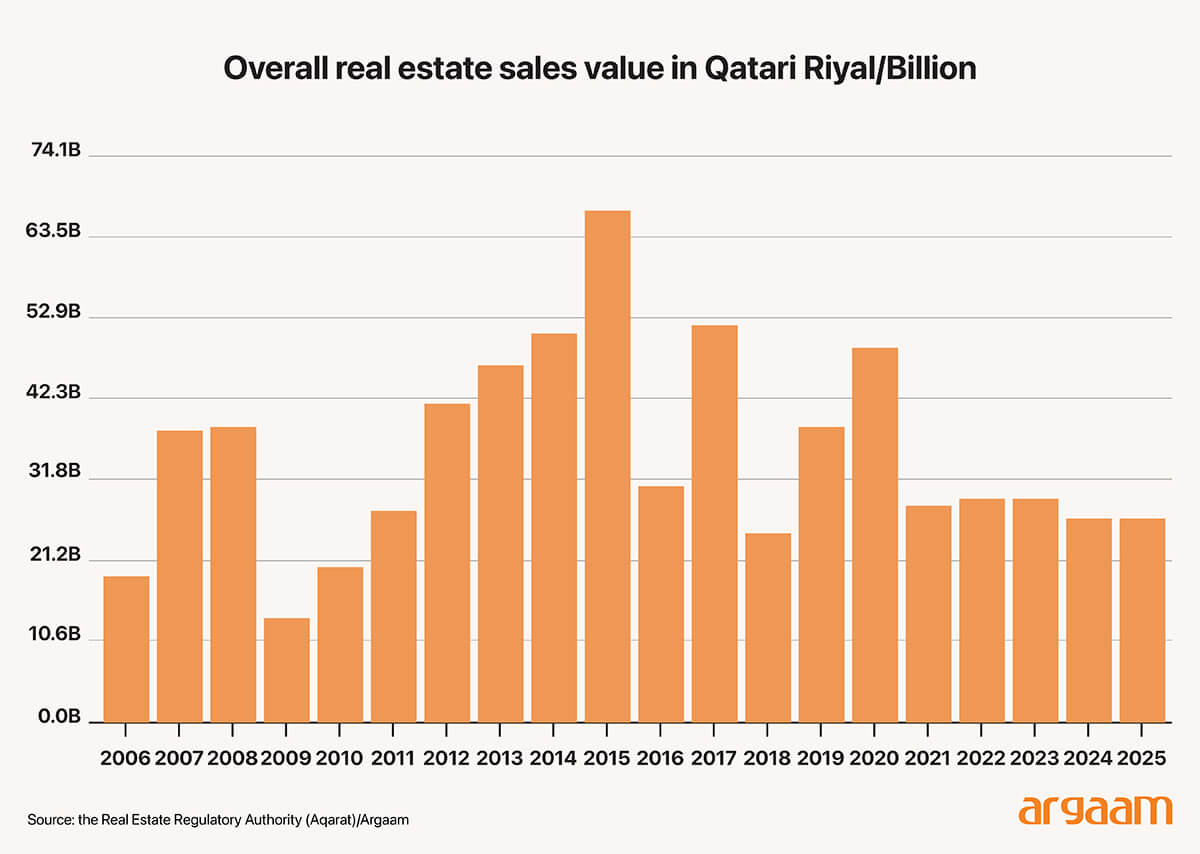
Figures from 2023 and 2024 further illustrate subdued market activity, with sales reaching approximately QAR 29 billion and QAR 26.6 billion respectively, marking declines of 0.3% and 8.4% YoY. These trends suggest that the sector has faced persistent demand-side challenges.
A significant factor contributing to this scenario has been the substantial overbuilding of properties during the lead-up to the World Cup. Accordingly, rents and real estate prices have been declining, according to an assessment by Fitch published in October 2024.
While the sector remains vital to Qatar’s economic landscape, the current market dynamics underscore the importance of maintaining a balanced approach to real estate development, emphasizing sustainable demand-driven growth overambitious expansion.
The country’s ambitious investment in infrastructure and real estate was aimed at creating a lasting legacy for the event and stimulating economic diversification.
Nonetheless, the scale of these developments, coupled with global and regional economic dynamics, has resulted in an oversupply of properties that have not been fully absorbed by the market.
The slight increase in overall real estate transactions in Qatar for the first eleven months of 2025, reaching QAR 26.7 billion and reflecting a 14.7% year-to-date growth, can be interpreted as a positive signal of renewed market activity.
It could be attributed to strategic market adjustments by developers and investors, such as price realignments to stimulate demand in specific segments or regions. These measures might foster a modest positive momentum in property sales.

What Demographic Fluctuations Mean for the Property Market
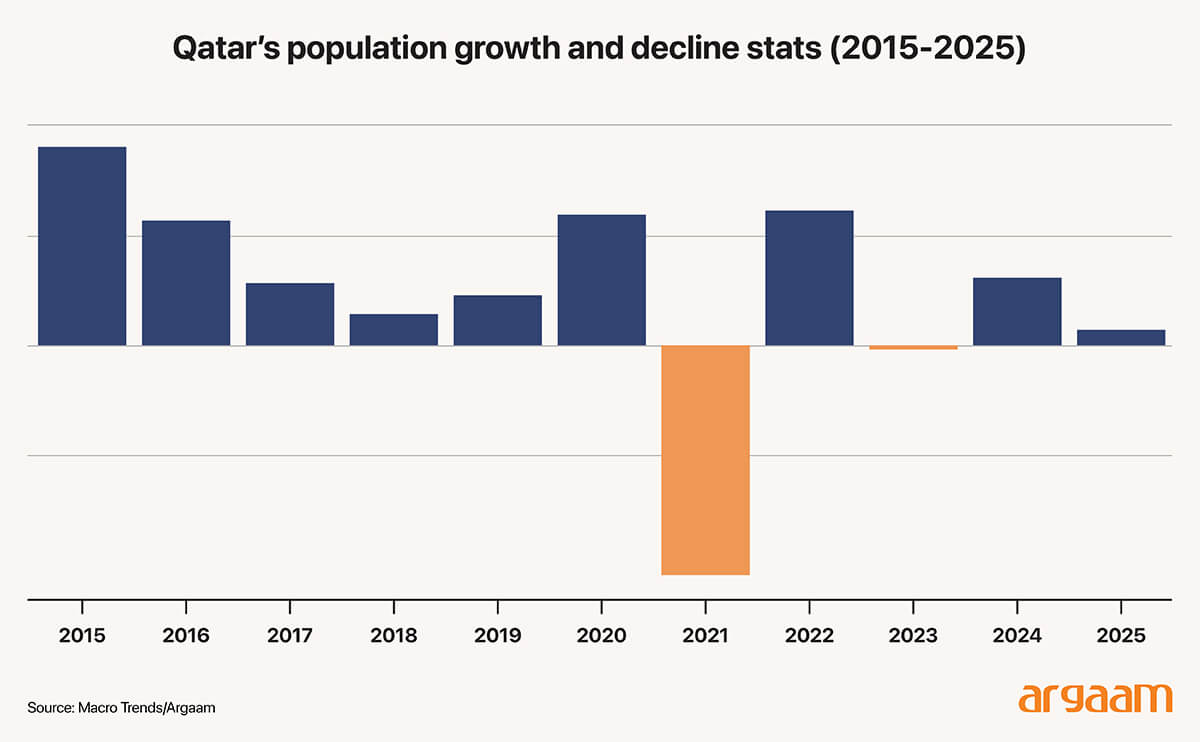
The population growth in Qatar, currently around 2.8 million people, exhibits significant fluctuations over the past several years, with periods of expansion and contraction as we see in the next chart below.
Notably, in 2019, there was a moderate growth rate of 5.8%, indicating strong inward migration likely driven by infrastructure projects and preparations for events like the World Cup.
Apart from the understandable sharp decrease during Covid-19 in 2020 (-10,35%), the slight decrease in 2023 of -0.05% suggests a stabilization or minor outflows, while projections for 2024 and 2025 show modest positive growth at 3.5% and 0.74%, respectively.
The near-zero or modest growth rates (2023-2025) can lead to sustained oversupply, especially as new developments age without sufficient absorption, causing market imbalance.
When Investment Outpaces Visitor Demand
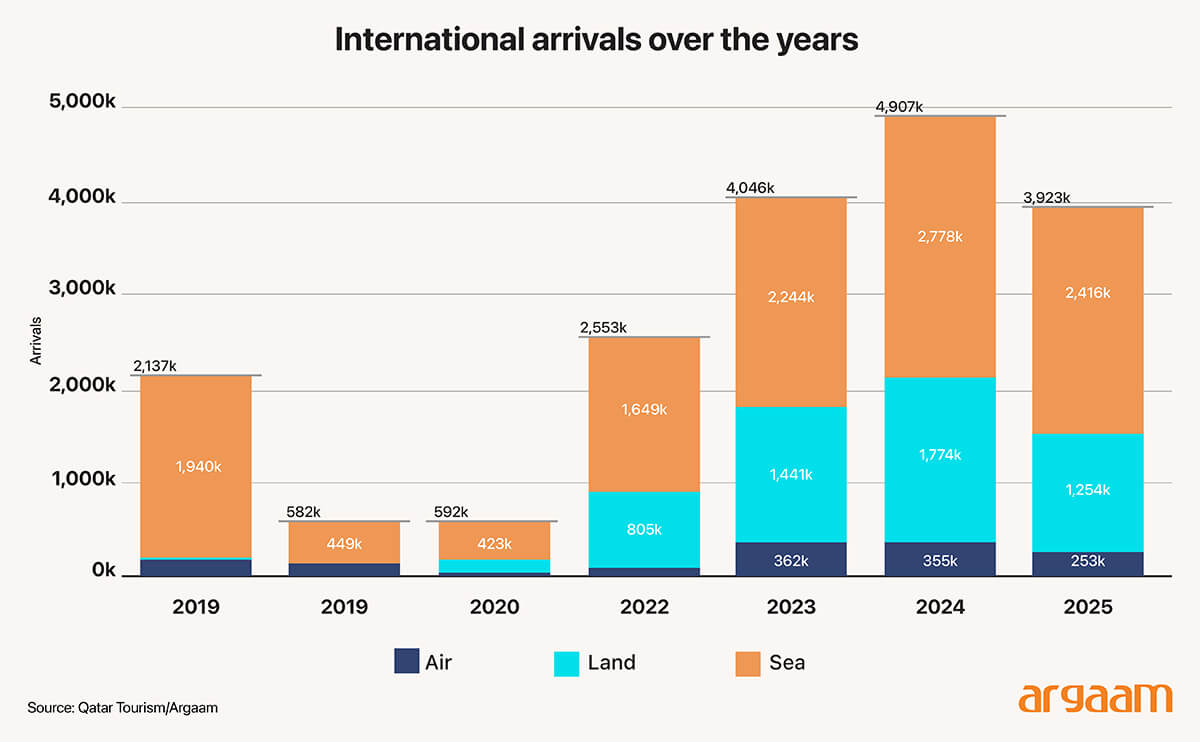
Despite significant investments in hotel capacity as well in Qatar ahead of the World Cup, the excess supply often led to lower occupancy rates, especially when visitor numbers did not meet expectations.
Qatar failed to draw the type of hotel occupancy rates the country’s hotels would have preferred.
The WC attracted approximately 1 million visitors to Qatar, with 0.3 million staying in neighboring countries and using shuttle flights.
The UAE, particularly Dubai, attracted an estimated 80% of WC spectators staying in other GCC countries, according to the IMF study, we referred to in the beginning of the analysis.
According to Qatar Tourism, occupancy came in at 56% in November 2022, compared to 61% in 2020. Occupancy stood at 71% in November, both in 2019 and 2021.
The mega-sporting event did, however, impact daily rates positively for owners and operators, with average daily rates reaching their highest levels at $501.62, up from $124.65 versus the previous month.
The price hikes were almost majorly led by 5-star hotels, which accounted for 17,375 keys in the market. Although this category saw the lowest occupancy rates (53%).
Only a third of luxury hotels in the country were fully booked through the entire event. In all, occupancies slipped 21% YOY.

Saudi Arabia’s supply chain management
In Saudi Arabia, there has been a disciplined expansion in real estate sector to ensure that the inventory keeps pace with the booming demand without risking oversupply, underpinning sustainable market development.
This influx of economic activity has pushed property values to record levels. Apartment prices in Riyadh have surged by 75% since 2019, while villa prices have increased by 40% in the same period.
For 2024 alone, apartment prices climbed almost 11% and villa prices by around 6%, underscoring a market where demand consistently exceeds supply.
The real estate sector in Saudi Arabia lies at the heart of Vision 2030. The scale and continuity of the Kingdom’s real estate and infrastructure projects indicate that it has already moved from the vision phase to the execution phase.
This transition is supported by sustainable financing mechanisms that align with societal needs and global standards of governance and environmental responsibility—instilling confidence in both local and international developers and investors.
Click Here to Read Complete Report