The IPO process duration is a critical factor for companies considering going public, influencing their decision-making, cost structure, and strategic planning.
Currently, Tadawul in Saudi Arabia generally takes up to 12 months to list a company, aligning with many international markets but still leaving room for improvement to elevate its competitiveness.
In the regional context, the Dubai Financial Market (DFM) boasts the shortest minimum IPO process, typically between 4 to 12 months, positioning it as a swift option within the Middle East.
Globally, the average IPO timeline hovers around 6 to 9 months, with leading exchanges like NASDAQ often completing the process in roughly 6 to 12 months.
Now, envision Tadawul shortening this timeline by even just one week shorter than its closest competitor DFM, whose shortest period is approximately 17 weeks (four months in terms of trading days excluding weekends and market holidays).
At first glance, one week may seem like a minor detail to some. However, amid fierce competition among global capital markets, shortening the listing timeline—even by just one week—can become a decisive factor when other market conditions are equal.
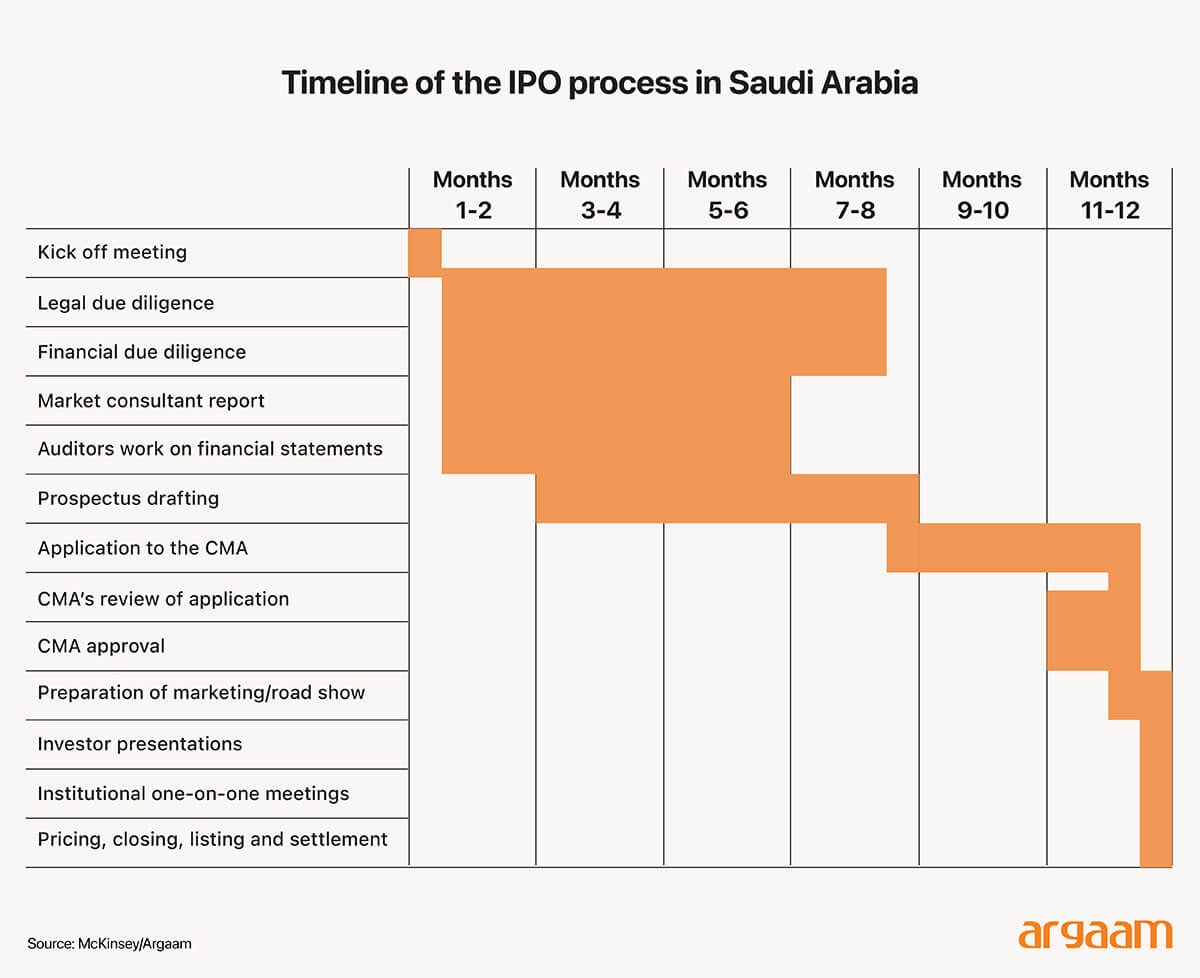
It is worth noting that many of these stages can be completed in parallel; however, the regulatory “gates” still constitute the main bottleneck in the listing process.
The IPO journey is inherently vulnerable to market volatility, with fluctuations in investor sentiment, economic indicators, or geopolitical events capable of impacting the offering’s success and valuation.
In June, for example, the Iran-Israel conflict broke out as s several firms in Saudi Arabia were advancing with their IPO plans.
Specialized Medical Co. was set to conclude the retail subscription of its $500 million IPO (i.e. non-institutional investors buy its IPO shares) during the week in which the conflict started, while gym chain operator Sports Club was slated to reveal the price range of its IPO on June 22, in the last days of the conflict (which lasted from June 13-25).
Developer Dar Al Majed Real Estate Co., Marketing Home Group Co. and tech firm Ejada Systems Ltd. Also all had regulatory approval to list at the time of the conflict.
But during geopolitical crises and given the listing process takes up to 12 months in the kingdom, investor sentiment can shift quickly, as initial optimism may wane as tensions escalated in the region.
A shorter IPO process enables firms to seize short-term market enthusiasm, regional stability, or investor interest, which tend to be fleeting, especially at the time there were real concerns of a drawn-out war and it wasn’t just a spasm of fighting.
Last week’s reports in the UK about the Financial Conduct Authority’s consideration of a shorter IPO process for the London Stock Exchange exemplifies the growing recognition that a streamlined, efficient listing regime is vital for maintaining and enhancing London’s stature as a leading global financial marketplace.
The proposed reforms in the LSE are mainly aimed at scrapping the current two-stage filing system, which leaves London IPOs more vulnerable to adverse market movements.
This two-stage filing period in the LSE is just one week, but it shows us how every single day counts in IPOs.

The few days between buy and sell
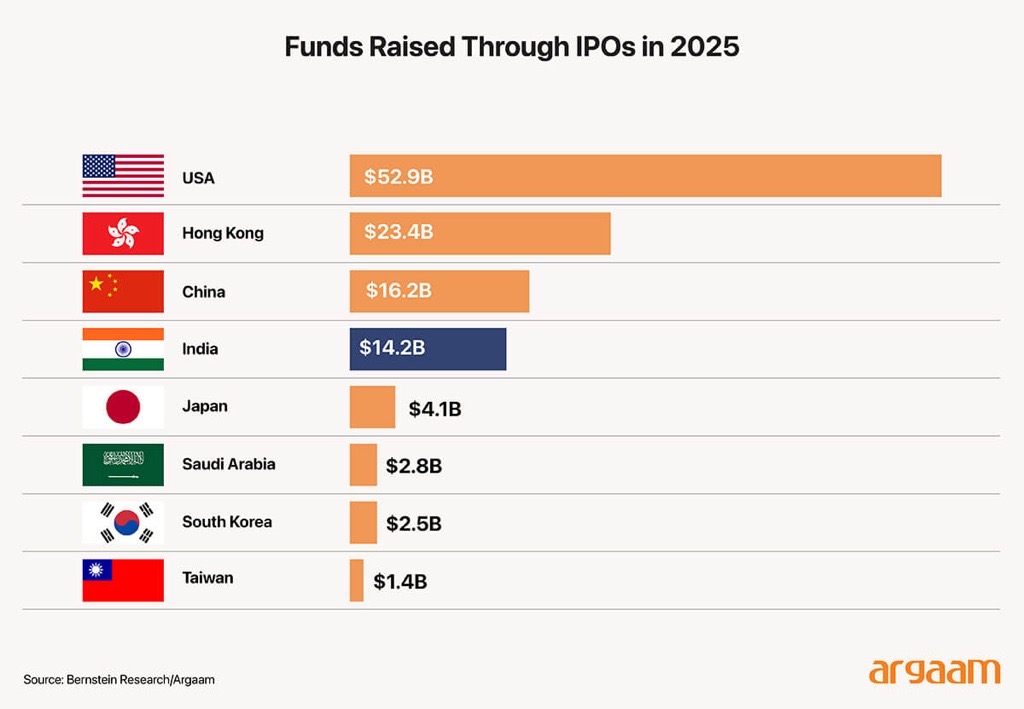
In H1 2025, Saudi Arabia’s equity capital market witnessed six companies raising a combined $2.8 billion through IPOs on the main Tadawul exchange.
Leading the activity was the public offering of low-cost carrier flynas, which raised SAR 4.1 billion ($1.1 billion) in what marked one of the region’s largest aviation listings.
Umm Al-Qura for Development and Construction Co. raised $ 523.1 million by selling 130.7 million shares at $4 each.
Delays, even with just a few days, increase the chances that the stock's price will become more uncertain, as outlined in an academic research on LSE, titled ‘The decline of stock markets in the UK: is regulation to blame and deregulation a fix?
This uncertainty can cause the difference between the highest price buyers are willing to pay and the lowest price sellers are asking (called the bid-ask spread) to widen.
Suppose before the IPO delay, the Highest price buyers are willing to pay (bid) is £100, while the lowest price sellers are asking (ask) is £102.
This results in a bid-ask spread of £2 (£102 - £100).
Now, during the delay caused by uncertainty, the spread widens, the highest bid becomes £98, while the lowest ask is up to £104. So, the new bid-ask spread becomes £6 (£104 - £98).
Let’s take another example in Saudi Arabia. The buyers are bidding at 32.00 riyals while sellers are asking for 32.20 riyals, creating a spread of 0.20 riyals (0.6%).
However, with increased uncertainty, the bid may drop to 31.40 riyals and the ask may rise to 32.60 riyals, widening the spread to 1.20 riyals (3.8%), which makes execution slower and more expensive.
So, a wider spread makes trading less efficient and more costly for investors. Additionally, the delay can prevent the market from quickly figuring out the true value of the stock.
As a result, the stock may not find its fair market value right away, making it harder for investors to trade confidently and accurately.

The unbundled research factor
Another key reform we recommend in this analysis for a better liquidity in Tadawul is making the research process in pursuit for high-quality information as part of the due diligence part and parcel of the application of the firm instead of ‘unbundling’ or separating the research cost.
So, the research process should be conducted in a parallel timeline to the other listing steps, while preserving the independence and quality of the research.
This adjustment does not imply the cancellation of independent research, but rather its organization in a way that reduces time delays and financial burdens on small and medium-sized enterprises.
Under the current regulations in the kingdom, a licensed financial advisor is required to do the extensive external market research before the approval of the Capital Market Authority.
In a peer market like Dubai Financial Market and also the US (unlike many stock exchanges in the EU), research and trading costs are often bundled within the investment relationship; namely, the ongoing interactions and contractual arrangements between the firm seeking to go public and the various financial institutions involved in the IPO process, such as underwriters, investment banks, and research providers.
Though the ‘unbundled approach, aims to increase transparency and eliminate potential conflicts of interest, redesigning the research mechanism could make Tadawul more competitive and aligned with similar moves that are being considered by international sock exchanges like the London Stock Exchange.
It was reported that the LSE already considers reversing a 2017 rule that was meant to bring external research into IPOs and give investors a more independent perspective on companies coming to market, as part of reforms to expedite the IPOs process in London.
It’s because that the separate external research has led to unintended consequences such long delays in research production, and increased financial burdens on the firms, two factors which can slow down processes like IPO preparation.
A less rigid requirement for unbundled research can attract a wider range of companies, particularly smaller or emerging firms that might be discouraged by the costs or logistical hurdles associated with independent research obligations.
The result is a higher number of listed companies. This, coupled with streamlined listing requirements and reduced entry barriers, can boost investor participation and trading activity in any stock exchange.
It will also eventually enhance market depth and long-term efficiency without compromising governance standards or investor protection.