While it’s common to think about building a house or a gated compound, from securing land to laying down the foundation and installing fixtures, what if we told you that constructing a data centre in Saudi Arabia is just as much a monumental feat, if not much, much more.
In Saudi Arabia, or anywhere else in the world actually, building a state-of-the-art data centre isn’t simply about bricks and mortar; it’s a massive, capital-intensive operation.
As part of its Vision 2030, the kingdom already launched in May Humain Ventures, a $10 billion company owned by the Public Investment Fund, to supervise the complex project management of building these data centres, starting with Riyadh.
This strategic project will be done in partnerships with the world’s leading high-tech and AI companies, chiefly Nvidia Corp, Advanced Micro Devices Inc, Qualcomm Inc., Cisco Systems Inc, as as well it’s in early talks with the Elon Musk AI startup xAI.
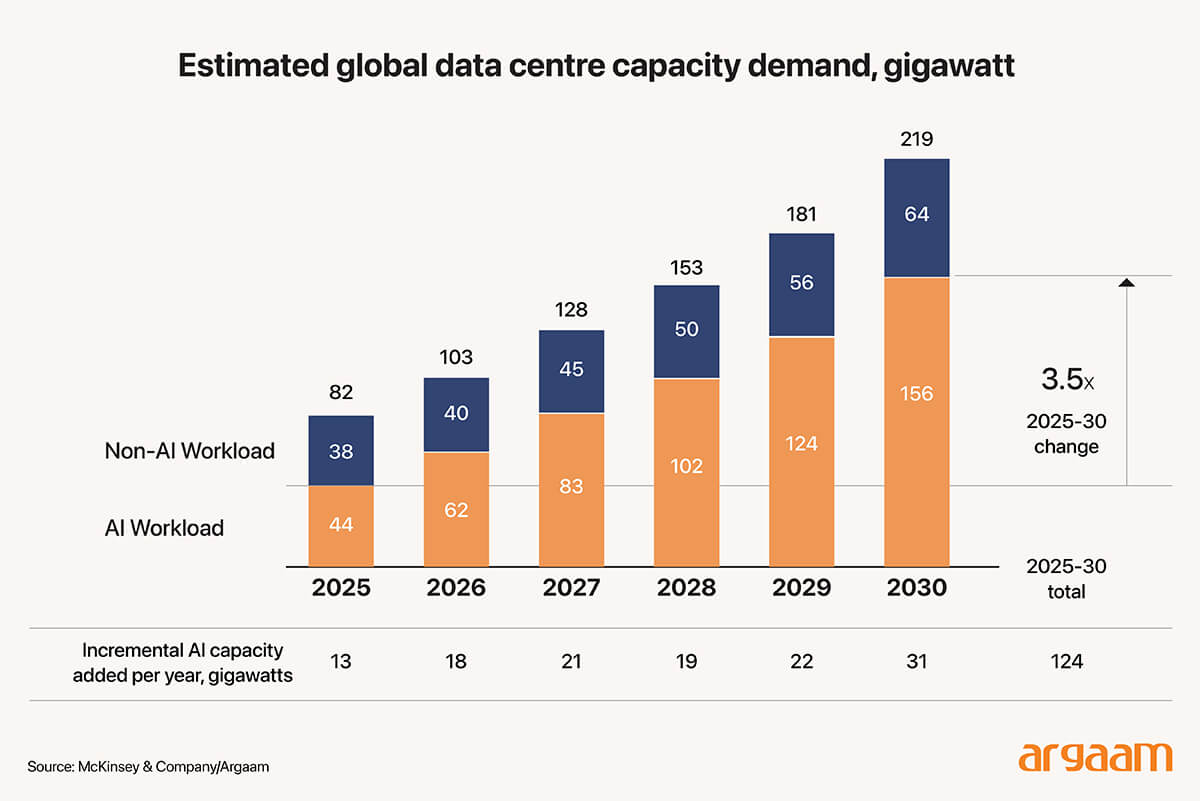
Humain plans to add 1.9 gigawatts’ worth of data centers by 2030. To put this into perspective, this capacity is roughly equivalent to the energy consumption of a large global city.
Our analysis delves into what it truly takes to build one data centre in the kingdom.
Laying the Foundation for AI
Saudi Arabia has adopted a private-public partnership (PPP) model for the development of its data centers.
Building a data center in Riyadh is akin to traditional real estate development, where selecting the right developer, in this case a digital developer, is a critical first step.
A ‘digital real estate’ developer in this case combines different expertise represented in AI and digital infrastructure, network integration, cooling systems, and energy management to ensure the data center meets technical specifications, scalability, and operational needs.
It’s believed that the estimated CAPEX for building the first data centre in Riyadh is SAR 2.5 billion riyals ($670m).
The Saudi Authority for Industrial Cities and Technology Zones (MODON) agreed in February with a digital developer on land lease terms for the development of the data centre.
The 55,000 square meter (592,015 sq ft) plot is located in east Riyadh’s Technology Valley.
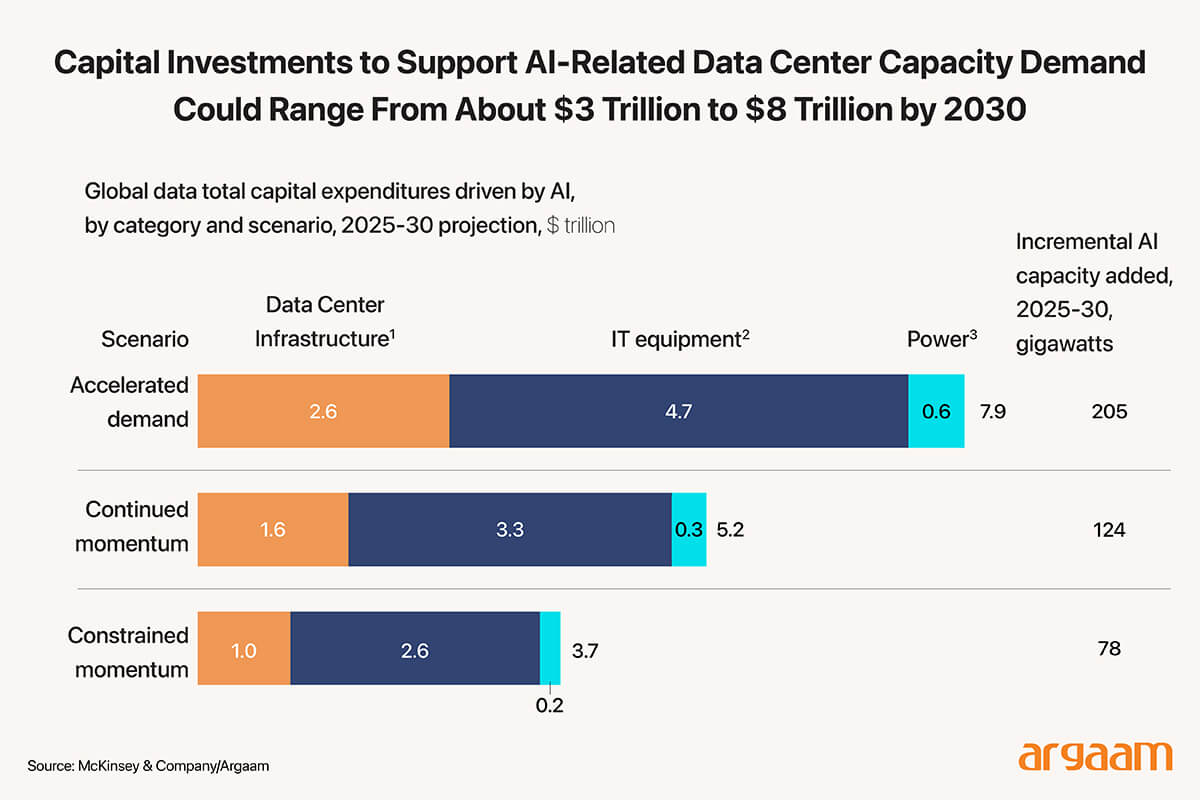
Based on insights from a specialist report done by McKinsey & Company in April titled “The cost of compute”, the cost associated with the land lease and development phase can be estimated by considering that land and related development expenses typically account for around 15% of the overall CAPEX.
Given the land is leased, this percentage covers not only the lease payments but also costs related to site preparation, infrastructure development, and procurement of building materials necessary to prepare the land for data center construction.
Applying this percentage, the land and development costs would amount to SAR 375 million out of the total CAPEX of SAR 2.5 billion.
Another highly crucial part of the CAPEX is power generation and transmission infrastructure, which represents approximately 25% of the total capital expenditure for data centers.
In our case, this translates to roughly SAR 625 million.
Despite the kingdom’s already low electricity tariffs, the allocation suggests that data centers require robust and possibly specialized power generation and transmission facilities to meet high and reliable energy demands, especially for cooling and continuous operation.

The digital architects
The role of the digital developer in this complex ecosystem carries an immense sense of responsibility.
We draw some inspiring thoughts from this interview with Bloomberg last year with the Chief Executive Officer of CoreWeave, an American AI cloud-computing company backed in part by Nvidia and listed in Nasdaq (market cap $61.3 billion).
In large supercomputer clusters, the intricate web of tens of thousands of connections requires meticulous precision and a deep understanding of both hardware and software interactions.
A single connection failure can halt an entire job, forcing restart procedures that can consume significant time and resources, and potentially jeopardize critical workflows.
The developer’s expertise ensures that these sophisticated layers—from the underlying hardware connections to the supportive software and customer collaboration—operate seamlessly.

Financing a data centre in a PPP model
Based on CoreWeave finance model, the digital developer secures loans or credit lines based on the value and reliability of the future cash flows from long-term contracts with AAA-rated entity like the sovereign wealth fund of Saudi Arabia.
Because the revenue streams are backed by reputable, large customers, the company can access capital at favorable rates.
The financial institutions see these contracts as strong collateral, reducing risk and enabling more attractive borrowing terms.
The Graphic Processing Units are assets that support the company's operations and growth but are not directly collateralized for the financing.
Instead, they are part of the underlying infrastructure enabling revenue generation through services or data processing contracts.
But one of the most interesting element in the finance part of a data centre is that having a portion of capital expenditure financed directly from the digital developer's own balance sheet is strategically important, especially when engaging with high-class customers like the Saudi wealth fund.
This commitment can enhance trust, which is critical when dealing with prestigious clients who expect assured delivery and financial stability.
When a developer funds part of the project upfront, it can negotiate more favorable contractual terms as well with the client, especially privileges in accessing resources and having tax breaks.
Self-funded CAPEX also allows the developer to expedite project timelines, as it is not solely dependent on raising external capital, which can involve lengthy approval processes or market conditions.
We are concluding this analysis by this short story inspired by a 213-page guidance available for free online by IBM on the measures it took in 1960s to build a computer.
It was a monumental effort back then in an era when engineers meticulously planned every detail to control vibrations, regulate temperature, and stabilize humidity, all while working with primitive tech by today's standards. That was a marvel of its time.
Now, fast forward to 2025: the modern data center. It’s definitely no longer just, as many think when we say a data centre, massive room filled with racks of servers.
If a simple computer once required such painstaking planning detailed in 213 pages, what would it truly take to construct the colossal behemoths that power our digital universe?
So, the next time you think of a data center as just a "place for servers” in the backyard of your company, think again.
|