




|
Over the past three years, a notable trend has emerged in the performance of Saudi Real Estate Investment Trusts (REITs), characterized by a decline in their market prices relative to their previously recorded values. This trend indicates that a number of Saudi REITs have been trading at discounts to their Net Asset Value (NAV), with market valuations falling below the book value of their underlying assets. Such divergence between market price and asset value may reflect a cautious investor sentiment within the market, This phenomenon may occur even when the asset base remains stable or grows, but the market assigns a lower valuation to the company’s shares. The REIT market in Saudi Arabia is estimated at more than SAR 20 billion in total assets spread across 20 funds, 19 in the main market and 1 in the parallel market. Saudi Arabia’s emphasis on a predictable and steady real estate environment is designed to safeguard asset values and support consistent returns, thereby protecting both investors and the broader financial system. In this context, recent policy shift permitting foreign ownership of property for the first time represent a significant shift in the market landscape. This new openness has the potential to attract additional sources of capital and enhance market liquidity, which may contribute to mitigating current valuation pressures experienced by Saudi REITs, as we explain in our analysis.  When Market Prices Drift from Book Values The recent trading patterns of many of the Saudi REITs show us that this market gradually drifting away from the book values that once anchored investor confidence. Starting with Riyad REIT, its share price, measured at SAR 6.61 at the start of the year, has declined noticeably over three years from a high of SAR 10.76 three years ago, down to SAR 7.01 a year ago, and now back to SAR 6.61. This steady descent highlights a growing disconnect between market valuations and the underlying NAVs, suggesting that investors are pricing in concerns or uncertainties beyond the simple asset values. 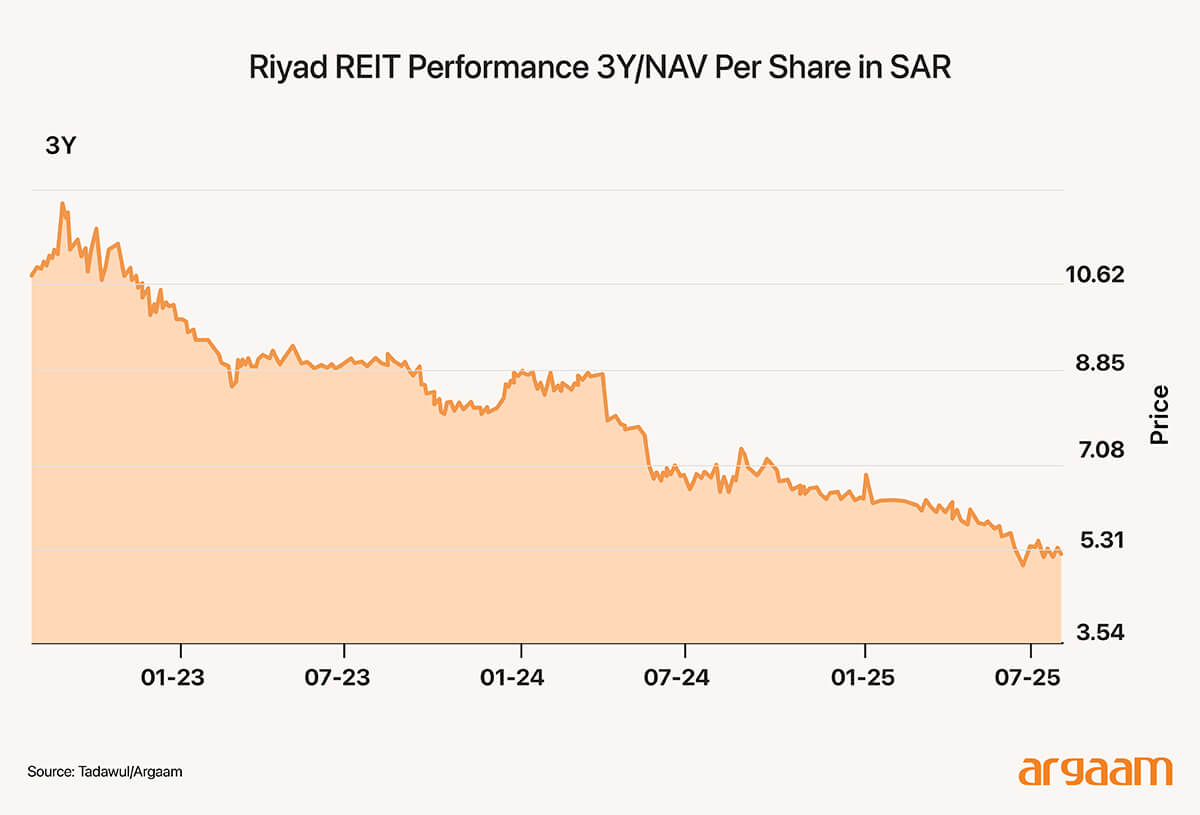 Turning to Al Jazira Capital, the pattern slightly diverges. While the start-of-year price stands at SAR 15.18, a gentle decline from SAR 17.44 three years ago, the drop is less steep compared to Riyad. Still, the gradual erosion of market prices signals that even relatively higher-valued REITs are not immune from investor reassessment. 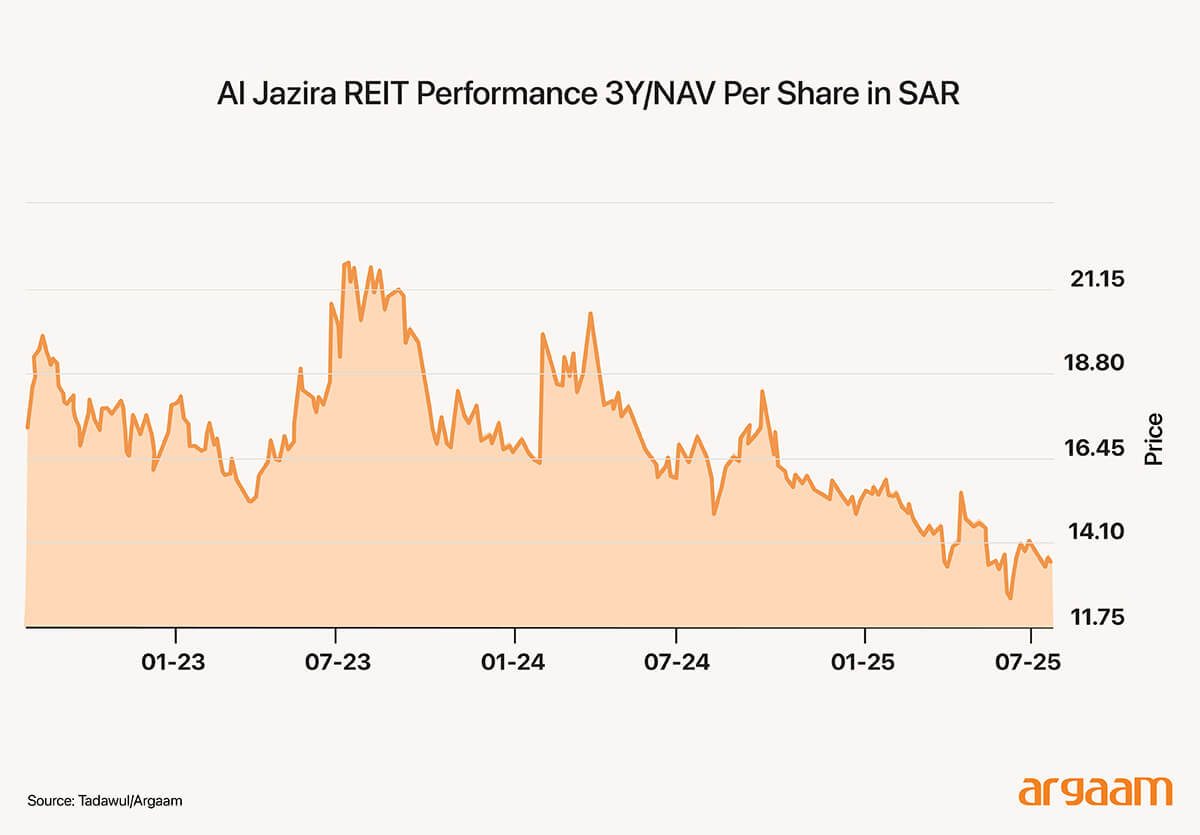 Next, we move to Taleem, whose price journey also recounts a consistent, albeit moderate, decline from SAR 12.22 three years ago down to SAR 10.3 at the start of this year. Taleem’s incremental slide further reinforces the theme of price discounts emerging in response to broader market dynamics or sector-specific challenges, such as shifts in tenant performance or changes in the regulatory landscape. 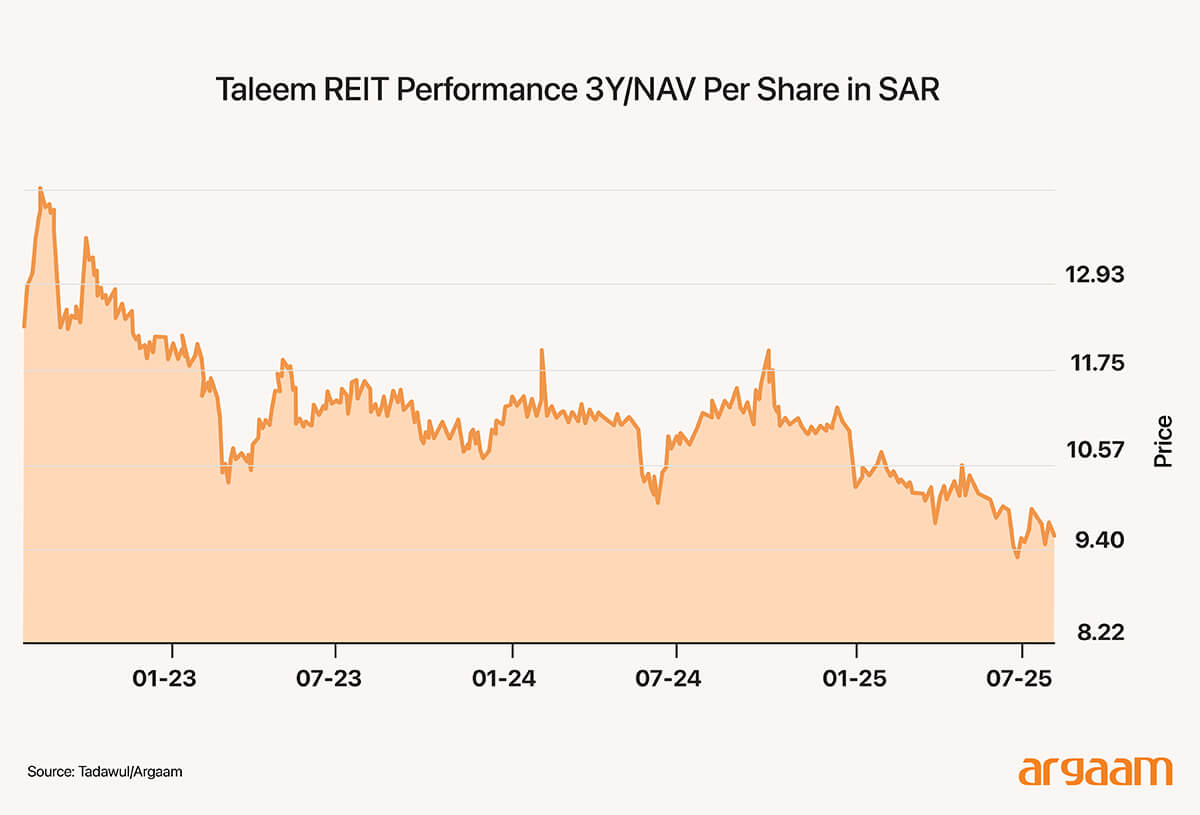 MUSHARAKA and MuLAKIA amplify this storyline with even sharper declines. MUSHARAKA has plummeted from SAR 9.37 three years ago to merely SAR 4.71 at the start of the year, a near halving in value, while MULAKIA mirrors this trend from SAR 9.21 to SAR 5.36 over the same period. 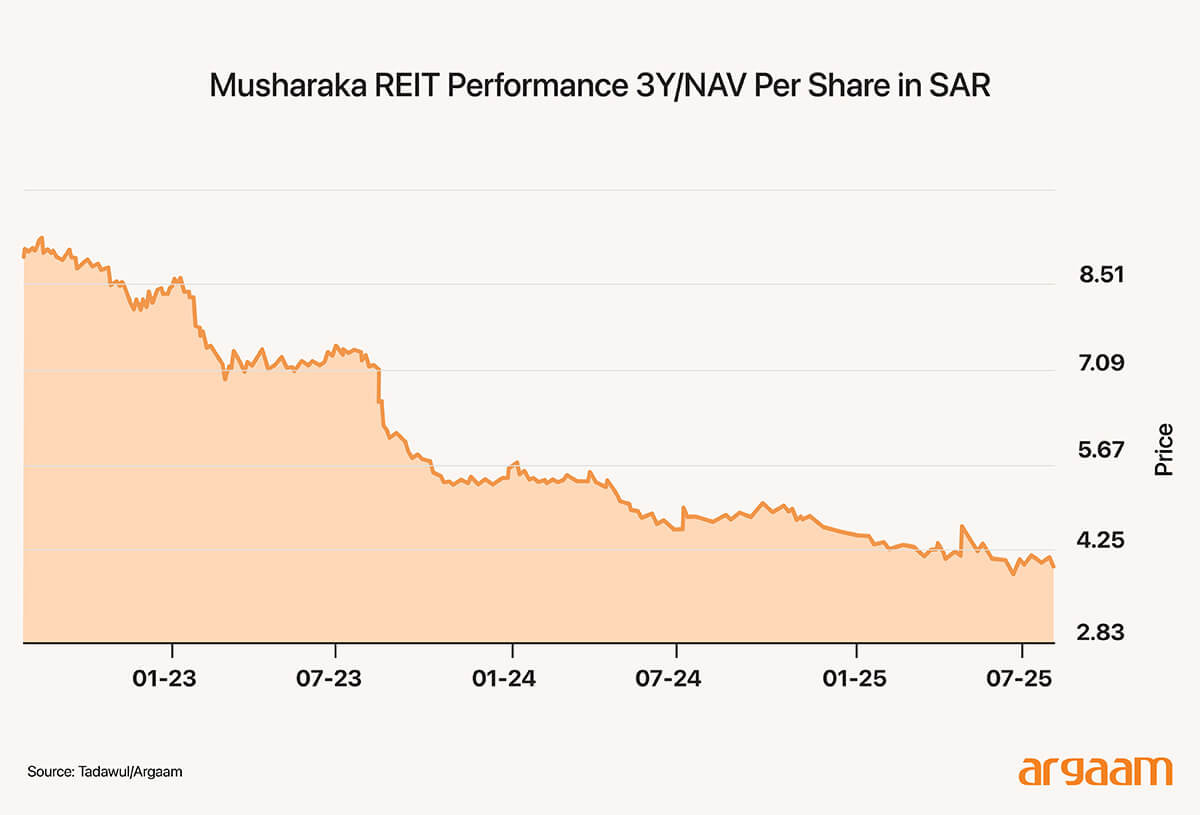
AL AHLI and Al Rajhi then conclude this narrative arc. AL AHLI’s decline from SAR 10.34 three years ago to SAR 7.12 today, alongside Al Rajhi’s more modest dip from SAR 9.71 to SAR 8.39, paint a picture of a sector-wide recalibration of value. While not as severe as MUSHARAKA or MULAKIA, the downtrend suggests cautious repositioning by investors seeking to discount potential risks. 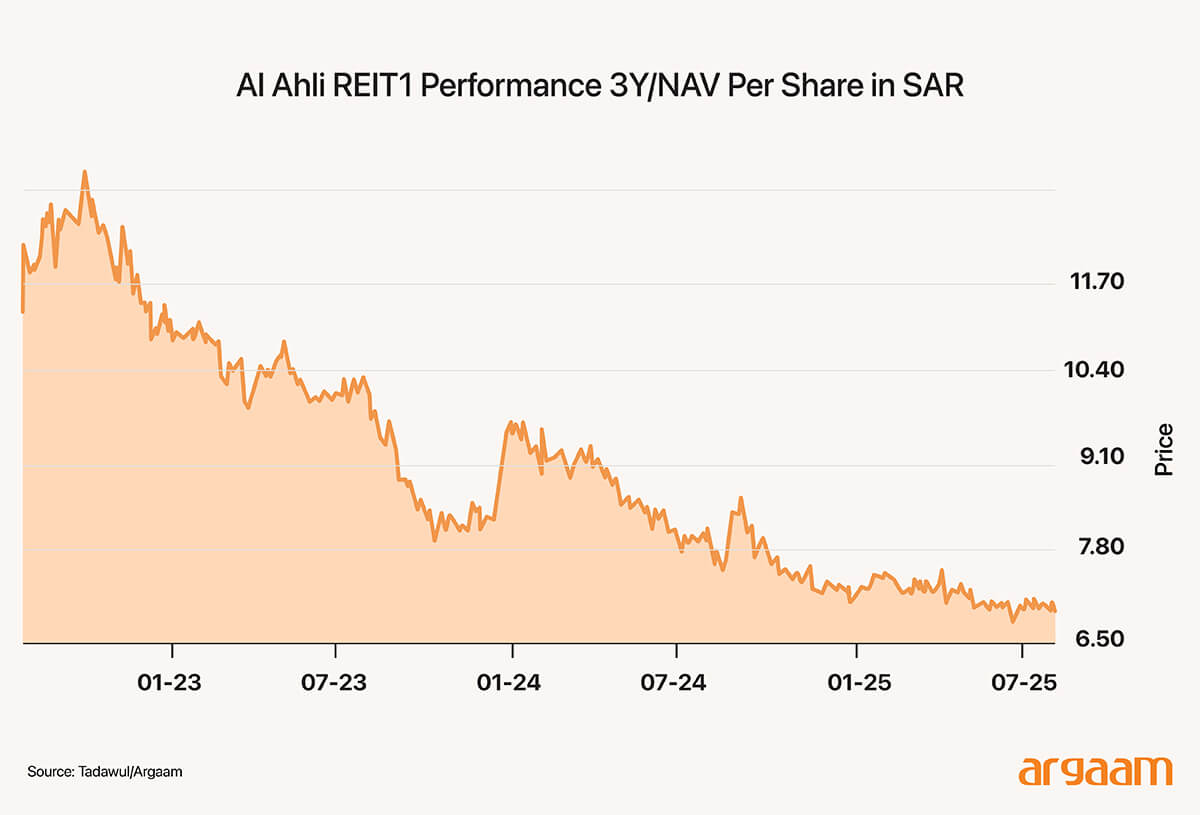 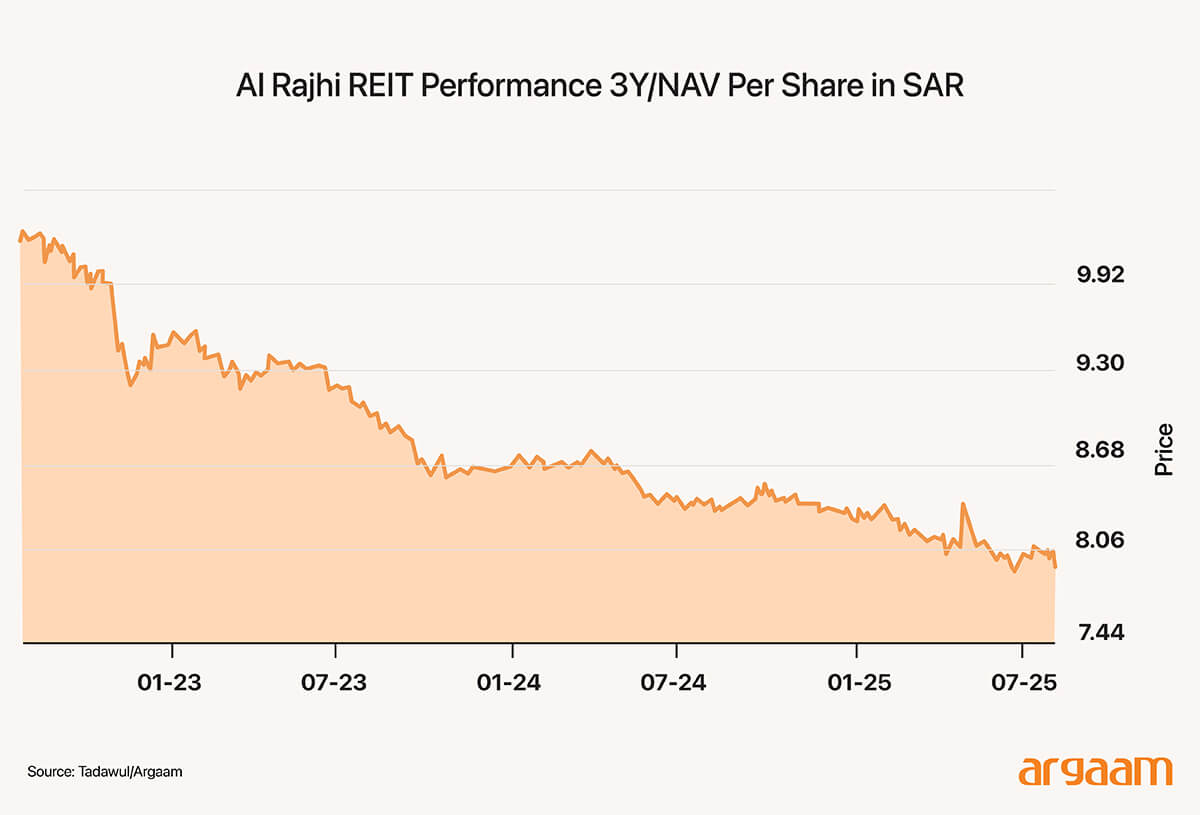
Overall, moving across these Saudi REITs, from Riyad to Al Rajhi, a story emerges of a market adjusting to realities that push trading prices below book values. This divergence between price and NAV embodies the classic phenomenon discussed in detail in an academic journal titled Why does price deviate from net asset value? The paper tackled REIT pricing inefficiencies, where factors such as investor sentiment, liquidity constraints, firm-specific characteristics, and volatility due to irrational factors including sentiments can lead to persistent discounts or premiums relative to the asset base. Understanding these forces is crucial for investors seeking value. 
Beyond Earnings to Keep Dividends Flowing Another factor that negatively affects Saudi REITs is that some of the funds distribute dividends at a ratio exceeding their adjusted operating income. This means they are paying out more than their core earnings to shareholders. This practice suggests that these REITs are funding distributions through non-operating income sources, borrowing, or using capital, which is not sustainable long-term. Persistent over-distribution can deplete cash reserves or increase leverage, raising financial risk. High distribution ratios that outstrip operating income may signal financial stress or management's inability to generate sufficient cash flow. This can erode investor confidence and lead to share price declines. As we demonstrated above, high dividend yields resulting from declining prices are often associated with firm-specific issues causing price-to-NAV (PNAV) divergence. Over-reliance on distributions exceeding income can exacerbate this divergence, making the REIT trade at discounts reflecting perceived risks or weaknesses. Let's take Al Ahli REIT and analyze whether it distributes dividends exceeding its operating income using the data of 2024 posted online by the fund: ● Number of units issued = 137,500,000 ● Cash from operations = SAR 54,211,059 ● Total dividend distribution per unit = SAR 0.5 ● Total revenue = SAR 187,881,938.11 ● Fund Assets Size (NAV proxy) = SAR 1,986,484,432 Calculation of total dividends paid: Total dividends = Number of units × Dividend per unit = 137,500,000 × 0.5 = SAR 68,750,000 Comparison with cash from operations: ● Cash from operations = SAR 54,211,059 ● Dividends Paid = SAR 68,750,000 Result: Dividends paid (SAR 68.75 million) exceed the operating cash flow of SAR 54.21 million by SAR 14.54 million. The fund then distributed dividends that are approximately 27% higher than its cash generated from operations in 2024. The Power of Long-Term Property Ownership for REITs Saudi Arabia's focus on avoiding property market volatility and boom-bust cycles fosters a predictable, steady real estate environment. This stability helps protect Real Estate Investment Trusts’ asset values from sharp price drops that can harm returns and cause financial stress. REITs thrive when properties are held long term, enhancing operational efficiency and cash flow—something supported by the Kingdom’s stable market approach. Stable markets encourage REIT managers to invest in improving assets over time rather than rushing transactions driven by speculation. An academic journal titled Rewarding a Long-Term Investment Strategy: REITs provides supporting evidence in the form of an empirical analysis of U.S. publicly traded REITs over the period 1995 to 2018. Portfolios composed of longer-holding REITs outperform shorter-holding portfolios by a spread exceeding 30% over a 5-year horizon. In detailed explanation, The researchers sort REITs annually into two portfolios: 1) A long-holding-period portfolio, comprising REITs with property holding properties longer than 70% or 80% of other REITs in the sample. 2) A short-holding-period portfolio, comprising REITs with property holding periods below %30th or %20 of the sample. The portfolios that keep properties longer earned about 30.79%-39.21% more over five years than those that hold for a shorter time. The study uses Operating Expense Ratio (OER), calculated as: non-real-estate depreciation divided by total revenue, as a measure of operating efficiency. |
❝
PS: The term "non-real-estate depreciation" refers to depreciation expenses excluding the depreciation related to the real estate properties themselves. Specifically, it means that when calculating the total operating expenses used in the OER, the depreciation and amortization charges for the actual real estate assets (buildings and property improvements) are removed when calculating the OER, while operating expenses such as administrative costs and maintenance are included. Amortisation in this context includes expenses such as fees for mortgage and leasing contracts. |
Results from research in this study show that REITs (Real Estate Investment Trusts) that keep their properties for a longer time tend to spend less on operating costs compared to the income they get from those properties. Put another way, the longer a REIT holds onto its properties, the more efficiently it runs them — it controls expenses better and wastes less money on day-to-day operations. This efficiency shows up as a lower OER. When REITs hold onto their properties for a longer time, they tend to generate more income from each dollar of property value. This means the properties are producing stronger cash flows, which helps the REIT be more profitable and perform better financially. 
The Hidden Cost of Longevity While REITs often hold properties long term to enhance operational efficiency and stable cash flows, older properties tend to have higher operating and maintenance costs, lower occupancy rates, and increased portfolio risk. An increase in the age of properties held by a Real Estate Investment Trust (REIT) is correlated with a measurable rise in portfolio risk, as evidenced by higher return volatility and market beta, according to a study published in 2025 in the Journal of Real Estate Finance and Economics. This relationship is significant because it shows that older properties not only face operational challenges but also expose the REIT’s overall investment portfolio to greater fluctuations in value and sensitivity to market movements. That said, we are not disputing the long-term strategy per se but cautions that older properties bring operational and financial challenges that may decrease shareholder value if not properly managed or offset by repositioning or redevelopment strategies.
If the average property age of a REIT rises significantly, its beta increases by 0.027, meaning its stock price becomes %2.7 more sensitive to market swings. If the overall market declines by 10%, the REIT with older properties (with a higher beta) might see a larger drop of 10.27% compared to a comparable REIT with newer properties. When the property age increases significantly (for example, it roughly doubles or triples), the occupancy rate declines by nearly 1%. Imagine you have a building that is 10 years old. Now, if this building gets older and becomes about 27 years old (which is roughly 2.7 times older than 10 years), the amount of space rented out—called the occupancy rate—will go down a bit. If the building was 90% full with tenants before, after aging to 27 years, it might only be about 89% full.
Let's break it down with a simple example for a residential building:
● Suppose you have a 10-storey residential building with 40 apartments (units). ● The occupancy rate is 90%, which means 36 out of 40 apartments are rented out before the building gets older (10 years old). Now, if the building ages so that the property age increases about 2.7 times older, from 10 years to 27 years: ● The occupancy rate drops to about 89%, meaning about 35.6 apartments would be rented out. ● Since we can't rent 0.6 of an apartment, realistically about 35 apartments are rented, so 1 apartment becomes vacant due to aging. Let’s suppose the average monthly rent per apartment is $1,000: ● Before aging (90% occupancy): 36 apartments × 1,000=∗∗36,000** rental income per month. ● After aging (89% occupancy): 35 apartments × 1,000=∗∗35,000** rental income per month. ▶ This means the building owner loses $1,000 per month or $12,000 per year. 
Why Do REITs Still Own Older Properties? Some REITs Managers might prefer owning older properties to expand portfolio size and maximize their compensation, even if it’s not value-adding for shareholders. So, older properties usually cost less to buy than new ones, so managers can buy more of them for the same amount of money. By owning more properties, even if they are older and less valuable overall, the managers make the company look bigger. Since managers often get paid based on the size of the company or how many properties they manage, buying older properties can increase their pay. However, this strategy might not be good for the investors, because older properties can have higher costs and risks and don’t always improve the company’s profits or stock value. REITs often prefer to invest in properties close to where their main offices (headquarters) are located. This happens partly because it’s easier and less expensive to manage and oversee properties nearby than those far away. Established markets—big, well-known cities or regions—usually have many older buildings since they’ve been developed for a long time. Because REITs focus on properties near their headquarters, they end up owning more older properties simply because that’s what’s common in those areas. In summary, the recent discount of Saudi REITs to their NAV highlights a cautious investor sentiment despite a stable or growing asset base within a sizeable and strategically important market. The policy shift allowing foreign property ownership marks a pivotal opportunity to inject new capital and improve liquidity, potentially alleviating current valuation pressures. Our analysis also explored the intriguing paradox whereby REITs, reliant on long-term property holdings for stability, face increased costs and risks when investing in aging assets, underscoring the complex dynamics influencing their market performance. |
|
|

|

|


|


|