




|
The global milk market is a complex web where fluctuations in prices ripple far beyond the dairy aisle, impacting beef production and, ultimately, the red meat prices in major importers such as the Gulf Cooperation Council (GCC) countries. When we analyze the situation unfolding in four key meat-exporting countries -- Pakistan, Brazil, Australia, and Argentina --each exhibits different milk price and production dynamics, yet all share a common story: dairy market pressures that strain beef supply chains and exacerbate red meat price volatility for GCC consumers. While GCC countries continue to rely heavily on imports to meet their red meat consumption needs, Saudi Arabia stands out with an impressive self-sufficiency rate of 61%, significantly outperforming its regional neighbors. In comparison, Oman achieves 46% self-sufficiency, the UAE sources less than 5% domestically, Kuwait and Qatar each maintain around 15%, and Bahrain produces only a small fraction of its red meat requirements. This highlights Saudi Arabia’s leading position in domestic red meat production within the Gulf Cooperation Council. This indicates that while the Kingdom successfully meets the majority of its red meat demand through domestic production, which helps to moderate price increases, it still relies on imports to fulfill the remaining approximately 39% of its consumption needs without this level of self-sufficiency, prices could have risen even more sharply. For example in Saudi Arabia and over the past five years, the prices of fresh red meats in have experienced a marked but controlled increase (as we see in the coming chart from Argaam Macro platform) thanks to the rise in self-sufficiency rate: sheep meat has risen from approximately SAR 48 to SAR 66.5, camel meat from SAR 39 to SAR 55.5, and fresh cattle meat from SAR 37.6 to SAR 52.2.  At the heart of this rising cost of red meat in GCC countries and worldwide lies the fundamental interplay between supply and demand on the international stage, particularly the pressures faced by major meat-exporting countries. A significant contributor to these challenges is the state of their dairy sectors. In Pakistan, the recent surge in milk prices following a new tax has escalated the cost burden on dairy farmers. This spike, while seemingly beneficial for milk revenue, paradoxically squeezes marginal producers caught between soaring feed and production costs and the eroding purchasing power of consumers who face more expensive dairy staples. The economic principle of profit margin compression is at play here: increased revenues from higher milk sales can be offset or even overwhelmed by higher input costs like feed. When margins shrink, farmers resort to culling less productive dairy cattle or exiting the sector entirely to survive financially. |
This contraction leads to a tightening of beef supply, which, in turn, drives prices upward in importing nations like Saudi Arabia and other GCC countries. Moreover, consumer preferences and growing population demands, including factors such as immigration, increase pressure on already strained supply chains. Milk production in Argentina has reportedly dropped by around 14% in 2024 compared to the previous year a substantial year-on-year decline indicative of systemic issues. when milk prices fall below production costs or milk yields decline sharply, dairy farmers often respond by sending low-yield or non-productive animals to slaughter to minimize losses. This short-term increase in slaughtering can temporarily boost red meat supply. However, if the decline in milk production reflects herd shrinkage, the medium to long-term effect is a reduction in the total number of animals available for meat production, leading to potential shortages and price increases in red meat markets, as outlined in a detailed study on Turkey titled: Understanding the impact of dairy farming on red meat prices.
🐄
Shrinking Herds and Soaring Costs The effect of milk market pressures is only one piece of a wider puzzle. With fewer cattle being sent to slaughter in recent months and years, natural market forces are working to limit the available supply. Rising feed and energy costs worldwide amplify production expenses across livestock sectors, while adverse climatic conditions, such as droughts, and wars further exacerbate these challenges by reducing pasture availability. Last year, the United States recorded its smallest cattle herd since 1951, as dry pastures and strong beef demand prevented the herd from expanding for the fifth straight year. McDonald’s posted last year another bigger than expected drop in sales as demand continues to slow, despite attempts to lure customers back with value meals |
While in Europe, the herd size dropped to its lowest level since the mad-cow disease crisis nearly 30 years ago. Another contributing factor in Europe is the increasing expenses associated with complying with new environmental regulations related to animal health and climate change. These challenges are not limited to government mandates; the private sector also plays a significant role, as supermarkets are imposing stricter standards on farmers, leading to higher production costs. |
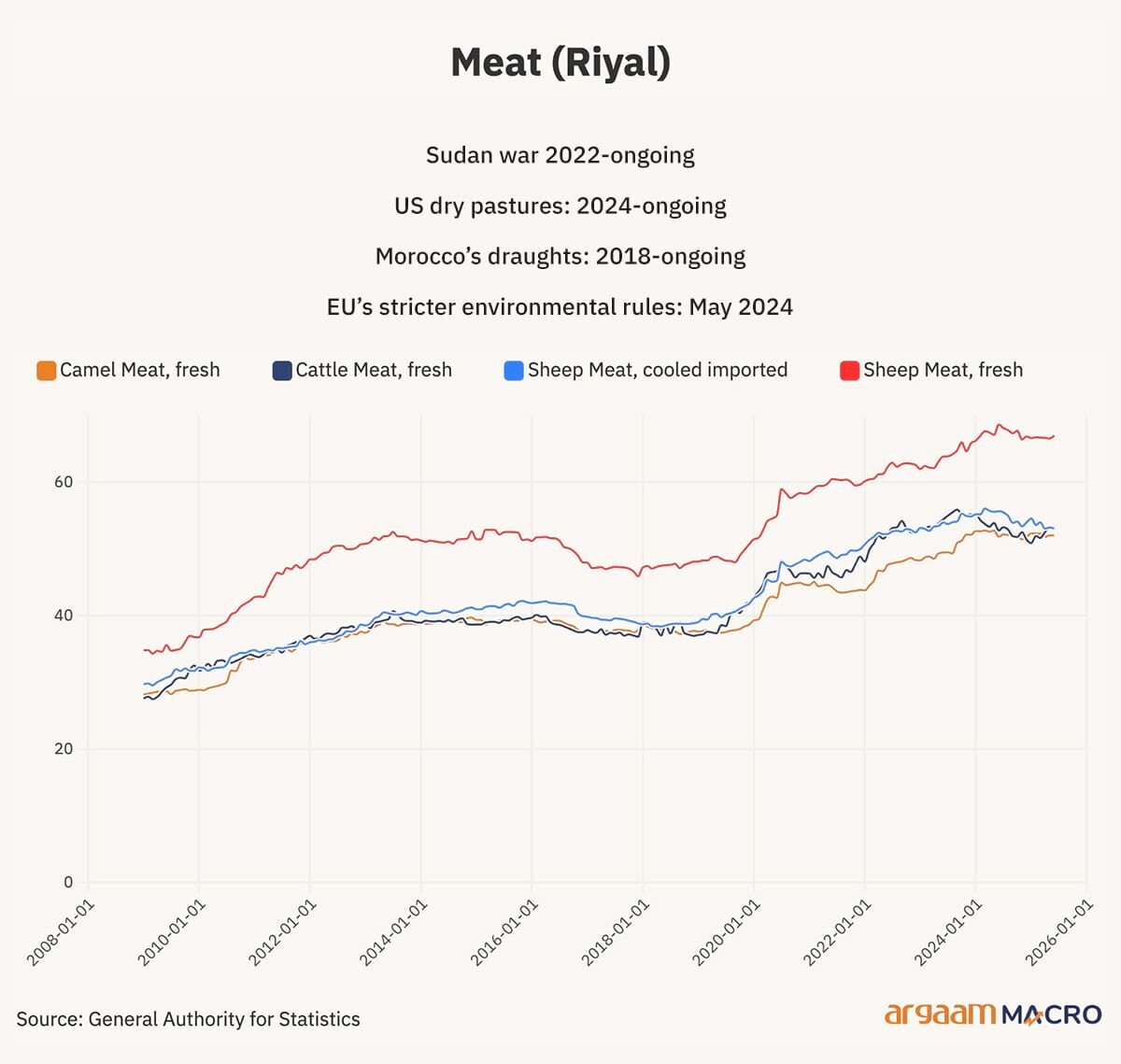 Sudan, which once used to be a big exporter of red meat to GCC and other Arab countries, once possessed over 110 million head of livestock. However, it lost 95% of its exports in 2025 due to the ongoing civil war. The Sudanese economy has lost around $2.5 billion in revenues from cattle, camels, sheep, and goats since the conflict began, owing to halted trade and export activities, as well as widespread looting and theft targeting livestock. Massive numbers of animals have perished due to disease outbreaks, the immigration of skilled veterinary personnel, the destruction of vaccine and serum laboratories, the degradation of natural pastures and water sources. In Morocco, the number of sheep and goats has declined by 38% this year due to a drought that has persisted for seven consecutive years. Farmers there have lost approximately $1.4 billion in annual sacrificial revenues, according to the Minister of Agriculture’s estimates. Together, these interconnected factors contribute to sustained upward pressure on red meat prices in the region. The combined impact of policy shortcomings in the dairy sector, escalating input costs, and environmental stresses threatens the long-term sustainability of local herds, which are crucial for maintaining stable meat supplies. |
|
|

|

|

|


|


|