




|
For low-cost carriers like the Hungarian Wizz Air, the variety of destinations offered from a single key base in the Middle East is critical to profitability. This is because these carriers thrive on high aircraft utilization, namely, maximizing the amount of time an aircraft spends in active flight rather than on the ground, enabling more flights per day, which attracts a broader customer demand and enhances network efficiency, driving revenue growth and cost optimization. Wizz Air’s decision to cease operations from Abu Dhabi starting this September can be analyzed then from a demand and revenue optimization perspective, despite the fact that the company stated clearly it was due mainly to geopolitical instability and the harsh climate for its Airbus-dominated fleet. The company has operated as a joint venture with Abu Dhabi Developmental Holding company (ADQ) since 2020. Millions of South Asians, including those from India, Pakistan, Bangladesh, and Sri Lanka, form the overwhelming majority of expatriates in the Arabia Gulf region. This demographic represents a large, consistent travel demand base that can’t be ignored in any business model in low-cost carriers operating in the Middle East when analysing the company’s exit decision. The absence of these very popular destinations for this massive segment of expats in the Arabian Gulf from the direct routes of Wizz Air in Abu Dhabi has affected its ability to capture lucrative passenger volumes that are typically generated by frequent visits for family and business purposes. 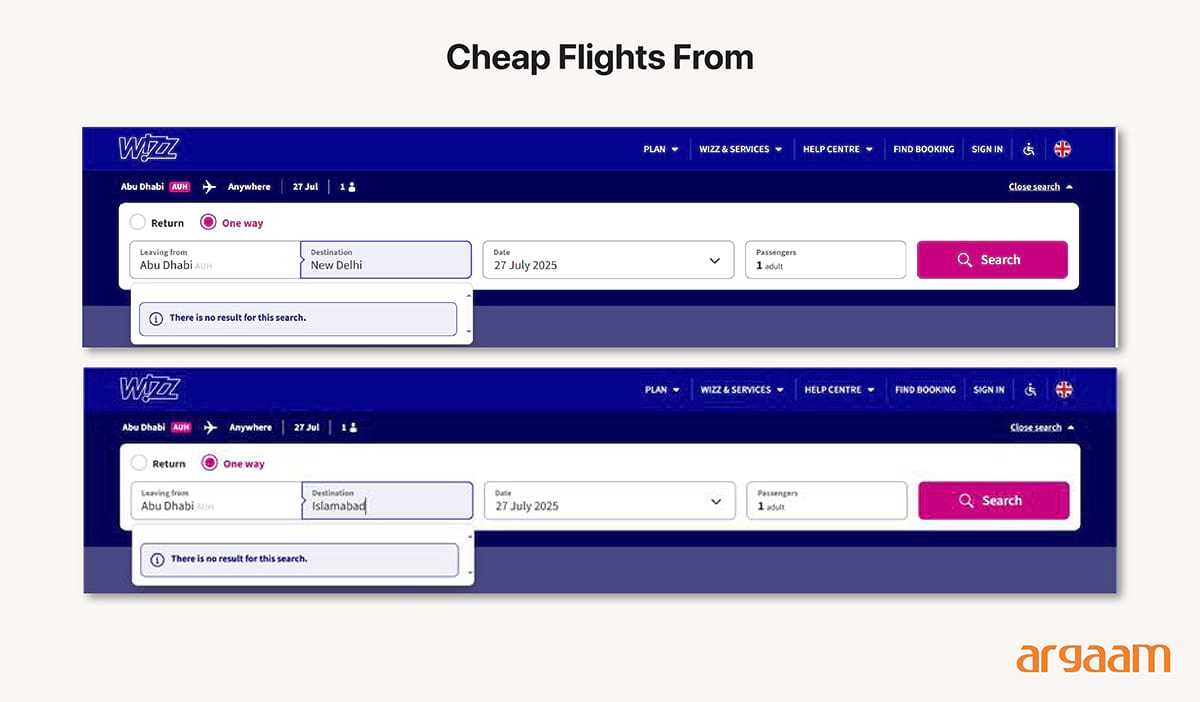 Following the company's initial public press release, Wizz Air CEO Jozef Varadi made statements, as reported by the British press, claiming that the main reason for the airline’s withdrawal from the Middle East market was the restrictions imposed by its Abu Dhabi partners, which allegedly limited access to the key market of direct flights from Abu Dhabi to Southeast Asia. However, from our objective perspective, this claim does not fully reflect the broader commercial challenges the airline faced across the Gulf and the Middle East. Firstly, even if such regulatory or partnership constraints were indeed present, it's essential to consider these factors within the wider operational and competitive context in which Wizz Air’s UAE branch was operating. Since its market entry in 2020, the airline has faced challenges that go well beyond route restrictions—most notably, fierce competition in Southeast Asia, where low-cost carriers contend with long-established regional and domestic airlines. These competitors enjoy deep market insight, robust brand recognition, entrenched customer loyalty, and consistent government backing—all advantages that are difficult for newcomers to replicate, especially for an airline primarily focused on Eastern European markets. Secondly, the aviation sector in Southeast Asia is characterized by high operational costs, which place a heavy burden on new entrants. These include licensing procedures, slot allocations, and airport fees, not to mention the challenging negotiation phase. Such costs directly impact the economics and viability of routes, especially for a carrier that is still in the expansion phase. Therefore, it would be reasonable for Wizz Air to acknowledge the multifaceted nature of the challenges it faced in the region, rather than attributing its losses solely to alleged restrictions in the Gulf, harsh weather conditions, or geopolitical factors. Wizz Air’s business model, which derives about two-thirds of its operations from Central and Eastern Europe, with Britain, Italy, and Austria contributing just under 30%, and only around 5% from Abu Dhabi, highlights a concentrated regional focus that has presented considerable financial challenge. Compared to more diversified low-cost carriers in the region that serve a broad mix of markets, including high-demand expatriate destinations like UAE’s Air Arabia, Wizz Air faces constraints in capturing lucrative international demand, from its sole subsidiary in the Middle Eat, outside its core footprint. 
Wizz Air’s Profitability Gap in the Middle East The comparison between Air Arabia, one the one hand, and Wizz Air reveals an interesting paradox regarding fleet size, route diversity, and profitability in the Middle East. Air Arabia operates a 81-aircraft fleet with around weekly 800 flights to more than 200 destinations across 200 countries. 
At first glance, Wizz Air's broader geographic reach and larger fleet suggest advantages in capturing diverse demand and financial resilience. However, despite its expansion into the Middle East with operations launched from Abu Dhabi, Wizz Air's operations in the region remain unprofitable. Based on the latest financials (FY ended March 2025) provided by the company online regarding its Abu Dhabi operations: ● Revenue: €283.1 million (current year) compared to €225.0 million (prior year), showing growth in revenue by approximately 25.8%. ● Net loss for the year: (€39.3 million) compared to (€35.6 million) prior year, indicating the company continues to operate at a loss in Abu Dhabi, with the net loss increasing by €3.7 million. Despite a notable increase in revenue (about 26%), Wizz Air Abu Dhabi remains unprofitable, with a net loss increasing slightly year-on-year. This suggests that operational expenses, costs, or other factors as we will outline later in this analysis are outpacing revenue growth. Let’s have a look at the company’s overall revenues and net income from these three charts: |
The company achieved moderate revenue growth (+3.7%) from FY24 to FY25, indicating continued expansion in sales, likely driven by increased passenger numbers, route network growth outside the Middle East and GCC countries, or improved pricing/premium services. Despite revenue growth, net income has declined substantially (-41.5%). This divergence suggests that operating costs, expenses, or non-operating charges increased disproportionately compared to revenue gains. A sharp decline in operating profit (61.7%) signals that operating expenses and cost of sales increased significantly. The most recent available financials of Air Arabia reveal that the company has demonstrated a strong financial performance in FY 2024. Total revenue increased from AED 5.999 billion in 2023 to AED 6.639 billion (1.5 billion euros) in 2024, marking a growth of approximately 10.7% year-over-year. The increase was primarily driven by higher passenger revenues, which grew from AED 4.997 billion to AED 5.351 billion. Total comprehensive income increased to AED 1.350 billion in 2024 compared to AED 1.239 billion in 2023. 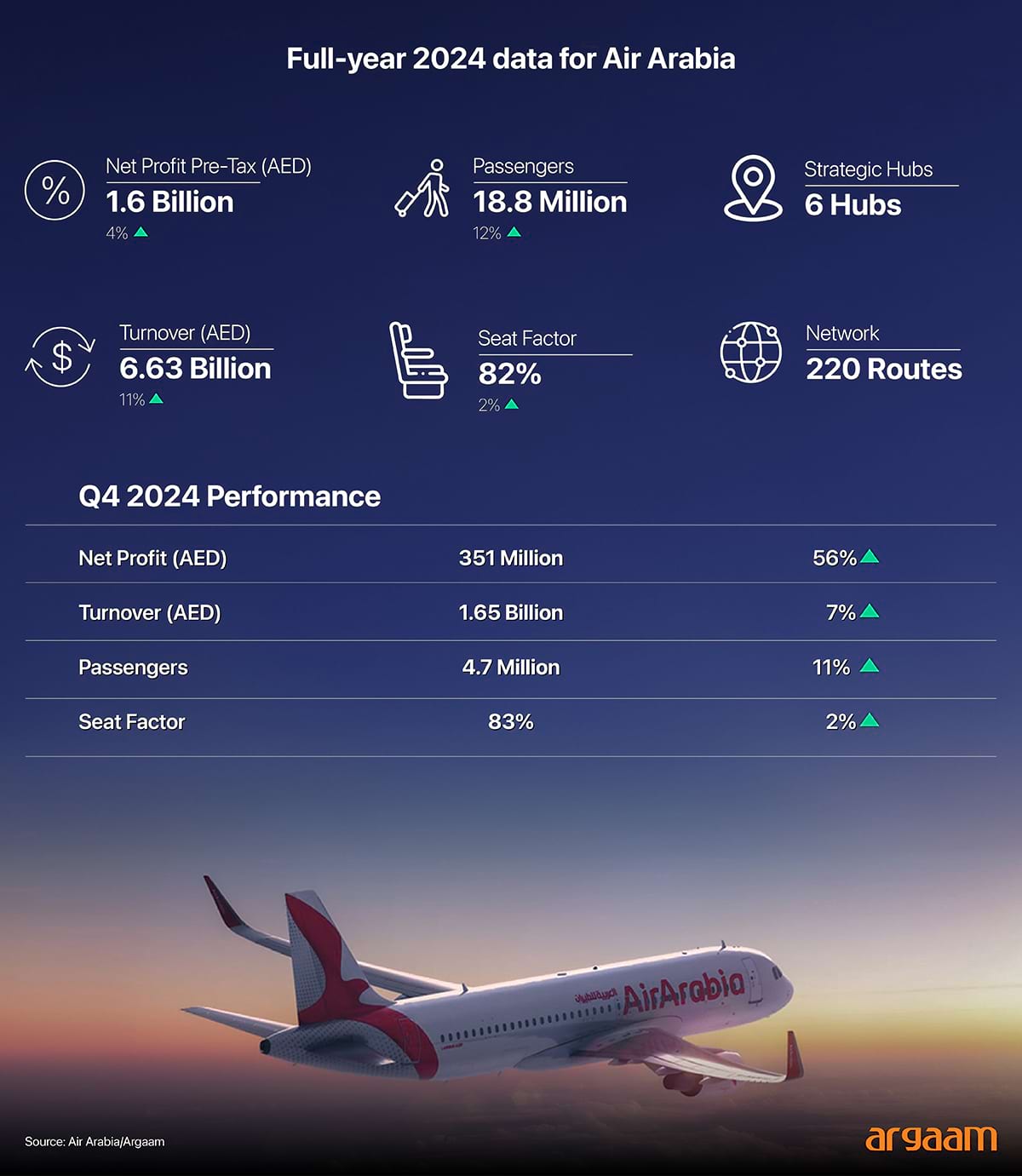 |
We believe that there are three main reasons behind Air Arabia outperforming Wizz Air in the Middle East in particular: 1) The very competitive market in the Middle East, which features several strong players including national carriers in many Arab countries and established low-cost airlines like Air Arabia and Flynas. 2) Wizz Air has become not attractive to a large segment of travellers made up of Southeast Asians. Without an extensive regional network, Wizz Air passengers have limited options for seamless connections within the Middle East itself apart from a handful of destinations including Cairo, Beirut, Amman. This lowers the airline’s appeal for travelers looking for flexible and integrated surface travel, making it harder to attract and retain customers in the region. 3) Cost advantages that airlines obtain due to the scale of their operations, with cost per unit of output generally decreasing with increasing scale. This often means that larger operational bases allow airlines to spread fixed costs over more flights and passengers, reducing the average cost per seat.
Controlled liberalisation of the Saudi travel sector
At the writing of this analysis, the Saudi General Authority of Civil Aviation (GACA) announced that Air Arabia will be part of an alliance that won the rights to operate a new low-cost airline in the kingdom from the King Fahd International Airport in Dammam and provide competitive travel options for passengers.  By 2030, the new Air Arabia alliance will operate 45 aircraft and will serve 24 domestic and 57 international destinations. It will also transport up to 10 million passengers annually. Air Arabia’s participation in this air alliance, which also includes Egypt’s Nesma and Jeddah-based Kun Investments Holding, marks a strategically significant move in the Gulf aviation landscape. The Saudi policy maker’s decision to allow Air Arabia to be part of the new low-cost airline consortium reflects a balanced regulatory approach aimed at protecting the interests of national carriers like Flynas while cautiously opening the market to foreign participation. It signals a controlled liberalization of the aviation sector that encourages foreign investment and expertise to stimulate growth while safeguarding local industry interests. From Air Arabia’s perspective, accepting a minority stake (which isn’t yet disclosed according a press release by the airline) is a pragmatic and forward-looking move to establish a foothold in the rapidly expanding Saudi travel market. Despite the minority stake ownership, this participation grants Air Arabia valuable market access, local partnership synergies, and brand presence within the Kingdom, positioning it advantageously to capture future growth opportunities as Saudi Arabia’s aviation sector evolves. Dammam acts as a gateway to the Eastern Province, a region rich in natural resources and cultural heritage, attracting both leisure and business travelers. The Eastern Province, with Dammam at its heart, is a major center for Saudi Arabia's oil and gas industry, attracting business travelers and investors. Dammam's King Fahd International Airport handled 12 million passengers last year of both domestic and international flights. By leveraging its established low-cost carrier expertise, brand reputation, and network reach, the new alliance can enhance air connectivity in the region, offering competitive pricing and increased route options. The move aligns with broader regional trends emphasizing aviation sector growth and diversification under Saudi Arabia’s Vision 2030, which encourages increased tourism. In conclusion, Wizz Air’s strategic priorities appear to have shifted towards markets with higher profitability and growth potential, particularly in Eastern Europe. This focus aligns with the geopolitical landscape, including the potential resolution of the Russia-Ukraine conflict, which could stabilize and stimulate demand in the region. Such a development could boost the company's profitability in future financial statements by enhancing market stability and creating new growth opportunities. |
|
|

|

|


|


|