




|
Emerging economies, including Saudi Arabia, face a critical challenge: international investors typically prefer to lend in major foreign currencies such as the US dollar, euro, and British pound. This reliance on foreign-currency borrowing exposes these countries to exchange rate risk—if the local currency depreciates against the currency in which the debt is issued, the cost of repayment rises.
One of the key recommendations we put forward in our analysis is the development of robust bond markets denominated in Saudi Riyals. 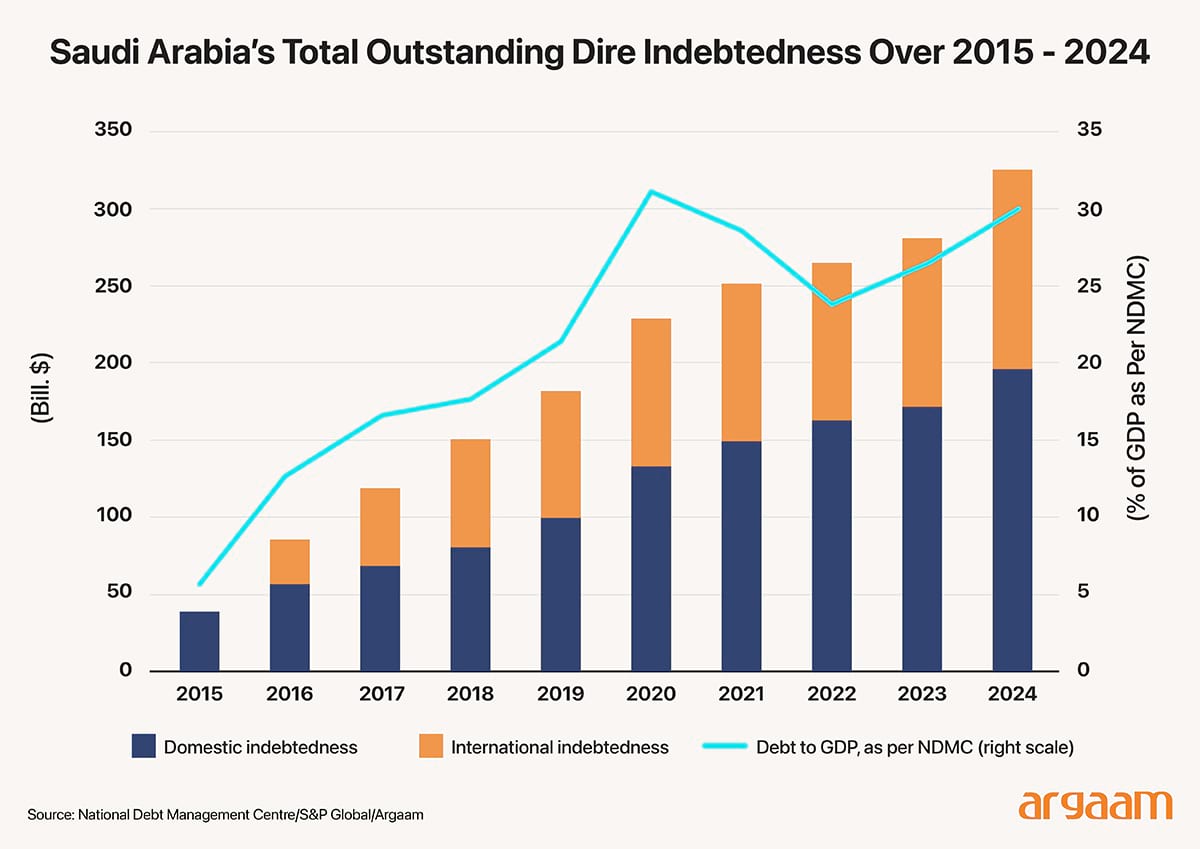  The ‘spare tire’ to a robust economy
A robust Riyal bond market provides stable, long-term financing sources that can support economic diversification and reduce vulnerability to oil price shocks. In plain terms, well-developed bond markets act as a "spare tire" to cushion the economy during credit contractions and financial distress. There are already domestic bonds denominated in Saudi Riyal (SAR) in Saudi Arabia. But they are mainly in the form of Shari’ah-compliant sukuk and the rest of the conventional market is still immature and underdeveloped compared to other markets like banking and equity markets in Saudi Arabia, and other bond markets in emerging economies. |
Between the first quarter of 2020 and the first quarter of 2025, total sovereign issuance of bonds and sukuk was about US$92.7 billion, and non-sovereign issuance was about US$63.5 billion. To put this figure in perspective, Saudi banks' loans to the private sector were US$804 billion in April 2025. According to Tadawul's statistics as of first-quarter 2025, total domestic sovereign and non-sovereign issuance stock accounted for about 20.7% of the kingdom's GDP. Corporate issuance accounted for 3.4%--up from 1.9% five years ago, though still below levels in more mature emerging markets. As of May 25, 2025, the market remains concentrated: Saudi financial institutions make up approximately 65% of outstanding issuance, followed by nonfinancial state-owned entities (SOEs; 25%), and private sector non-financial corporates (10%). Foreign investors--including investors from the Gulf Cooperation Council (GCC) region--accounted for less than 2% of the outstanding listed and unlisted issuance (including sovereign and non-sovereign) as of first-quarter 2025. This contrasts with high levels of international participation on the hard currency cross-border issuances of the Saudi non-sovereigns. 
Helping Saudi Banks Manage Risk and Liquidity
The Saudi financial system is traditionally bank-centric with a sound and relatively large banking system that meets much of the financing demands of firms and investors. Banks remain the main source of credit, limiting the need for firms to seek alternative financing through bond markets. The local bond market gives banks access to long-term funding from institutional investors in the bond market, which may be more stable than short-term deposit funding. Traditionally, many bank assets (like long-term loans) remain on balance sheets funded by short-term liabilities like deposits, creating maturity mismatch risk. This mismatch creates a risk because the bank’s obligations (short-term liabilities) may come due before the bank receives the payments from its long-term assets. |
If many depositors or creditors demand their money back at the same time, the bank may face liquidity problems as it doesn't have immediate access to cash tied up in long-term loans. Issuing bonds in Saudi riyals then enables banks to match their assets and liabilities better by securing liabilities with specific maturities. Regarding foreign currencies, If banks were to borrow directly in foreign currencies other than US dollar to which the Saudi riyal is pegged, they would face exchange rate risk due to fluctuations against the riyal. The development of the local currency bond market protects banks from exchange rate risk by enabling them to borrow in Saudi riyals rather than foreign currencies, thereby avoiding potential fluctuations against the riyal.  Why Sukuk Alone Can’t Fuel a Robust Bond Market Sukuk represent Sharia-compliant Islamic bonds and cater primarily to investors seeking such instruments. A broader local currency bond market, including conventional bonds, would attract a wider and more diversified investor base, both domestic and foreign, increasing overall market liquidity and depth. Conventional bonds can complement sukuk by providing different structures, maturities, and risk profiles, which enhance the flexibility and efficiency of the bond market as a whole. Sukuk are often structured as asset-backed or asset-backed certificates, meaning returns are linked to the underlying assets' performance. Poor asset quality, valuation difficulties, or operational issues with these assets can affect sukuk performance differently than conventional bonds, which rely on issuer creditworthiness. |
Sukuk structures can be quite complex, involving multiple contracts such as Ijarah (leasing), Musharakah (partnership), or Murabaha (cost-plus financing). This complexity may result in higher transaction costs and harder-to-assess risks for investors. Due to Sharia restrictions, sukuk returns are often structured around profit-sharing or rental incomes rather than fixed coupon payments, potentially leading to varying returns that might not always meet investor expectations, especially in volatile market conditions. By contrast, conventional bonds typically provide fixed interest payments. In conclusion, developing a local currency bond market reduces dependence on foreign currency borrowing, lowering exposure to global financial shocks and potential disruptions in access to international capital. Access to long-term financing through bond markets is critical for infrastructure and capital-intensive projects. The injunction not to put all your eggs in one basket can be found in any finance textbook. |
|
|

|

|


|


|