




|
Once hailed for earning its innovators a Nobel Prize and reshaping the future of medicine, the groundbreaking gene-editing technology has made its way into the agriculture sector. This powerful tool offers unprecedented precision in improving crop traits, promising to enhance yield, resilience, and sustainability in farming practices worldwide. In our view, Saudi investment in gene-editing of seeds --- and not genetically modified organisms -- has the power to completely reshape the food security and agricultural landscape in the kingdom. |
Saudi Arabia has unique environmental challenges. It’s characterized by extremely dry conditions and very limited renewable freshwater resources. The kingdom relies heavily on non-renewable fossil groundwater, which already and naturally dwindling yearly, and desalination for water supply. This scarcity limits traditional agriculture and necessitates water-efficient crop varieties. The region experiences very high daytime temperatures, particularly in summer. These heat stresses can greatly reduce crop yields. Soil salinity is a significant challenge. High salinity negatively affects crop growth and limits the types of plants that can be cultivated. Gene-editing of seeds can be then leveraged to develop crop varieties that are drought-tolerant, salt-resistant, and better adapted to harsh growing conditions. For instance, gene-editing technology could enable the creation of crops that require less irrigation, withstand high salinity in soils, or have enhanced nutritional profiles suited to the dietary needs of the growing population. Saudi Arabia relies heavily on food imports, importing over 80% of its food needs. |

Twice the Wheat, Half the Land
With the kingdom’s wheat and corn demand projected to grow by 5% annually due to the growth in population, gene-editing technology presents a promising opportunity to enhance domestic crop productivity and resilience. By developing gene-edited wheat and corn seeds, the improved agricultural performance could significantly decrease dependence on imports, currently at 3.5 million mt for wheat and 5 million mt for corn, thereby enhancing food security. Gene-editing technology can effectively double crop yields on the same piece of land. For example, if a farmer currently produces 100 kilograms of wheat from one hectare, gene-edited seeds could increase that output to 200 kilograms per hectare. This doubling means that with the same land area, farmers can harvest twice as much food. To put this into perspective: if Saudi Arabia wants to reduce its wheat imports of 3.5 million metric tons by using gene-edited seeds, producing twice as much per hectare means it would only need half the current planted area to meet the same demand. This increase in yield not only boosts food production but also reduces the pressure on land resources, lowering the need to clear more land for agriculture and minimizing costs related to farming inputs. 
Gap in R&D research
In our view, this can be done either by partnering with leading agritech companies through R&D and technology transfers or partial acquisitions of companies pioneering in this field. Secondly, it can be done via partial acquisition of leading firms in this field, as it allows Saudi Arabia to gain strategic access to advanced gene-editing technologies and expertise while sharing risks and investment costs with the firm. For example, Saudi Agricultural and Livestock Investment Co. (SALIK), which is owned by the Public Investment Fund, recently struck a $1.78 billion deal for a controlling stake in Singapore-based Olam Agri Holdings. The agreement will raise SALIC’s stake from 35.43 percent to 80.01 percent, with an option to acquire the remaining 19.99 percent within three years. Olam Agri has a strong presence in grains and oilseeds, animal feed and proteins, edible oils, rice, and cotton. SALIK, however, focuses primarily on the final agricultural product rather than investing in the R&D of gene-editing technology for seeds. It typically prioritizes downstream activities such as processing, marketing, distribution, and sales. We also understand that It also concentrates on efficiently transforming raw agricultural produce into consumer-ready goods or specialized products like processed foods, animal feed, or bio-based materials. Their core competencies lie in supply chain management, branding, and customer relations rather than in the scientific development and innovation of new seed varieties. At the heart of the latest Vision 2030 report lies ambitious plans for food security. The Vision supports high-tech methods including climate-smart farming. From $29.07B of agricultural sector contribution to GDP in 2023 to $30.4B in 2024. While gene-editing technology is not yet included in such technologies, we have identified the gap in R&D regarding gene editing of seeds that, if addressed, could unlock its transformative potential.to further strengthen these efforts for food security. The gene-editing of seeds would complement existing successful agritech innovations in the kingdom. One example of such innovations is the successful cultivation for the second in a row of cucumbers, tomatoes, and chili peppers on arid land. The farm is based in the town of Al Bada, in Tabuk. This achievement results from a collaboration between agritech startup iyris, real estate developer Red Sea Global, and Saudi Basic Industries Corporation (SABIC). The project is based on a greenhouse with a water purification system and innovative roofing made from recycled plastics combined with iyris’ Second Sky technology to block near-infrared rays and improve growing conditions. 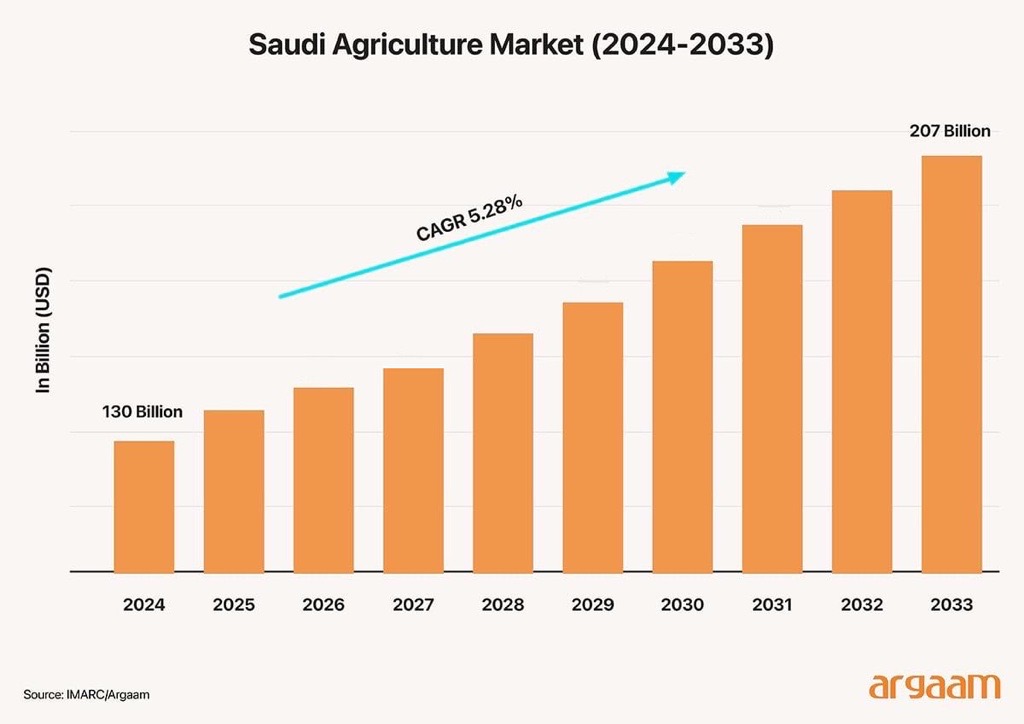 
Public acceptance and trust
The public acceptance of gene-edited seeds is generally higher than that of genetically modified foods across multiple countries, influenced largely by differences in the regulatory frameworks and perceived health risks associated with the GM food. Because gene-edited crops are more “natural” in a genetic sense, they tend to face less public resistance. Academic studies indicate that consumers and CEOs of leading food firms perceive gene-edited crops as safer and more acceptable than traditional GM food. One of these academic studies is titled: Managers’ attitudes toward gene-editing technology and companies’ R&D investment in gene-editing: the case of Chinese seed companies. Some public concerns -- addressed in this study through empirical research about GM foods -- arise from the potential for introduced foreign genes to trigger allergic reactions or produce unexpected toxic compounds. For instance, despite extensive safety testing, the insertion of genes from other species can theoretically create novel proteins that may cause allergic responses. Because gene-editing makes changes indistinguishable from natural mutations or traditional breeding, it reduces fears related to allergenicity or horizontal gene transfer, encouraging public acceptance. In conclusion, establishing a foundational program for the development of gene-edited seeds in the kingdom is a strategic imperative to enhance national food security. The kingdom’s commitment to a regulatory framework that encourages responsible gene-editing applications and supports seed company investments will be essential to realize these benefits. |
|
|

|

|


|


|