




|
While Saudi Arabia possesses tremendous financial resources and has formed partnerships with leading global AI and technology firms, these assets alone are insufficient to secure an independent position in the AI value chain. Saudi Arabia could serve primarily as a strategic hub for the implementation and operation of US-developed or Chinese AI technologies, but it’s crucial to fostering indigenous capabilities. As the kingdom hosts advanced physical infrastructure but does not command the strategic or economic advantages, the value chain’s high-value segments, including research, development, strategic decision-making, and IP control, may remain outside Saudi Arabia. US and Chinese technology firms often supply the expertise and talent necessary to operate and optimize these AI systems abroad, effectively exporting AI human capital to the kingdom. The Global AI Index is the first index to benchmark nations on their level of investment, innovation and implementation of artificial intelligence. One of its key ten pillars is talent. It’s focuses on the availability of skilled practitioners in artificial intelligence solutions. Saudi Arabia ranks in an advanced position in the overall category, coming at 14 out of 83 countries, but it ranks 60 in the talent category, according to the most recent ranking published in September 2024. 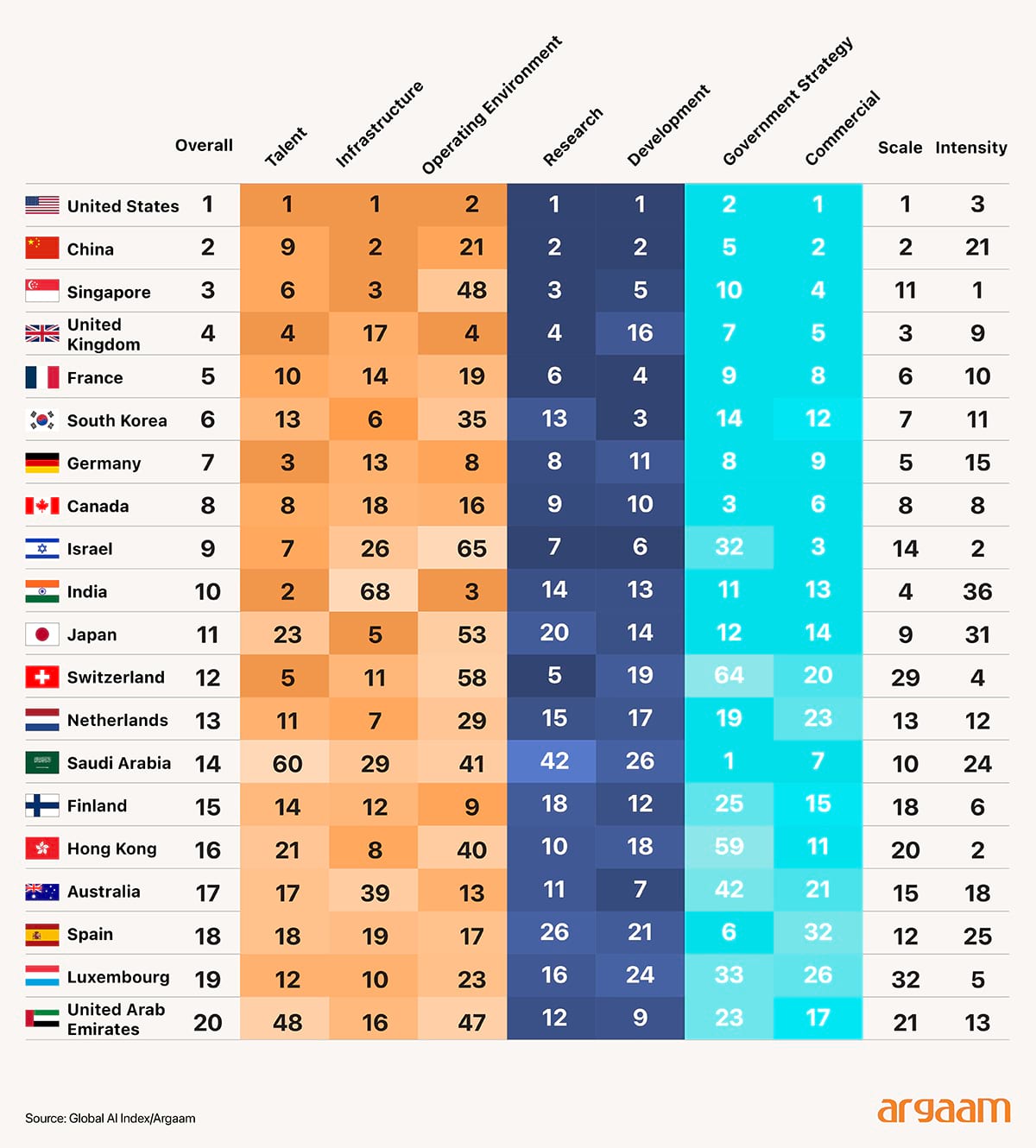
Saudi Arabia’s Vision 2030 indeed places significant emphasis on developing human capital as a cornerstone of its economic transformation, recognizing that a skilled and engaged workforce is vital for sustainable growth. The reforms implemented have notably strengthened the private sector’s role as the primary job creator. Between 2020 and 2024, the number of Saudis employed in the private sector increased from 1.7 million to 2.4 million, representing an approximate 41% growth. 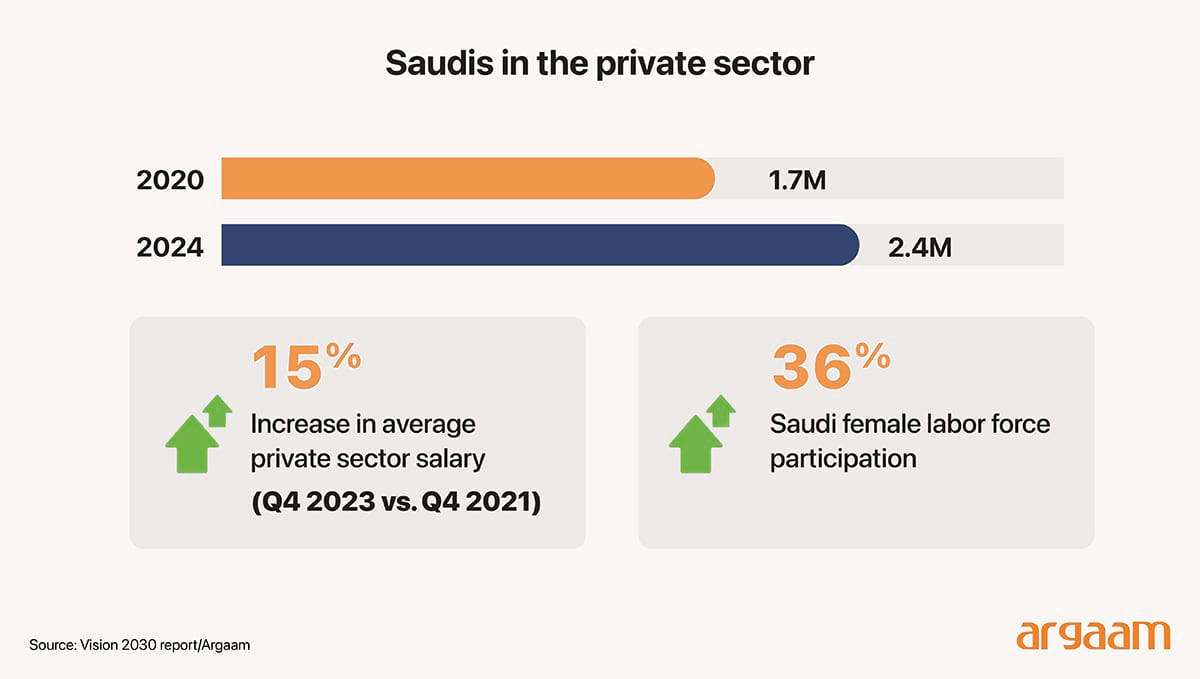
This expansion is accompanied by wage growth and increased opportunities for women, signaling a more inclusive and dynamic labor market. Given these positive trends, it is recommended that this focus on enriching human capital be fully extended to the artificial intelligence (AI) domain. 
Re-positioning the Al Dammam AI Hub
Without a sufficient pool of skilled local workforce, Saudi Arabia would largely depend on foreign expertise to develop and maintain AI systems and infrastructure. Let’s take the recent Saudi-US agreements in the AI sector as an example. The kingdom is creating one of the world’s most-sophisticated AI hub in Al Dammam, composed of a supercomputer powered by 18,000 Blackwell GPUs from Nvidia, server CPUs from Qualcomm. This’s the result of a $10 billion collaboration with Advanced Micro Devices, Inc., and a $10 billion partnership with Google Cloud. Even with state-of-the-art infrastructure, without a strong domestic AI talent pool and research expertise, Al Damama may primarily serve as a deployment and operational site rather than an innovation center for Nvidia and other American companies in the massive project. Two years after Nvidia made history by becoming the first chipmaker to achieve a $1 trillion market capitalization, the company reached another milestone on July 9, 2025 when it became the first in history to hit the market valuation of $4 trillion, eclipsing other high-tech giants like Microsoft and Apple. 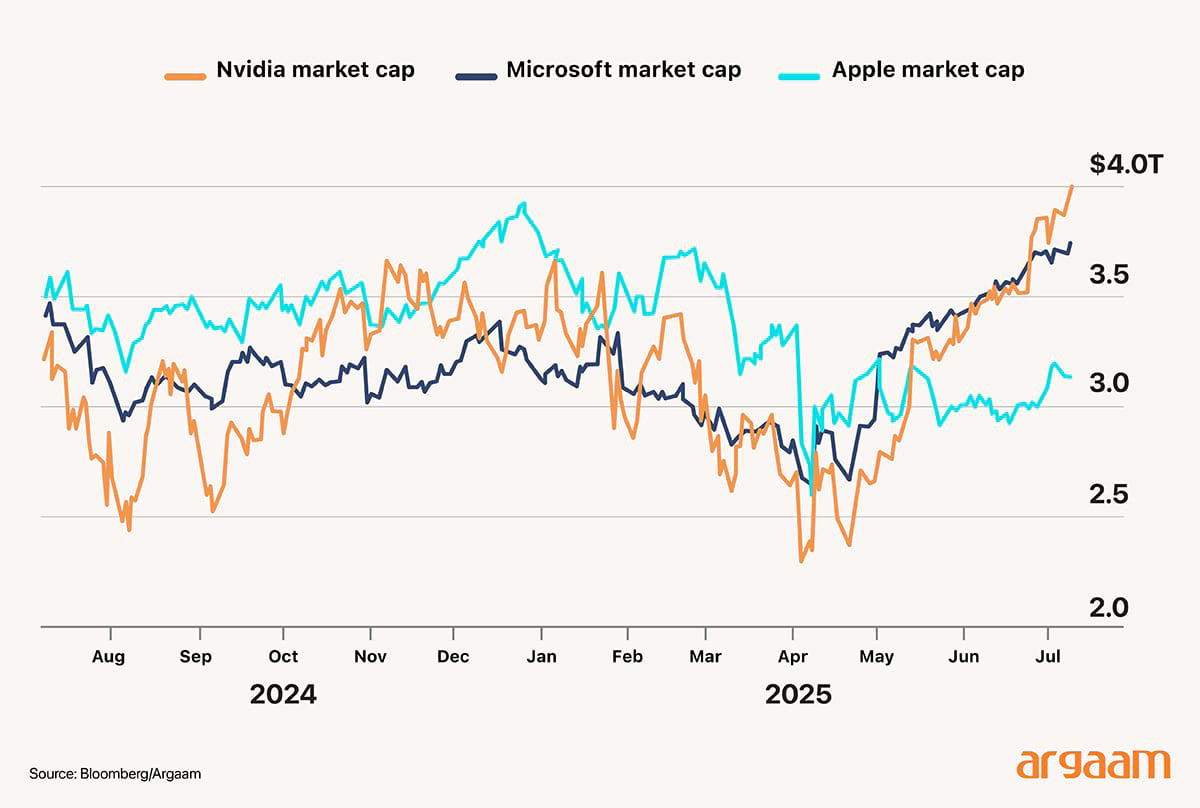 The advanced hardware and cloud services will be powered and optimized by foreign technology companies and experts, limiting Saudi Arabia’s ability to customize, innovate, and control AI applications. If the development, management, and continuous improvement of AI technologies rely on foreign experts or companies, critical intellectual property (IP) will be owned by these foreign entities. Revenues generated via AI applications, data monetization, and services running on this infrastructure will eventually benefit the foreign technology providers (e.g., Nvidia, AMD, Google Cloud). Licensing fees, cloud service charges, maintenance contracts, and profits from AI-based products developed externally will flow back to the US and other partner economies, potentially leading to significant economic leakage. This high demand on US microchips drives sales, profit growth, and market dominance for these firms, further solidifying the US's leadership in AI hardware and cloud computing sectors. By embedding their AI infrastructure in Saudi Arabia, US tech companies entrench their products, platforms, and ecosystems globally, enhancing customer lock-in, gathering valuable data, and expanding their worldwide footprint. The concept of pioneering orientation
The pioneering orientation concept is mainly behind the growth of these AI global companies. It enables companies to act as first movers by developing novel products, entering unexplored markets, and continuously fostering creativity and innovation to maintain a competitive edge. For example, the infrastructure that enables Nvidia to network its chips into an AI supercomputer was developed by a start-up called Mellanox, which was acquired by Nvidia in 2019 for $6.9 billion. Apple pioneered the smartphone market with the iPhone, transforming mobile communications and digital media. Tesla is still a pioneer in the electric vehicle (EV) market, developing innovative battery technology and autonomous driving features. Netflix started as a DVD-by-mail service but pioneered in streaming media and original content production. Chinese Alibaba innovated e-commerce and digital payments with platforms like Taobao and Alipay, creating new market spaces in online retail and fintech. Chinese ByteDance developed TikTok, revolutionizing social media platforms globally with AI-driven personalized content. Like the US and China, Saudi Arabia should keep pioneering orientation a centre stage in its AI strategy. If we have a quick look at the 2024 Saudi budget, we find out that it allocated 195 billion SAR to education, ranking as the fourth-largest allocation after military (269 bn SAR), general items (216 bn SAR), and health and social development (214 bn SAR). This substantial investment highlights the government's recognition of education as a strategic priority, albeit behind defense and social sectors.
In conclusion, to realize its ambition of becoming a leading AI nation, Saudi Arabia must prioritize building a robust domestic talent base and fostering a vibrant local AI research community. Strategic policies should focus on nurturing homegrown innovation ecosystems, incentivizing knowledge creation, and retaining intellectual property within the kingdom. |
|
|
|

|


|


|