Riyadh and Paris have little in common. One is a capital city reinventing itself at breakneck speed. The other is a centuries-old city where planning permission for a rooftop terrace takes six months.
Yet it costs almost exactly the same to put up a building in either place: $3,112 per square metre in Riyadh against $3,153 in Paris. Singapore $3,104 and Brisbane $3,135 sit in the same bracket.
The difference is in what workers are paid. A construction labourer in Riyadh takes home $12 an hour, all in - a quarter of the $45 paid in Paris and a tenth of what Swiss workers earn. Saudi Arabia has some of the cheapest construction labour on earth. But It does not produce cheap buildings.
This is more than an oddity. It is a fiscal fact. Vision 2030 has committed over $1 trillion to construction - more than a tenth of the $9.4 trillion global market. Saudi Arabia and the UAE report the world’s strongest construction activity growth. Every dollar of that pipeline is priced by the paradox.

The numbers
Construction cost data for 99 markets in 42 countries prices six standard building types in US dollars at March 2025 exchange rates. The results defy intuition.
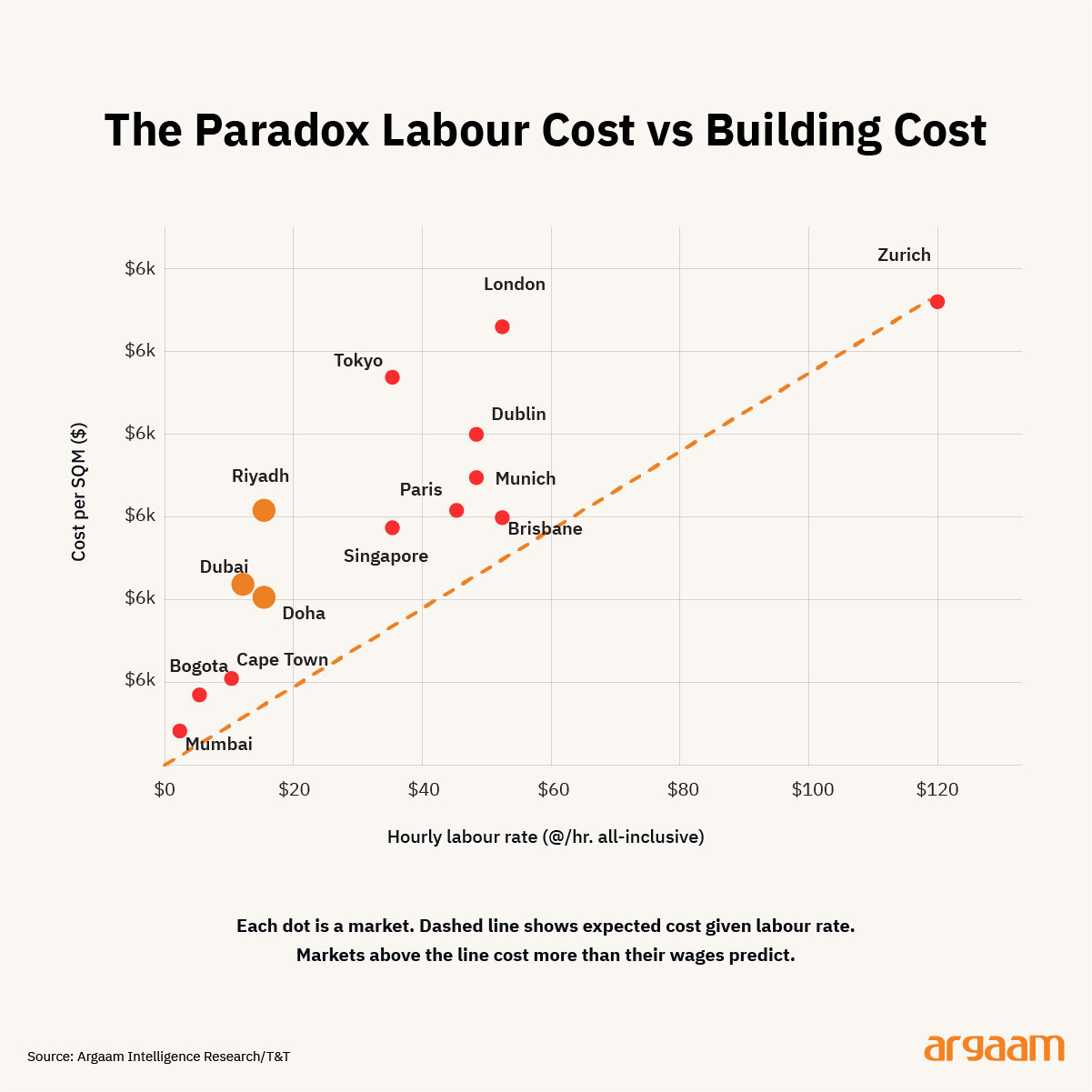
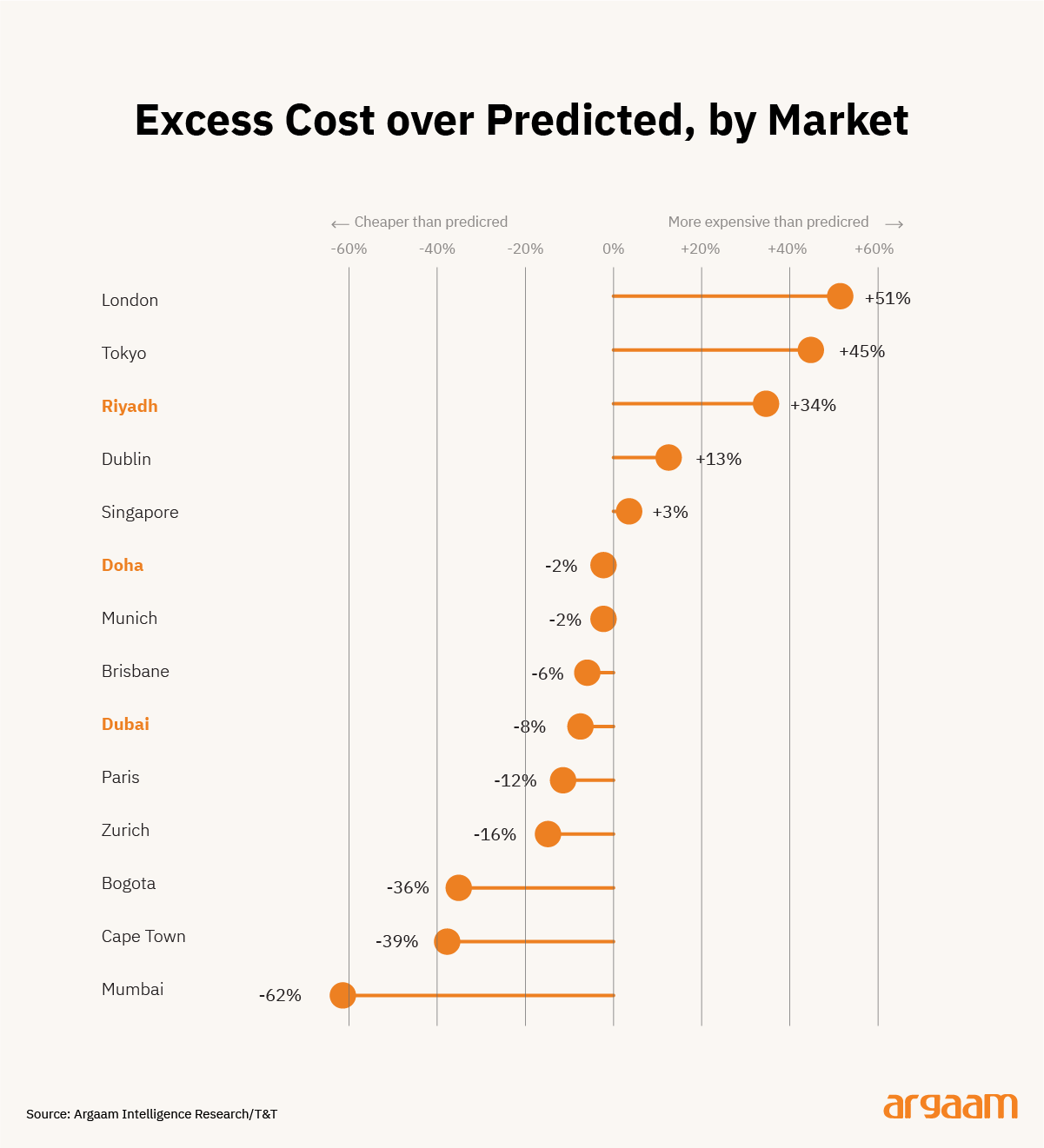
Wages account for 30-50% of a typical construction project. The arithmetic should be straightforward. If labour makes up roughly 40% of costs and Riyadh’s workers earn a quarter of London’s rate, $12/hr vs $44, then buildings should cost about 70% of London’s $5,385 per square metre - around $3,770. They actually cost $3,112, or 58%.
Riyadh is cheaper than London, but not by as much as its wages would predict. Against Paris, the point is starker still: labour costs a quarter as much, $12/hr vs $45, yet buildings cost virtually the same, $3,112 vs $3,153.
The wage saving is being absorbed by higher spending on materials, margins, and management. For complex work, the picture is worse: on airports and gigaprojects, Gulf costs match or exceed Western levels.
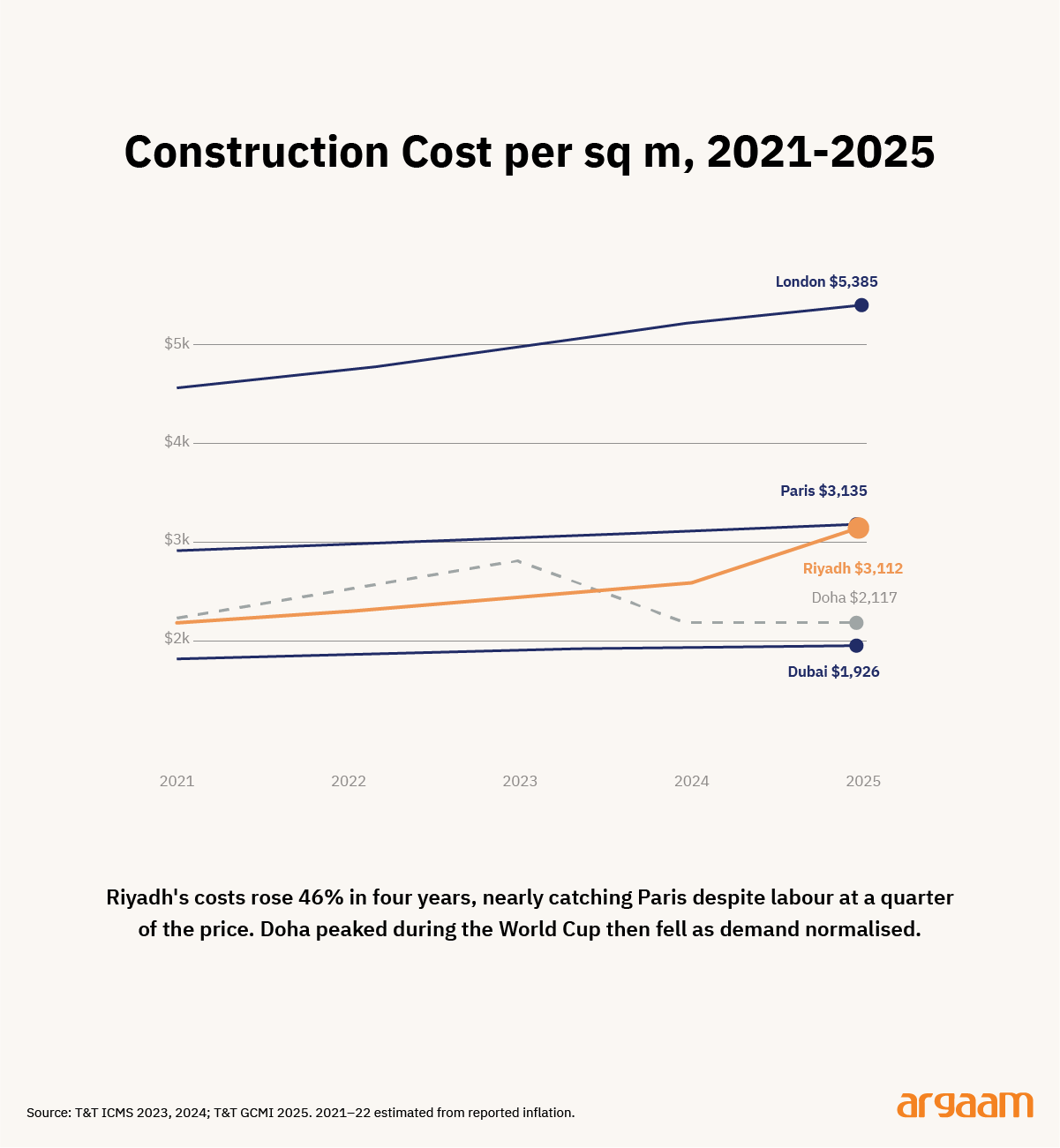
Every Middle Eastern market sees skilled-labour shortages with a major impact on delivery. The shortage is not of hands. It is a skill. Riyadh’s construction costs are inflating at 5% a year - nearly double Europe’s 2.9%.
The gap between GCC and Western costs is closing, not widening. For large infrastructure projects - stadiums, metro systems, desalination plants - the paradox is more profound still: labour represents an even smaller share of total cost while imported equipment and specialist engineering dominate.
Four mechanisms
Why does cheap labour fail to produce cheap buildings? Four forces are at work. On the demand side, Vision 2030's ambition has arrived at scale in a market still building its capacity to absorb it.
The pace and volume of demand have naturally placed upward pressure on prices across the sector.. On the supply side, three structural features - imported materials, layered subcontracting, and expensive management - prevent costs from falling.
Since Ronald Coase's foundational work in 1937, economists have noted that the decision to build in-house or outsource is ultimately a cost calculation.
When you cannot count on suppliers to deliver on time, at the agreed price, and to the required quality, contracts are hard to enforce, or specialist skills are scarce, it becomes cheaper to bring the work inside the firm than to source it externally.
In the Gulf, where construction runs through long subcontracting chains rather than integrated firms, those transaction costs are a substantial share of the final price.
Imported materials. The GCC produces bulk materials domestically - Saudi Arabia has 85 million tonnes of annual cement capacity and exports the surplus. But specialist components - lifts, glazing, mechanical and electrical systems, switchgear - are imported from global oligopolies.
When megaproject demand exceeds bulk capacity, even steel must come from abroad; Neom reportedly consumed a fifth of global structural steel at its peak.
The vulnerability showed in early 2026 when the Hormuz closure disrupted global supply chains.
PVC piping jumped 70% in Japan and 28% in Australia. The GCC's own petrochemical output was unaffected, but the finished components it imports - switchgear, prefabricated systems, specialist fittings - faced the same shipping disruption as everyone else.
The Public Investment Fund’s target of 60% local content on gigaprojects implies more than two-fifths of project value currently leaves the country. Compared with Mumbai, $723 per square metre.
Which has its own steel mills, or Johannesburg $1,188, which combines accessible labour with a well-developed domestic materials industry, or Bogota $1,265, which produces the vast majority of its construction inputs locally and exports cement to international markets.
Each combines low wages with local production. Riyadh has cheap hands, but imports nearly everything they work with. The lift industry illustrates the point.
Four firms - Kone, Otis, TKE, and Schindler - control two-thirds of the global market. A lift costs $320,000 in Riyadh versus $218,000 in Dubai - a 47% premium explained by demand, not wages. For a typical Gulf high-rise, such globally priced components represent 30-40% of total cost.
Stacked margins. Subcontracting is common everywhere. The difference in the Gulf is the margin size and competitive pressure. Combined overheads, profit, and site-management costs run at 25% on large projects in Riyadh - nearly double London's 14% and well above Zurich’s 15%.
This premium is applied to imported materials already carrying logistics costs, through chains where a surge in projects has thinned the contractor pool and weakened tendering competition.
Administrative and regulatory costs compound the problem. Visa processing, labour-camp compliance, and health-and-safety regimes on large-scale infrastructure add overhead absent from smaller markets. When regulatory capacity is outpaced by demand, the result is delays and cost overruns that accumulate silently.
Oliver Williamson’s transaction cost economics, in his paper published in 1973, explains the deeper mechanism: every time work passes from one organisation to another, someone has to agree on the terms, check the work, and manage what happens when things go wrong.
In construction, where outputs are bespoke and hard to specify, those costs are high. With 71% of industry leaders optimistic about demand yet facing workforce constraints as the binding limit, fewer bidders extract fatter margins at every tier. Egypt offers an extreme comparator: up to 35% of contract value is charged to oversee construction work.
Demand pressure: Riyadh’s average building costs $3,112 per square metre; Dubai’s costs $1,926 - a gap of $1,186, or 62%, despite sharing the same regional labour market. A tower crane costs $4,202 a week in the Saudi capital versus $2,178 in Dubai - a 93% premium explained by demand alone.
Riyadh rents are up 50% since 2020; flat prices have doubled. Saudi wages have risen just 11% since 2016, while cumulative inflation reached 17%.
The Line is an emphatic case in point. Its budget tripled from $1.6 trillion to an internal estimate of $4.5 trillion within months - driven not by scope change but by supply scarcity.
The broader implication is arithmetic. If 19% of a $3,112-per-square-metre building goes to labour and 56% to imported materials, then halving labour costs would cut the total by less than 10%.
But a 20% rise in materials prices adds 11% to the bill. The kingdom’s cost exposure is overwhelmingly to global commodity markets, not to local wage levels.
A materials shock equivalent to 2026’s Hormuz disruption would add $60 billion to the tourism programme’s cost alone - almost double that of Saudi Arabia's budget deficit.
Expensive management: A site foreman in Riyadh earns $24 an hour - double the labourer's $12. The average GCC construction professional takes home $10,300 a month, five times the labourer's wage.
Nine-tenths of the UAE’s population is foreign-born; the workforce is imported at every tier, from labourers to quantity surveyors. The workers are cheap. The people directing them charge Western rates wherever the building stands - and their fees are embedded in every square metre.

What this means for Vision 2030
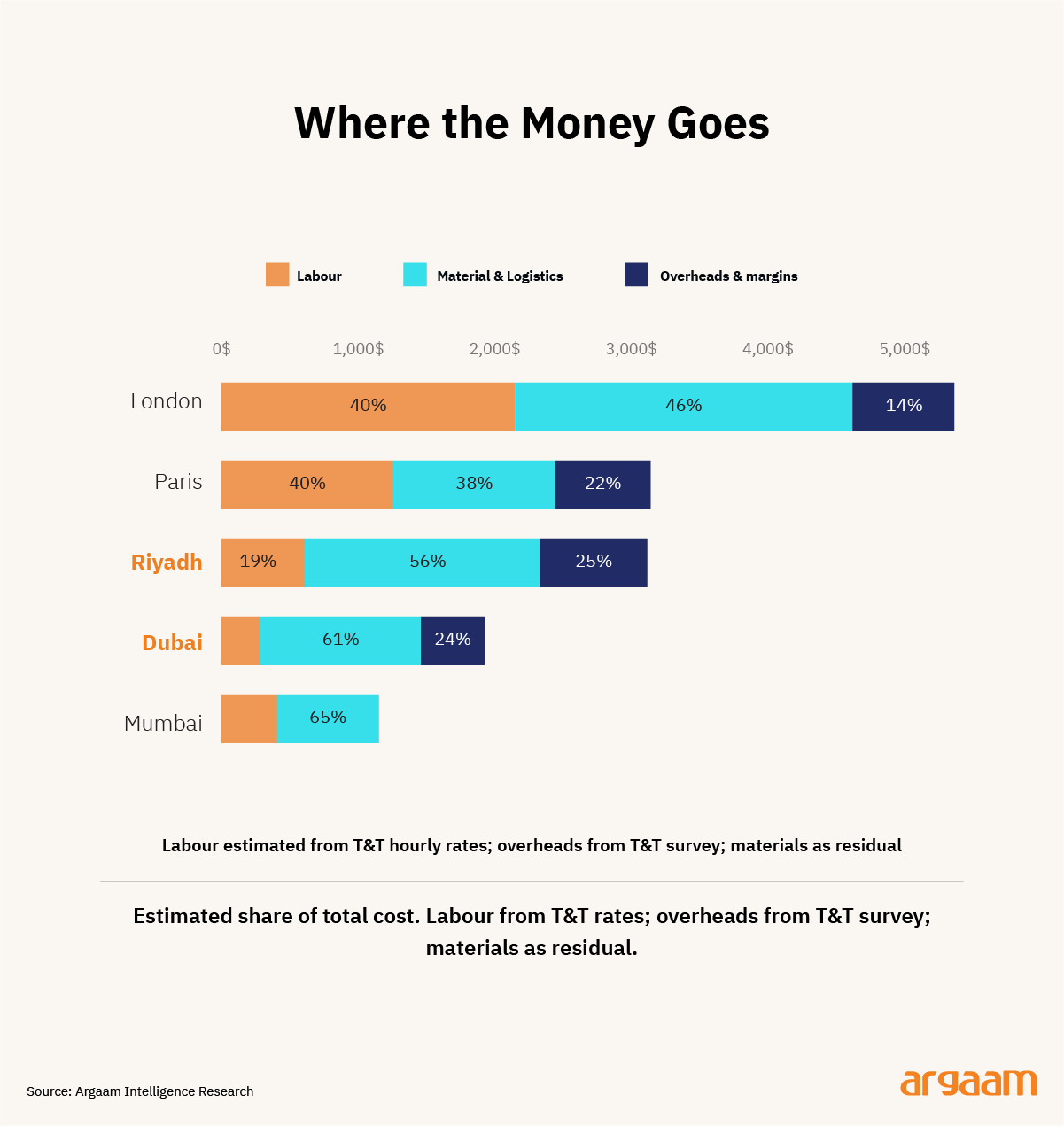
These mechanisms are structural, not cyclical. They compound. Riyadh's overheads run at 25% against London's 14% - an 11-percentage-point gap. Add imported materials at global prices and demand-driven plant costs, and the cumulative premium over a market with local supply chains and competitive tendering reaches roughly 20% of total project cost.
Saudi Arabia has pledged $550 billion to tourism alone over six years. A 20% structural premium on that figure means $110 billion absorbed by the supply chain rather than converted into hotels.
In April, the Public Investment Fund unveiled a strategy narrowing from 13 sectors to six “ecosystems”. After investing $199 billion domestically at $40 billion a year, the fund made no equivalent pledge for 2026-2030 - an implicit acknowledgment that the spending rate was unsustainable at current construction costs.
The retrenchment is visible. The Mukaab - a planned 400-meter-tall cube-shaped skyscraper in the al-Qirawan district of Riyadh - was halted. Trojena’s $4.7 billion contract for a year-round mountain and ski resort was terminated at 30% completion.
The Line has been cut repeatedly. Neom's focus is shifting to data centres and logistics - sectors that do not require imported cladding. The war with Iran accelerated things: the fiscal deficit widened to $33.5 billion in Q1 2026 - the highest since 2018, defence spending rose 26%, and the IMF cut its GDP forecast from 4.5% to 3.1%.
The shifting geopolitical tensions due to the war in Iran created an opportunity for the kingdom to recalibrate its project portfolio, bringing ambition into closer alignment with fiscal discipline.
Qatar illustrates the upside: after the World Cup, Doha's inflation fell to 1%. Demand pressure passes. But the absence of local supply chains, the reliance on imported components, and the deep subcontracting structure remain regardless of how many projects are in the pipeline.
✦ A final thought ✦
The paradox is not about labour. It never was. It is about everything else: imported specialist components priced by global oligopolies, margins stacked through layers of subcontracting, demand that overwhelms a thin market, and expensive expertise needed to direct cheap hands. Resolving it requires action on each front.
✦ First ✦ domestic manufacturing beyond cement - mechanical and electrical components, glass, prefabricated modules.
The trade-off is real: importing from global markets is efficient in peacetime but fragile under geopolitical stress, as Hormuz demonstrated. Building local capacity costs more per unit but reduces exposure to shocks that can add billions overnight.
✦ Second ✦ flatter supply chains: single firms that design, procure, and build eliminate the margins compounding through four tiers.
✦ Third ✦ demand discipline: smaller projects spread across more contractors restore competitive tendering.
The kingdom has proved that low costs are achievable where local advantages exist. Al Shuaiba produces electricity at $0.01 per kilowatt-hour - a twentieth of Britain’s nuclear price. Humain - a year-old artificial intelligence company wholly owned by the Public Investment Fund - sells computing at half the global rate on Saudi sunshine.
Neither requires imported cladding. If the same logic is applied to construction - local production, fewer intermediaries, sequenced demand - the paradox is solvable.
Until then, the structural premium will continue to absorb over $100 billion from the kingdom’s construction pipeline - money that pays for margins, logistics, and imported components rather than for buildings.
|