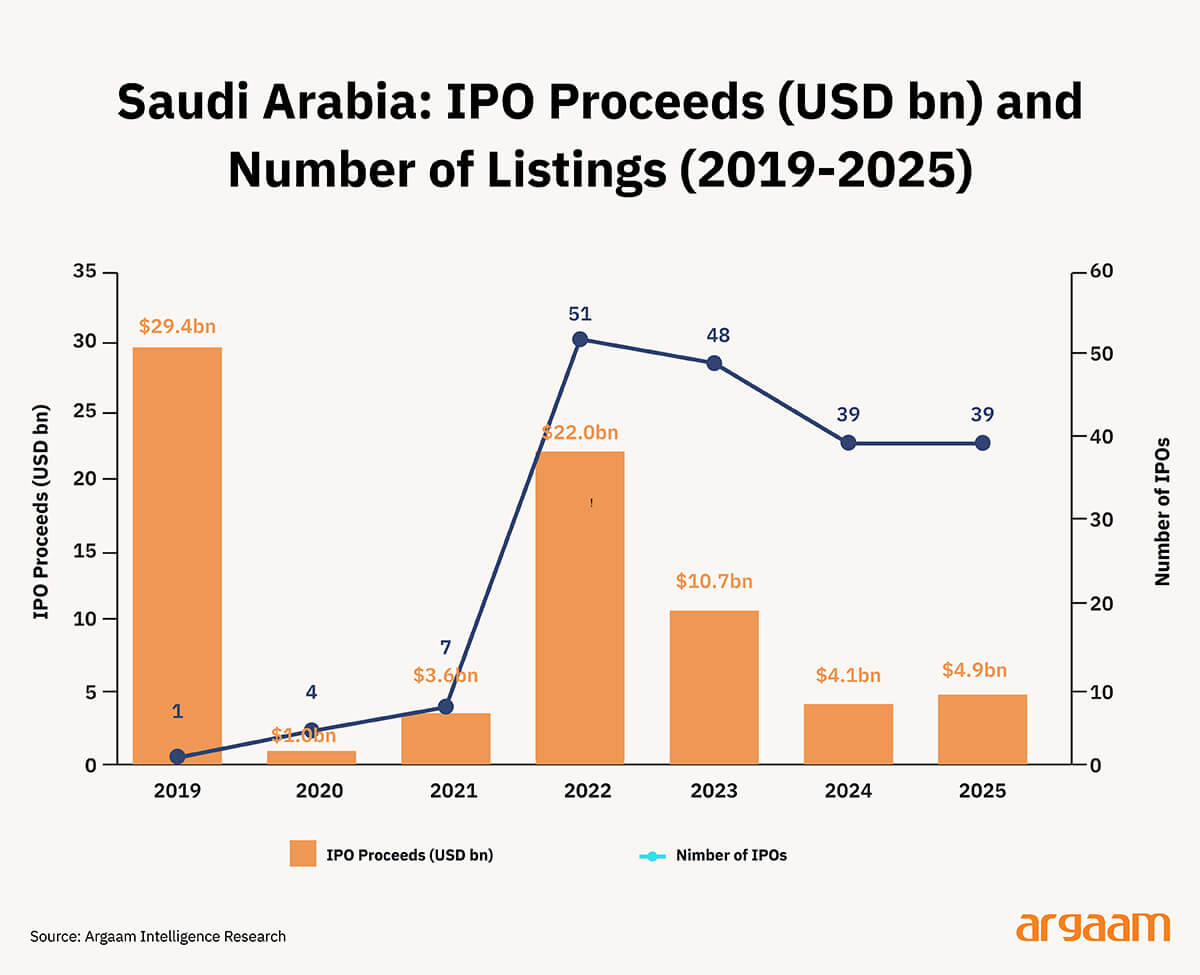
Saudi Arabia's capital market has undergone a structural transformation that deserves to be assessed on its own terms. Between 2014 and 2024, Tadawul's main market hosted 91 IPOs for an aggregate offering of approximately $65 billion - excluding Saudi Aramco’s secondary offering of about $11.2 billion completed in June 2024.
The market capitalisation of the Saudi Exchange reached $2.7 trillion by the end of 2024 — a rise of 463% over a 10-year period. By any regional standard, this is a remarkable record and reflects deliberate policy, rather than circumstances.
The numbers do tell a compelling story. While total MENA IPO proceeds declined 41.8% y/y to $7.3 billion in 2025, driven primarily by a slowdown in UAE listings, Saudi Arabia’s 39 of 49 regional IPOs, raising $4.9 billion, confirmed Tadawul’s position as the region’s dominant listing venue.
In 2022, the Kingdom helped push total MENA proceeds to a record $22 billion. From a single landmark listing in 2019, the IPO pipeline has grown to include dozens of transactions annually spanning energy, logistics, healthcare, and consumer markets.
The Nomu Parallel Market, designed explicitly for mid-sized issuers, has deepened the pipeline further. This trajectory isn’t accidental — it’s the product of systematic CMA regulatory reform, Vision 2030 programme execution, and deliberate deployment of state-linked balance sheets to catalyse private capital formation.
What’s Next: The 2026–2027 Privatisation Pipeline
The pipeline ahead is equally ambitious. The National Centre for Privatisation and PPP (NCP) has outlined a programme targeting more than 220 new public-private partnership contracts by 2030 - with an initial capital deployment target of $64 billion (SAR 240 billion).
Across sectors from transport to utilities to entertainment and aviation, government-owned assets are being prepared for public listing or private concession. Five candidates that illustrate the breadth and scale of what is coming are stated in the table below.
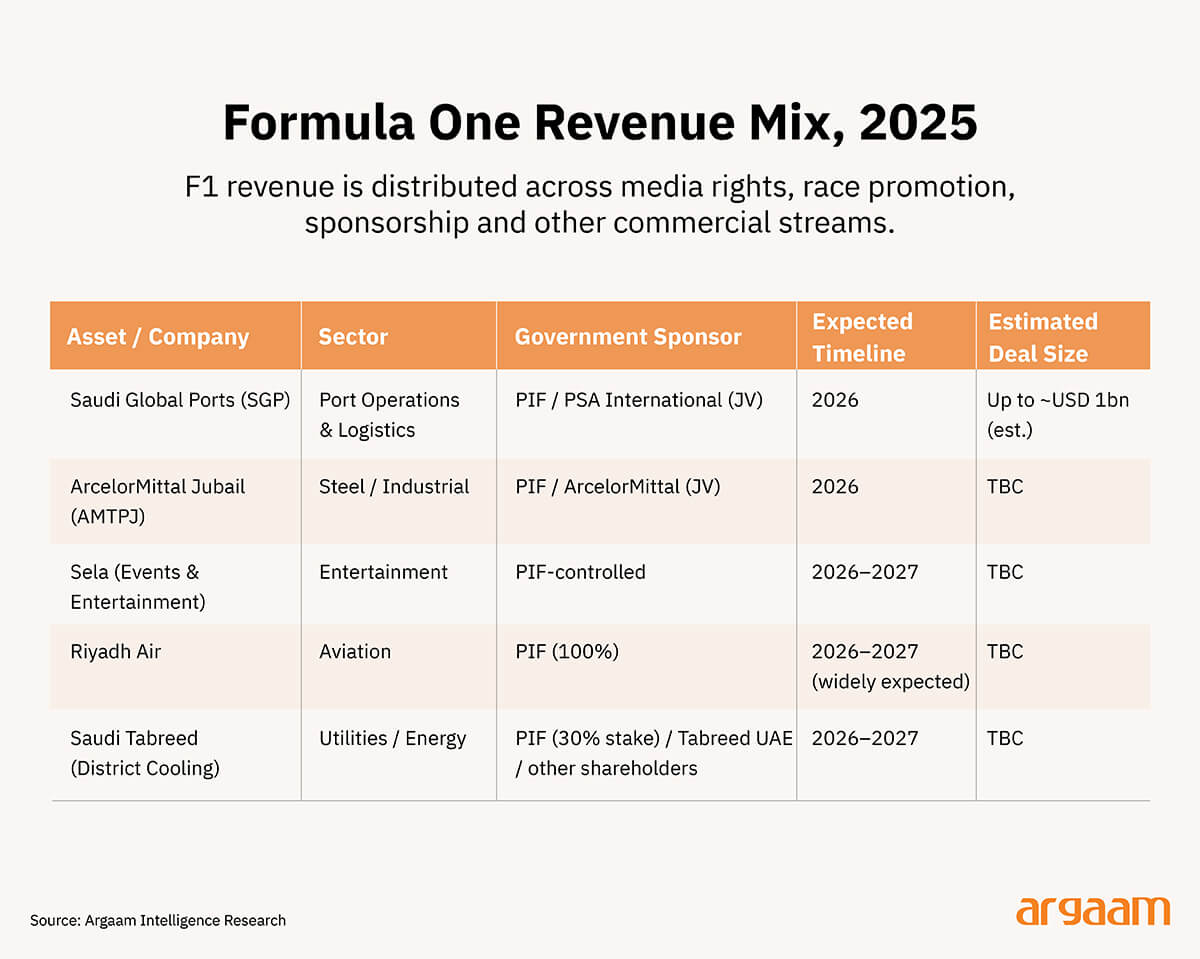
➢ Note: Est. Deal Size from publicly available media reports. TBC = not yet publicly announced. All deal sizes and timelines are subject to CMA and PIF confirmation.

The Ownership Architecture: Who Holds What, and Why It Matters
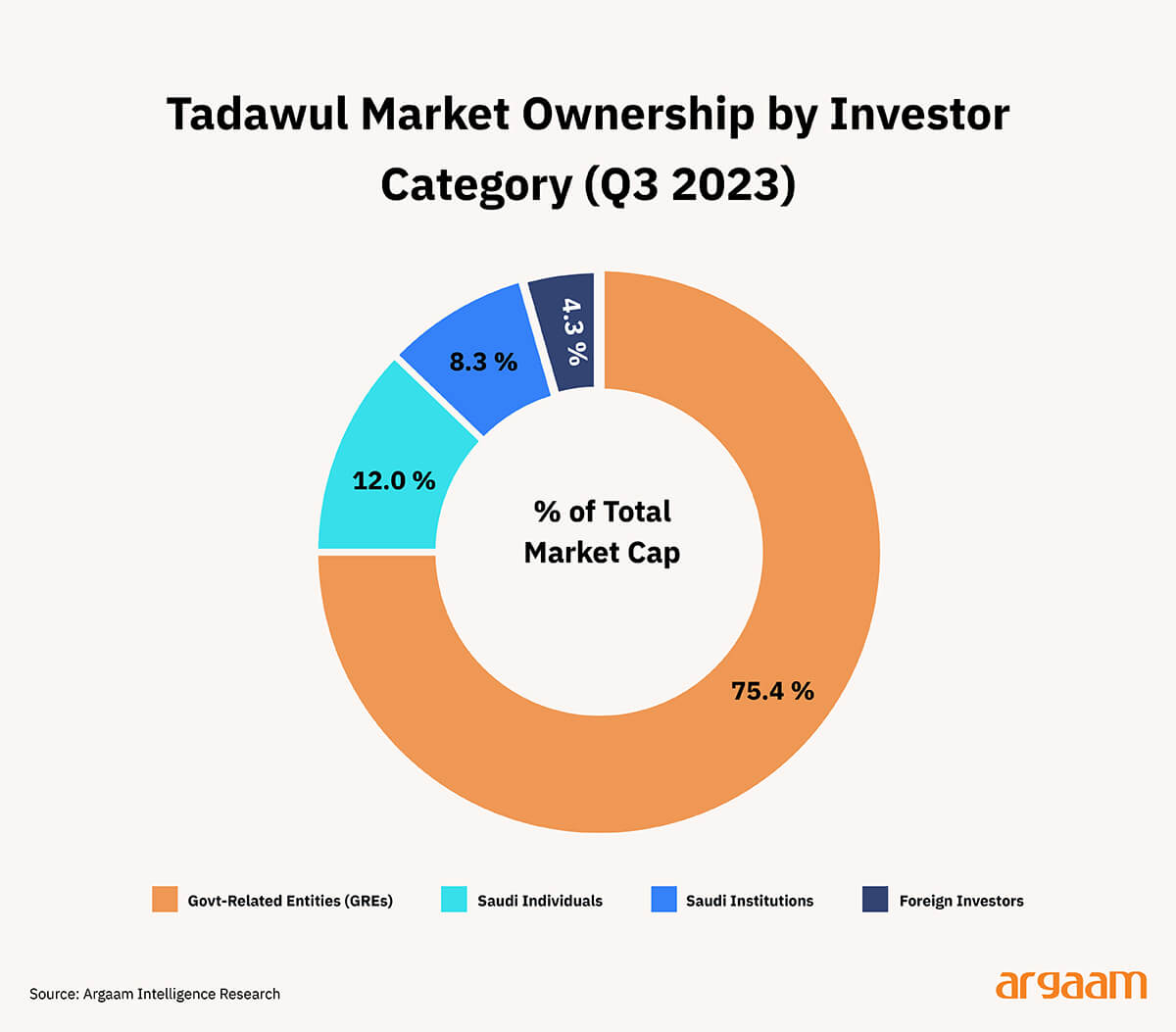
Understanding Tadawul's capital market requires understanding who actually owns it. Government-Related Entities (GREs) — a category that includes PIF, GOSI (through its investment arm Hassana), the merged Public Pension Agency, and other state-linked funds — held approximately 75.4% of total Tadawul market capitalisation as of Q3 2023.
More recent S&P Global data from May 2025 reinforces this picture with greater force: Saudi Aramco alone represented approximately 67% of the exchange’s total market capitalisation at end-2024, and the seven largest issuers — all GREs with the single exception of Al Rajhi Bank — collectively accounted for over 80% of total market capitalisation, based on CMA ownership data and individual issuer market capitalisations.
Foreign investors, by contrast, held about 4.3% of total market capitalisation in َQ3 2023, a share that has risen to roughly 6%–6.5% by the end of Q3 2025. Saudi individuals and private institutions account for the remainder.

What makes this analytically significant is the dual role these entities play
PIF is simultaneously the Kingdom's primary strategic investor — with $913 billion in assets under management in 2024 — and the principal shareholder in many of the companies being brought to market through or via the privatisation programme.
GOSI, through Hassana Investment Company, manages more than $320 billion and is among the most active institutional buyers in domestic equity markets.
The Public Pension Agency, now merged into GOSI, added further scale to this consolidated position. When the entity selling equity and the entity buying that equity are both organs of the same state, the resulting ownership structure has characteristics that are structurally different from markets where sellers and buyers represent genuinely independent capital pools.
The Circularity Question: Two Recent Examples
The analytical question isn’t whether this ownership structure is an appropriate policy — it is — but what it means for the signals that sophisticated foreign investors use to assess genuine market depth. Two recent IPOs illustrate the point clearly.
The first is Saudi Aramco's IPO in December 2019, the largest in capital market history, which raised $25.6 billion at launch (US$29.4 billion including the over allotment option). The institutional tranche was oversubscribed 2.95 times.
What the headline subscription figure didn’t disaggregate was the composition of that institutional demand. As reported during the bookbuild period, foreign investors represented only approximately 10.5% of institutional bids, with the offering overwhelmingly domestically subscribed — the retail tranche alone attracted 4.17 million Saudi subscribers.
International institutional demand, while present, was not the primary driver of the oversubscription metric. For a foreign portfolio manager reading the subscription ratio as a signal of a genuine global demand, the figure required more precise interpretation than the headline implied.

The second is ADES Holding Company’s IPO in September 2023, the largest Saudi IPO of that year. A 30% stake was sold down by PIF and two co-shareholders, with PIF the largest among the selling shareholders. The offering raised SAR 4.6 billion (approximately $1.2 billion).
The institutional tranche received orders of SAR 286.85 billion against a SAR 4.57 billion offer — a 62.7 times oversubscription. ADES was simultaneously a PIF-owned asset being sold and a company whose IPO book was dominated by domestic institutional investors, including state-linked funds.
The resulting subscription metrics were structurally robust — but the degree to which they represented independent, arms-length institutional demand from investors with no prior state relationship to the issuer is a question that foreign investors need to assess before or prior to treating those metrics as a direct read on market appetite.
The deeper point here is this: when government-linked institutional buyers are pre-committed anchor investors in government-linked IPOs, oversubscription ratios — which investors typically read as a signal of genuine demand — are structurally elevated.
This isn’t a market failure. It’s a structural characteristic that sophisticated foreign investors need to understand clearly before drawing conclusions about the depth and independence of the liquidity they are entering.

What the Free Float and Foreign Ownership Data Tell Us
The aggregate free float picture reinforces the structural reading. According to The CMA's 2025Q2 Quarterly Statistical Bulletin, a total market capitalisation of SAR 9.13 trillion against a free float market capitalisation of SAR 3.13 trillion — implying an effective free float ratio of approximately 34% across the exchange.
In practice, free float on many individual large-cap listings is considerably lower, because the definition of free float excludes only shares held by strategic shareholders above a defined threshold and not the full constellation of government-linked holdings across multiple vehicles.
Foreign investors held SAR 590 billion in Saudi equities by the end of Q3 2025 — a meaningful and growing figure that represents approximately 6.5% of total market capitalisation and, on the CMA’s own figures, around 11% of free float shares.
The CMA's own target was 17% of free float ownership for foreign investors by 2024 — a goal that hasn’t yet been reached. In February 2026, the CMA abolished the Qualified Foreign Investor (QFI) regime and opened the main market to all foreign investors directly — a genuinely significant reform step.
But regulatory access and genuine depth of independent liquidity aren’t the same thing, and the ownership concentration data suggest that the latter still has considerable distance to travel.

The Malaysia Parallel: A Constructive Reform Pathway
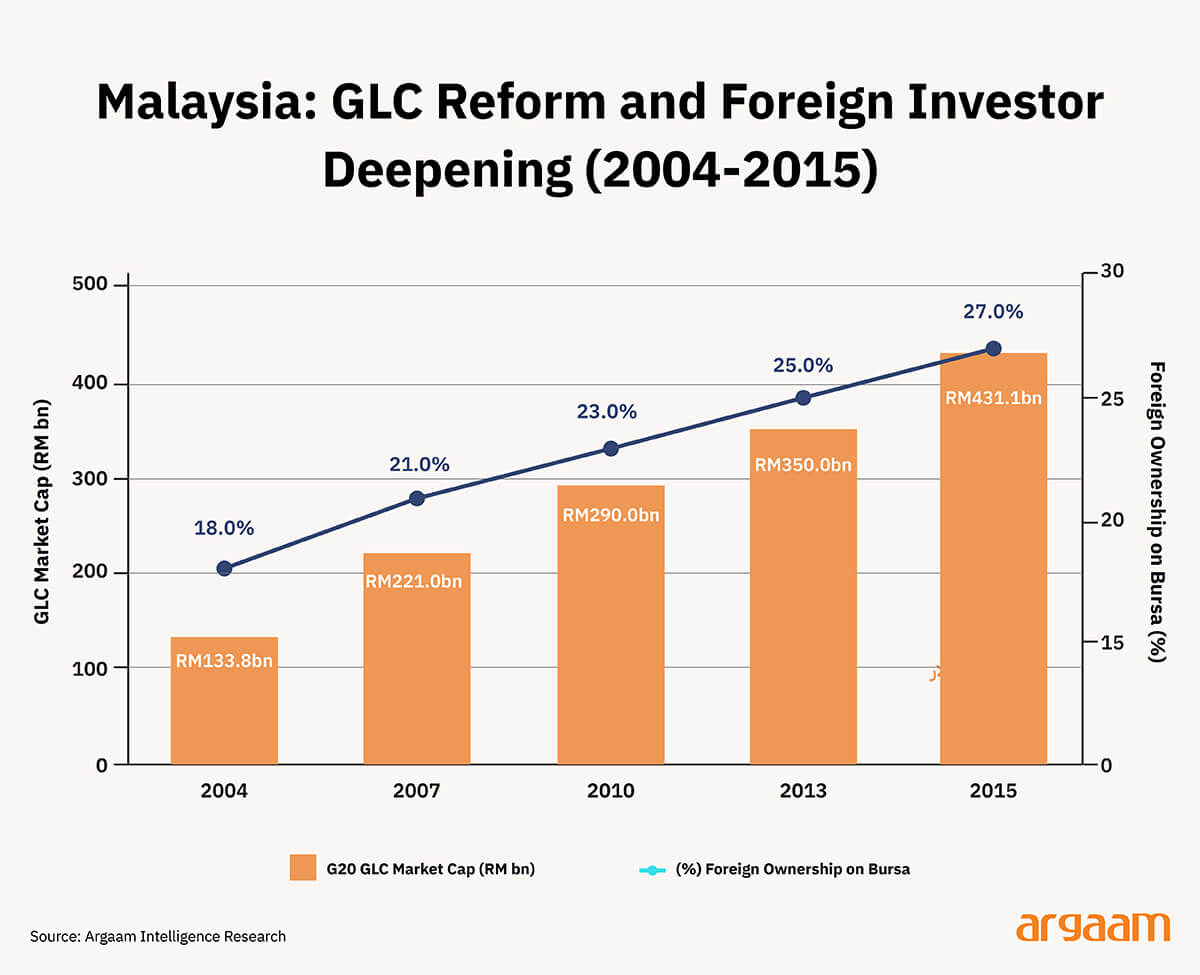
Malaysia navigated a structurally similar ownership challenge and offers the most relevant international lesson. At the launch of the GLC Transformation Programme in May 2004.
Malaysia's government-linked companies — held through Khazanah Nasional (the sovereign wealth fund) and the Employees Provident Fund (EPF) — dominated Bursa Malaysia in precisely the way PIF and GOSI currently dominate Tadawul.
Khazanah was simultaneously the seller of GLC stakes, and EPF — acting as the dominant domestic institutional anchor buyer — was the primary absorber of those same offerings. The circularity was structural, and it was producing liquidity and governance metrics that didn’t fully reflect independent investor conviction.
The GLC Transformation Programme, which ran from 2004 to 2015, addressed this directly. The PCG Graduation Report documents that the G20 GLCs grew their combined market capitalisation from RM 133.8 billion to RM 386.0 billion — a 2.9 times increase over the eleven-year period, with an all-time programme high of RM 431.1 billion reached in April 2015.
The programme required GLCs to meet enhanced free float targets, adopt international corporate governance standards, and reduce cross-holdings between related state entities.
Bursa Malaysia tightened its free float rules and FTSE introduced minimum free float thresholds for index inclusion — an external discipline that forced genuine market deepening.
South Korea's post-1997 experience offers a corroborating example: the unwinding of chaebol cross-holdings and the broadening of KOSPI's foreign investor base were driven by the same logic — that index inclusion requires free float integrity, and free float integrity requires genuine separation between the sellers and buyers.
The lesson isn’t that state-linked ownership is incompatible with deep markets. It’s when markets deepen that the structural separation between sellers and buyers is progressively enforced through free float rules, governance requirements, and external benchmarks applied equally to state-linked and private issuers.
▶ What This Means for Foreign Investors Assessing Saudi Market Depth
The structural characteristics described above are not deterrents to investment in Saudi Arabia's capital market. They are the context that sophisticated foreign investors need to incorporate into their analytical framework.
Tadawul is not a shallow market — it’s the Arab world's largest bourse, with a $2.7 trillion market cap, a broadening issuer base, and a regulator that has consistently demonstrated appetite for reform. The February 2026 abolition of the QFI regime is the most significant single access reform in the market's history.
▶ What the ownership data tells a foreign portfolio manager is this:
The relevant measure of genuine market depth is not total IPO volume or headline oversubscription ratios, but the proportion of equity that trades freely between independent, arms-length investors — those with no prior ownership relationship to the issuer and no institutional mandate to support the state's capital recycling programme.
▶ On that measure, a free float of approximately 34% of total market capitalisation, foreign ownership of approximately 6.5% of total market cap - on the CMA’s own figures, around 11% of free float shares— and a top-seven GRE concentration exceeding 80% of market cap are the numbers that matter.
They describe a market that is genuinely expanding, but where the effective trading universe for independent investors remains materially smaller than what is suggested by headline figures.
▶ The constructive read — and it’s the right one — is that Saudi Arabia has the institutional architecture, the regulatory will, and the explicit Vision 2030 mandate to address this progressively.
What Malaysia's experience demonstrates is that the pathway works when free float rules are enforced with consistency, when state-linked entities gradually reduce their role as anchor buyers in state-linked offerings, and when external benchmarks — MSCI, FTSE — serve as an independent discipline on the quality of what counts as genuine liquidity.
▶ Tadawul is already on this path. Understanding the current structural characteristics is the prerequisite for assessing how far along the market has travelled, and how much further it needs to go.