



|
Saudi Arabia pays Formula One more than $100 million every year just to participate in the sport. Around $55 million of that is the annual fee Liberty Media, an American media and entertainment conglomerate that owns the commercial rights to Formula One, charges to keep the Saudi Grand Prix on the calendar.
The Concorde Agreement It is the contract that holds Formula One together commercially. It binds the constructor teams, the FIA as regulator, and Liberty Media as commercial rights holder into a single legal framework governing how revenues are split, how prize money is distributed, how the calendar is structured, and what rights each party holds when any of those terms are renegotiated. What Saudi Arabia is missing is a constructor status — meaning it does not own a team that designs and builds its own car and competes under the Concorde Agreement. That distinction is not technical. It is the difference between being a customer of Formula One and being a participant in its governance. Constructors sign the Concorde Agreement. They receive a share of the sport's annual revenues. They have formal standing when commercial decisions are made. Saudi Arabia, despite spending more than $100 million a year on the sport, holds none of that standing yet. Every hosting contract it signs, every sponsorship it funds, every circuit it builds — all of it sits on terms that Liberty Media sets and can reset. 
The kingdom builds the Circuit. It Did Not Secure the Race Qiddiya is not a sponsorship. It is a $500 million permanent structure being built into the landscape outside Riyadh, designed around a single commercial assumption — that Formula One will race there for decades. Hotels, hospitality infrastructure, residential apartments, and a purpose-built circuit are all being sized and positioned around an F1 calendar slot that Liberty Media controls and that a future owner of the sport's commercial rights will control after that. The economic literature on sport-event infrastructure is unambiguous on this point: host cities and nations do not extract lasting value from events automatically. The physical asset and the event contract have to be aligned in duration and in governance terms for the investment to generate the returns that justified building it. Qiddiya exposes that misalignment precisely. Saudi Arabia is committing half a billion dollars of permanent capital to an infrastructure play whose entire commercial logic depends on a calendar relationship it has no contractual power to enforce, no governance standing to protect, and no constructor seat from which to negotiate if the terms change. 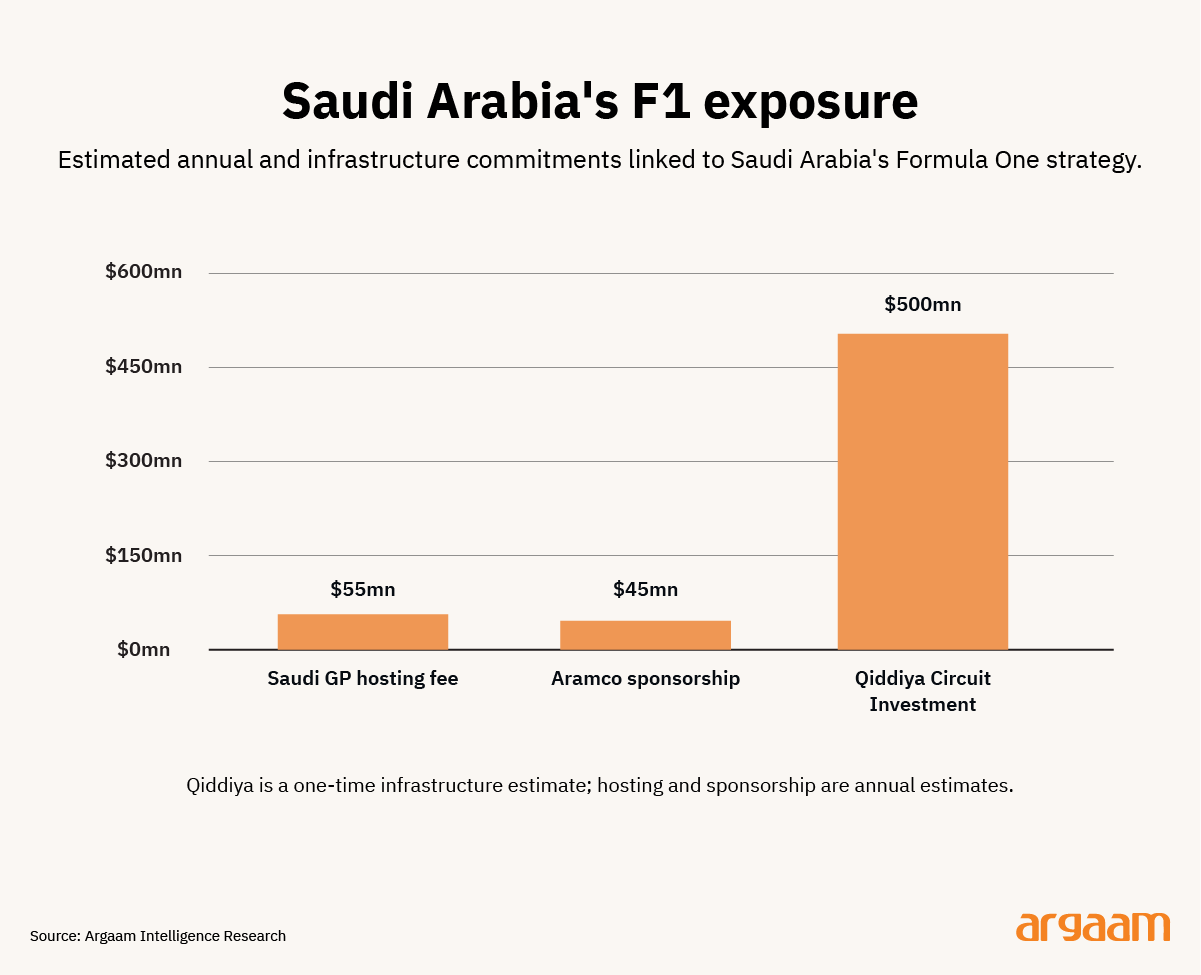  Why Saudi Arabia's Aston Martin Stake Is Not an F1 Stake Bahrain owns a controlling stake in McLaren Racing — the constructor that signs the Concorde Agreement, competes on the grid, and receives annual prize money distributions directly from Liberty Media. Abu Dhabi holds a non-controlling position in the same business. Qatar has agreed to acquire a significant minority stake in Sauber, the constructor transitioning into Audi's factory entry in 2026. These positions carry different levels of commercial power. But they share one characteristic that Saudi Arabia's publicly confirmed F1 exposure does not yet clearly replicate — a direct, declared equity link to a constructor inside F1's governance structure. Saudi Arabia's position deserves careful reading. PIF holds a significant stake in Aston Martin Lagonda, the publicly listed luxury carmaker. That is a substantial automotive investment. But the carmaker and the F1 constructor are legally distinct entities with separate ownership structures, separate balance sheets, and separate commercial futures. Aston Martin Lagonda has since divested its own equity stake in the racing team entirely, making the separation between the two assets a matter of public record rather than interpretation. Whatever exposure PIF's Aston Martin Lagonda position provides, it does not, on the basis of publicly confirmed information, constitute a direct constructor stake of the kind that carries Concorde Agreement governance rights. Whether Saudi Arabia holds additional undisclosed positions in the F1 constructor is a question this analysis cannot answer from publicly available sources. What can be said is that no confirmed constructor equity position has been declared — and in the context of a sport where Bahrain, Abu Dhabi, and Qatar have all made their constructor stakes a matter of public record, the absence of a declared Saudi position is itself analytically significant. 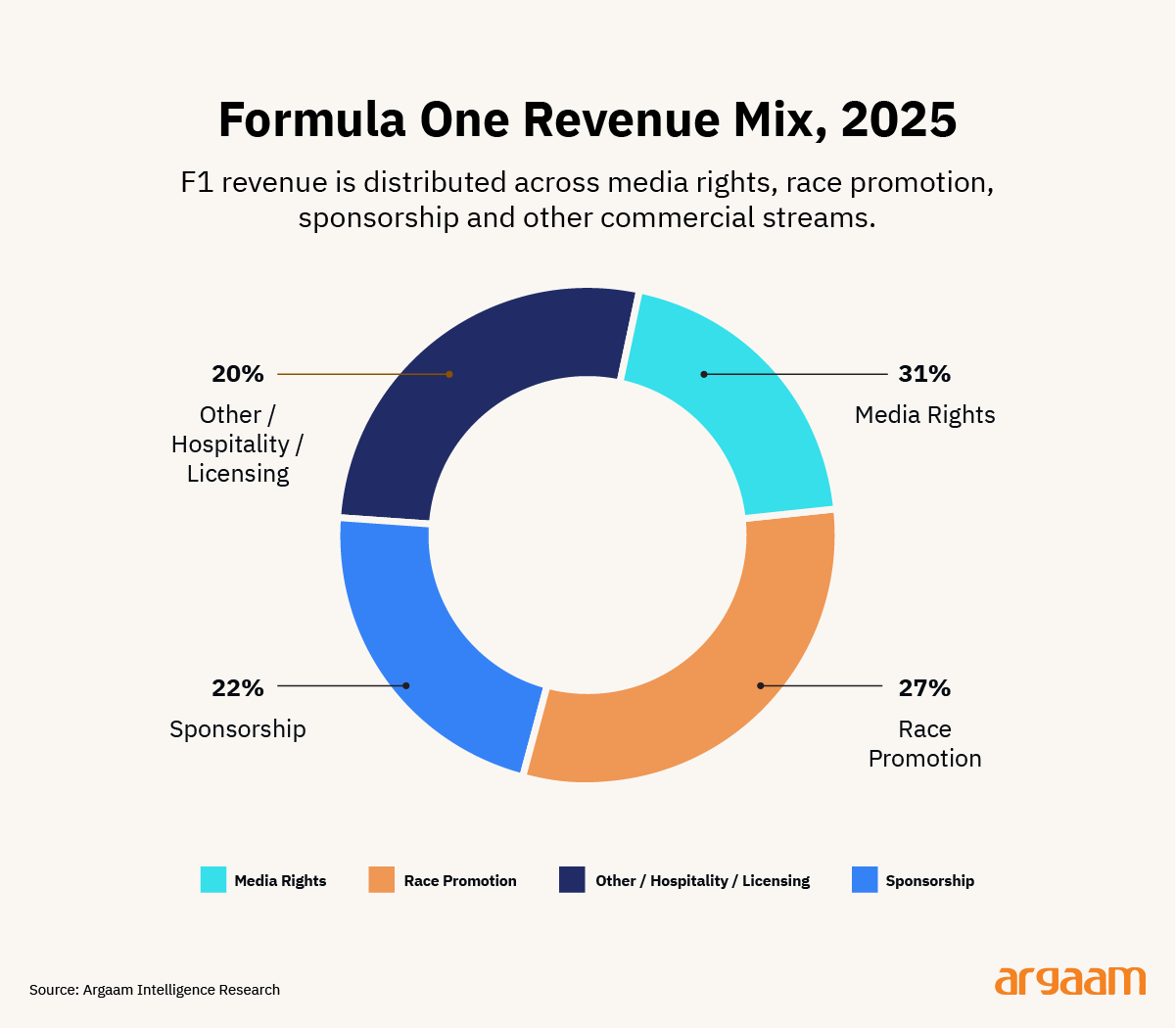 Formula One generated $3.65 billion in revenue in 2024. Of that, approximately $1.27 billion was distributed directly to constructor teams under the terms of the Concorde Agreement — not as discretionary payments, but as contractually guaranteed annual distributions tied to championship performance and historical standing. McLaren, as the 2024 constructor champion, received an estimated $140 million. Sauber, finishing last, received approximately $60 million. A mid-grid constructor — which is where Aston Martin currently sits — would fall somewhere between those figures, receiving an estimated $80 million to $100 million annually simply for competing. That income floor matters. It means a constructor seat is not primarily a racing proposition. It is a financial instrument with a guaranteed revenue baseline, an appreciating asset value — Aston Martin's constructor is currently valued at approximately $3.2 billion, up 45% since 2024 — and a governance position inside a sport generating nearly $4 billion a year in commercial revenue. Saudi Arabia's current F1 spending buys none of that. It funds the sport. It does not participate in its operating economics. 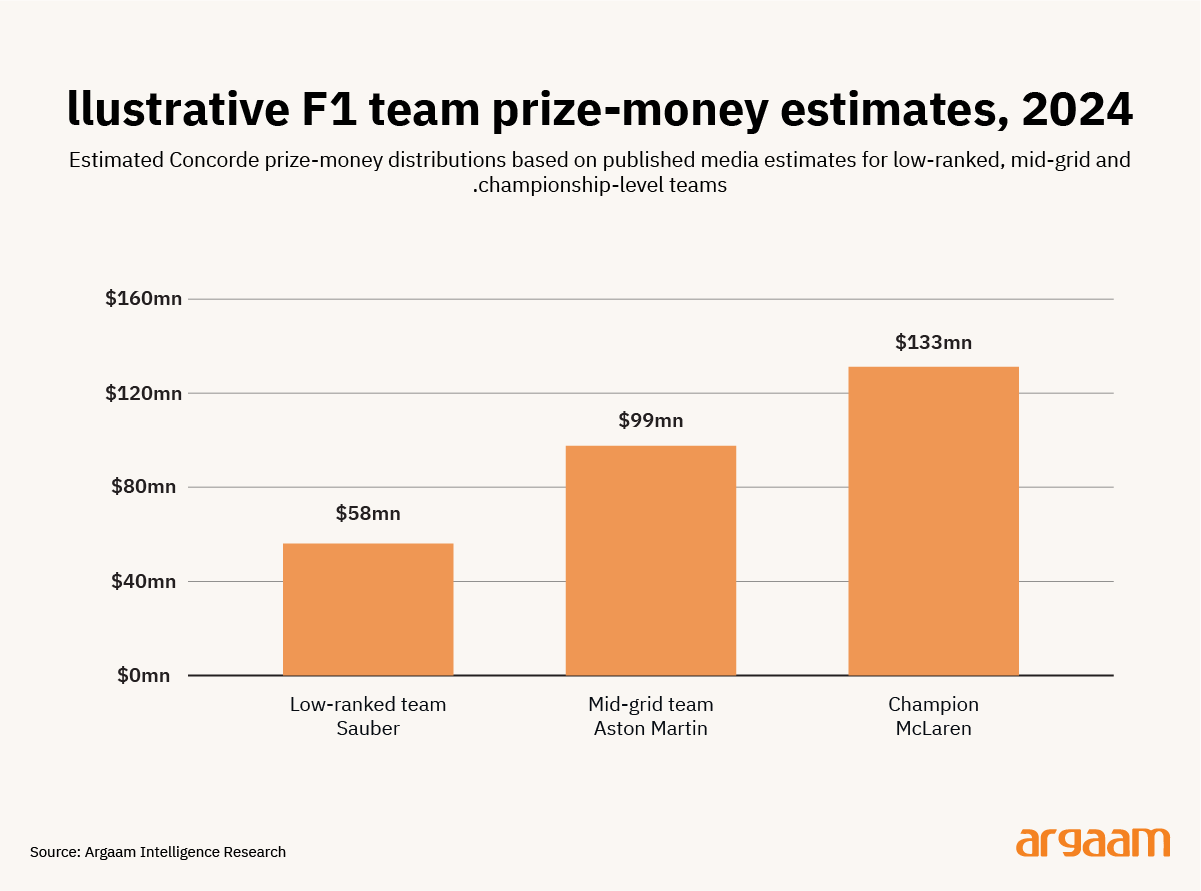 
The Renewals are coming soon The next three years create a specific window of commercial exposure for Saudi Arabia that does not exist in the abstract — it exists on a calendar. The current Concorde Agreement runs to 2030. Negotiations for what comes after will begin well before that deadline, likely around 2028 — the same year Qiddiya is scheduled to host its first Formula One race and the same year Aramco's title partnership with the Aston Martin constructor reaches its renewal point. Three of Saudi Arabia's most significant F1 commitments therefore converge on a single two-year window in which the sport's commercial terms are being renegotiated from the ground up. Layered on top of that, Liberty Media has not ruled out testing buyer interest in Formula One's commercial rights during the current cycle. A sale would not automatically void existing contracts — but it would place every hosting agreement, every sponsorship arrangement, and every calendar commitment into a renegotiation environment controlled entirely by a new owner whose priorities Saudi Arabia has had no role in shaping and no governance standing to influence.  The Aston Martin Questions Aston Martin is the obvious starting point for any Saudi constructor conversation — the brand relationship is established, the Aramco sponsorship is already in place, and the political friction of entry would be lower than with any other team. But familiarity is not the same as value, and three questions need honest answers before any deal makes strategic sense. ➤ The first is whether a stake would actually change anything. A small minority position might deepen the commercial relationship without providing the governance rights that make constructor ownership strategically meaningful. Buying into Aston Martin without securing Concorde-relevant standing would be an expensive way of formalising an arrangement that already exists informally. ➤ The second is whether the price is rational. Aston Martin's constructor was valued at approximately $3.2 billion in its most recent stake transaction — so Saudi Arabia would be buying in after the price has already risen, not before it. ➤ The third is whether Aston Martin is even the right asset. Saudi Arabia does not need the Aston Martin name. It needs a constructor position that converts its existing financial exposure into formal governance standing. Those are different objectives, and they do not necessarily point to the same team. |
|
|

|
|


|

Argaam.com Copyright © 2026, Argaam Investment, All Rights Reserved |