Saudi banks closed the year 2025 with the strongest aggregate results in the kingdom's banking history. Combined net profits for the top listed banks reached SAR 92.52 billion - a gain of 16.17% y/y over 2024's SAR 79.64 billion, which was itself a record at the time.
The Return on Equity (ROE) stood at 15.2%, capital adequacy ratios (total CAR) remained well above the regulatory minimum at 20.5%, and the NPL ratio, at 0.9%, is amongst the lowest of any major banking system globally.
The strength of Saudi banks is then well-documented and well-earned. What is less examined is a structural evolution in the composition of their credit portfolios — one that conventional asset-quality metrics, including the NPL ratio, are not designed to fully capture.
What merits attention now is not a flaw in that performance but its next chapter: a loan book increasingly concentrated in sovereign-linked corporate credit, where the risk is less about individual borrower default and more about correlated exposure to a single national investment agenda.

The shape of the corporate book has changed — and the numbers tell why
Saudi bank credit growth has been driven almost entirely by the corporate segment. Since 2022, corporate loans have grown at roughly 16% per annum on average, consistently outpacing retail lending.
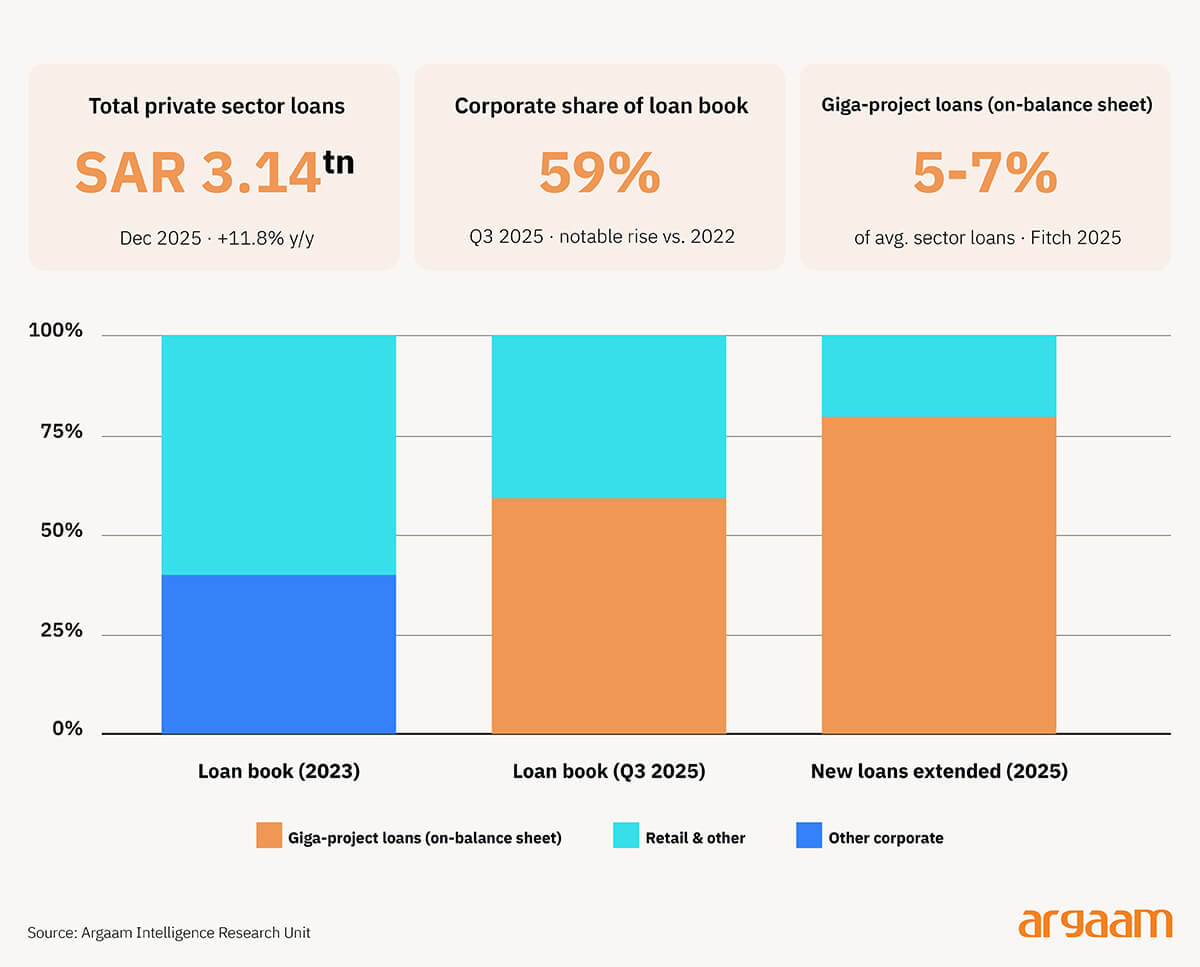
By Q3 2025, corporate lending accounted for approximately 59% of total sector loans, and Fitch Ratings estimated that the corporate segment drove roughly 80% of all new loans extended in 2025. Total private sector bank lending stood at SAR 3.14 trillion by December 2025, up 11.8% y/y.
What’s driving that growth is largely Vision 2030 and its project economy — PIF subsidiaries, giga-project special purpose vehicles, government-related contractors, and the dense ecosystem of suppliers who depend on state-led pipelines for revenue.
According to Fitch, bank financing to Saudi giga-projects alone stood at 5–7% of average sector loans in 2025, with total on-and off-balance-sheet exposure approaching 10% of combined sector credit risk.
Applying the midpoint of that range to SAR 3.14 trillion implies an estimated SAR 188 billion in giga-project bank financing, according to our estimate based on our analytical methodology.
On-and-off-balance sheet exposure
Saudi banks do not break out their loans to giga-projects or PIF-linked entities as a separate line in their financial results. This is not a deliberate omission — it is simply that the reporting categories in use were designed before these projects existed at their current scale, and the classification system has not yet caught up.
The IMF's 2024 Financial Sector Assessment Programme for Saudi Arabia noted this gap directly and recommended that SAMA develop a dedicated monitoring framework for the financial system's aggregate exposure to large-scale mega and giga projects. The Fund identified sectoral concentration data as an area warranting closer supervisory attention.
That framework is still in development. In the interim, sector-level estimates from Fitch and other rating agencies (which we used in our analytical methodology) serve as the most reliable available proxy — useful for directional analysis, though not a substitute for the granular, institution-level data that a formal reporting regime would produce.

Concentration by design
Standard banking practice is built on the idea that spreading loans across different industries, countries, and economic cycles means that no single event can damage a large portion of the portfolio at once. When one sector struggles, others hold steady.
The pattern of corporate lending growth in Saudi Arabia over the past four years works differently.
The Public Investment Fund sits at the centre of five of the country's most ambitious development projects — NEOM, Qiddiya, Red Sea Global, ROSHN, and Diriyah — whose combined projected value exceeds USD 1 trillion. The PIF owns or controls all five, and funds roughly half of each. Saudi banks have financed much of the rest.
What this creates, in practice, is not a diversified corporate loan book in the conventional sense. It is a set of exposures that share a common owner, a common decision-making structure, and a common dependency on continued state investment.
When a policy decision is made at the sovereign level — about budgets, timelines, or priorities — it does not affect one project in isolation. It moves across all five simultaneously, and by extension across the banks that have financed them.
This is the structural difference from ordinary sector concentration. In a typical case, even heavy lending to, say, real estate or manufacturing still involves many independent borrowers whose fortunes are not tied to a single institutional decision.
Here, the thread connecting the borrowers runs back to the same place. Some early signals of deceleration are now visible and worth noting analytically. New project awards fell by approximately 50% in 2025.
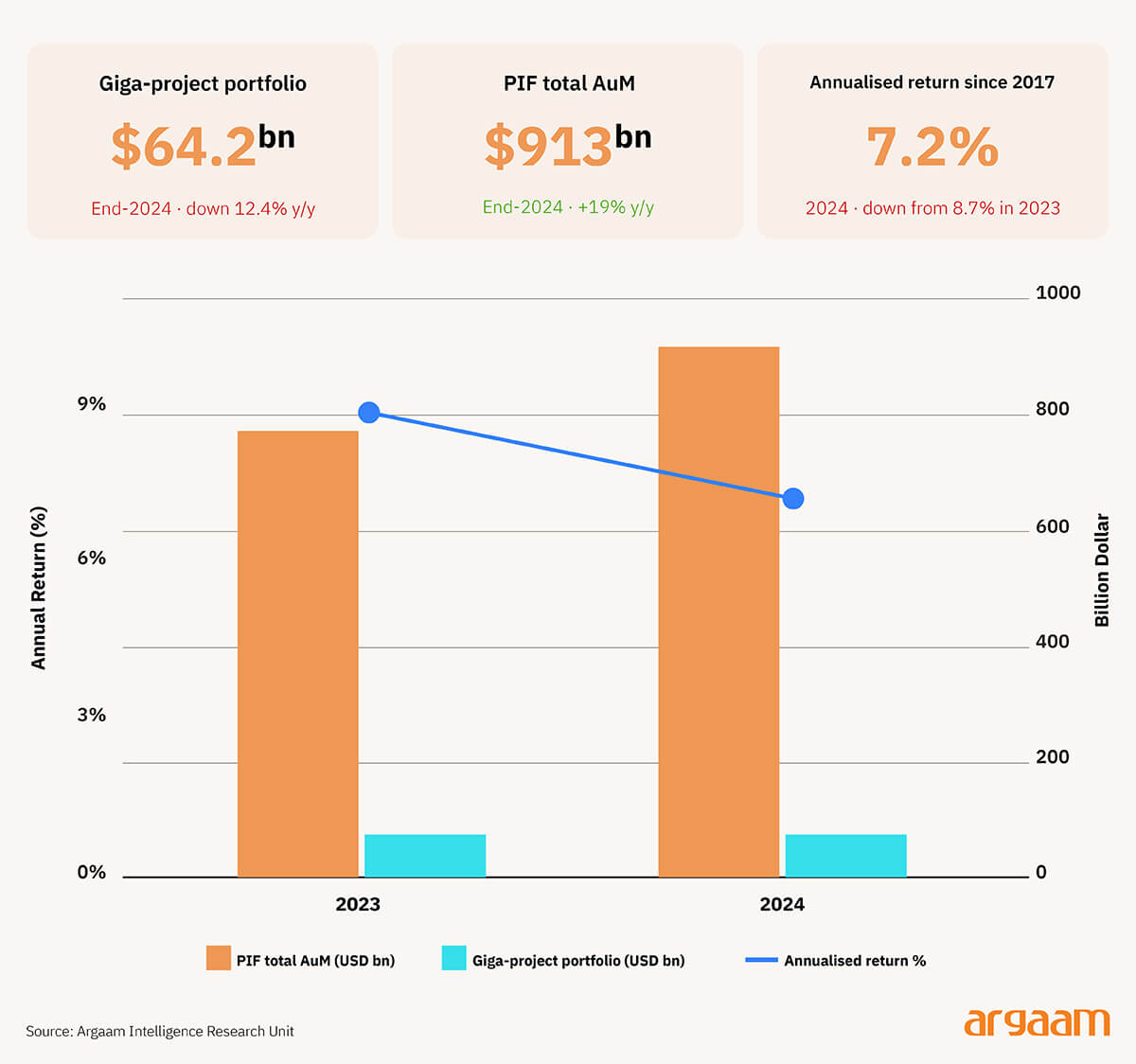
The Public Investment Fund valued its giga-projects that include the futuristic city Neom and tourism ventures like Red Sea Global at 241 billion riyals ($64.2 billion) as of end-2024, over 12% lower than the previous year. Annualized returns since 2017 fell to 7.2% from 8.7% a year earlier.
Still, overall assets under management rose 19% to $913 billion, solidifying the PIF’s position as one of the world’s biggest state-backed investors. It recently raised its 2030 target for assets to $2.67 trillion, up from a previous goal of $1.87 trillion.
So, these figures raise a pertinent question about credit underwriting: whether the assumptions built into these loans were calibrated for the possibility of a slower execution cycle, or whether they were priced on the expectation that the current pace of state-led investment would continue uninterrupted.

What a slowdown does to NPL ratios
The sector NPL ratio of 0.9% at end-2025 is, by any global benchmark, a remarkably low number — declining steadily from 1.5% in 2023 and 1.1% in 2024, supported by a coverage ratio of 162.4% and a cost of risk of just 0.30%.
The IMF's 2024 FSAP adverse stress test found that even under a sharp shock scenario, aggregate capital ratios fell by just 2.6 percentage points, and all banks remained above regulatory hurdle rates.
But the relevant question for today or now isn’t about a sharp shock — it's about a potential prolonged deceleration. Applying Fitch's 5–7% giga-project exposure estimate to SAR 3.14 trillion in total loans implies approximately SAR 188 billion in giga-project bank financing.
In an illustrative stress scenario where 15% of this exposure migrates to Stage 3 over a 12-month slowdown — broadly consistent with project finance distress rates in comparable emerging market decelerations — the sector NPL ratio rises by roughly 0.9 percentage points. (According to our own analytical methodology which’s available at request).
In this moderate stress scenario, the NPL ratio rises from 0.9% toward around 1.8%, a level that is still low by global standards and broadly comparable to the IMF’s 2023 baseline of 1.5%.
The more material impact would be on capital. Banks are required by regulators to hold a minimum cushion of their own capital against every loan they make.
The riskier the loan, the more capital must be set aside. This cushion — measured as a percentage of total risk-weighted assets — is what absorbs losses before depositors are affected.
The Saudi banking sector currently holds that cushion at around 20.5% of risk-weighted assets, which is comfortably above international minimums. But the direction of travel matters as much as the current level.
That ratio has already eroded by roughly 2.13 percentage points between 2020 and 2024 — a meaningful decline even if the absolute level still looks healthy.
Two forces are now pushing in the same direction at the same time. First, loans to giga-projects carry higher-than-average risk weights — between 80% and 130% — meaning every riyal lent to NEOM or Red Sea Global consumes more capital than a standard corporate loan.
As these exposures grow, they quietly compress the capital ratio from the top. Second, SAMA is introducing a 1% countercyclical capital buffer from May 2026, which requires banks to hold additional capital on top of existing minimums — compressing the ratio further from the bottom.
The compounding risk is this: if project loans begin to underperform at the same time as the new buffer takes effect, banks would face deteriorating asset quality and rising capital requirements simultaneously — and both pressures would trace back to the same source.
That is not a prediction of stress. It is a description of how the risk is structured, and why the current capital headroom deserves closer analytical attention than the headline ratio alone suggests.

The risk transfer gap
In the decade since the global financial crisis, Western banking systems have built a sophisticated ecosystem of credit risk transfer.
Significant Risk Transfer (SRT) transactions — synthetic securitisations that shift credit risk off balance sheets to pension funds, insurance companies, and specialist investors — now protect loan portfolios of almost €800 billion globally as of end-2024, with issuance growing fivefold since 2016.
European banks have used SRTs aggressively to manage capital efficiency without cutting lending capacity. Saudi banks currently have no such comparable mechanism.
Saudi Arabia's domestic bond and Islamic finance (sukuk) market has grown substantially — outstanding issuances reached approximately USD 520 billion in 2025, with sukuk (Islamic bonds structured to comply with Sharia law) accounting for around 62% of the total.
By any measure, that is a meaningful capital market. The limitation is not its size — it is its function. The market remains dominated by government and government-linked borrowers.
It has not yet developed into a mechanism through which banks can package up their corporate project loans and sell them on to outside investors, thereby freeing up space on their own balance sheets.
The pool of investors capable of absorbing that kind of risk is the General Organisation for Social Insurance (GOSI) and the Public Pension Agency (PPA).
The Kingdom's two largest domestic institutional investors, alongside insurance companies and international asset managers, remain too underdeveloped as active participants in the secondary credit market to play that role at scale.
Saudi Arabia's first Residential Mortgage-Backed Securities (RMBS) transaction — a structure that packages home loans into a tradeable bond — was launched by the Saudi Real Estate Refinance Company (SRC) only in August 2025.
That is a genuine milestone, but it also illustrates how early the securitisation market remains in its development. Securitisation is the primary tool through which mature banking systems transfer credit risk off balance sheets and into capital markets.
On the index front, JP Morgan formally confirmed Saudi Arabia's inclusion in its Government Bond Index – Emerging Markets (GBI-EM) in April 2026, with phased entry beginning January 2027 at a 2.52% weight.
Combined with the Bloomberg Emerging Markets index, the estimated passive inflow exceeds USD 10 billion. That is a positive structural development for the sovereign bond market.
But it does not materially change the secondary liquidity picture for bank-originated corporate credit, which is a different and more specific problem.
Saudi banks have responded to their funding pressures by borrowing internationally. Their foreign borrowing reached approximately USD 33 billion in 2025.
Across the sovereign, quasi-sovereign, and banking sectors combined, total Saudi dollar-denominated bonds and sukuk now stand close to USD 100 billion.
The sector's Loan-to-Deposit Ratio (LDR) — the share of deposits that has been lent out — has risen to around 106.5%, meaning banks are lending out more than they hold in deposits and are increasingly reliant on wholesale funding to bridge the gap.
The important distinction is this: external borrowing is a funding solution, not a capital solution. It addresses the question of where banks find the money to keep lending.
It does not address the question of whether banks have sufficient regulatory capital to absorb losses if those loans go wrong. Filling a liquidity gap and freeing up capital are two different things — and for the next phase of Vision 2030 financing, it is the second that matters more.
Editorial Note The Capital Market Authority (CMA) published a strategy for developing the corporate sukuk and debt capital market in June 2024, signalling a clear institutional awareness of the gaps.
Fitch, in February 2026, went further — explicitly noting that Saudi banks could make growing use of instruments such as Significant Risk Transfers (SRTs, which allow banks to transfer a portion of their credit risk to outside investors while retaining the underlying loans) and Residential Mortgage-Backed Securities (RMBS) to manage capital pressure.
Fitch also acknowledged that the market infrastructure needed to support such instruments is still in its early stages. The policy direction is well understood.
What would sharpen the response is a clearer sense of the timeline — because the financing volumes already sitting on bank balance sheets are growing faster than the infrastructure being built to manage them.
|