




|
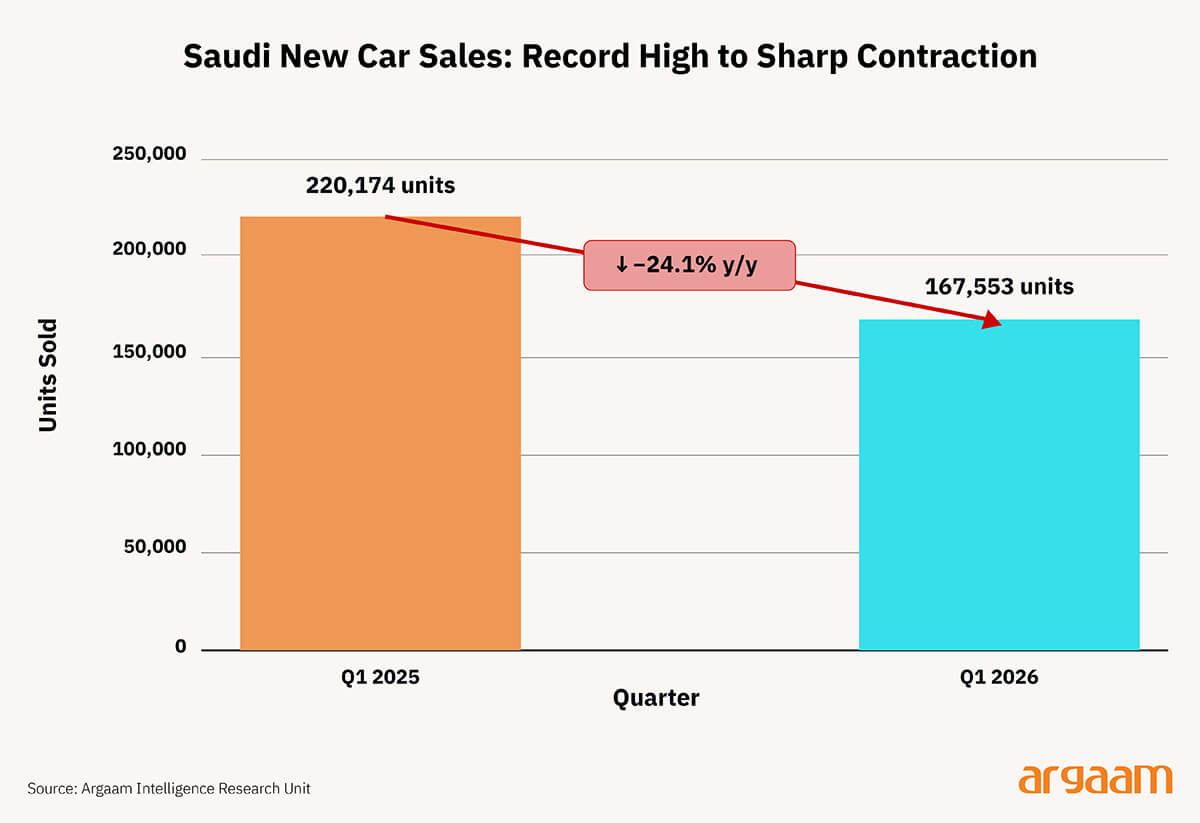
Saudi Arabia's new car market contracted -24.1% y/y in 2026Q1, with 167,553 units sold. In March alone, it fell -34.7% - a sharp decline that’s comparable in scale to the steepest monthly drops witnessed during COVID 19 in 2020.
Market commentary widely links the Q1 2026 shock to war-related disruptions to shipping through the Strait of Hormuz, with dealers reporting an abrupt drop in arrivals.
Editorial note: The observations in this analysis reflect Argaam Intelligence's reading of available data points and should be understood as an analytical framework rather than a definitive assessment of market conditions. SAMA's regulatory architecture is consistent with established international practice, and the boundary between commercial and financial regulation is a standard feature of how markets are structured globally. The dynamics described here represent our assessment of how certain structural characteristics of the Saudi auto finance market interact under specific conditions — and are intended to inform dialogue, not to draw conclusions about any particular institution or outcome.
The floorplan credit facility is a revolving line of credit extended by a bank to an auto dealer to finance inventory purchases. Each vehicle is individually financed - the dealer repays the bank only after the vehicle is sold.
When lenders and borrowers are both regulated, there are rules that limit how much debt can be built up between them. But when an unregulated middleman sits between the two — as dealer floorplan financing does in the Saudi auto market — those limits do not apply.
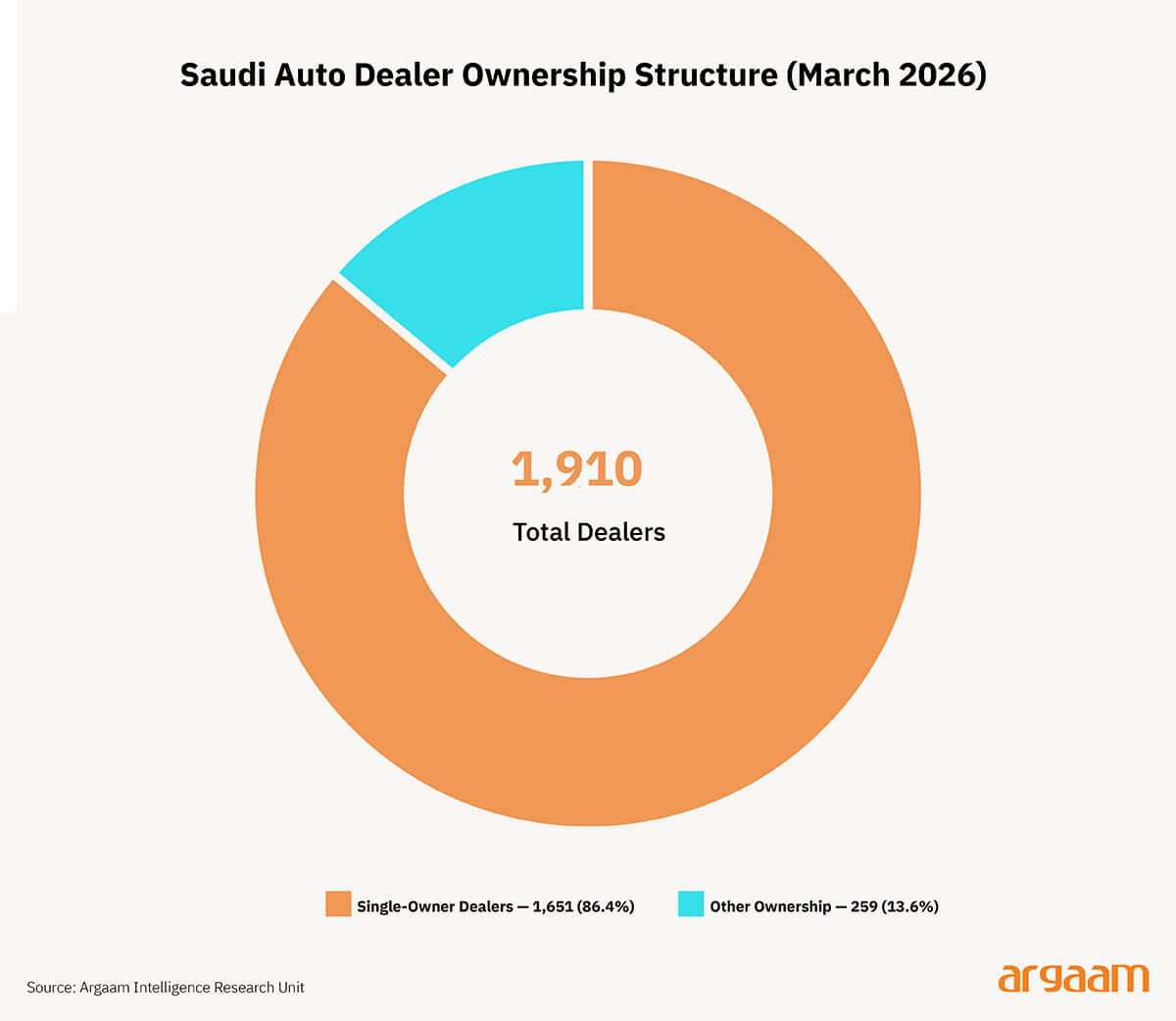
What the data shows, and what it cannot show Saudi bank credit to the private sector stood at SAR 3.147 trillion at end-2025, up 10% y/y. The 68 SAMA-licensed finance companies held SAR 25.93 billion in auto financing as of Q2 2025, roughly 26% of their total credit portfolio of SAR 99.37 billion. These are the consumer-side figures — disclosed, monitored, and stress-tested. What is not disclosed, not monitored, and not stress-tested is the dealer-side figure: the aggregate volume of bank lending extended to Saudi auto dealers through floorplan facilities. No Saudi bank reports this as a standalone line item. Saudi Arabia has 1,910 registered car dealers, of which approximately 86.4% are single-owner operations with limited balance sheet depth to absorb inventory shocks. A constructed estimate is possible. At Saudi Arabia's 2025 sales run-rate of roughly 214,000 units per quarter (used here as a representative flow for order of magnitude purposes), conservative average vehicle values of SAR 100,000 to 150,000, and a 60 to 90 day inventory cycle. Aggregate dealer floorplan exposure likely sits in the order-of-magnitude band of SAR 20 to 32 billion at any given point in time (see chart below) — an informed approximation, and not a disclosed statistic (full derivation stated in Argaam Intelligence’s methodology document, which’s available at request). 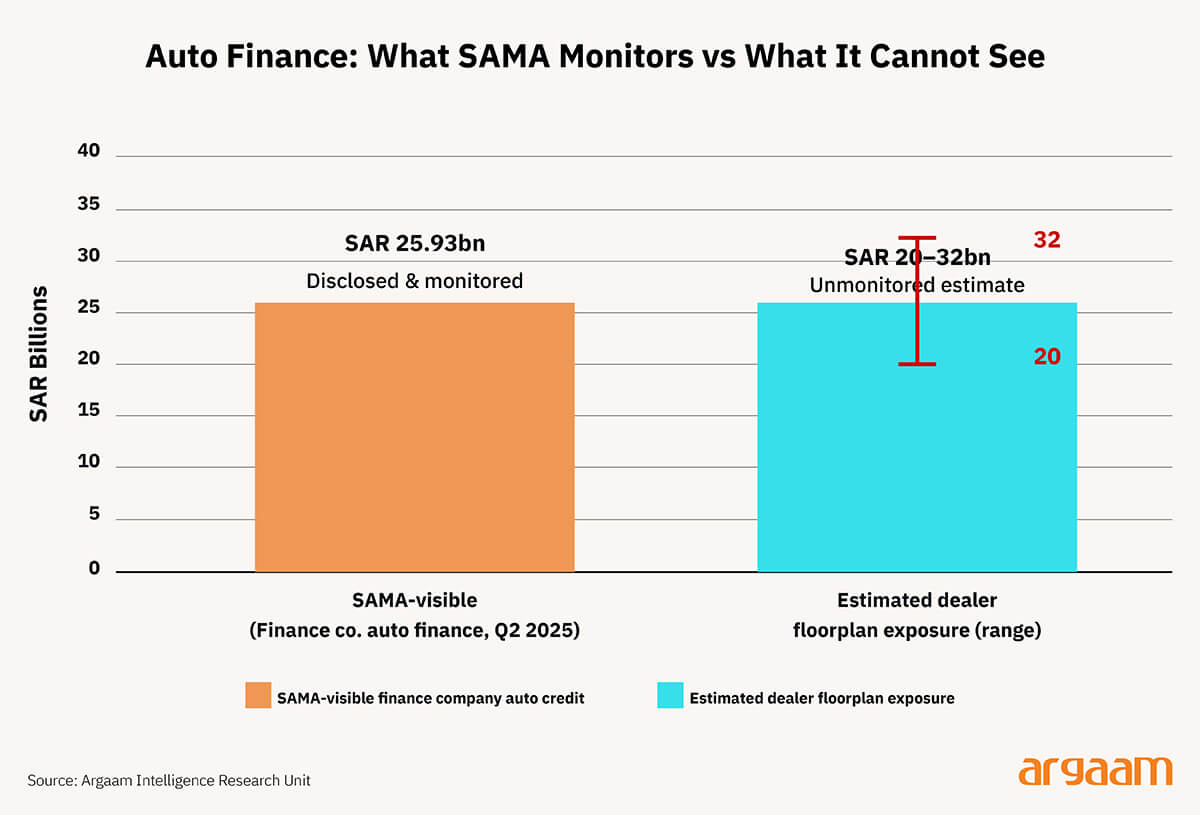 When the dealer defaults, the bank steps in to repossess and sell the vehicles, but into a used car market that is already flooded. Depreciation rates are rising directly because of the current inventory overhang, compounded by more than 30 Chinese brands now competing in the Kingdom. This is where the systemic dimension becomes clear. The same large banks are exposed on both sides — dealer floorplan and retail auto finance. A single dealer default can hit both simultaneously. Standard credit models have not treated these two exposures as correlated. They are. 
Why collateral is not the safety net it appears to be
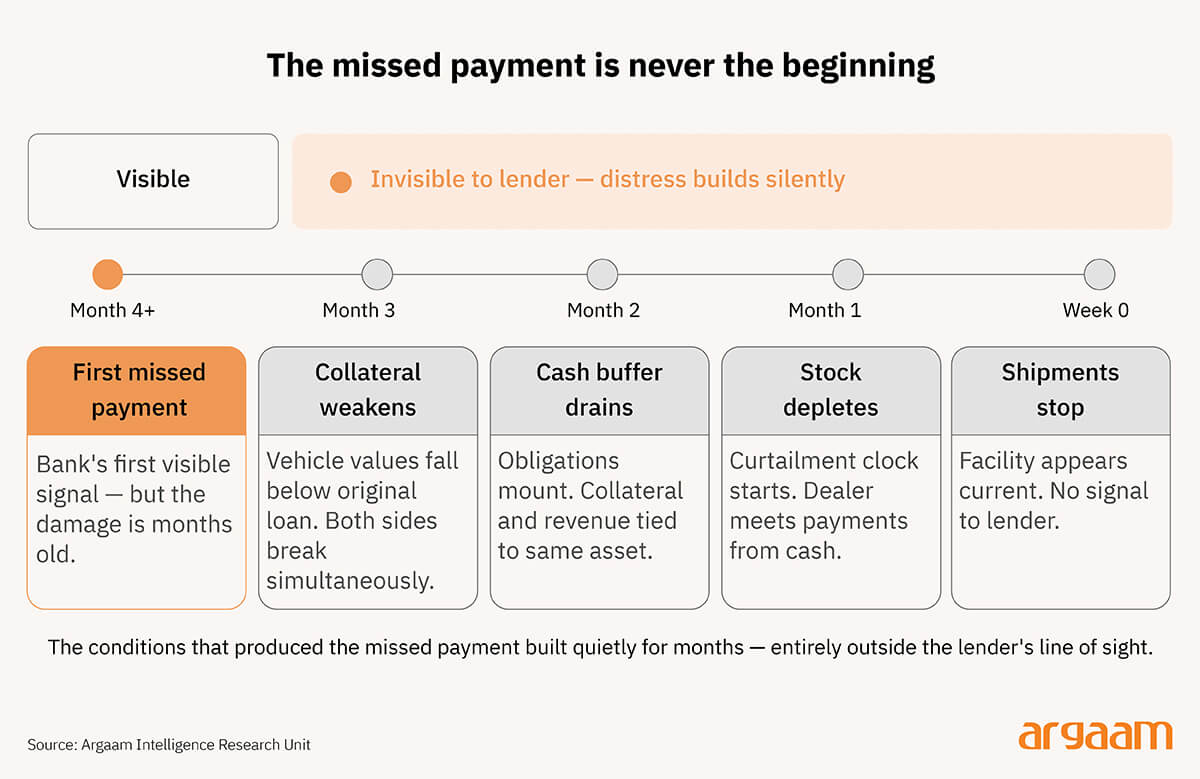
In most lending situations, when a borrower defaults, the collateral retains its value independently. Auto dealer floorplan finance is different. The event that pushed the dealer into default — new vehicle shipments stopping — is the same event that flooded the used car market and pushed resale values down. Every dealer facing the same supply shock is trying to offload stock at the same time. So when the bank moves to recover its money by selling the repossessed vehicles, it is selling into a market that the default itself helped destroy. It is not just recovering less than expected. It is recovering less because of the very event that triggered the recovery. A large fleet operator with deep pockets can look at today's used car prices, decide they are too low, and choose to hold its vehicles off the market until prices recover. It has the liquidity to wait. A single-owner dealership does not have that choice. It has loan repayments due, curtailment charges accumulating, and no incoming revenue. When the bank comes calling, the dealer must sell — at whatever price the market is offering today, not the price it hopes for tomorrow. The same vehicle. The same depressed market. Two very different abilities to absorb the timing.
The Law Works. The Market Doesn't Saudi Arabia's Moveable Property Security Law provides a sound legal framework for enforcing collateral claims. The problem is not legal. It is economic. A security interest over a vehicle is only worth what that vehicle can fetch in the market on the day it is sold, when the market is simultaneously flooded with distressed sellers — all trying to offload stock for the same reason, at the same time, the price that the vehicle commands falls. The bank's collateral position weakens not because the law failed, but because the market could not absorb the volume at the price the original loan assumed.
Auto dealers operate as commercial entities within the broader economy, outside the financial services regulatory perimeter — an arrangement that is entirely standard across most markets globally.
Editorial Note: The financial regulatory domain covers entities that take deposits, extend credit to consumers, or manage investments — banks, finance companies, insurance firms. These are supervised by SAMA, which sets capital requirements, monitors liquidity, and collects detailed data on its exposures. The commercial regulatory domain covers businesses that buy and sell goods and services — retailers, manufacturers, distributors, and dealers. These are governed by the Ministry of Commerce, which focuses on business licensing, consumer protection, and trading standards. It does not monitor balance sheets or credit exposures in the way a financial regulator does.
Saudi Arabia has strengthened its financial oversight architecture in recent years, including through legislation reinforcing the Ministry of Finance's supervision of public funds. This reflects the Kingdom's continued commitment to building a robust and transparent financial system. These developments sit alongside SAMA's macroprudential framework, which continues to govern the supervised financial sector. The analytical observation this piece would offer — constructively and in the spirit of the Kingdom's own Vision 2030 financial sector development objectives — is that the bank-dealer-consumer transmission channel represents an area where additional data visibility could further strengthen the resilience of an already well-developed regulatory architecture. Three areas merit consideration as the framework continues to evolve. Greater granularity in bank reporting on floorplan credit as a sub-category of corporate lending would enhance systemic visibility. Modelling the bank-dealer-consumer channel within stress testing frameworks would complement SAMA's existing macroprudential tools. And a basic financial health reporting framework for dealers — developed collaboratively between SAMA and the Ministry of Commerce — would close a data gap that most advanced markets are now actively addressing. The Q1 2026 episode in the auto market provides a timely and concrete basis for this kind of regulatory reflection. |


|
|

|

|


|

|