Saudi Arabia's AI infrastructure programme represents one of the most deliberate and consequential sovereign technology investments of the current decade. The strategic logic is sound: build the capacity first, then grow the economy into it.
But the relationship between infrastructure deployment and economic absorption is rarely linear — and understanding that relationship with precision is what separates a well-sequenced transformation from one that leaves value unrealised.
The central dynamic worth examining is one of timing rather than capability. Large enterprises currently account for nearly 70% of Saudi Arabia's AI and big data market.
Which is entirely consistent with where AI adoption stands globally, and reflects the natural sequencing of how transformative technology diffuses through an economy: institutions with scale and resources move first, and the broader private sector follows as costs fall and models mature.
What merits closer attention in this analysis by Argaam Intelligence is the pace and depth of that diffusion into the SME base, given how central that base is to the economic diversification architecture in the kingdom.
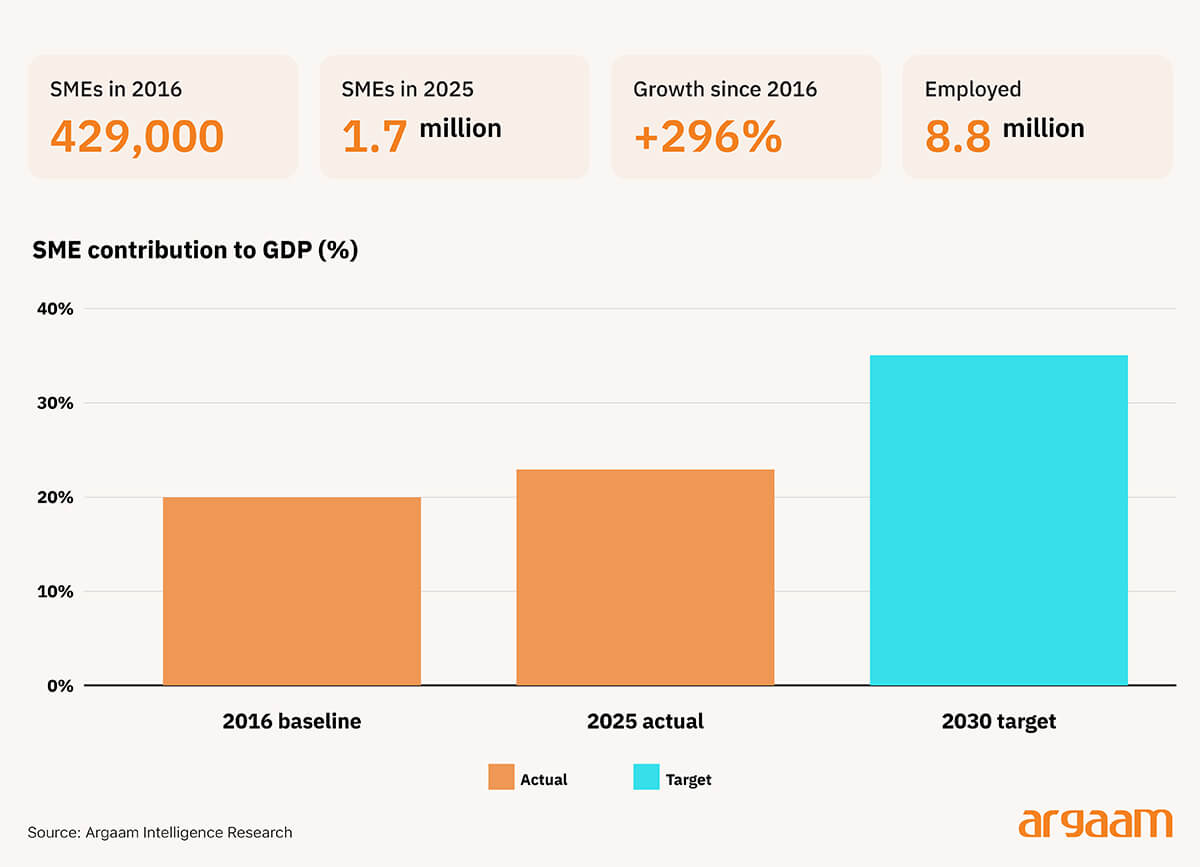
The number of Saudi SMEs has surpassed 1.7 million, employing 8.8 million people and contributing 22.9% of GDP, recording a massive leap compared to 429,000 enterprises in 2016.
Small and medium enterprises now constitute 30% of listed companies in the Nomu Parallel Market. The Kingdom is targeting a 35% contribution from the SME sector to its gross domestic product by 2030.

AI Is Not Optional for Saudi SMEs
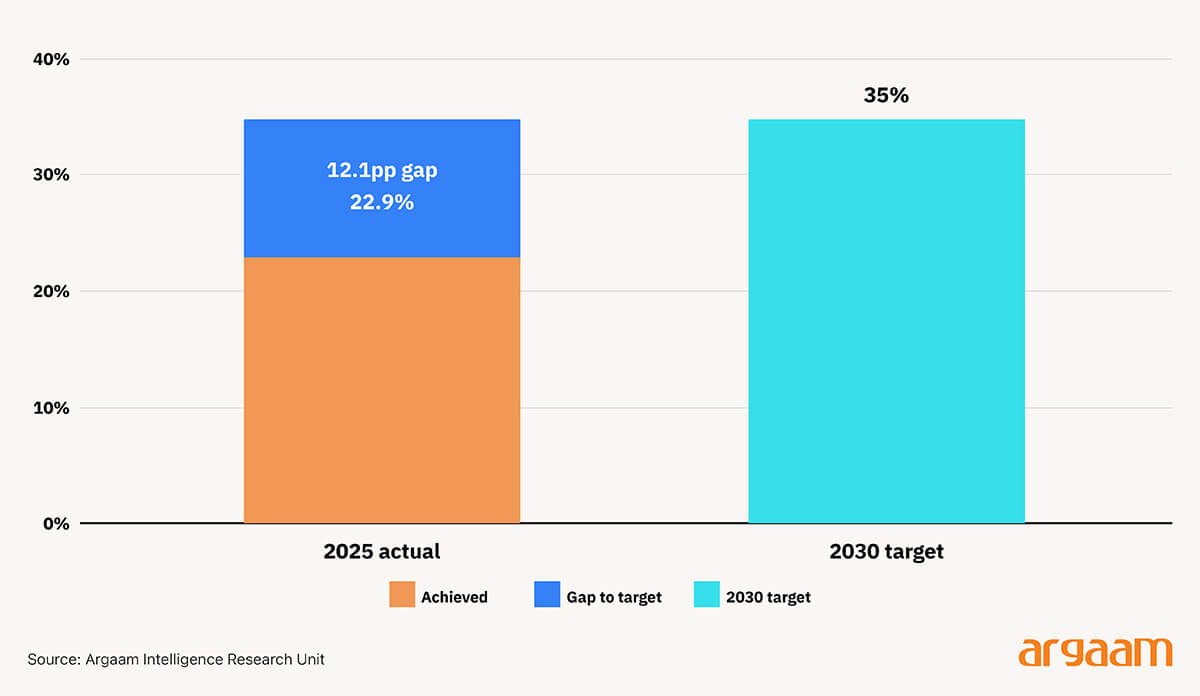
Saudi SMEs currently contribute 22.9% of GDP against a 2030 target of 35% — a 12.1 percentage point gap that must be closed in under five years. At Saudi Arabia's current nominal GDP of $1.31 trillion, that gap represents approximately $158 billion in additional economic output that the SME sector is expected to generate.
The World Bank projects non-oil GDP growth of 3.6% on average between 2025 and 2027 — a rate that, sustained linearly, would not close a structural gap of this magnitude by 2030 through conventional input growth alone.
The arithmetic makes the dependency on productivity clear. Labour productivity growth must accelerate to sustain the gains Vision 2030 requires, and the SME sector cannot close a 12-percentage-point GDP gap through labour or capital accumulation at the pace available to it.
The working-age Saudi population is growing, but the path to 35% SME GDP contribution runs through output per worker, not headcount.
That is precisely where AI enters the equation — not as an optional enhancement, but as the most scalable available mechanism for delivering the scale of productivity improvement the target demands within the time available.
The global evidence on what AI-driven productivity can deliver, when properly deployed, is specific: early adopters of agentic AI systems reported 15.2% average cost savings and 22.6% productivity improvements — gains that, applied across a 1.7-million-enterprise SME base in the kingdom employing 8.8 million people, would represent a material contribution to closing that output gap.
The constraint is not the productivity potential of the technology. IBM's 2025 EMEA study found that large enterprises report AI-driven productivity gains at a rate of 72%, compared to 55% for SMEs — a 17-percentage-point adoption gap that mirrors, at the enterprise level, exactly the structural asymmetry this analysis identifies at the national level.
The productivity gains are real and quantified then. The question is whether Saudi SMEs can access them at the scale and within the timeline that Vision 2030 requires.

The Real Cost of AI Is Not the Hardware
Artificial intelligence does not generate economic returns the moment it is switched on. It generates returns only after the organisations using it have rebuilt their internal processes around it — new workflows, retrained staff, redesigned management structures, and custom software built specifically for their operations.
All of that rebuilding takes time, and crucially, it costs money that never appears on a balance sheet. It is invisible to standard accounting.
This is not a theory. American economists went back through decades of United States economic data and recalculated the productivity numbers after adding in the value of all this invisible organisational investment.
The adjusted figures showed that actual technological progress in the US economy was 15.9% higher than official government statistics had recorded — hidden not because it did not exist, but because traditional measurement tools were never designed to capture it.
The economy was doing better than the government said. Not because the government was wrong, but because the government was only measuring what it could see — physical purchases.
For Saudi Arabia, this insight carries direct and immediate relevance. The Kingdom is currently in the early capital-spending phase of its AI programme — data centres, computing infrastructure, sovereign platforms.
HUMAIN is pursuing a $77 billion infrastructure strategy targeting 1.9 gigawatts of data centre capacity by 2030. The billions being committed to physical AI infrastructure are the visible layer.
The invisible layer — the process redesign, the workforce retraining, the custom software, the organisational restructuring across 1.7 million SMEs and thousands of larger enterprises — will likely exceed the hardware investment in both cost and economic significance. And almost none of it will be measured in real time.
This is precisely the phase where standard economic indicators will understate what is actually being built. The returns will not show up in GDP or productivity statistics immediately, not because the investment is failing, but because the most valuable part of the transformation — the organisational rewiring of Saudi enterprises around AI — is happening inside companies' operations, not on their hardware invoices.
For the SME sector specifically, this dynamic is even more pronounced. The 12.1 percentage points that separate current SME GDP contribution from the 2030 target will not be closed by hardware procurement alone.
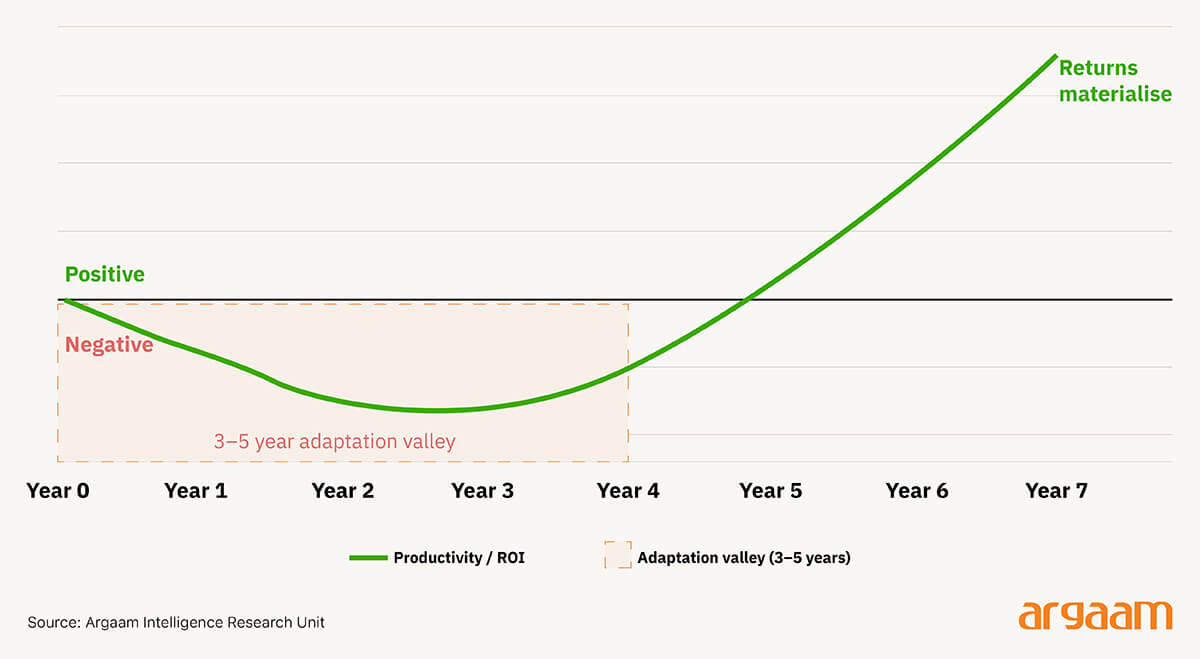
This chart shows the AI Productivity J-Curve. The graph displays early negative returns before a steep upward surge. The horizontal axis clearly marks an "Estimated 3-5 Year Adaptation Valley." Corporate profits stay negative during this time because companies are building intangible assets.
Firms experience operational disruptions as they redesign business workflows and train employees. Saudi Arabia is currently transforming its non-oil economy. Local managers need to prepare for this exact timeline.
Installing computing hardware is fast, but accumulating intangible assets takes a long time. Moving from hardware installation to real financial profit requires three to five years of strategic endurance. Actual profits will only appear on financial reports after companies cross this adaptation valley.

The Absorptive Capacity Squeeze
Saudi companies need more than money to benefit from artificial intelligence. They need to already have the right data systems, technical skills, and internal capabilities in place before AI can deliver any meaningful return.
Economists call this absorptive capacity — the ability of a business to take external technology and actually put it to work. Without it, the technology sits idle regardless of how much was spent acquiring it.
This is where a closer analytical reading of the growth data reveals an important sequencing challenge — one that is neither unique to Saudi Arabia nor insurmountable, but that deserves precise attention as the Kingdom enters the final phase of Vision 2030.
The non-oil economy is genuinely growing. Non-oil activities now account for more than half of Saudi GDP, with the private sector contributing 51%. SMEs are a significant part of that growth story.
But the sectors driving that growth — construction, retail, hospitality, food services — are overwhelmingly traditional businesses with limited digital infrastructure.
The dominant global AI models were also built for English-language business environments. For Saudi SMEs conducting business entirely in Arabic — within Gulf-specific commercial, cultural, and contractual contexts — these tools do not translate.
The friction is not cosmetic. A model that cannot interpret an Arabic invoice or navigate the norms of a Saudi business transaction is not a productivity tool.
This makes Saudi Arabia's sovereign AI programme — ALLaM, the native infrastructure buildout, the SDAIA governance framework — a functional prerequisite, not merely a strategic ambition.
Until the Arabic-first technology layer matures to a quality and cost level accessible to businesses without dedicated technology functions, the AI adoption clock has not yet started for the majority of Saudi SMEs — and specifically not for the micro-enterprise base.