Saudi Arabia's climate parameters are well understood by the operators and investors who plan around them. What is shifting is their reliability as a forward planning baseline.
The Arab region is warming at nearly twice the global average, and the distribution of that change — across timing, geography, and intensity — is becoming less consistent with the historical patterns embedded in existing asset and operational frameworks.
For listed companies and institutional investors with exposure to Saudi Arabia's energy, logistics, and infrastructure sectors, this has a practical consequence.
The models that inform capacity decisions, staffing, and contingency reserves were calibrated against a climate that is being structurally altered. The resulting gap between planned and actual operating conditions is real, recurring, and increasingly material to asset performance.
Weather intelligence addresses this gap directly. At Argaam Intelligence, we assess this as a risk management input with rising economic returns — one that capital allocators and operators in Saudi Arabia's core sectors can no longer treat as peripheral.
This analysis examines that proposition through two case studies central to Saudi Arabia's Vision 2030 targets: renewable energy grid management and Hajj logistics throughput.
Saudi Arabia's 50% of its electricity to be generated from renewables target by 2030 places grid precision at the core of energy sector performance. Its ambition to receive 30 million annual pilgrims (for Hajj and Umrah) by the same date makes logistics reliability a measurable revenue and reputational variable.
In both cases, forecast error is not a technical abstraction — it translates into quantifiable operating cost, capital inefficiency, and service delivery risk that policy makers, investors and operators need to price accordingly.

Case study 1: Renewable energy grid management
Saudi Arabia's renewable energy programme has moved well beyond a policy ambition — it is now a capital deployment exercise of significant scale.
The Kingdom targets 50% renewables in its electricity mix by 2030, with annual tender volumes of around 20GW and a total capacity objective of 100–130GW.
Recent solar PPA awards, totalling 5.5GW at approximately $3.28bn, illustrate the financial exposure now accumulating in this sector. At that scale, forecast error ceases to be an operational inconvenience.
It becomes a direct charge on capital efficiency — affecting dispatch planning, grid balancing costs, and ultimately the financial performance of assets in which listed companies and their investors hold material positions.
When renewable output cannot be forecast with confidence, grid operators are required to hold insurance in physical form — battery storage, backup generation, and reserve capacity maintained against shortfalls that may or may not materialise.
This capital carries a real cost whether or not it is used. In financial terms, forecast uncertainty directly inflates the system's required buffer, tying up capital in optionality rather than productive capacity.
For listed energy companies and their investors, this is not an abstract efficiency question. Every reduction in forecast error translates into a measurable reduction in the cost of that buffer — improving asset utilisation, tightening operating margins, and strengthening the investment case for renewable capacity at scale.
Granular, grid-wide forecast error data for Saudi Arabia is not publicly available. As a working proxy, this analysis draws on peer-reviewed irradiance forecasting research conducted across Dhahran, Riyadh, and Jeddah.
The research examined one-hour-ahead global horizontal irradiance forecasting across the three cities — a methodology that closely mirrors the operational question at hand: not whether Saudi Arabia possesses strong solar resources, which is well established, but whether usable output over the next hour can be predicted with sufficient precision to inform dispatch decisions.
Published GHI forecasting studies of this kind are treated here as a reasonable proxy for system-level forecast performance, with the caveat that actual operator margins may differ. The analytical direction, however, remains valid.
Dust exposure represents a material and Saudi-specific risk factor for solar generation that extends well beyond routine maintenance planning.
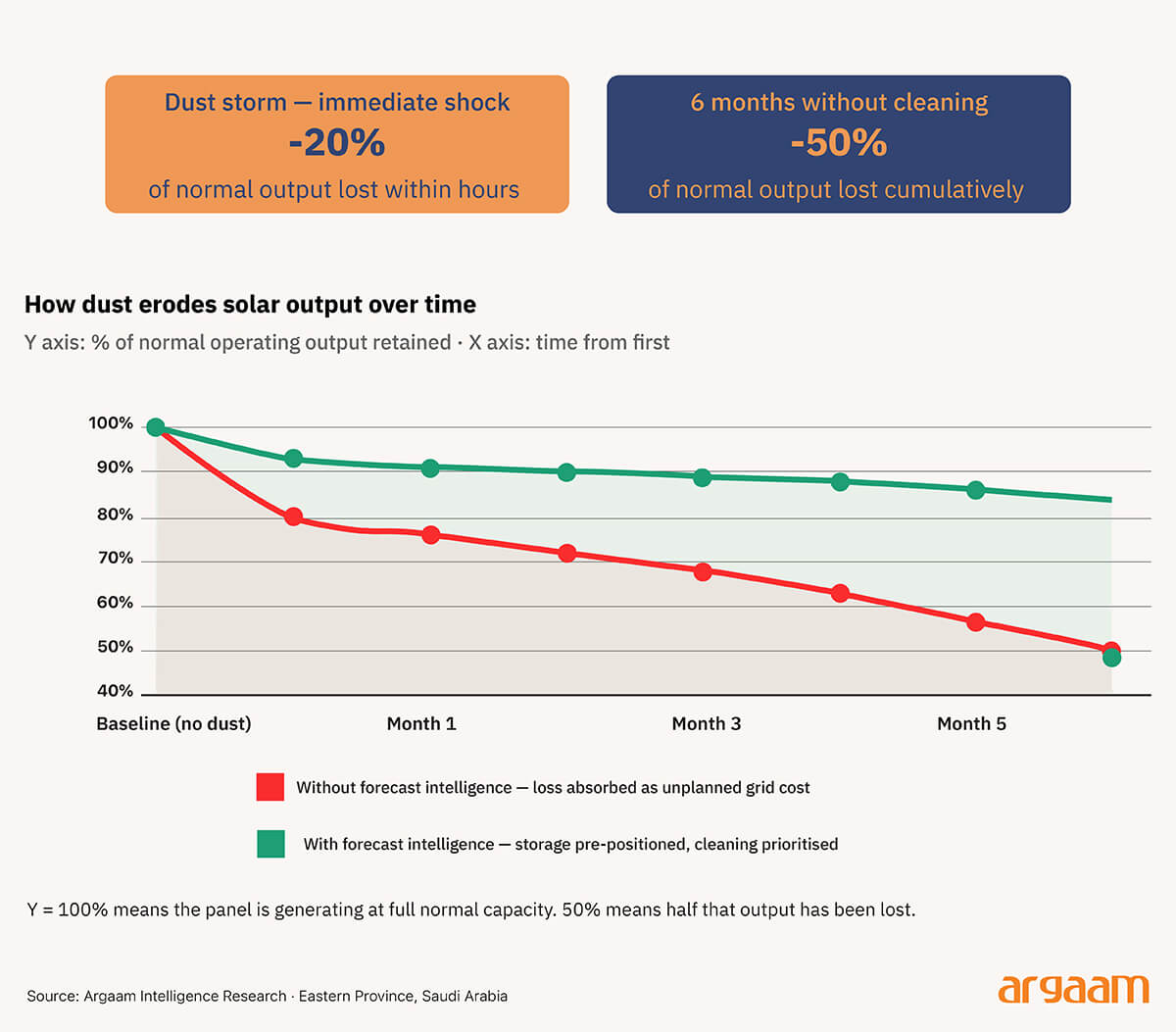
Research on the Eastern Province indicates that a single dust storm can reduce photovoltaic output by as much as 20%, while cumulative soiling over a six-month period can suppress power generation by more than 50%.
For grid operators and the investors behind utility-scale solar assets, this is a financial exposure, not merely an operational inconvenience. The critical variable is not whether dust will affect output — it will — but whether the timing, geography, and severity of that impact can be anticipated with sufficient lead time to pre-position storage discharge or backup generation.
That is precisely where high-resolution weather intelligence creates measurable value: converting an unmanaged output shock into a forecastable, actionable event.
The capital cost of operating under forecast uncertainty is quantifiable. When one megawatt of uncertain renewable output must be backed by four-hour battery storage, the implied storage requirement is 4 MWh.
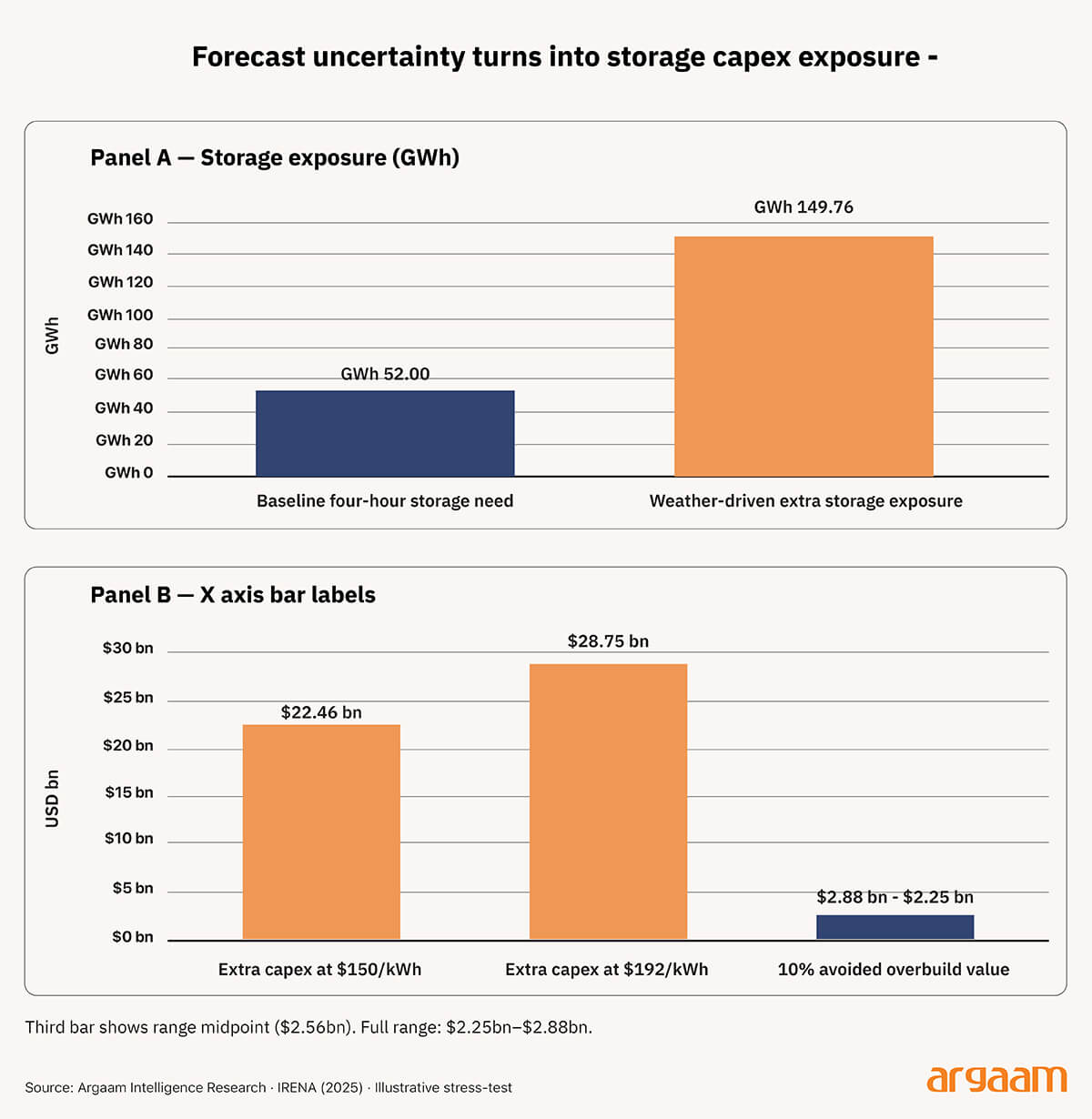
At current utility-scale battery cost benchmarks — IRENA reports $192/kWh for 2024, with $150/kWh used here as a market-sensitivity floor — that translates into a capital commitment of approximately $600,000 to $770,000 per megawatt of unmanaged forecast exposure, before financing, land, and grid-connection costs are applied.
This is not a system-wide total. It is a per-unit cost that scales directly with the volume of capacity left unhedged by imprecise forecasting.
For listed energy companies and project developers building into Saudi Arabia's renewable pipeline, the implication is straightforward: forecast error is not an operational abstraction — it has a capital equivalent, and that equivalent is material at the scale of deployment the Kingdom is targeting.
At system scale, the capital implications become significant. On an illustrative 130GW renewable buildout — consistent with Saudi Arabia's 2030 targets — if 10% of capacity required four-hour firming, the baseline storage requirement under conditions of perfect forecasting would stand at 52GWh.
The additional storage burden introduced by weather uncertainty is the critical variable. If published research on Saudi solar variability is used as a proxy for that uncertainty premium, the implied total storage exposure rises materially beyond the theoretical baseline.
At IRENA's 2024 benchmark range of $150–192/kWh, even a modest reduction in uncertainty-driven overbuild — in the order of 10% — could represent billions of dollars in avoided storage capex at this scale of deployment.
These are not official grid projections. They are an order-of-magnitude illustration, offered to show the scale at which weather forecast precision becomes a capital-allocation variable relevant to investors and policymakers tracking Saudi Arabia's energy transition.

Case study 2: Hajj Logistics Throughput
Hajj is, among other things, a logistics system. It has a fixed route, a compressed time window, and a service network that must process millions of people through the same sequence of ritual sites.
In 2025, GASTAT recorded 1.67 million pilgrims, including 1.51 million from outside Saudi Arabia, supported by over 420,000 workers from public and private entities.
Saudi Arabia's target is to raise combined Hajj and Umrah throughput to 30 million annually by 2030 — a target that compresses the tolerance for operational weakness at every point in the system.
Heat is not only a health variable in this context. It is a throughput variable. When temperatures rise, movement slows, service consumption increases, and the effective processing capacity of every corridor, bus route, water point, and cooling station falls.
The relevant economic framework is queueing theory. When a service system is already operating near capacity, a small reduction in throughput rate — caused by heat slowing pedestrian movement or increasing medical demand — produces a disproportionate rise in waiting times and congestion.
The dynamic is comparable to a delayed flight at a hub airport: a localised bottleneck propagates disruption across the wider network faster than operators can respond reactively.
Simulation studies of Hajj pilgrim transport between holy sites support this characterisation, showing how discrete-event modelling can expose the points at which the system tips from manageable congestion into cascading delay.
The operational implication for investors and policymakers is that heat is not a background condition to be managed after the fact. It is a forecastable input that, if anticipated at sufficient resolution, allows service capacity to be pre-positioned before congestion spreads rather than deployed in response to it.
A one-hour average delay across two million pilgrims gives the order of magnitude. If 25–50% of the 420,070 Hajj workers are affected, and the hourly operating cost is assumed at $5–10, the labour-system cost is about $0.53–2.10m.
If 30–50% of two million pilgrims require bus or shuttle movement, with 50 passengers per bus and a $50–150 bus-hour cost, the transport asset-hour cost is about $0.60–3.00m.
Together, a one-hour average delay could plausibly create $1.1–5.1m in direct labour and transport-system costs alone. This excludes reactive water supply, misting, shading, medical escalation, cleaning, security redeployment and reputational costs.
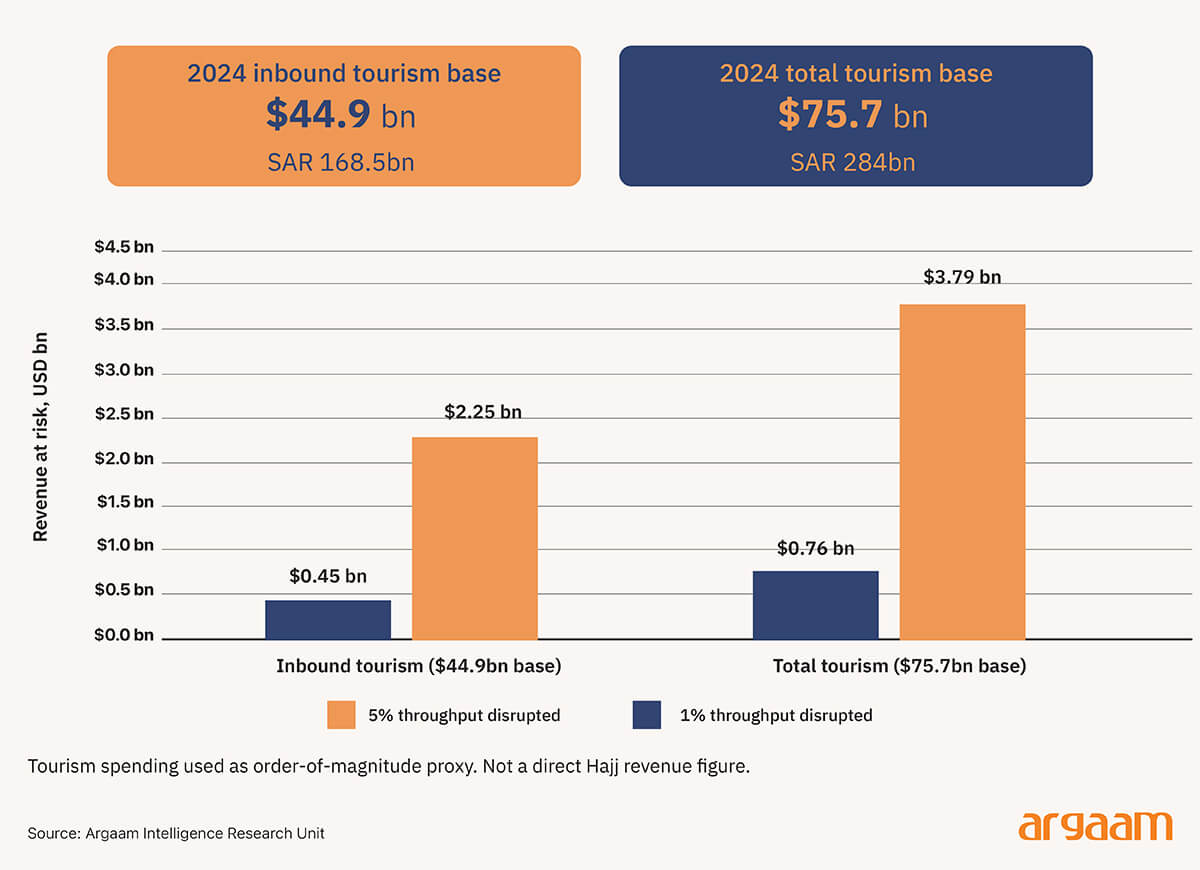
The revenue exposure is material. Saudi Arabia's 2024 inbound tourism spending stood at SAR168.5bn ($44.9bn), with total tourism spending reaching SAR284bn ($75.7bn). These figures are not pure Hajj revenue accounts — they are the broadest available proxies for the economic activity that pilgrimage throughput supports.
Against the inbound base, every 1% of disrupted throughput represents approximately $449m in revenue at risk. Against total spending, the same 1% equals roughly $757m. At 5%, the exposure reaches $2.25bn and $3.79bn respectively.
These figures establish why zone-level weather intelligence carries direct economic value in this context.
The ability to anticipate heat-driven congestion two to three hours in advance — and pre-position shuttles, reroute corridors, and deploy water and cooling capacity before pressure builds — is the difference between managed throughput and compounding operational failure.
✧ Concluding remarks ✧
The value of weather intelligence is not the subscription price of a forecast. It is the avoided cost of overbuilding, idling assets and responding late. In renewable power, the decision layer turns solar irradiance, wind speed and dust conditions into dispatch instructions: whether to charge or discharge batteries, schedule backup generation, clean panels before output falls, or accept curtailment.
The economic value is not better weather description, but lower balancing cost and less unnecessary storage overbuild. In Hajj logistics, the same logic applies to people rather than power.
Zone-level heat and congestion intelligence two to three hours ahead can support shuttle rescheduling, corridor rerouting, and pre-positioning of water, misting, shading and staff before bottlenecks form.
This is a service-capacity planning problem under uncertainty: aggregate resources may be sufficient, but they lose value if they are in the wrong place at the wrong hour. |