Activity among individual investors in Saudi Arabia's financial market is expanding at a notable pace, yet the figures in circulation warrant a more careful and rigorous reading. The central question posed by the Argaam Intelligence goes beyond simply asking how many new investors have entered the market.
It extends to what these numbers are actually measuring: are they counting people who entered the market for the first time, portfolios added to already-existing investors, or cases where a single investor opens multiple accounts with different brokerage firms — each account recorded as a separate figure in the statistics, inflating the "new investor" count without reflecting the entry of genuinely new participants?
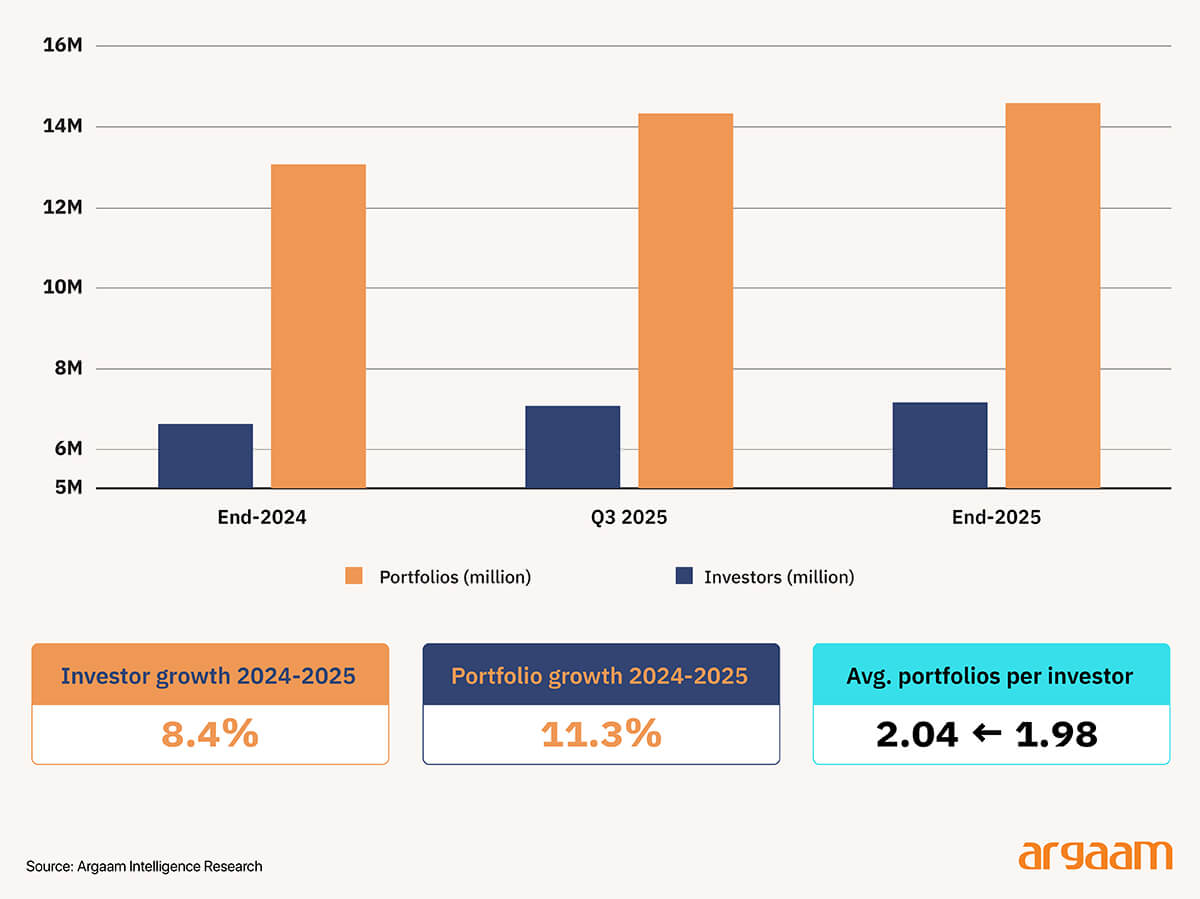
By the end of 2025, the number of individual investors registered in the Saudi market had reached 7.16 million, while the number of individual portfolios stood at 14.57 million — more than double the investor count.
This wide gap between the two figures reveals plainly that the number of portfolios does not equal the number of actual investors, and that part of this growth may reflect multiple accounts held by the same investor rather than a genuine expansion in the base of market participants.
This distinction matters considerably. Market rules allow a single investor to open more than one account with more than one licensed brokerage firm. The proliferation of market entry options does not therefore translate automatically into a proportional rise in genuinely new investors.
This becomes all the more significant against a backdrop of intensifying competition among digital brokerages licensed by the Capital Market Authority, and a marked decline in trading costs.

Sahm Capital announced commission-free trading on the main market (Tadawul) for life, while Derayah Financial eliminated trading commissions on both Tadawul and the parallel market Nomu.

Discussions around the growth of Saudi Arabia's individual investor base tend to treat a single headline number as though it tells the whole story, when in fact that number aggregates vastly different situations that cannot be measured on the same scale.
This means the official system itself draws a distinction that public commentary often ignores: the person on one side, and the account opened in their name on the other. Hence the importance of distinguishing between four concepts that many market followers treat as interchangeable — as illustrated in the infographic below:
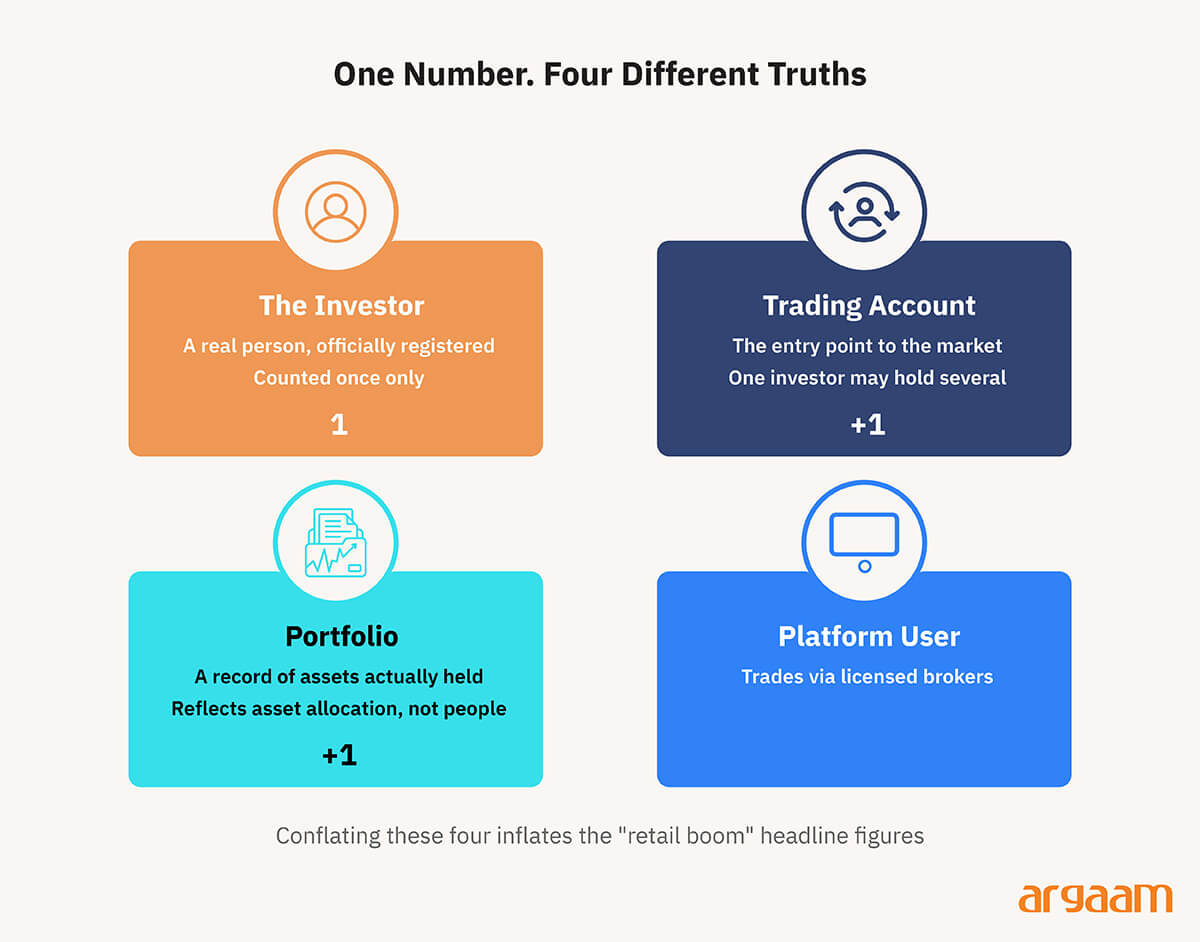
When news reports say "investor numbers have risen", they are mostly counting accounts, not people. The difference is not a technical one — it is the difference between two entirely distinct questions: is the market attracting new participants, or are existing participants simply opening more accounts?
The first is a measure of participation depth; the second is a measure of platform reach. Growth in market entry points is real and visible, but the full picture requires an equally serious reading of participation quality, not just participation volume.
This gap is hard to ignore when the data is examined closely. At the end of 2024, the number of individual investors registered in the Saudi market stood at 6.60 million, against 13.09 million individual portfolios.
By end-2025, both figures had risen — but portfolios grew faster, with the average number of portfolios per investor climbing from 1.98 to 2.04. This alone does not prove that account duplication is the primary driver, but it does reveal a consistent pattern in the public data: the account side of the market is expanding faster than the people side.
The gap between growth rates across two consecutive years reinforces this. Between end-2024 and end-2025, the number of individual investors grew by approximately 8.4%, while individual portfolios grew by approximately 11.3%.
The difference is not large in absolute terms, but it is meaningful: it suggests that part of the growth in individual participation reflects existing investors adding new market entry points, rather than entirely new participants entering the market for the first time.
The same pattern holds even within 2025 alone. By the end of the third quarter, investors stood at 7.05 million and portfolios at 14.29 million. By year-end, both had risen again — to 7.16 million investors and 14.57 million portfolios.
Portfolios continued to outpace investors even across a matter of months, lending the pattern a consistency that is difficult to dismiss, as illustrated in the chart below:
What this analysis makes clear is that publicly available data does not reveal account duplication rates across different brokerage firms, nor does it tell us how many platform users are genuinely entering the Saudi market for the first time.
The headline figures therefore reflect real expansion, but they do not tell us precisely where that expansion is coming from.
What deserves attention here is not simply the decline in trading costs — or their outright elimination by some firms — but a deeper structural shift in the market itself. As brokerages race to bring commissions to zero and applications multiply that reduce account-opening to a matter of minutes, investor behaviour changes in a fundamental way: the investor is no longer compelled to choose one platform and stay with it.
They can now hold multiple accounts simultaneously, using each platform for a different purpose — behaviour that was neither practical nor economically worthwhile when the cost of switching between platforms was high.
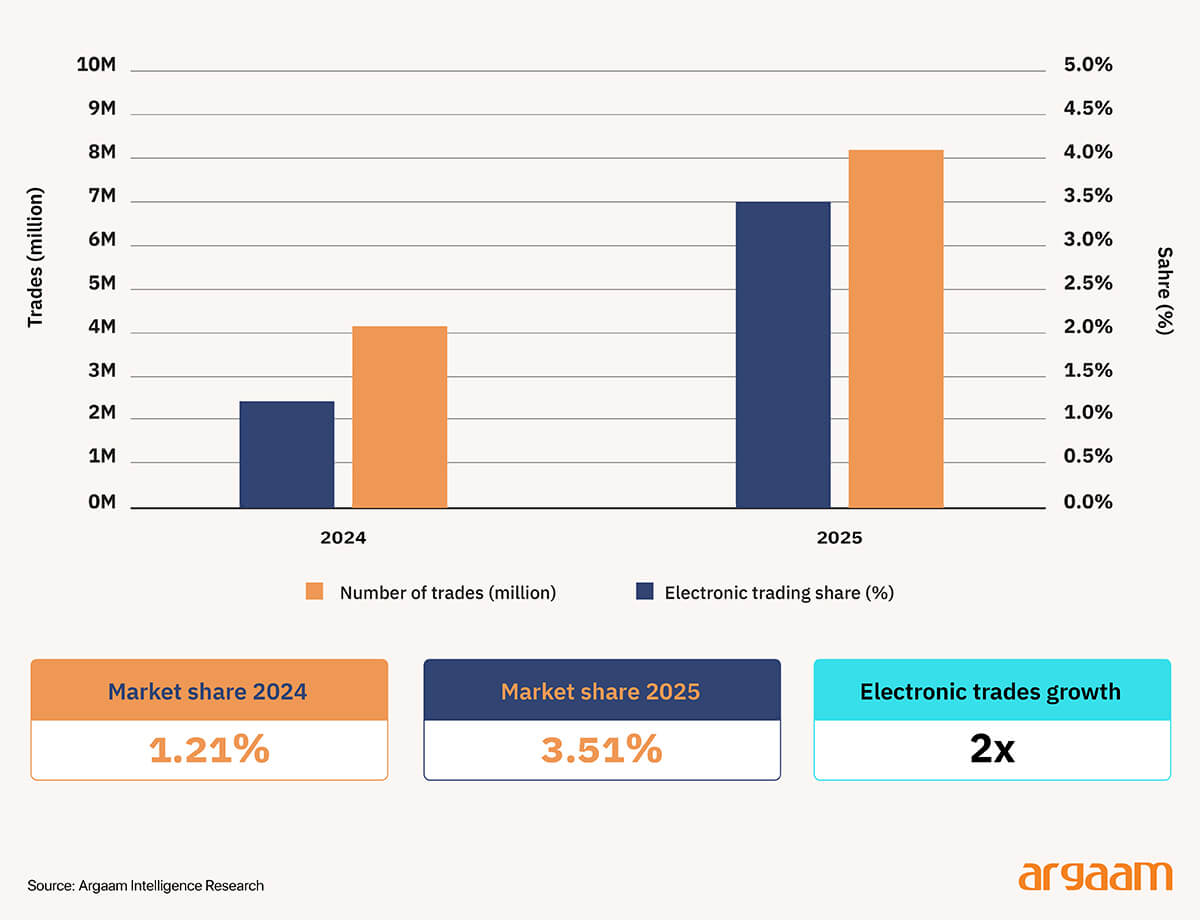
Perhaps the clearest evidence of this pattern comes from Sahm Capital's electronic trading data. Its share of total electronic trading value rose from 1.21% in 2024 to 3.51% in 2025, while the number of its electronic trades nearly doubled, from 4.12 million to 8.19 million transactions over the same period.
These figures do not prove in themselves that users are maintaining multiple accounts. But they say something more important: a new digital brokerage managed to double its market presence within a single year at this scale — which means that part of this growth does not necessarily come from investors entering the market for the first time.
It may instead come from existing investors who found in this new platform a reason to switch to it, or to add it alongside their existing brokerage relationships. When that becomes possible at near-zero cost, it stops being a theoretical possibility and becomes a rational economic behaviour that cannot be ignored when reading the headline growth figures.
✧ Conclusion✧
The most important conclusion this analysis reaches is that growth in investor numbers and account counts does not automatically translate into deeper market activity.
A mature market is not measured solely by the number of accounts opened, but by the extent to which those accounts convert into genuine and sustained participation. This is precisely what the most recent available data confirms.
In 2025, the total value of shares traded fell to SAR 1,299.23 billion, down from SAR 1,862.33 billion in 2024, while the total number of transactions declined to 119.03 million from 128.57 million. The rise in investor and account numbers did not, therefore, automatically translate into stronger market-wide activity.
Saudi Arabia's financial market is experiencing real expansion in its individual investor base, yet the figures in circulation conflate two distinct phenomena: the entry of genuinely new investors on one hand, and the multiplication of accounts held by existing investors across different brokers on the other.
The difference between the two is not a technical detail — it is the heart of the question: is the market deepening, or merely widening in form? |