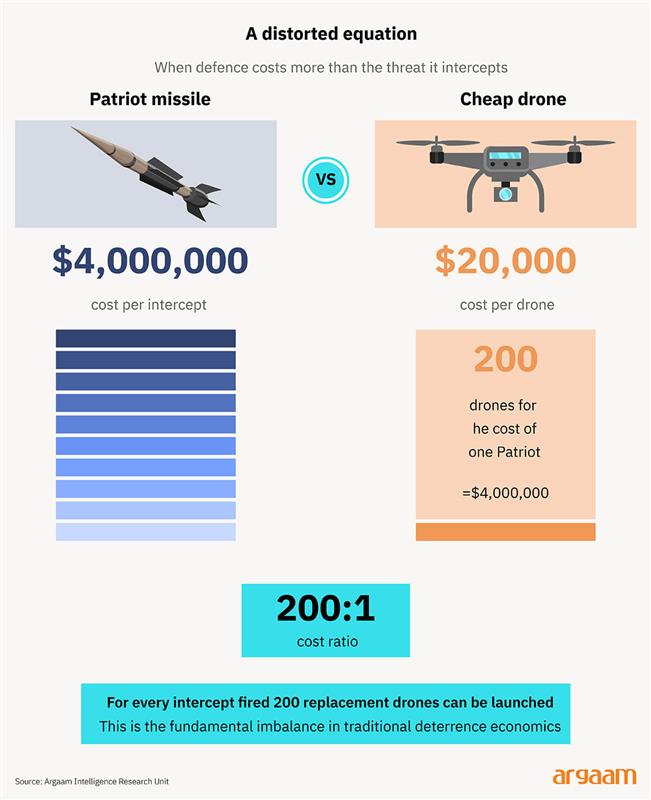
In recent weeks, the shape of warfare has changed fundamentally. Low-cost drones and missiles can now strike high-value targets, while the cost of intercepting them is prohibitively high.
The Iran-Israel-US conflict illustrated this equation starkly: Iran launched mass waves of drones and missiles, forcing Gulf states to spend enormous sums defending themselves. The core question has become: does what states spend on defensive armaments actually buy them effective deterrence efficiently?
This does not mean that combat aircraft, warships, and large air defence systems have lost their relevance — they remain indispensable.
Yet it is increasingly difficult to argue that these systems alone are optimal for countering today's actual threats, particularly drones, cruise missiles, and attacks on critical infrastructure.
Saudi Arabia is among the world's largest defence spenders, with its 2025 budget allocating approximately $78 billion — representing 21% of total government expenditure, or 7.1% of GDP.
The dual challenge is clear: is this money going to the right place in the economics of modern warfare?
The fundamental question, from an economic standpoint, is not how much the Kingdom spends on defence, but how that spending is allocated internally.
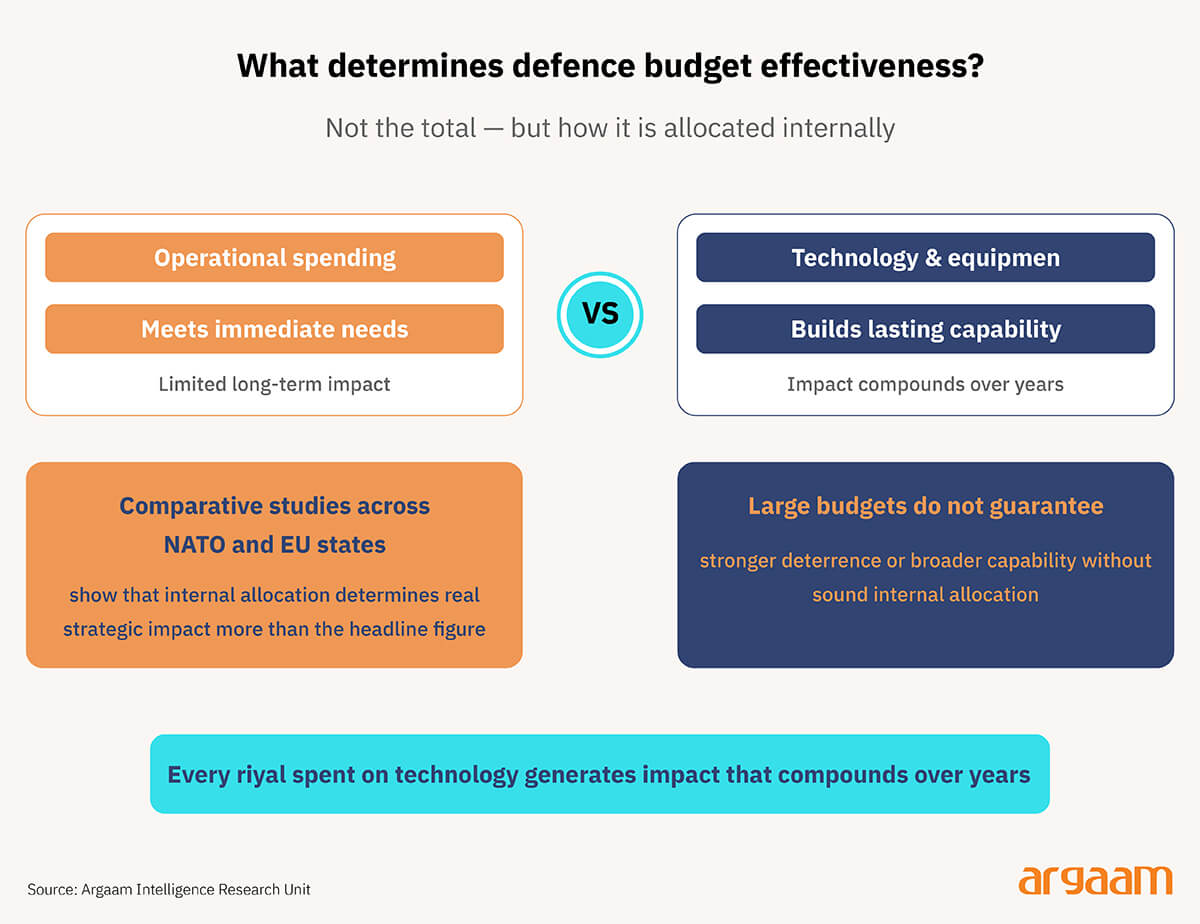
A large defence budget does not guarantee stronger deterrence unless every riyal flows to where it generates the highest actual strategic impact.
To understand this logic, it helps to think of any defence budget as a basket divided into two principal axes: the first covers current operational requirements and day-to-day sustainability, while the second is allocated to acquiring advanced systems and developing new technologies.
Comparative academic studies of NATO and EU member states show that this internal allocation is what determines the true economic and security impact of any defence budget — far more than the headline figure itself.
Operational spending — while absolutely necessary to maintain readiness — tends by nature to meet immediate and recurring needs, rather than building new capabilities or developing strategic assets that grow in value over time.
Spending on technology and equipment, by contrast, generates enduring defence capabilities, drives domestic manufacturing, and builds engineering and technical expertise that accumulates over years.
In short: a riyal spent on salaries is consumed once, while a riyal spent on a technological system produces returns that extend for years.
The balance of budget allocation remains a fundamental issue in long-term strategic planning. When current operational requirements absorb a large share of available resources, the margin left for investment in new technologies and advanced systems may shrink — constraining the ability to keep pace with rapidly shifting threat environments.
It is worth noting that this is not necessarily a Saudi-specific challenge: a number of major defence economies have faced this same difficulty, finding themselves with growing budgets in absolute terms yet needing greater flexibility to direct a portion of those resources toward investing in the capabilities of the future.
In the Saudi context specifically, this logic carries added weight. The Kingdom's defence architecture was historically built around imported, high-complexity systems that carry with them costly operational tails: long-term maintenance contracts, high-cost training programmes, and dependence on specific foreign suppliers.
These arrangements are understandable and logical within their strategic context, reflecting established partnerships with first-tier international suppliers. Yet their accumulation over decades has produced a structure that leans heavily toward operations and maintenance, and may narrow the margin available for redirecting resources toward newer systems better aligned with the deterrence requirements of the current security environment.
From a macroeconomic standpoint, the strategic impact of any riyal in the defence budget is measured not by what is paid, but by what is built in return.
Historically, the economic model underpinning Saudi Arabia's defence industries sector has rested on large, imported, high-cost systems: air fleets, support contracts, and maintenance structures tied to major Western corporations such as Boeing, BAE Systems, and Lockheed Martin. These partnerships carry enduring strategic value.
Yet they were designed for a different threat environment — one dominated by conventional air superiority rather than swarms of low-cost drones. The result is that a significant share of riyals is locked into rigid operational commitments that cannot be redirected toward the flexible, advanced systems that the modern battlefield demands.

Reviewing Defence Procurement Mechanisms
There is a dimension no less important than direct cost: the burdens inherent in the structure of large defence contracts. Studies on French defence procurement reveal that the most significant risks in this category of contract are not primarily technical, but contractual — delayed delivery, repeated specification changes, and dependence on a single supplier with no readily available alternative.
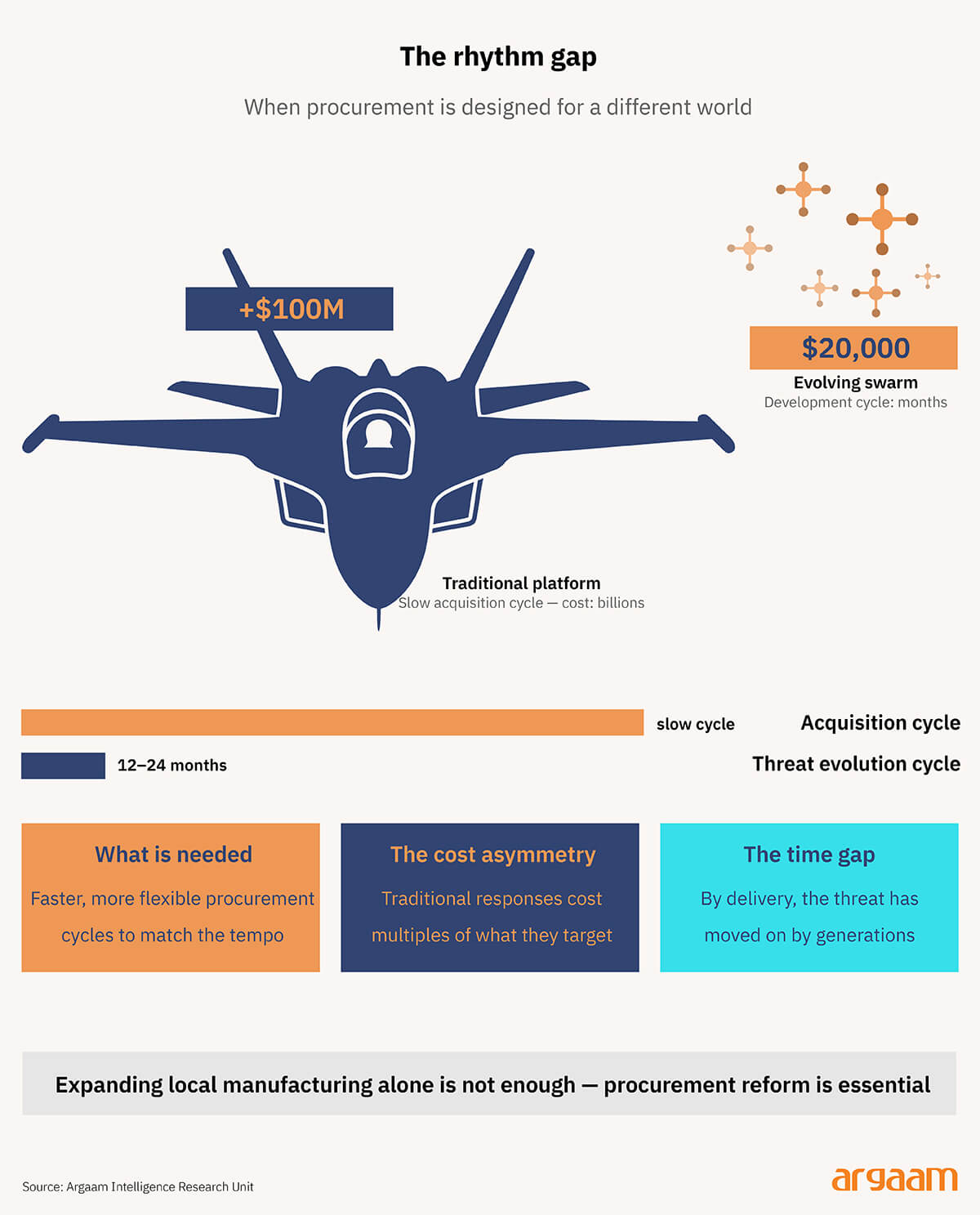
This challenge becomes particularly clear when contrasting two distinct logics. Major platform programmes operate on extended life cycles spanning many years, evolving at a measured pace that suits their nature.
Counter-drone systems, by contrast, require accelerated periodic updates every twelve to twenty-four months — as demonstrated by the Ukrainian experience in countering Iranian-manufactured drones deployed by Russia — given their fundamental dependence on software and electronics that become obsolete rapidly in the face of fast-moving threats.
A genuine systemic gap emerges from this contrast. Traditional procurement mechanisms were designed for a world in which threats evolved slowly. The new generation of drone-related threats, however, renews and develops at a pace that classical procurement cycles are structurally ill-equipped to absorb.
Expanding existing domestic manufacturing programmes alone will therefore not suffice. What is required is a comprehensive review of procurement mechanisms themselves — one that renders them more flexible and better equipped to adapt to the shifting demands of an evolving threat environment.

Saudi Defence Localisation: Progress and Strategic Priorities
Saudi Arabia has achieved tangible progress in defence localisation under Vision 2030. According to the General Authority for Military Industries (GAMI), the domestic content rate rose from approximately 4% in 2018 to 24.89% by end of 2024 — a milestone that merits genuine recognition.
That said, the localisation journey to date has been built primarily around established capabilities within the classical model: specialised maintenance and repair services, licensed assembly of components for certain military aircraft and naval vessels under agreements with major foreign manufacturers, and joint ventures focused on highly complex, low-volume systems.
Taken together, these represent genuine industrial achievements that reflect meaningful qualitative progress in the national manufacturing base.

The Strategic Priority for the Next Phase
Encouraging indicators are signalling a new chapter in Saudi Arabia's defence development trajectory. Saudi Arabian Military Industries (SAMI) and its partners showcased the "eBariq" defensive drone system and the "Al-Rasid" radar at IDEX 2025.
While the 2026 World Defense Show saw the conclusion of new agreements to strengthen technical capabilities and broaden the scope of partnerships. These are markers of a clear strategic vision and a demonstrated capacity to anticipate the requirements of the next phase in the economics of the defence industry.
This phase calls for prioritising specific capability categories: counter-drone systems, radar, sensing and artificial intelligence technologies, electronic warfare, and critical infrastructure protection. This orientation rests on three complementary rationales.
✧ First, these capabilities connect directly to the nature of threats that warrant prudent preparedness in a shifting security environment — most notably the protection of oil infrastructure, airports, navigation corridors, and strategic installations.
✧ Second, they align with faster development cycles and create space for SME participation, thereby strengthening the national industrial base from the ground up.
✧ Third, they generate valuable civilian spillovers into advanced technology industries and cybersecurity — objectives that intersect closely with the targets of Vision 2030.
Should the Kingdom succeed in building credible domestic capability in this domain — spanning detection, interception, software integration, and rapid periodic updates — SAMI, backed by its private sector partnerships and Public Investment Fund support, is well positioned to become the Gulf's industrial supplier of choice for these systems.
The returns extend well beyond improved national security to encompass sustainable economic revenues and a regional market share. Demand is demonstrably rising, and the opportunity belongs to whoever moves first.