Riyadh’s current parking lot charge of SAR 3.45 per hour rate, coupled with a 15-minute free grace period, is designed to target a specific occupancy level as an operational goal, assuming that maintaining an optimal occupancy would lead to efficient space utilization.
But we argue in this analysis by Argaam Intelligence that this approach to manage paid street parking spaces across key districts could potentially overlook the fact that occupancy is an outcome rather than a direct policy tool. It is shaped primarily by how parking prices are set and how strictly rules are enforced.
Our suggested approach underscores that effective parking management should start with designing appropriate pricing strategies.
These prices influence driver decisions—such as how long they stay and whether they choose alternative options—and thereby determine occupancy levels, turnover rates, and revenue streams.
This approach emphasizes a behavioral economics perspective, recognizing that driver responses to price signals are central to achieving sustainable and financially viable parking systems.
Parking prices are not just a way to generate revenue—they act as signals to drivers about how costly it is to park in a particular spot.
When prices clearly reflect how limited and valuable parking is, drivers respond by adjusting their behavior, such as how long they stay or how much time they spend searching for a spot.
At the core of on-street parking economics is a fundamental causal chain: pricing mechanisms drive behavioural responses, and these behavioural responses in turn determine usage outcomes such as occupancy and turnover.
More continuous pricing (for example per minute) aligns marginal cost with actual usage, allowing drivers to make decisions that better reflect both their preferences and the true opportunity cost of curb occupancy.
By setting price structure and granularity first, this create the conditions under which usage metrics can be meaningfully interpreted and managed, rather than treating those metrics as exogenous targets.

The Efficiency Loss in Hourly Parking Pricing
Hourly street-parking rates use a step-by-step pricing system, even though parking actually happens continuously—drivers can park for any amount of time, minute by minute. However, the price is only updated and applied in fixed hourly chunks.
This mismatch between actual usage and billing periods creates a predictable efficiency loss. Drivers might extend their stay just past the hour boundary, even if they only need a few more minutes, resulting in paying twice for a small amount of additional time.
If it’s by minute, drivers would only pay for the exact amount of time they use, preventing overpayment
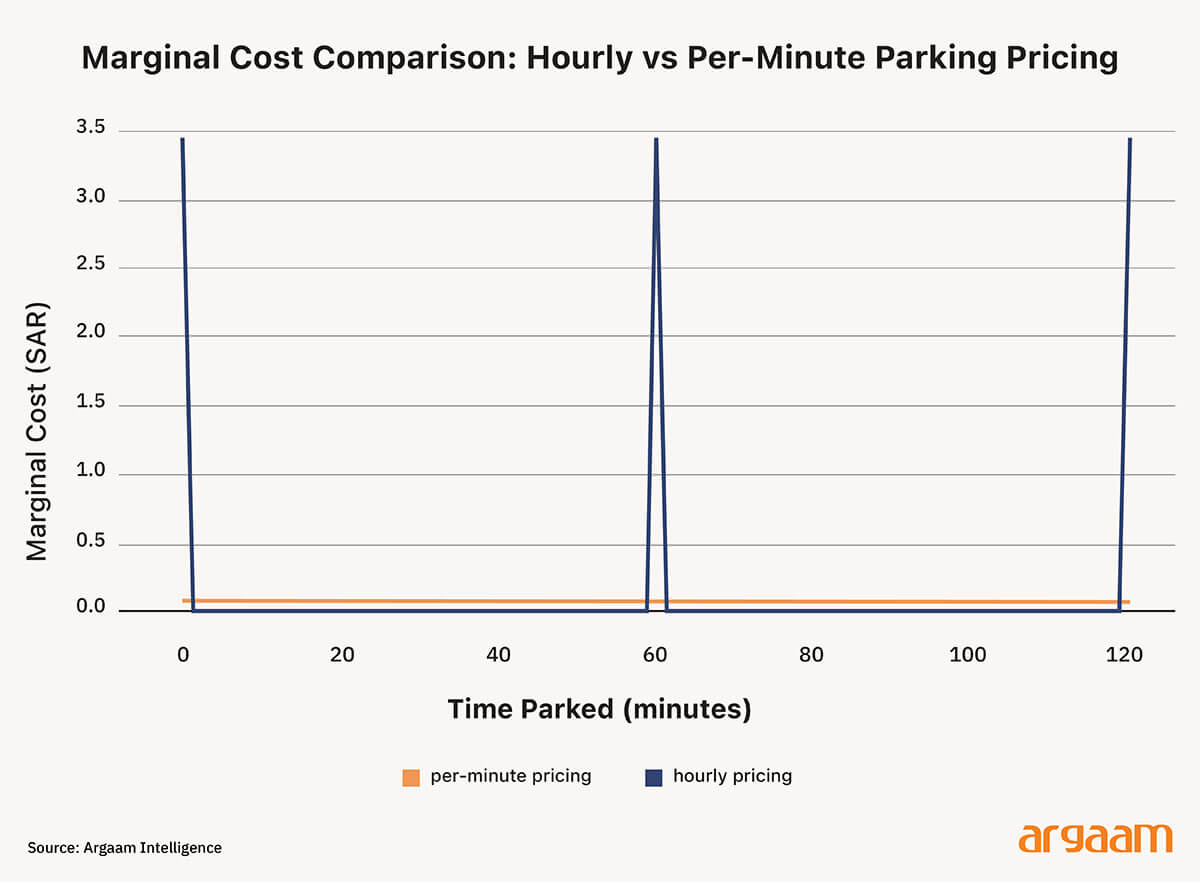
As illustrated by the marginal-cost comparison in the coming figure, under hourly pricing the marginal cost of time collapses to near zero once an hour has been paid for, only spiking again when the next hour is triggered.
In simple terms, within each paid hour, there’s almost no extra cost for additional time, but once the hour is over, you have to pay again to continue.
Faced with this discontinuous price signal, drivers have a rational incentive to “use up” prepaid time even when their true willingness to pay for the final minutes is low.
Economic theory identifies this mechanism as a source of deadweight loss, arising from distorted marginal decisions under rigid or stepped tariffs rather than from demand conditions themselves.
Moving to per-minute billing restores continuous pricing, where each additional minute carries a visible and predictable marginal cost.
As shown in Figure 1, the marginal price of time becomes constant rather than lumpy. This means that each additional minute of service costs the same fixed amount, providing a steady and predictable rate for incremental usage.
In contrast, when pricing is not continuous—say, in larger blocks or variable pricing—the cost per unit of time can fluctuate with some increments costing more or less depending on the billing structure.
ℹ︎
Turnover is the real metric
It means how often parking spaces are used and then freed up:
● If turnover is high, each parking spot is used more efficiently, helping the public by reducing congestion and making parking easier to find.
● For private investors and public-private partnerships (PPPs), high turnover means steady income, because more cars are parking and leaving regularly.
A curb space can be fully occupied all day but still deliver low economic utility if the same vehicle stays for long periods; by contrast, higher turnover means the same fixed stock of spaces serves more trips, improves access for short-stay users, and creates a broader revenue base without expanding supply.
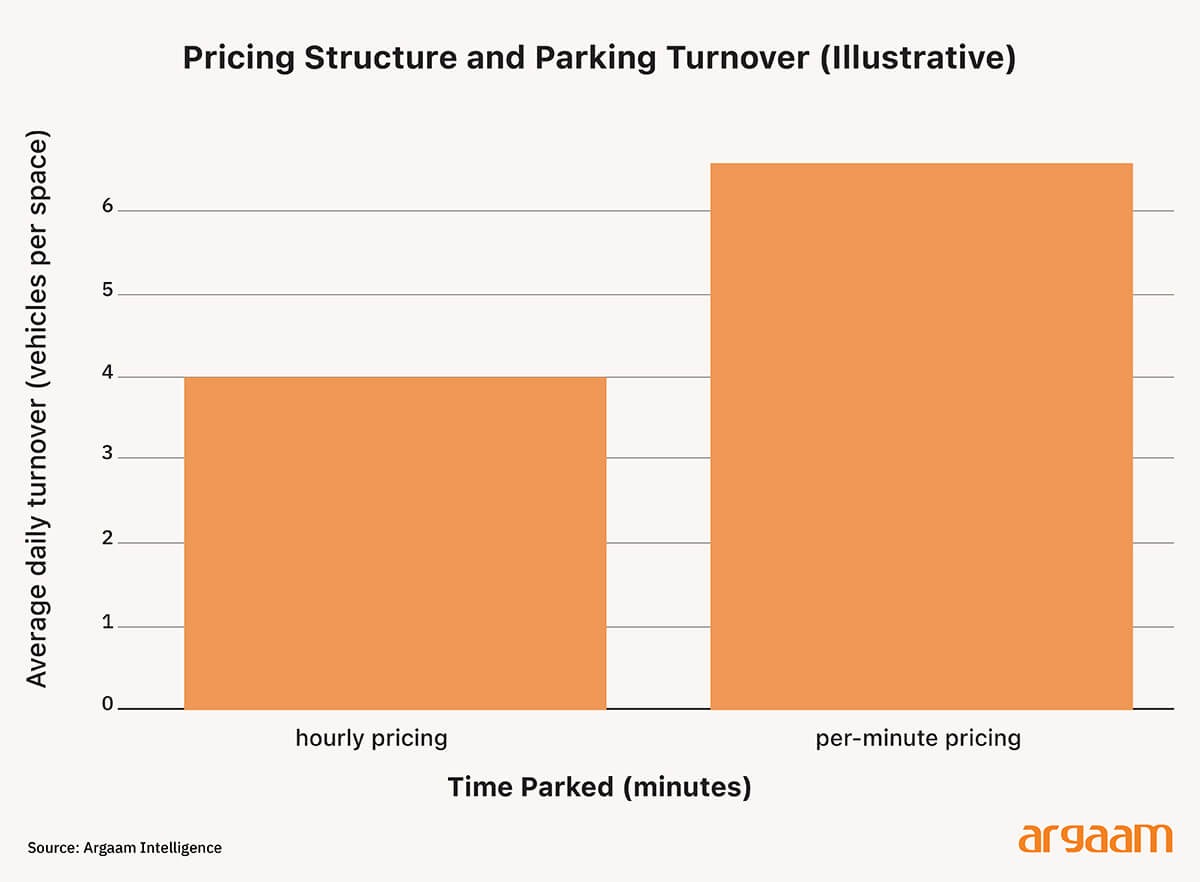
The key point is that turnover is not something policymakers can command directly. It emerges from how the marginal cost of time is presented to drivers. When pricing is coarse (hourly steps), drivers often face long stretches and turnover falls.
When pricing becomes more continuous (per-minute or fine time bands), drivers re-evaluate the value of staying more frequently, which mechanically shortens average duration and lifts turnover.
This mechanism is backed by real-world demand-based parking deployments that measure duration and availability directly.
The U.S. DOT’s evaluation summary of LA ExpressPark reports faster circulation after pricing reform, including a 37% reduction in parking duration in Downtown LA (with additional reductions in other districts), alongside a 10% increase in parking availability and a 16% increase in parking revenues in some areas—all consistent with pricing design shifting behaviour toward shorter stays and higher rotation.
Academic evidence using large datasets similarly finds that parking duration declines as prices rise and that turnover responses can vary across contexts, reinforcing the idea that pricing affects the time decision at the margin rather than just the whether to park decision.
For a Riyadh’s Private-Public Partnership pilot, this framing matters because a turnover-driven revenue base is typically more scalable and resilient than relying on high occupancy alone.

Reassessing the Economics of 15-Minute Free Parking Policy
The 15-minute free grace period is often justified as a user-friendly feature, but from an economic perspective it functions as a zero-price subsidy at the margin.
Even very short stays occupy scarce curb space and impose opportunity costs on other users, including reduced availability and additional search traffic.
When the first block of time is priced at zero while marginal social costs remain positive, the price signal becomes distorted and true demand is partially concealed.
Parking economics literature consistently emphasises that efficient allocation requires prices to reflect marginal costs as closely as possible, particularly in high-demand environments where small distortions can have outsized effects on behaviour.
In practice, free grace periods inflates apparent demand without revealing users’ true willingness to pay, complicating future calibration of prices and undermining turnover-based efficiency gains discussed earlier.
A practical alternative is not necessarily charging “from the first second,” but adopting a small, positive pricing unit, such as five-minute billing intervals. This approach preserves pricing continuity while limiting transaction friction and cognitive burden for users.
📈
IF Pricing reform implemented
● Fine-grained time pricing ● No zero-price period
THEN Clear marginal signals
➤ Shorter stays ➤ Higher turnover ➤ Stable cashflows ➤ Bankable PPP
📈
IF Pricing rremains coarse
● Hourly steps ● Free grace period
THEN Distorted signals
➤ Longer stays ➤ Low turnover ➤ Volatile revenues ➤ PPP stress / renegotiation
From a financial perspective, a parking PPP succeeds only when demand risk is matched with pricing control. In user-pay PPP structures, revenues depend on how users respond to prices, not merely on asset availability.
Standard PPP guidance therefore emphasises that when the private party bears demand risk, it must also have sufficient control over the tariff mechanism to manage that risk; otherwise, revenue volatility undermines bankability and raises the likelihood of renegotiation or fiscal support.
Concluding remarks:
If pricing design allows marginal behaviour to adjust—through continuous or fine-grained time pricing and the removal of zero-price periods—then revenue performance becomes driven by turnover rather than static occupancy.
This matters for lenders and investors because turnover-based revenues are typically more scalable and predictable: shorter average stays increase the number of paying transactions per space per day, smoothing cashflows without requiring higher headline tariffs or capacity expansion.
Demand-responsive user-fee structures reduce exposure to volume shocks by broadening the revenue base, rather than relying on a small number of long-stay users.
If, however, pricing remains coarse and includes free initial periods, then demand signals are suppressed and turnover potential is capped.
In such cases, the private operator bears operational and collection risk while lacking the primary economic lever needed to correct underperformance.
PPP literature shows that this mismatch frequently results in contract stress, renegotiation, or a shift toward government-backed availability payments to restore financeability—effectively re-socialising risk after privatisation.
In this context, pricing reform is not a secondary policy tweak but a precondition for a financially robust parking PPP.
By aligning marginal pricing with user behaviour, Riyadh can improve revenue stability and reduce fiscal risk, strengthening the PPP model without increasing nominal prices. |