Saudi Arabia is a car-centric country, and the rise of electric cars at the expense of the internal combustion engine could gouge a hole in the public finances. Currently, Saudi Arabia incorporates a 15% Value Added Tax on car fuel, a key component of its non-oil revenue strategy. The rate was tripled from the initial 5% in July 2020.
The government does not, however, publish specific, separate figures for the total annual revenue generated solely from the VAT on car fuel, as this is grouped with other non-oil tax revenues.
Total gasoline consumption in the kingdom averaged approximately 514,000 barrels per day (b/d) in 2024.
Our analysis explores a new policy of taxing EVs charging costs in Saudi Arabia as a means to address the tax revenue loss due to the expected declining fuel tax revenues from the traditional petrol vehicles.
As internal combustion vehicles decline and EVs increase in any country, consumption of gasoline and diesel decreases, resulting in a reduced fuel tax base and, consequently, less tax revenue.
Half of Saudi citizens are now open to purchasing an electric vehicle. (Arab News, July 2025).
Fuel taxes are a major source of funding for transportation infrastructure development and maintenance.
Between 2010 and 2025, Saudi pump prices have seen substantial hikes. Gasoline 91, for instance, rose from about 0.45 to 2.18 SAR, nearly five times its original level.
A significant policy shift occurred in July 2021, when the government capped gasoline prices at SAR 2.18 for 91-octane and SAR 2.33 for 95-octane.
This measure was intended to ease the cost of living, with the state covering any cost above the cap. (darbpay.com)
Meanwhile, diesel—which had long been subsidized for transport and industry—continued to rise in stages.
In January 2024, its price was raised by 53%, and in January 2025 by another 44%, bringing the diesel rate to approximately 1.66 SAR per liter (around $0.44).
The kingdom has a target of 30% EV adoption by 2030. As the first homegrown EV brand, Ceer, is expected to start production in 2026, the kingdom is also a promising frontier to established EV brands like the American Tesla and Chinese BYD.
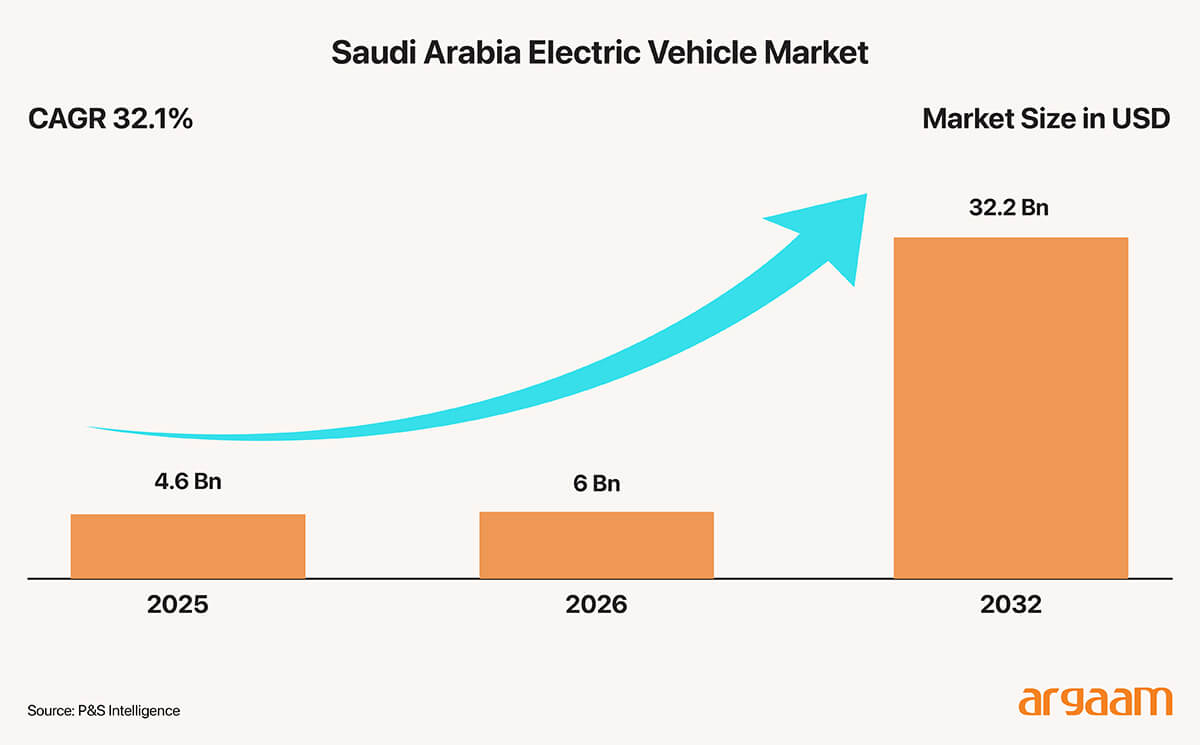
Saudi Arabia has allocated $40 billion for EV infrastructure and manufacturing. This massive investment is driving 32.1% annual market growth in the EV market, projecting the industry’s value to reach $32.2 billion by 2032.
The EV infrastructure is expanding rapidly, with charging stations increasing from 1,200 in 2023 to 5,000 by 2025 and a target of 50,000 by 2030.
The government is rolling out high-speed charging stations along key routes, including the 900 km Riyadh-Makkah corridor, which currently lacks any charging points.
Saudi researchers are also exploring solid-state batteries for better performance in harsh summer climate.
The Consumer Willingness-to-Pay metric
Charging costs are used as the base monetary amount on which the EV charging tax is applied. Using an electric car as an example with a 64 kWh battery, and an electricity cost of approximately 0.18 SAR per kWh in Saudi Arabia, while a complete battery recharge would cost around 11.52 SAR at home. (yaaracar.com)
In the public space, where these chargers are often found in malls, workplaces, and public parking lots, the price is generally higher than residential rates around SAR 0.32 per kWh. A full charge would cost approximately SAR 19.20.
We used academic research to estimate the EV charging tax if the kingdom decides to change EV policy in the future. (Energy Economics, 2024).
Based on SAR 0.18 per kWh, we should know the EV's efficiency (how many km it can run per kWh). A Tesla, for example, drives about 5-7 km per kWh of electricity. (Tesla.com).
We then estimate the charging tax rate per kWh from the willingness-to-pay metric. This metric is based on a public survey to capture how much consumers are willing to pay per kilometer or per mile driven in an EV to cover tax burdens.
If someone in Saudi Arabia, for example, consumes 150 litres of Octane 95 fuel per month in Saudi Arabia, where one litre costs 2.33 SAR and a 15% VAT tax is applied per litre, the total monthly fuel cost including tax is 402.68 SAR, and the VAT tax paid is 52.40 SAR.
So in order for the government maintains stable tax revenues as electric cars are increasing every year, EV taxes on a per-kilometre basis would need to be adjusted upwards to the equivalent of the VAT when the policy enters into effect.
We have a real life example. From 2028 the drivers of electric vehicles in the United Kingdom will be subject to a tax at three pence ($0.04) per mile for fully electric cars and half that for plug-in hybrids. (BBC News).
Forecourt taxes account for a big chunk of government revenues, raising £24.4bn in 2024-25. The Office for Budget Responsibility expects revenues to collapse from 0.7% of GDP today to just 0.1% by 2050-51. The new scheme will fill around a quarter of that shortfall. (The Economist).
PS: Forecourt taxes are taxes levied at the point of sale of fuel, typically applied directly to gasoline or diesel pumps at service stations (the "forecourt" area where vehicles are refueled).
Another example is from South Korea. A study found that by 2050, without additional taxation on EVs, tax revenue could decrease by over 80% compared to 2022, threatening the financial sustainability of transportation projects in the country. (A case study of South Korea)
Imposing taxes on EV charging aligns with the fairness principle by ensuring that all vehicle users contribute equitably to road infrastructure costs, preventing an unfair tax burden shift onto fossil fuel vehicle owners.
Since EV users utilize roads and related infrastructure but do not pay fuel taxes, charging them helps uphold the user-pays principle in transportation taxation, which mandates that individuals contribute proportionally to their infrastructure usage.
Without such taxes, EV users benefit from infrastructure funded by fossil fuel users without paying their fair share, creating an imbalance and distorting equitable cost distribution.
More this Weekend
Building on Borrowed Capital: Insights into Debt Management for Middle East Property Developers
The use of debt financing is a common practice in the real estate sector, where large upfront capital investments are typical before generating steady cash flow.
The recent debt crisis experienced by Evergrande, once China’s largest property developer as we explain in the last part of this analysis.