




|
The traditional love affair with gold among Saudi families has long been a symbol of investment, wealth and financial security. Yet, what if we could gently introduce a different kind of investment targeting the low-income in particular in Saudi society, one rooted not in the shimmer of gold, but in the potential of the stock market in the kingdom for them? The challenge isn’t just about investment; it’s about mindset. Many Saudi families are not known for their love of saving, but they do care deeply about stability and family’s future. We present this unique scheme in our analysis by introducing a government-backed and -managed mutual equity fund tailored only for low-income households. This scheme is will enable Saudi citizens and eligible residents to engage with capital markets without the need for substantial initial capital or sophisticated financial knowledge. Starting with a minimal investment threshold of SAR 50 makes stock market participation less intimidating and more approachable and fosters a culture of household saving in the kingdom. Aligning this program with Saudi Vision 2030’s goals of economic diversification and social empowerment amplifies its significance. It encourages a culture of ownership and responsibility among citizens and residents, fostering a more resilient economy rooted in domestic participation. Mutual funds are known as investment pools that gather the capitals of a group of investors and manage them according to a specific strategy and investment goals which are set by the fund’s manager to achieve investment benefits that cannot be achieved by an individual investor alone. Today, there’s a growing trend around the world that fund managers, based on their own skills and experience in investment, use specialised AI Asset Management models in the stock markets with live trading to analyse the performance of all companies and mitigate the risks. These models have saved a lot of time and efforts from fund managers following up moment by moment stocks that outperform or underperform the market. Saudi Arabia was the first to launch a mutual fund in the Arab world. The National Commercial Bank (AlAhli) founded the first mutual fund under the name of “AlAhli Short Term Dollar Fund” in December 1979. The rules governing mutual funds in Saudi Arabia were issued 14 years after that date, i.e. by the beginning of 1993. (A list of the available mutual funds can be found on the website of the Saudi Stock Exchange (Tadawul) www.tadawul.com.sa). The market capitalization of Saudi Arabia’s Tadawul All Share Index reached $2.7 trillion at the end of 2024, according to credit rating agency S&P Global. The main stock market index climbed 10.34% in September, though it remains 3.43% lower than a year ago. All in all, the index is down 9.6% so far this year. But in September, Saudi Arabia's stocks posted their biggest daily rise since 2020 following reports that the market regulator may ease the 49% cap on foreign ownership of listed firms. In recent months, Saudi stocks had a P/E ratio near the lowest it has been in over five years. 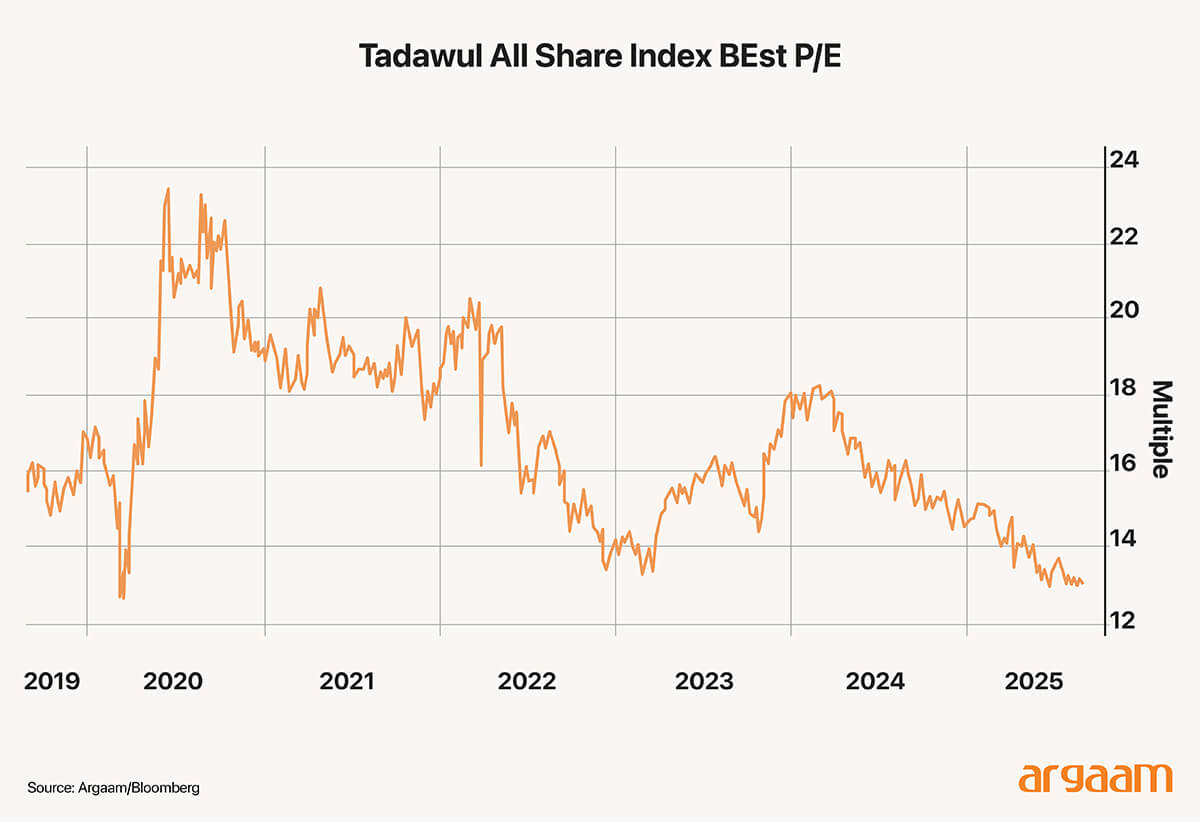 
Fee-Free Funds for the Low-Income One key support in the suggested scheme in in our analysis is to waive the fund fees. These fees are burdens on low-income investors because they directly reduce the amount of principal invested and the potential returns they can earn over time. There are three kinds of fees to enrol in mutual funds in Saudi Arabia: 1) Management Fees. 2) Subscription or Redemption Fees. 3) Performance Fees. These fees often act as significant barriers for low-income individuals, whose limited income makes it difficult to participate in mutual funds when additional charges are imposed. Management fees, charged annually for fund administration and oversight, can gradually erode savings, especially over long holding periods. Similarly, subscription and redemption fees, incurred when investors buy into or exit a fund, can diminish the initial capital or the returns on investment, discouraging participation from those with limited financial flexibility. Performance fees, which may only be applicable to actively managed funds that meet specific return targets, can create additional uncertainty and unpredictable costs, further deterring low-income investors from engaging with such funds. Also, the government support for low-income investors is important in eliminating or subsidizing broker's commissions. By waiving or reducing these fees, the financial barrier to entry is lowered, allowing low-income individuals to participate without the burden of high transaction costs. 
When a large number of low-income individuals start investing SAR 50 or similar amounts, even if small per person, the collective pooled savings grow within the formal financial ecosystem. This phenomenon is described as an increase in the share of personal savings in financial assets under management. Our two main metrics in this analysis are Saudi Arabia’s nominal GDP, which reached SAR4.06 trillion (approximately $1.083 trillion) in 2023, and the population of people over 18 in Saudi Arabia (the minimum legal age to open an investment account), which is approximately 23.4 million. Investing SAR50 each, let’s say by 15 million individuals, in a mutual equity fund could significantly influence Saudi Arabia’s economy, especially when pooled into the Tadawul stock market. This collective investment, totaling approximately SAR750 million or $250 million, represents an additional infusion of liquidity into the market. But how about if we make it a four-year investment scheme with each of the 15 million individuals commits SAR50 monthly into the mutual fund? Over the span of four years, the total contribution would reach SAR36 billion ($9.6 billion). This could correlate with approximately 0.89% of Saudi Arabia's GDP over four years. A figure just below 1% can serve as a baseline for growth. If policies or initiatives aim to increase this contribution as a percentage of GDP, even small percentage increases could represent significant economic shifts and social impacts over time. Also, the ripple effects of this pooled investment can be profound. As these funds become available, they can be channeled into publicly listed companies, providing them with the necessary capital to expand operations, innovate, and undertake new projects. If our idea materialises, we will witness a trend in the kingdom of small-town residents, from shopkeepers to laborers, participating in Saudi Arabia’s stock market, signalling a significant shift towards financial inclusion. Their initial investments, often modest, will steadily increase trading volumes on Tadawul, fostering greater liquidity and market resilience. Beyond market metrics, this growing participation cultivates a sense of financial security and empowerment within families. |
|
|

|

|


|

|