
Argaam Weekend logo Argaam Weekend logo
العربية
شعار أرقام ويك اند
الرئيسية الإصدارات اشترك تواصل معنا موقع بوابة أرقام
Week #66 > The Bold Promise of AI that Could Really Transforms Saudi Health Sector


The Bold Promise of AI that Could Really Transforms Saudi Health Sector

Share 𝕏
Subscribe

Saudi Arabia’s major investments in both artificial intelligence and biotechnology, paired with strategic partnerships with major pharmaceuticals, create a compelling foundation for transforming drug discovery and development.
We present this unique idea to policy makers, especially in the nascent HUMAIN AI company in the kingdom, as this twin strategy could open the door to a revolutionary business model that harnesses AI’s power to drastically cut down the lengthy, costly process of clinical trials.

This isn’t just a business opportunity but offers significant benefits for Saudi society by enabling faster development of new treatments for prevalent diseases like diabetes, cardiovascular conditions, and genetic disorders.

Our analysis of harnessing AI to revolutionize drug discovery and facilitate its commercialization is firmly grounded in comprehensive research on the traditional drug development process.


The process of discovering and developing a single new drug can take approximately 10-15 years and cost upwards of $2.3 billion, according to a recent research by Pfizer.

A significant portion of this expenditure, often exceeding 90%, is allocated to research and development (R&D), encompassing promising candidate identification, preclinical testing, and multiple phases of clinical trials.
Only about 10% of investigational drugs successfully reach market approval.

Financially wise, these failures result in billions of dollars annually in lost R&D investments, as failed trials not only waste direct costs but also delay potential revenue streams and inflate development costs across different stages.

And from a scientific perspective, our idea for leveraging AI in drug discovery is reinforced by recent history, where groundbreaking techniques at the core of precision medicine have been recognized with Nobel Prizes, highlighting their transformative potential.

Innovations such as high-precision gene editing, advances in immunotherapy, and breakthroughs in viral diagnostics have set new standards in medicine.

Building on this recent legacy, we strongly believe that Saudi Arabia can financially and strategically take the initiative in the region to invest in this new AI-powered medicine discovery.

In May, the Public Investment Fund (PIF) launched the kingdom’s main AI company Humain as part of Vision 2030.

The company has already started building its first data centres in Saudi Arabia, which are due to come online in early 2026. It aims to add 1.9GW of data centres by 2030, supported by semiconductor supply deals with US manufacturers including Nvidia.

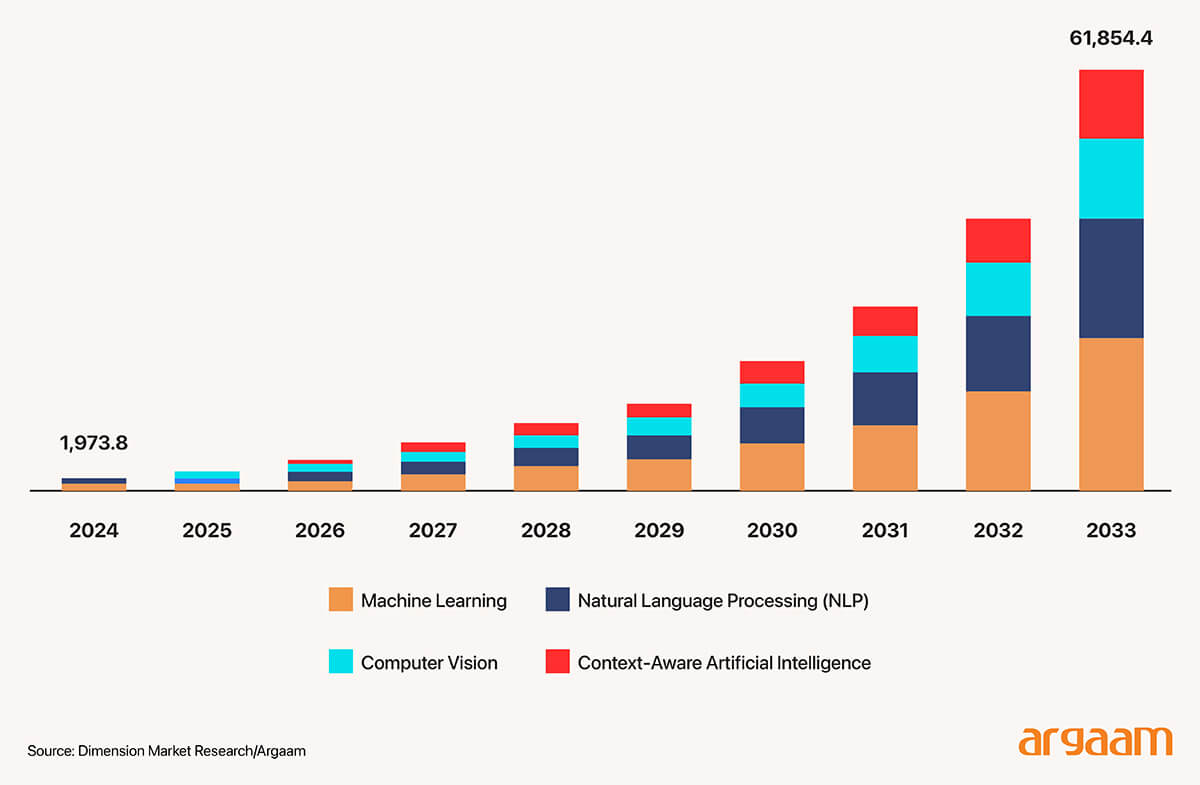
The Artificial Intelligence market in the kingdom was estimated $1,97 billion in 2024 and is further anticipated to reach $61.85 billion by 2033 at a CAGR of 46.6%.

machine learning
 
 That AI strategy in the kingdom is unmatched outside a handful of US and Chinese Big Tech companies, which have had years, if not decades, to build their businesses and technical expertise.

Humain is set to launch a $10 billion venture capital fund to invest in startups across the US, Europe, and parts of Asia.
Since its launch, HUMAIN has signed deals worth $23 billion with US tech giants, including Nvidia, AMD, Amazon Web Services, and Qualcomm. Based on current market rates, the cost of the overall project is estimated at $77 billion.
 
machine learning model
How AI Transforms Data into Drugs
 
AI-designed drugs are a revolutionary development in pharmaceutical research, leveraging advanced computational techniques to streamline and optimize the drug discovery process.

The core concept was explained thoroughly in a recent academic paper titled “Drug discovery in the context of precision medicine and artificial intelligence”. 

It involves using artificial intelligence (AI), particularly machine learning (ML), deep learning (DL), and generative models, to analyze complex biological, chemical, and pharmacological data.

This approach aims to identify new therapeutic compounds or optimize existing ones more efficiently than traditional methods.

Faster development cycles mean more drugs reach the market in less time, increasing output per unit of input, which directly boosts the kingdom’s GDP.

Lower R&D costs improve profit margins for biotech firms, potentially leading to higher investments and industry expansion, which contribute to economic growth.

More importantly from an economic perspective, this innovation can enhance exports of high-value drugs to the MENA region in particular, making the kingdom a leading exporter of new medicines and perhaps compete in a global biotech market worth $50 billion.

Increased exports improve the trade balance, a key component of GDP calculation.
The kingdom is projected to reap more than half of the economic benefits of its investment in AI in the GCC region, or $12.2 billion, by 2030, according to an estimate PwC.

The UAE, which has also been boosting its initiatives to adopt the latest innovations, has the next biggest potential with $5.3 billion.


One key AI aspect in the process of producing AI-designed drugs is the generative AI model, because it has already been applied in May 2024 by Google DeepMind, the research laboratory owned by Alphabet Inc., to predict protein structures in its continuing pursuit to produce AI-designed drugs.

These AG generative models simulate chemical space exploration, proposing molecules that may have high efficacy, low toxicity, and favorable pharmacokinetics (the medical term that describes the four stages of absorption, distribution, metabolism, and excretion of drugs.)

This approach accounts for the chemical diversity and synthetic accessibility of potential drugs, expanding the space of possibilities beyond what traditional chemistry could achieve.

In conclusion, while no AI-designed drugs have yet completed a successful clinical trial as of October 1, 2025, the rapid advancements in AI technology, coupled with significant investments from countries like Saudi Arabia, suggest that this milestone might not be far off.
More this Weekend
This’s How Saudi Luxury Brands Can Rival Hermes, Gucci and Prada
 
In recent weeks, we have seen a striking moment on TikTok that captures the evolving landscape of luxury consumption among Saudi youths. Young Saudi men and women from Gen Z openly express that despite having the means to afford luxury wedding experiences including dresses or throw extravagant celebrations, they are choosing to think differently.
Read more
Inside the Growing Trend of Reward Point Arbitrage Among Saudi Consumers
 
Within Saudi Arabia’s increasingly competitive credit market, a noteworthy trend has emerged among high-frequency credit card users, who leverage reward points across multiple cards to optimize their cash flow and reduce borrowing costs.
Read more
X
Facebook
LinkedIn
Download our App
Argaam.com Copyright © 2025, Argaam Investment, All Rights Reserved