




|
Along the Red Sea coastline, a new era in health tourism might emerge in Saudi Arabia. We believe that Saudi Arabia can offer an innovative health tourism package that seamlessly integrates cutting-edge fertility treatments with luxury wellness experiences. The target demographically is wealthy young couples aged 18–34 in the Kingdom and from the Middle East and around the world, since In-Vitro Fertilization (IVF) procedures are typically costly and require substantial financial resources. The young represent a viable market segment for a premium health tourism offering that combines both IVF and rejuvenating Red Sea experience for such a stressful and emotionally draining experience. Travel-medical packages could be created in advance and carefully designed around the waiting and recovery periods to visit some of the kingdom picturesque reserves and cultural sites. A full IVF cycle generally takes about 4 to 6 weeks from start to finish, depending on individual factors, the specific treatment plan, and whether tests like preimplantation genetic testing (PGT) are included. IVF costs in Riyadh start from around SAR15,000 ($4,000) for one cycle. IVF success is not guaranteed in a single cycle, and many patients require multiple cycles to achieve a pregnancy. One 2023 study in the United States found out of every four women at the age of 40 undergoing their first IVF procedure, about one is likely to have a baby from the first cycle. In New York, the cost of the IVF cycle typically ranges from $12,000 to $25,000. In London, the average cost ranges from £6000-£10,000. While in Malaysia, the cost of a single IVF cycle in generally ranges from USD $5,000 to $8,000. So, we believe that Saudi Arabia offers cost-effective IVF treatments without compromising quality, making it an appealing destination for this segement of medical tourists. The kingdom integrates advanced reproductive technologies such as Intracytoplasmic Sperm Injection (ICSI) and Preimplantation Genetic Testing (PGT), with state-of-the-art facilities across both private and public healthcare sectors. Saudi Arabia’s IVF market was valued at $378.60 Million in 2024 and is anticipated to reach $589.56 million in the forecast period with a CAGR of 7.86% through 2030. 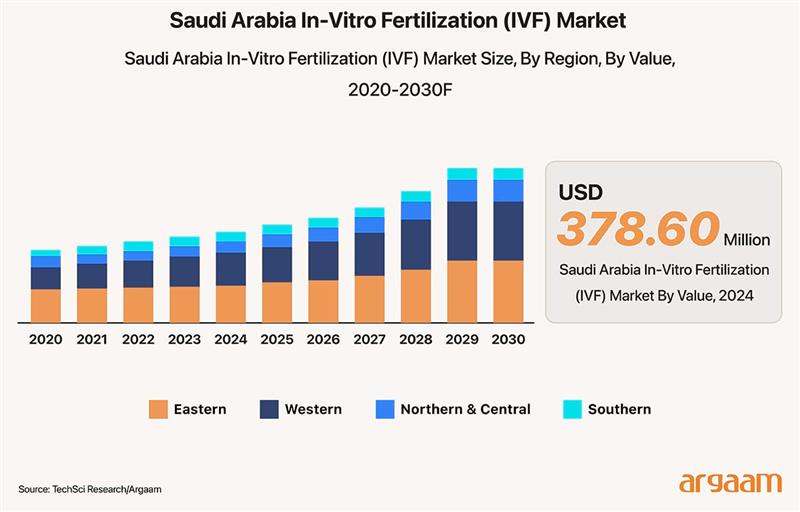  Infertility is a significant issue globally, affecting approximately one in six adults 17.5% according to the World Health Organization. Reasons behind IVF vary between infertility, postponing parenthood for professional advancement, or preserving the gametes (eggs or sperm) as one of the couples face medical treatments such as chemotherapy, radiation, or surgeries that can impair fertility. Obtaining reliable data on the infertility rate across the entire Kingdom of Saudi Arabia remains challenging as existing studies, including a recent one conducted in Jeddah, are geographically limited and may not reflect the diverse social, economic, and cultural conditions present in other regions of the Kingdom. Additionally, many studies rely on convenience sampling techniques that target specific populations, such as women attending governmental hospitals, which may not represent the general population. The UN Population Fund recent data shows that Saudi Arabia's total Fertility Rate is projected to be 2.3 births per woman in 2025. This is a decrease from 2.2 in 2020 and reflects a global trend of declining fertility rates. Independent research figures also give a macro perspective on birth rate over the past decades. 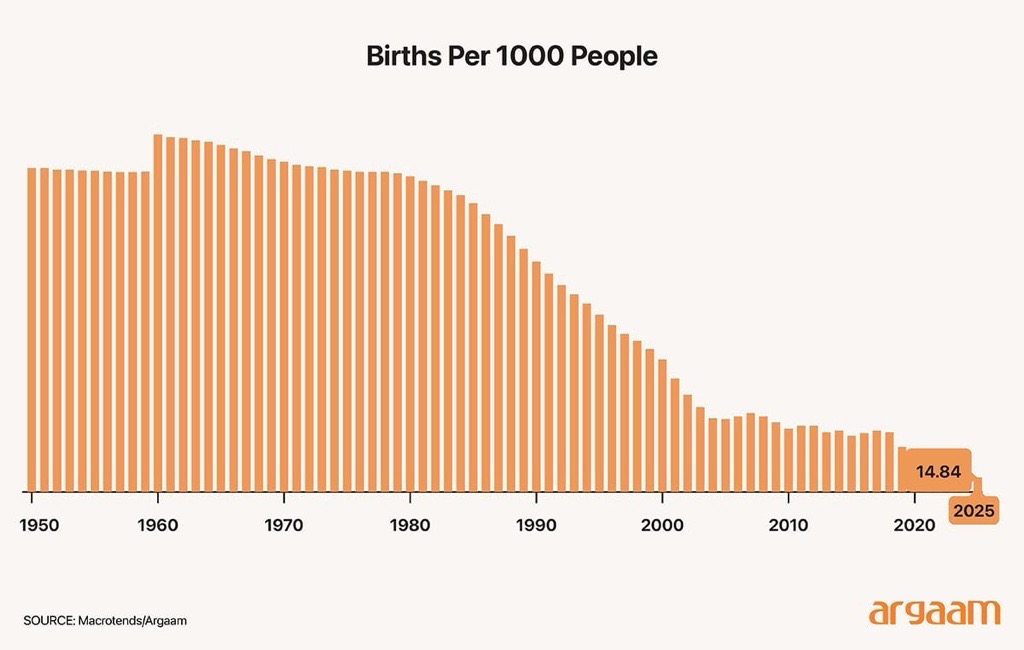 Here's a summary of the available data, according to Macrotrends, a financial research company specialised in long-term investments. ● Birth rate: ➤ 2025 (projected): 14.84 births per 1,000 people. ➤ 2023: 16.42 births per 1,000 people. (A 7.87% increase from 2022.) ➤ 2022: 15.22 births per 1,000 population. (A 4.31% decline from 2021.) ➤ Compared to 1950 (53.34 births per 1,000 people), the 2025 birth rate represents a 67% decrease. In this context, making In Vitro Fertilization (IVF) affordable and accessible, especially for Saudi low-income young couples, aligns with Saudi Arabia's economic self-interest. At the same time, maintaining unsubsidised IVF treatment options for wealthier Saudi nationals and foreign patients creates a dual benefit: it generates revenue by boosting the growing medical tourism sector, which attracts patients willing to pay premium prices for advanced reproductive services. This approach allows the government to balance social equity objectives with economic sustainability, using revenues from medical tourism to partly offset the costs of subsidising IVF for those with limited means, while strengthening Saudi Arabia’s position as a regional hub for high-quality fertility treatments. 
One Embryo, Twice the Benefit A compelling academic study conducted in the Netherlands highlights the critical importance of implementing a single-embryo transfer (SET) policy in IVF treatments. IVF laboratory costs were reimbursed exclusively when clinics adhered to the SET approach. This policy led to a remarkable increase of over 30% in IVF cycles, reflecting improved access for couples due to coverage being contingent upon SET. More importantly, the practice resulted in a greater than 50% reduction in twin pregnancies. Since multiple pregnancies are associated with significantly higher neonatal care costs, this reduction translated into substantial economic benefits, potentially saving up to 85% of the IVF budget by minimizing expensive neonatal interventions. For Saudi policymakers, adopting a similar SET-linked reimbursement strategy could not only enhance the accessibility and safety of IVF but also generate significant long-term cost savings within the healthcare system. Why IVF Defies Simple Government Budgeting? The same study though raises a controversial ethical topic, which’s the worth of investing in IVF treatment. It shows that the discounted lifetime net present value of IVF-conceived individuals is negative, meaning that, on average, the government spends more on these individuals over their lifetime than it recovers through taxes [-€81,374 overall; -€47,091 for men and -€123,177 for women]. This implies that from a purely fiscal perspective, investing in IVF may appear as a net loss when the future economic productivity of these individuals is uncertain or if they do not become sufficiently productive taxpayers. IVF services require upfront public expenditure, and the government essentially makes a long-term investment in human capital without guaranteed future economic benefits. Economic variables such as healthcare costs, discount rates, and future earnings significantly affect the net fiscal outcome, further complicating policy decisions. But restricting IVF funding based solely on potential financial returns raises important ethical issues. Denying access to IVF because of economic calculations risks undermining reproductive rights and could be seen as devaluing human life based on fiscal utility. The ethical imperative to support life and the broader social benefits of IVF require a more nuanced approach that balances economic realities with moral and societal values. |
|
|

|

|


|


|