




|
As of July this year, Saudi Arabia has connected approximately 10.213 GW of renewable power sources to its grid, reflecting meaningful progress toward its ambitious Vision 2030 target to diversify the economy and increase the share of renewables in its energy mix. The Kingdom aims to expand its renewable capacity to 130 GW by 2030, with 58.7 GW expected from solar and 40 GW from wind under Vision 2030. The planned shift could reduce the utility sector's liquid fuel use by 1.1 million barrels per day, which could dedicate more crude oil for exports. While this represents a significant and commendable commitment to sustainable growth, the pace of transition underscores the gradual nature of such a large-scale energy transformation. Given the current capacity and the timeline ahead, it is clear that fossil fuels will continue to play a vital role in meeting local power needs until key renewable infrastructure is fully developed and operational. We have spotted this challenge based on our analysis of data from the Joint Organisations Data Initiative, the US Energy Information Administration, and Kpler, a data analytics company specialised in tracking energy markets in key markets. There’s 25% year-on-year rebound in direct crude oil burn this summer, coinciding with the rising temperatures not only due to summer time but also due to climate change. This reflects the continued reliance on fossil fuels, particularly oil, to meet electricity demand during periods of increased consumption. In Saudi Arabia, natural gas accounts for a significant share of electricity generation, approximately 62%, underscoring the crucial role that fossil fuels continue to play in the kingdom's energy sector. This predominance of natural gas in power generation highlights the ongoing dependence on fossil fuel resources to meet the country’s substantial and growing electricity demand, driven by rapid economic development and increasing urbanization. Oil on its own still plays a substantial and indispensable role, accounting for roughly 38% of the energy mix, while renewables currently contribute less than 1%. 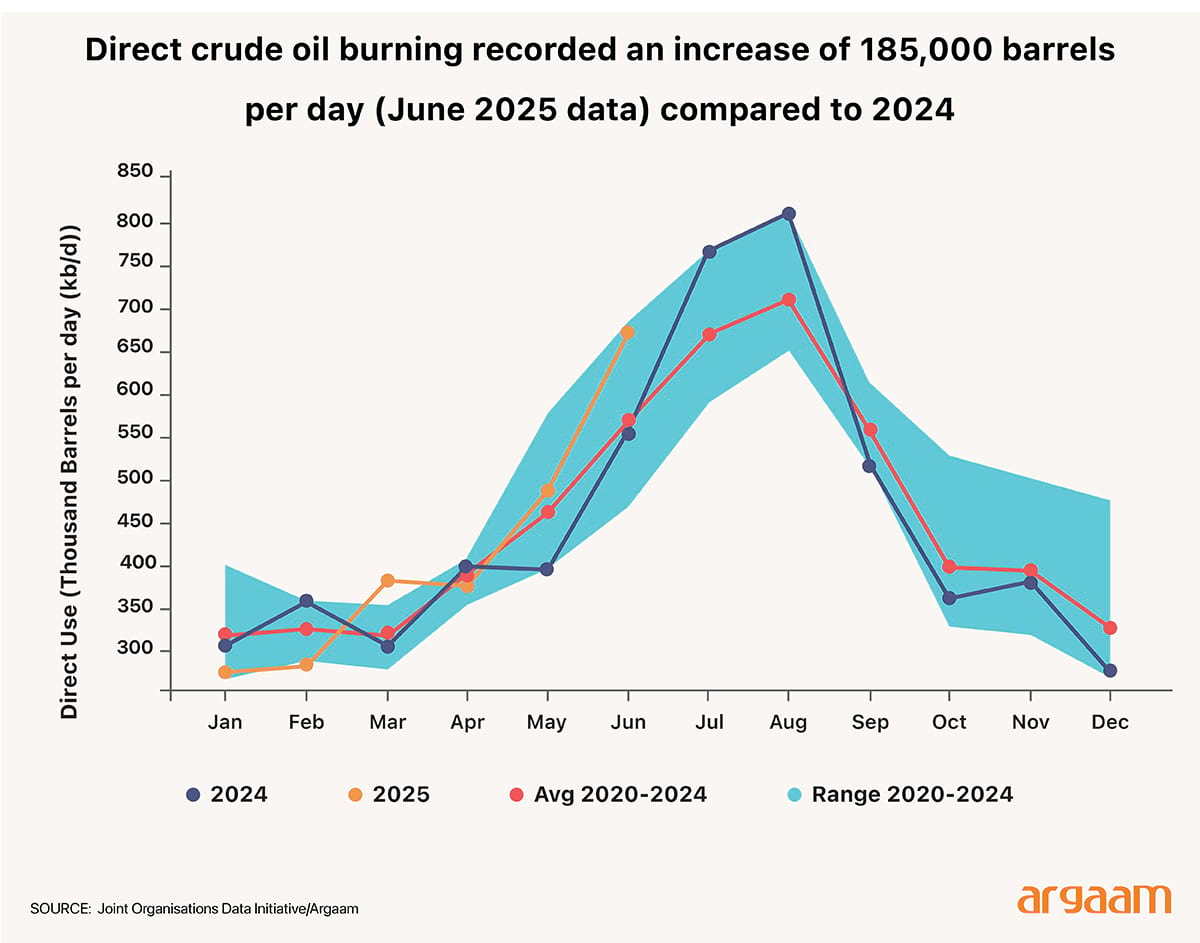
Last year direct crude burning rates went on to climb to nine-year highs of 814 kbd in August. And with the rise in June this year, there’s a big possibility that the direct crude burning rates will match or surpass last year’s, especially if we take into consideration OPEC+ new increase in oil production by 547,000 barrels per day for September, the latest in a series of accelerated output hikes to regain market share. In the following two timetables, we highlight the major operational and planned natural gas power plants in Saudi Arabia, as well as the major operational and planned renewable power plants since 2023. This overview provides insight into the country’s ongoing and future efforts to expand its natural gas power generation capacity, reflecting its commitment to meeting rising electricity demand while enhancing energy diversity and sustainability.
Major Operational and Planned Natural Gas Power Plants in Saudi Arabia
CCGT : Combined Cycle Gas Turbine/ TBD: To be Determined
Source: ACWA/Kpler/Argaam

Location and Economics Shape Green ambitions In a recent academic paper titled Limitations, challenges, and solution approaches in grid-connected renewable energy systems, any country making a leap into an energy transition should anticipate and proactively address technical challenges associated with integrating large-scale Renewable Energy Sources (RESs) into the national grid. An often underestimated but critical technical challenge in achieving this goal lies in the selection and deployment of energy storage systems (ESS) that are optimally suited for Saudi Arabia’s unique desert climate and evolving economic conditions. Saudi Arabia’s desert environment features extreme temperatures, low humidity, vast solar irradiance, and limited natural water resources. This sets very specific requirements for ESS technology. For example, certain battery chemistries may degrade quickly under high ambient temperatures unless substantial cooling measures are implemented, increasing costs and lowering overall system reliability. Similarly, large-scale pumped hydropower storage, which is highly mature and widely used globally, depends on suitable topography and abundant water—resources scarce in Saudi Arabia’s geography. Saudi Arabia’s economic landscape is rapidly shifting as the kingdom pursues diversification under Vision 2030, with fluctuating investment patterns and evolving infrastructure priorities. Selecting energy storage technologies that balance upfront capital expenditure, operational costs, system efficiency, and longevity within this economic context is complex. Energy storage systems (ESS) vary widely in their initial capital costs (USD/kW), operational expenditure (OPEX), efficiency, and lifetime, which means that selecting the right technologies requires careful cost-benefit analysis tailored to the kingdom’s evolving financial priorities and constraints. According to the academic research paper, pumped hydropower storage (PHS) is a mature and highly efficient technology (65–85% efficiency) with a long lifetime (30–60 years) but entails very high upfront capital costs in the range of USD 600–2000 per kW and requires specific geographic conditions that Saudi Arabia lacks. On the other hand, batteries such as lithium-ion (Li-ion) have relatively high energy densities and rapid deployment potential, making them attractive for desert climates and integration with solar PV. But their costs historically hover around USD 300–1000 per kW or higher, with concerns about degradation at high temperatures increasing replacement and maintenance costs, thus impacting net lifecycle costs and return on investment. This intricate interplay of geographic and economic factors makes the task of choosing an appropriate, diversified ESS portfolio challenging, and potentially explains part of the slower-than-anticipated progress toward the 130 GW renewable energy goal. But it’s for sure a transitional phase, which highlights the importance of continued investment in renewable infrastructure and integration technologies to gradually reduce dependence on fossil fuels while maintaining energy security and reliability. |
|
|

|

|


|


|