




|
|
In many bustling cities across the Middle East, the sleek SUVs and familiar sedans cruising the streets might not be what they seem. Behind the polished exteriors and seemingly legitimate paperwork lies a chilling possibility: some of these vehicles could have a darker, hidden past. What secrets do these cars conceal, and how deep does the shadow of theft stretch in this market? Beneath a façade of popular vehicles like Nissan Patrol, Land Cruiser, Ford Explorer, and Toyota Camry lies a sophisticated web of international crime illicitly trading in a steady stream of stolen cars originating primarily from the US and Europe. They slips through border controls at port cities in the region by masquerading as legitimate imports in big containers. It is no wonder that if you walk around cities like Washington DC, Paris, or London, you will notice that most of the latest SUV and sedan models are equipped with steering wheel locks to protect the valuable cars from theft end ending up as whole or spare parts in Middle East and African countries. The economic ripple effects extend far beyond individual transactions, posing a serious challenge to both the growth of used cars industry and regulatory enforcement. Even when these vehicles enter the market through apparently legal channels, their origins as cloned and stolen cars not only distorts fair competition but also erodes consumer trust, disrupts legitimate businesses, and ultimately threatens the stability of a market that tens of millions around the Middle East and GCC rely on. The GCC used car market's segmentation highlights Saudi Arabia as the predominant player, holding a substantial share of around 50%. The UAE follows closely, with smaller contributions from Kuwait, Qatar, and Oman.
Predicted to grow at a substantial rate of 6.4% from 2023 to 2028 in the Middle East and GCC countries, the used car market is driven by factors such as a rising population, an influx of expatriates, increased income levels, and the availability of financing options. According to latest available official data in Saudi Arabia till Q1 last year, dealers and businesses imported over 1 million vehicles valued at over SR83 billion ($22 billion), making it one of the top 20 global markets. These imports are of new and used vehicles from 51 countries around the world. Total vehicle sales in the Arab world exceeded 1.7 million units, with 36 % of these sales occurring in Saudi Arabia, a 7.1 % increase from the previous year. The UAE ranked second with 12.7 %, followed by Egypt with 10.9 %. 
The Unseen Link in the stolen spare parts trade
In the Middle East and GCC, Independent repair shops are becoming increasingly preferred by vehicle owners due to cost efficiency and flexible service offerings. But unlike authorized dealerships that often have higher service charges, independent workshops source parts from multiple vendors. These workshops create a robust aftermarket ecosystem, especially for out-of-warranty vehicles, which dominate the spare part consumer base. E-commerce platforms increase access and convenience but also create anonymity and fragmentation in the market. Sellers can operate with minimal oversight, and buyers rarely verify legal provenance. Criminal suppliers exploit the high demand from several independent workshops by offering lower-priced stolen parts, which then resell or install them for cost-conscious customers. While the US and European countries like France are the primary markets for whole stolen and cloned cars, the UK serves as a major transit point for vehicles destined to be dismantled and resold as spare parts—particularly engines and other high-value components. Nearly 130,000 vehicles were stolen in the UK in the year ending March 2024, a 15-year high, resulting in £640 million ($867 million) in insurer losses. This high theft volume, combined with the UK’s extensive port infrastructure and export links, makes it a key transit point for cloned and stolen cars destined for Africa and the Middle East to be dismantled and sold as spare parts, including the Democratic Republic of Congo (nearly 40% of intercepted containers at UK ports and the United Arab Emirates (20%). 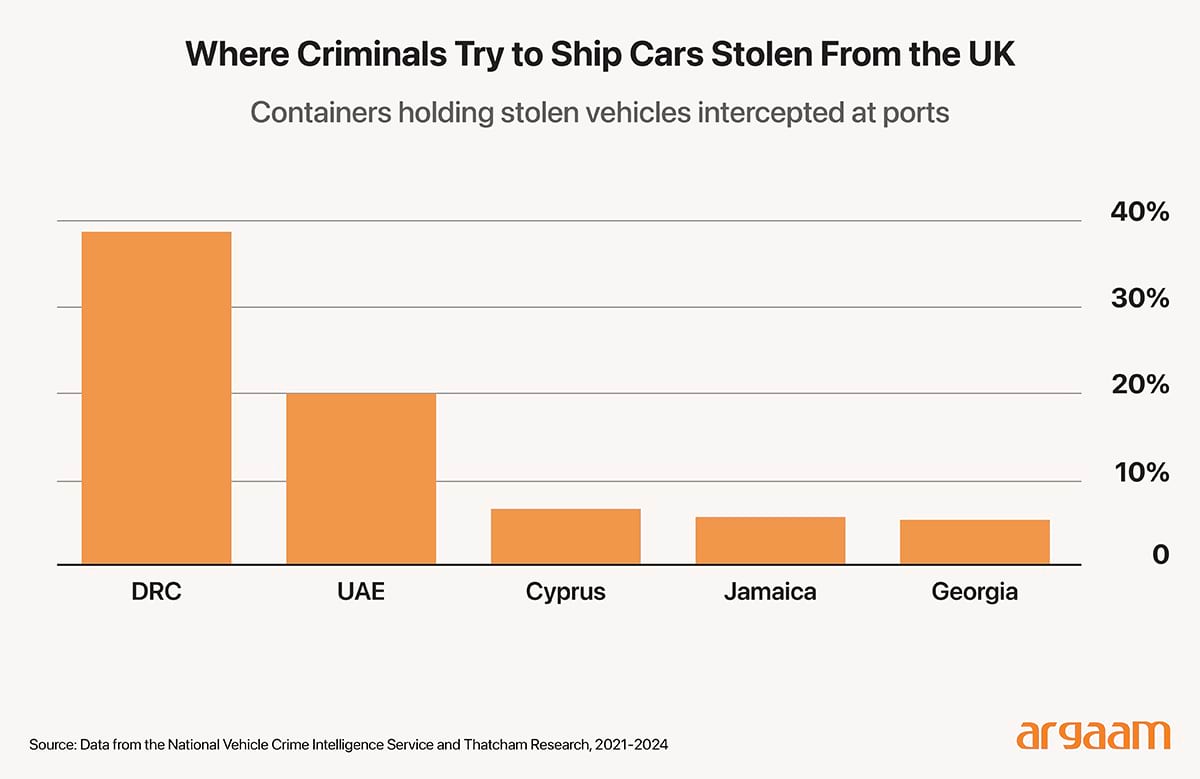
The Secret Lifecycle of Illicit Imports
Signal jammers have become the biggest threat to new cars because they interfere with the electronic systems that keep cars locked and secure. New cars often use remote keys or smart key systems that communicate wirelessly to lock or unlock doors. Signal jammers block these wireless signals, making it easy for thieves to open the cars without using a key. Cloning the stolen car is the method that allows criminal gangs after the theft to launder stolen vehicles into legitimate markets internationally, evading law enforcement and defrauding buyers and governments. They mainly obtain vehicle registration details, including makes, models, year, and the unique Vehicle Identification Number of cars in auction listings or through corrupt officials who can provide access to detailed vehicle data beyond public reach. Chile has the highest rate of car thefts globally, followed by Uruguay, Israel, Luxembourg, and then the US, which has around 288 vehicle thefts per 100,000 people. US drivers are now paying an average of $2,543 per year – or 212 per month -- for car insurance, reflecting a 26% increase from 2024 and a 52% increase since 2021. A significant driver of these rising costs is the surge in car thefts, which has led some insurance companies to refuse coverage for certain vehicle models frequently targeted by thieves.  The Money Trail of Stolen Cars
The financial incentive to import stolen cars illegally and sell them as legitimate vehicles is substantial, motivating criminal gangs and some unscrupulous dealers in the Middle East to engage in such practices despite the associated risks. Suppose a stolen 2023 Toyota Land Cruiser, which is valued at around $40,000 in 2025, is imported at a bargain price through illegal means from the US and sold as a legitimate used car in the dealer's country. The dealer pays the criminal gang $8,000 for the stolen Land Cruiser. This relatively low price reflects the vehicle’s stolen status and the gang’s need for quick liquidation. Since the vehicle appears legitimate, the dealer must pay customs duties, import tariffs, and taxes as required by law. Assume these costs amount to 45% of the declared value on customs documents. If the dealer declares the car at a slightly undervalued price of 30,000 to reduce customs fees and taxes, which are about $13,500. Other legitimate Import costs include shipping fees, registration, paperwork processing, minor repairs, approximately $2,500. The dealer sells the vehicle in the local market at the prevailing market price: $40,000 Gross Profit = Selling Price - Total Costs = 40,000−24,000 = $16,000. Addressing the root causes of this global phenomenon requires a focused and sustained crackdown on these criminal groups in the West, including stricter jail terms and fines, as well as investment from carmakers in R&D to improve technology aimed at protecting their cars. For authorities in the Middle East and GCC, adopting a mandatory traceability system for all imported cars and auto parts is essential. This system typically involves assigning unique identifiers, such as QR codes or digital certificates, to every auto part, which record information like manufacturing details, import/export data, and transaction history. This would at least increase transparency and reduce the circulation of illicit components in the legal market. |
|
|

|

|


|


|