




|
As Saudi Arabia advances its green hydrogen sector, it is evident that the global industry has proven far more complex than initially anticipated. Since the early 2020s, when countries like the US and those in the European Union first began adopting green hydrogen strategies and generating global excitement around its potential, the market dynamics and technological challenges have revealed significant uncertainties, as we explain in our analysis. Given this complexity, adopting de-risking strategies, which are designed to reduce investment uncertainties and attract private capital as we explain in the last part of this analysis, is crucial to ensure the long-term success of the green hydrogen sector in the kingdom. Saudi Arabia’s adoption of grey hydrogen in pilot tests within the transportation sector, as reported in the latest Vision 2030 annual report, indicates initial steps toward integrating hydrogen into the energy mix. However, grey hydrogen production involves significant CO₂ emissions and does not align with net-zero climate goals. So, the kingdom is committed to the next stage of the hydrogen industry, specifically green hydrogen, which is made by splitting hydrogen from water with machines called electrolyzers running on renewable power. 
The cost of complexity
While real estate projects typically unfold over months or even years To ensure a high global demand on green hydrogen, this requires a similarly coordinated and massive investment, such the one pursued by Saudi Arabia, from different countries around the world. While it plans an significant production, Saudi production alone cannot fully drive global demand but can serve as a key component within a broader supply base. Green hydrogen projects worldwide face high financial uncertainty, since increased production costs translate directly into higher capital expenditure (CAPEX) and operational costs, worsening the price gap between green hydrogen and the already available and tried fossil-fuel alternatives. This challenges the economic viability of many planned projects and may cause investors to hesitate to be involved in this emerging and complicated industry. In the US and the EU, the cost of green hydrogen production increased in December 2024 by 55% compared to 2022. The actual design and engineering of green hydrogen plants have proven more complicated than initially anticipated. The logistics has proven another key challenge. Supply chains for key components , such as electrolysers, storage tanks, pipelines, and fuel conversion technologies, are not yet fully developed or standardized. This immaturity leads to delays, shortages, and higher procurement costs. As shown in the previous chart, approximately 1.1 gigawatts worth of electrolysis capacity for hydrogen production was operational worldwide in 2023. This is very tiny of figure compared to the 263.1 gigawatts that were hoped for. And despite much higher capacities proposed or envisioned in feasibility studies about energy production (164.7 GW) or conceptual targets (263.1 GW), the actual projects that have secured firm financial commitment from investors and are moving ahead with concrete investment in 2023 amount to only 14 GW of production capacity.
When Innovation Meets Reality
Engineering complexities are another big hurdle behind the cancelation of many projects around the world in 2024. This hurdle often cause time overruns and supply chain bottlenecks, which further increase costs and delay market growth. We don’t want to be very technical, but just to give a basic idea behind the complicated process, projects require integrating cutting-edge electrolysers, renewable energy sources (solar, wind), conversion systems (to ammonia, methanol), and transport infrastructure as the factories should be established in remote areas. Scaling from pilot or demonstration plants to commercial-scale facilities introduces risks of component failures and underperformance, such as electrolyser degradation or energy inefficiencies. Other countries in our chart, though regionally close to the warring parties Iran and Israel, may see different effects according to their economic resilience and exposure: Likely, home prices could decline moderately or stagnate due to lowered investor confidence and higher financing costs. Rental prices may increase in some areas because of expected rise in inflation. This would tend to reduce or moderately decrease the P/R ratios in these countries, especially in Qatar and Egypt where the ratio was already borderline high, signaling that renting could become relatively more favorable compared to buying. 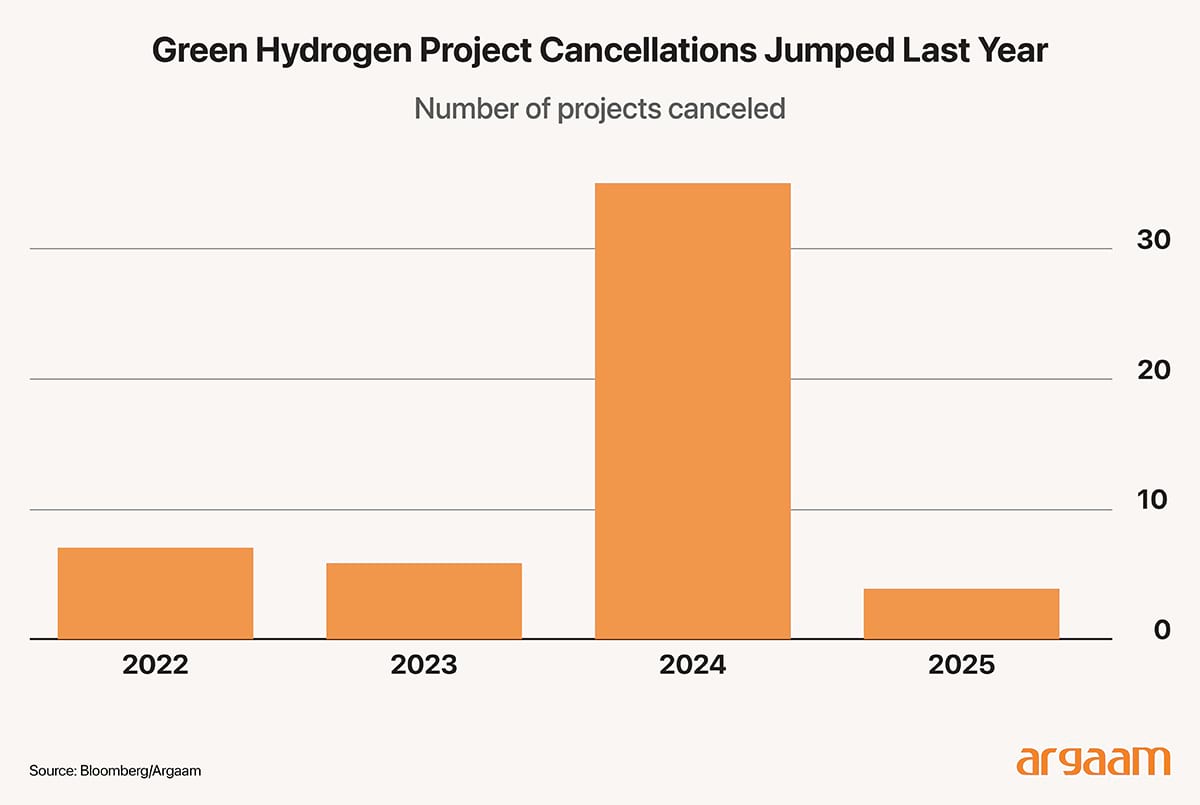
When production costs remain uneconomic alongside technical complexities, green hydrogen cannot compete effectively in existing energy markets, limiting demand from industrial users, transport sectors, and export markets. The lacklustre response from investors to this emerging industry and theri hesitancy slows the scale-up of production capacity, leading to limited green hydrogen availability on global markets, which suppresses demand as customers lack reliable, affordable supply options. Accordingly, the absence of affordable green hydrogen creates a vicious cycle: limited demand leads to small-scale production, which keeps costs high. Demand-side policies in importing regions—such as carbon pricing, quotas for low-emission products, long-term purchase agreements, and regulatory frameworks—are essential to create stable markets that can absorb increased green hydrogen output. 
Roadmap to sustainble Green Hydrogen
Saudi Arabia’s ambition to become a global leader in green hydrogen hinges then crucially on effective de-risking mechanisms that can attract private capital, foster industrial growth, and ensure sustainable value capture. Given the capital-intensive and technologically complex nature of green hydrogen projects, it’s advisable that the kingdom adopts a multi-faceted, internationally coordinated approach to de-risk its large-scale investments. Saudi Arabia, while rich in resources and capital, can benefit significantly by fostering long-term purchase agreements and demand aggregation with established hydrogen importers: the Netherlands (35% of global imports) followed by the United States, France, Germany, and Mexico. This reduces price and offtake uncertainty by creating a stable market environment, thereby attracting more private investors. Another ‘de-risking’ measure is also about designing innovative credit schemes, guarantees, and loan facilities which incentivize private sector participation while managing public exposure. The introduction to investors of instruments such as minimum price guarantees, when the government assures producers that they will receive at least a specified minimum price per unit of green hydrogen sold. If the market price falls below this guaranteed price, the state pays the difference to ensure stable revenue streams. |
|
|

|

|


|


|