The low-cost airline model was built on a precise discipline: compress the cost of the seat until the fare becomes the reason to travel, then extract whatever additional margin the passenger will bear before boarding.
That discipline produced some of the most capital-efficient businesses in aviation history. But It also produced a structural blind spot. The low-cost carrier owns the most commercially decisive moment in the traveller's journey — the confirmation of a destination — and then systematically walks away from everything that moment makes financially possible.
So, the most commercially valuable moment in tourism is not the hotel check-in or the tour departure. It is the ten seconds after a passenger confirms a flight. The airline that triggered the customer’s decision captures the fare.
Everything that follows — the accommodation, the experiences, the transfers, the dining — flows from that single decision. Every other participant in the tourism value chain captures what the fare made possible.

Commission Is Not Pricing Power
The launch of Saudi Experiences — a booking platform embedded directly into the checkout flow of flynas, the first and only airline listed on Tadawul, developed jointly with the Saudi Tourism Authority, offering more than 150 activities across 15 Saudi destinations in ten languages — is the airline's first attempt to claim a share of the spending its seats make possible.
The economic logic is sound. The execution question is harder. Saudi Arabia's Tourism Exchange already distributes local supplier inventory across global platforms including Booking.com and Trip.com. A platform that aggregates the same content from a more convenient entry point generates commission income. It does not generate pricing power.
The traveller who finds a desert safari at checkout and then finds the same product at the same price on a competing platform has no structural reason to book through flynas.
Flynas was not starting from zero. Its IPO prospectus already identified Nasholidays as part of its differentiated product offering and said the airline intended to expand its holiday-package portfolio while increasing direct sales and reducing reliance on third-party channels.
The prospectus also shows the existing ancillary base. Ancillary revenue rose from SAR 390.8 million in 2021 to SAR 779 million in 2023, before reaching SAR 795.8 million in the first nine months of 2024.
Dividing those figures by reported passengers implies roughly SAR 69.7, or $18.6, per passenger in 2023 and SAR 73.2, or $19.5, in the first nine months of 2024. These are our calculations rather than company-reported KPIs.
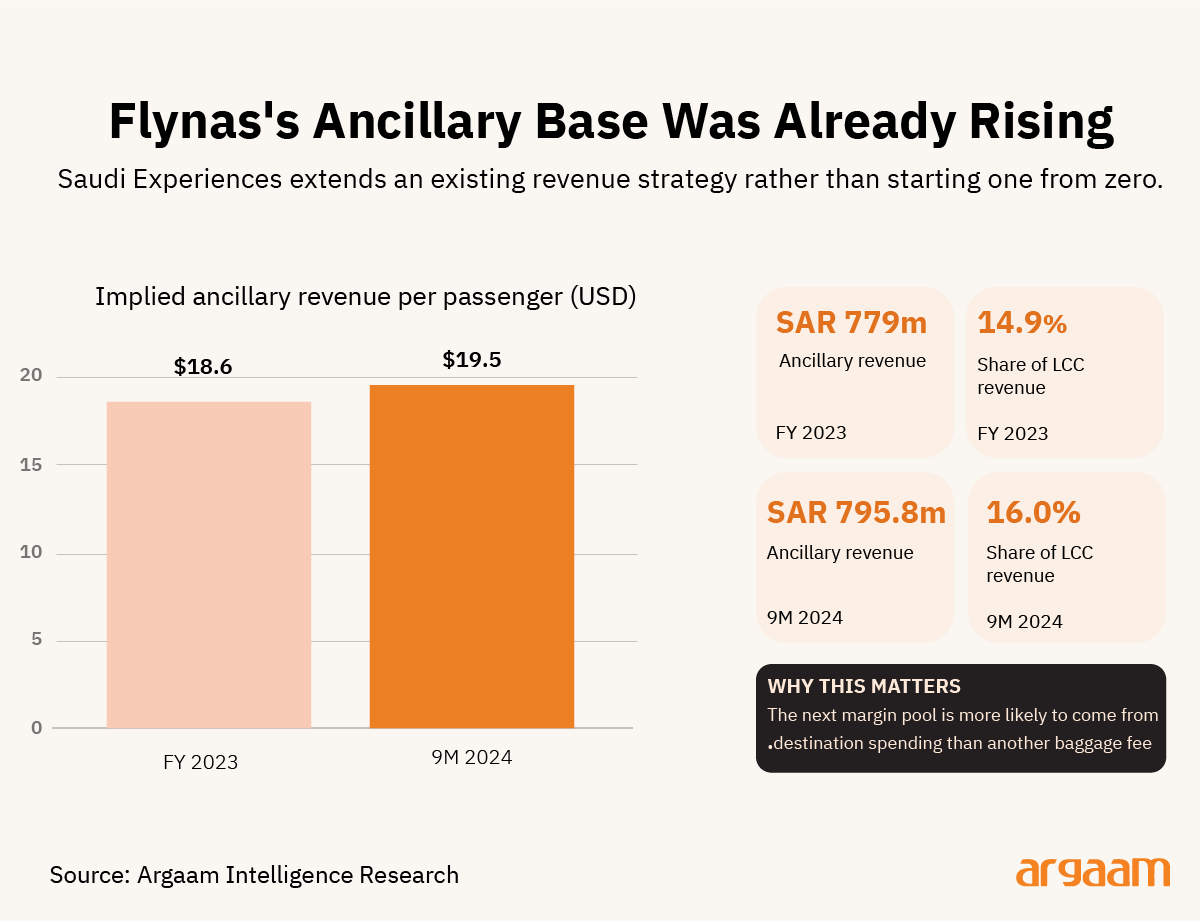
That is not a weak ancillary business. Ryanair generated €23.94 per booked passenger in FY2026 — though comparing that figure directly to flynas requires caution, since the two airlines operate in different currencies, fly different types of routes, and count ancillary revenue using different product definitions. The number is a useful reference point, not a precise benchmark.
The Desert Tour That Makes Flynas Smarter
The real test is not whether flynas can sell experiences. It is whether selling experiences eventually makes flynas a smarter airline.
If enough passengers book through Saudi Experiences, flynas starts seeing something no competitor can see from the outside — which routes produce travellers who spend, which destinations generate repeat demand, and which passenger types convert most reliably.
That data does not just generate commission income. It informs which routes to open, how to price seats, and where to put capacity. The platform stops being an add-on and starts being an input into how the airline runs itself.

The 30-second window
Flynas has announced 150 activities across 15 destinations — a credible inventory for a launch.
What it has not announced is anything that would allow an assessment of the platform's commercial significance: no bookings disclosed, no gross transaction value, no commission rates, no conversion data, no confirmation of whether Saudi Experiences is embedded throughout the checkout process or surfaced selectively, and no disclosure of whether the Saudi Tourism Authority partnership carries exclusivity.
That last point is the most consequential. Saudi Arabia's Tourism Exchange operates as an open distribution infrastructure — local suppliers upload inventory, synchronise availability, and push content simultaneously across multiple channels including Booking.com and Trip.com.
If the same desert safari that appears on Saudi Experiences at checkout is also discoverable on a global Online Travel Agency 30 seconds later at the same price, the platform's commercial advantage reduces to timing.
In this 30-second window after reserving the seat at flynas has genuine commercial value: the passenger is attentive, the intent to spend is high, and the path of least resistance is to book what is surfaced in front of them.
But the checkout window closes. The traveller who does not convert at that moment enters a distribution ecosystem — Booking.com, TripAdvisor and other travel agencies — that is better funded, more deeply indexed, and present across every device and platform the passenger uses from that point forward. Flynas owns thirty seconds of that journey. The OTA ecosystem owns everything that follows.
Catching the passenger at checkout is better than not catching them. But timing is a thin basis for a margin argument. A traveller who books at checkout because it is convenient rather than because the product is unavailable elsewhere is not a captive customer.
They are a customer who happened not to look further. The distinction matters because one produces a conversion rate and the other produces structural pricing power — and only one of those is worth building a business around.
When Ancillary Revenue Becomes Essential, Not Optional
The timing of the Saudi Experiences launch reflects more than strategic ambition. Flynas carried 15.8 million passengers in 2025 and reported an adjusted net profit of SAR 556 million — a 7% adjusted margin that represents a genuinely profitable core business.
But the statutory result was a SAR 527 million loss after SAR 1.083 billion of IPO-related costs, and the first quarter of 2026 introduced a more uncomfortable set of signals. Available seat kilometres grew 19% — the airline is expanding capacity aggressively — but passengers grew only 9%, load factor fell from 84.6% to 80.7%, revenue per available seat kilometre declined 6%, and net profit dropped 20%.
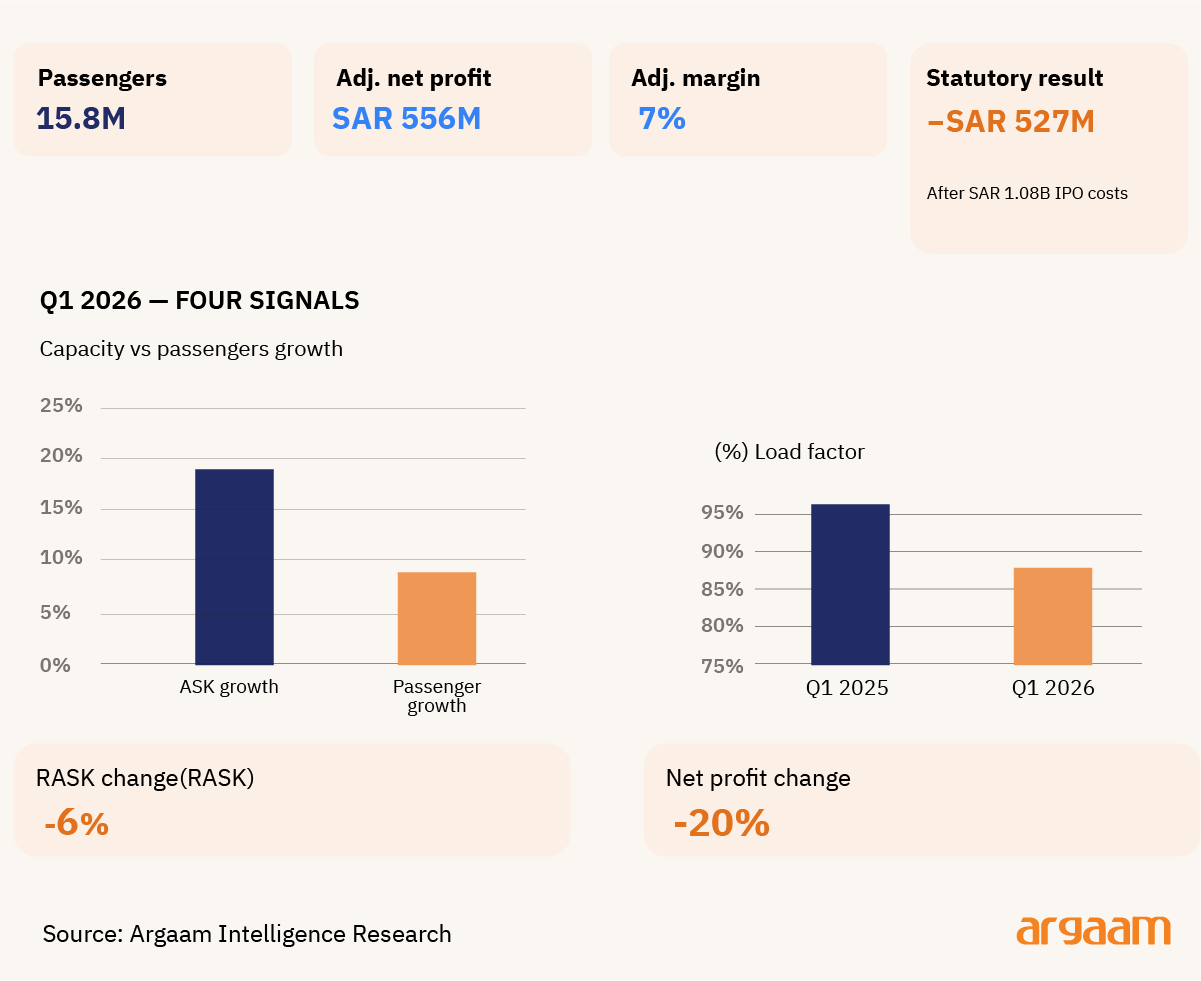
The pattern that emerges from those four data points is specific and important. Flynas is adding seats faster than it is filling them, and earning less from each seat it does fill. That combination — capacity expansion outpacing demand growth alongside unit revenue compression — is the condition under which ancillary revenue stops being a strategic opportunity and becomes a financial necessity.
When the core yield is declining, every additional riyal extracted from the passenger beyond the fare carries more weight in the economics of the business. Saudi Experiences arrives in that context. It is not only an attempt to capture downstream spending from a position of strength.
It is also a mechanism for recovering per-passenger economics at a moment when per-seat economics are moving in the wrong direction. That distinction does not diminish the platform's strategic logic — the destination monetisation argument remains sound regardless of the quarterly results. But it makes the distribution question considerably more urgent.
A platform that generates commission income on commoditised inventory is a modest help when load factors are under pressure. A platform that controls differentiated, exclusive content that passengers cannot find elsewhere is a structural answer.

What EasyJet's Numbers Imply for Flynas
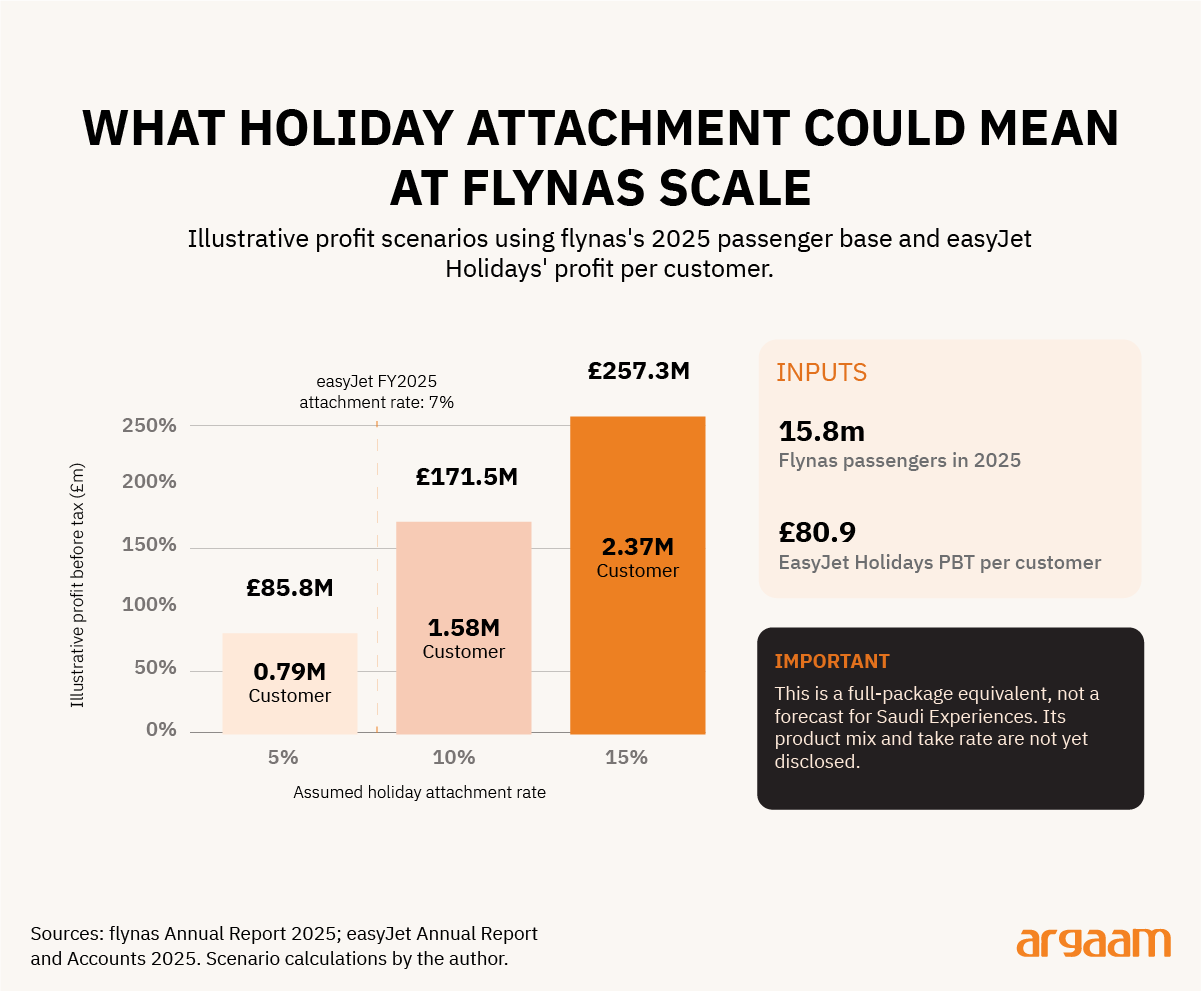
EasyJet Holidays generated £250 million in profit from 3.1 million holiday customers in FY2025 — a 7% attachment rate against its total passenger base and approximately £80 per holiday customer in profit before tax.
As we outlined earlier in this analysis, Flynas carried 15.8 million passengers in 2025. If Saudi Experiences achieves even a fraction of easyJet's attachment rate, the numbers become material quickly.
At 5% conversion, that is 790,000 holiday customers. At 10% it is 1.58 million. At 15% it is 2.37 million. Apply easyJet's profit per customer to each scenario, and the implied profit contribution ranges from approximately £64 million at the low end to £191 million at the high end.
These are not forecasts. They are a translation of easyJet's proven economics onto flynas's passenger base — a way of sizing the prize rather than predicting the outcome.
The gap between the two carriers is very important to explain: easyJet owns hotels, controls inventory, and has been building its holiday business for years. Flynas launched a platform on 7 July 2026.
The arithmetic does not predict what flynas will achieve. It shows what the opportunity is worth if the platform works. Even at modest conversion rates, the implied profit contribution is material.
And the gap between earning a thin commission on tours anyone can book elsewhere and earning the margin that comes from controlling what the traveller can only find through flynas is not a detail — it is the difference between a distribution business and a defensible one.
Jet2 is a UK-based low-cost airline that has built one of Europe's most integrated package holiday businesses alongside its core flying operation.
It raises a harder question than easyJet does. Package customers represented 63.3% of Jet2's total passengers in FY2026 — meaning the holiday business is no longer a retail add-on sitting beside the airline. It has become large enough to influence how the airline itself operates.
Marketing, pricing, and capacity decisions move between package and flight-only demand in both directions. The airline shapes the holiday product and the holiday product shapes the airline's network.
When a Platform Is Not Enough: The Norwegian Conclusion
Norwegian is a Scandinavian low-cost airline based in Norway. It shows what it looks like when an airline decides that incremental is not enough.
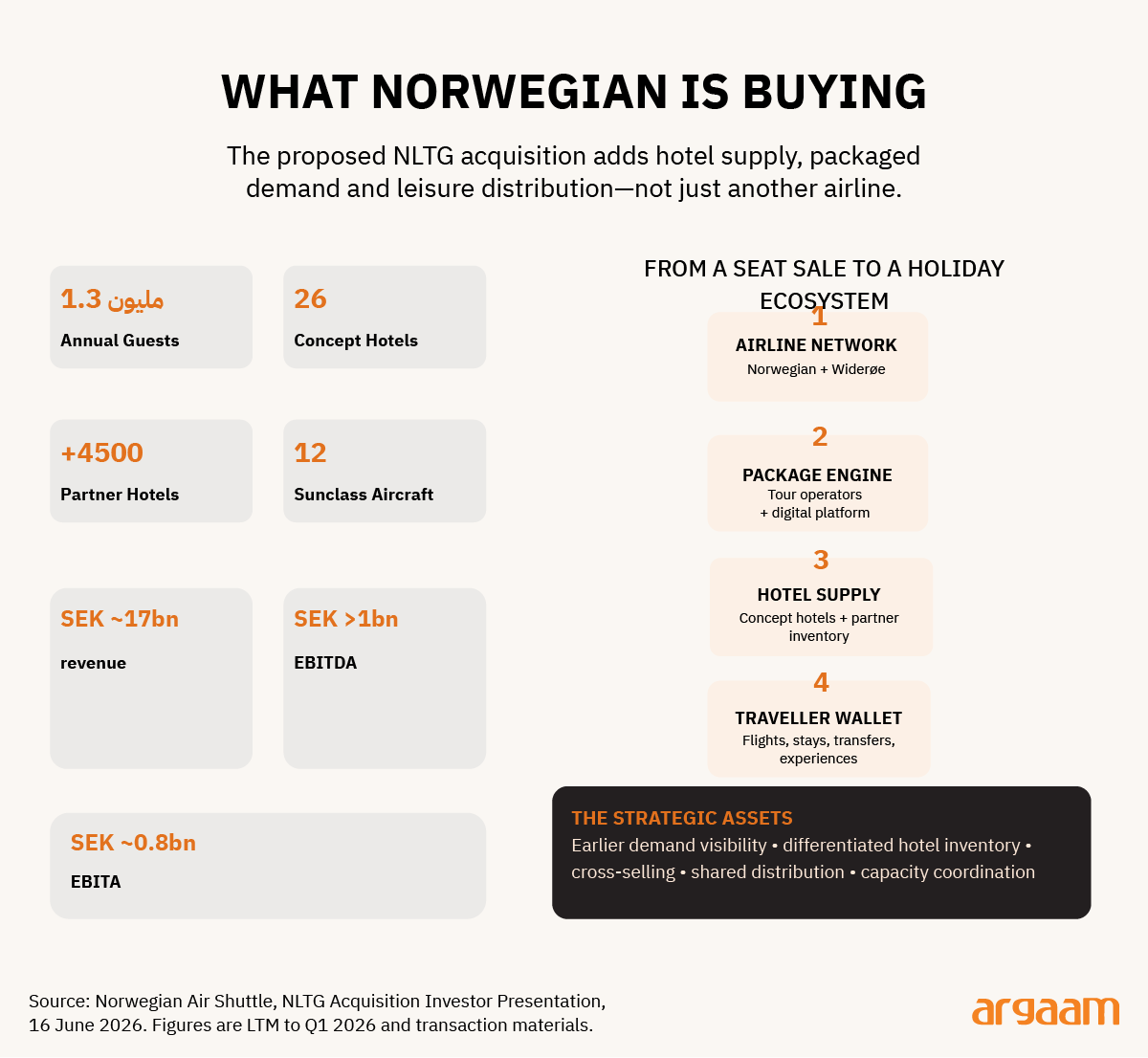
Its proposed SEK 7.94 billion ($818 million) acquisition of Nordic Leisure Travel Group (NLTG) would transform it from a pure low-cost airline into a fully integrated travel company.
The deal adds tour operators, 26 branded concept hotels, access to 4,500 partner hotels, and a 12-aircraft leisure carrier to a group already built around Norwegian and regional carrier Widerøe.
Shareholders approved the transaction on 8 July 2026, though regulatory clearance is still required before completion, with the fourth quarter of 2026 as the target closing date.
Nordic Leisure Travel Group is not a small addition. It brings approximately 1.3 million annual guests, SEK 17 billion ($1.79 billion) in revenue and more than SEK 1 billion ($105 million) in EBITDA, meaning it generates real operating cash before the accounting adjustments.
But the financial scale is not the most interesting part. Its concept hotels account for only around one quarter of total tour-operator volume yet generate approximately 60% of gross profit.
Nordic Leisure Travel Group owns 2 concept hotels. These proprietary resorts operate in popular sun destinations, including Spain, Greece, Cyprus, Türkiye, and Thailand. They connect seamlessly with NLTG's tour operators (Ving, Spies, Tjäreborg) and Sunclass Airlines to deliver fully integrated holiday packages.
When Nordic Leisure Travel Group's concept hotels generate 60% of gross profit from only 25% of bookings, it means those hotels are earning roughly four times the margin of a standard hotel booking on a per-room basis. Norwegian is acquiring that pricing power — not the commoditised hotel beds that any online travel agency can also sell.
Norwegian mastered the low-cost seat economics, stripping the product to its bare minimum and filling planes at the lowest sustainable price. But the seat was only ever the entry point to a much larger spending chain.
The passenger who pays $80 for a flight to Malaga might spend $800 on the hotel, $200 on transfers, and $500 on food, excursions and experiences once they land. The airline captured the $80.
The seat was never the destination. It was the beginning of a spending chain the airline built but never fully entered. Norwegian spent years perfecting the economics of the entry point — the fare, the load factor, the ancillary fee — while the hotel, the tour operator, and the experience provider captured everything that followed.
The $818 million acquisition is the acknowledgement that optimising the entry point has a ceiling. Beyond that ceiling sits a much larger commercial opportunity — one that requires not a better checkout flow but ownership of what the traveller actually came to do. The seat gets them there. Everything else is where the money is.