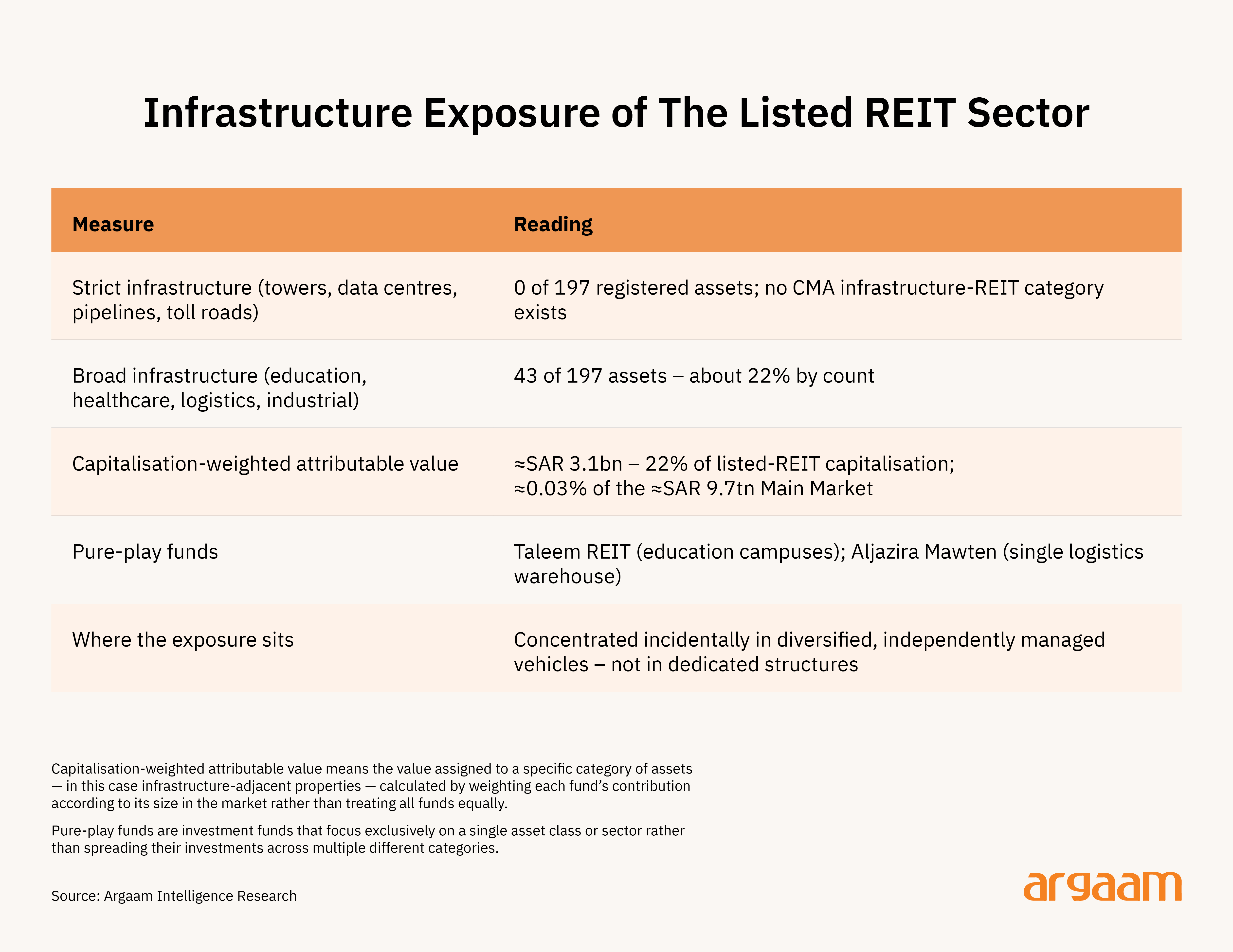
Of the nineteen listed Saudi REITs examined in this analysis — covering 197 individual assets — infrastructure emerges as the most conspicuous gap in the market.
In its strict definition, infrastructure exposure across the entire listed REIT sector is zero. The regulatory framework does not even have an infrastructure category.
Looking more broadly, around 43 assets carry characteristics that resemble infrastructure — logistics facilities, utilities-adjacent properties, and similar — worth roughly SAR 3.1 billion when weighted by market capitalisation.
That represents approximately 22% of total listed REIT value but a negligible fraction of the Main Market overall.
Crucially, these holdings sit inside diversified funds managed independently rather than in dedicated infrastructure structures — meaning the exposure is incidental, not deliberate.
The REIT wrapper in Saudi Arabia is legally confined to real estate. The July 2025 amendments to the Real Estate Investment Funds Regulations expanded development exposure on Nomu but left that boundary intact.
Nothing in the current framework prevents broad infrastructure-adjacent holdings — but nothing enables a dedicated infrastructure REIT either.
⛔
The Paradox: The Assets Exist, the Access Does Not
Saudi Arabia is already monetising infrastructure cash flows at enormous scale.
Aramco has completed three major sale-and-leaseback transactions on its pipeline infrastructure — an oil pipeline deal worth $12.4 billion in 2021, a gas pipeline deal worth $15.5 billion in 2022, and a Jafurah midstream transaction worth approximately $11 billion in 2025. Each packages exactly the kind of income a REIT is designed to hold — contracted, long-duration, and investment-grade. But the equity in all three sits with offshore private consortia rather than listed local vehicles.
BlackRock's reported exploration of a sale of its gas pipeline stake by mid-2025 confirms there is an active secondary market for these assets — which means the raw material for a listed infrastructure vehicle already exists. The question is whether the regulatory framework will evolve to allow it.
In parallel, PIF took TAWAL, the Kingdom’s dominant tower company with well over fifteen thousand sites, private; Humain has secured 211 land plots and, with DataVolt, launched a multi-gigawatt AI data-centre programme; and the National Privatisation Strategy targets some US$64 billion of private capital across roughly 200 projects, with the National Infrastructure Fund created expressly to crowd capital in.
The domestic private-capital ecosystem tells the same story from beneath the listed market. Of roughly US$21.6 billion in Saudi private-capital assets under management (September 2025), real estate accounts for US$12.2 billion (56%) and private equity and venture US$8.9 billion (41%); private debt, infrastructure and natural resources are marginal. The pipeline replicates the pattern – of 154 funds in market seeking US$19.1 billion, four-fifths are real-estate vehicles – and the largest managers by capital raised are sovereign- or bank-linked (the top three alone account for 45.8% of raised capital).
Infrastructure income, in short, is absent not only from the listed REIT shelf but from the domestic fund industry altogether; the only Saudi infrastructure equity that trades anywhere trades in private offshore consortia.
The consequence is a structural exclusion: domestic retail and institutional investors – the same clientele that oversubscribes REIT distributions – cannot buy the Kingdom’s most bankable income streams, while foreign private capital can.
An infrastructure REIT class is, at its core, the mechanism that resolves this asymmetry.
🔍
What Global Markets Show
Infrastructure is not a niche in global REIT markets — it is approaching half of the entire asset class by capitalisation. Of 782 listed REITs across around thirty markets, 183 are infrastructure vehicles representing roughly $1 trillion of a $2.3 trillion total — led by digital infrastructure, industrial and logistics, and healthcare.
The lesson for Saudi Arabia is about sequencing and template. The American infrastructure REIT class grew bottom-up over decades from private landlords. No late developer has replicated that path.
China and India instead created the class top-down as a deliberate policy instrument — designed to recycle state-originated infrastructure capital into listed vehicles, with retail participation built in and the regulatory framework tailored to concession assets rather than freehold property.
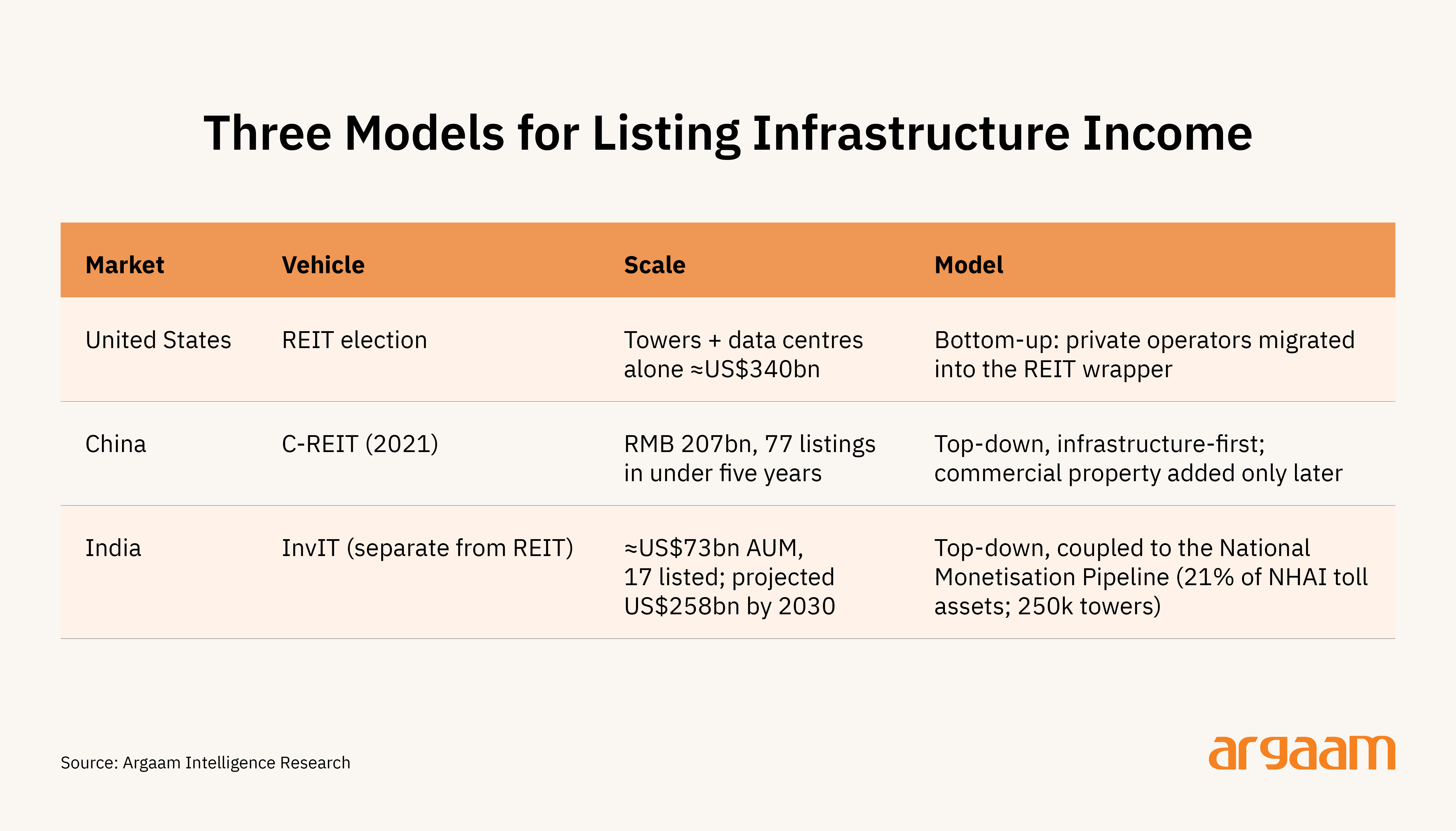
Saudi Arabia — where the state originates virtually all infrastructure and already runs an active monetisation programme — is structurally in the China-India camp. There is one important difference: Saudi Arabia has already built the harder part of the institutional apparatus in reverse order.
Commercial REITs came first, which means listing rules, distribution infrastructure, and retail familiarity with the wrapper already exist. China had to build all of that from scratch alongside the infrastructure class itself.
The Chinese experience adds a second lesson on ownership design. The C-REIT is deliberately a hybrid — part listed vehicle, part patient institutional capital, part state instrument — engineered to recycle private and institutional equity into largely state-owned infrastructure without the over-financialisation the United States experienced before the global financial crisis.
Saudi Arabia's ownership structure already resembles that landscape — a bank-affiliated commercial core beneath a dominant sovereign owner, with independents and foreign managers only now arriving. That is precisely the environment in which the state-anchored hybrid is the feasible template, not the American bottom-up model.
💎
Saudi Arabia Has the Assets, the Investors, and the Demand
The assets are identifiable today. TAWAL's tower portfolio, data centres from the Humain-DataVolt programme, secondary stakes in Aramco's pipeline leases, desalination and power assets with government offtake contracts, and airports under privatisation. A single tower or data-centre listing would exceed the entire current infrastructure exposure of the listed REIT sector several times over.
Demand is already there. The Saudi asset management industry reached $306 billion by mid-2025 — up 21% year on year — and is targeted to exceed $500 billion by 2030. Nearly 1.6 million retail investors now hold public funds, a third of whom already own REITs. The wrapper is familiar. Distribution yields on existing REITs compress into a 6% to 7.6% band because investors compete for the mandatory 90% payout — contracted infrastructure income serves exactly that appetite.
Foreign investors gained full direct market access in February 2026. Insurance and pension pools need long-duration riyal income that today only sovereign sukuk provide. And an ijara-based structure makes the vehicle naturally Shariah-compliant — a differentiator no other infrastructure REIT market offers at scale, with obvious appeal to GCC and Islamic investors beyond Saudi Arabia.
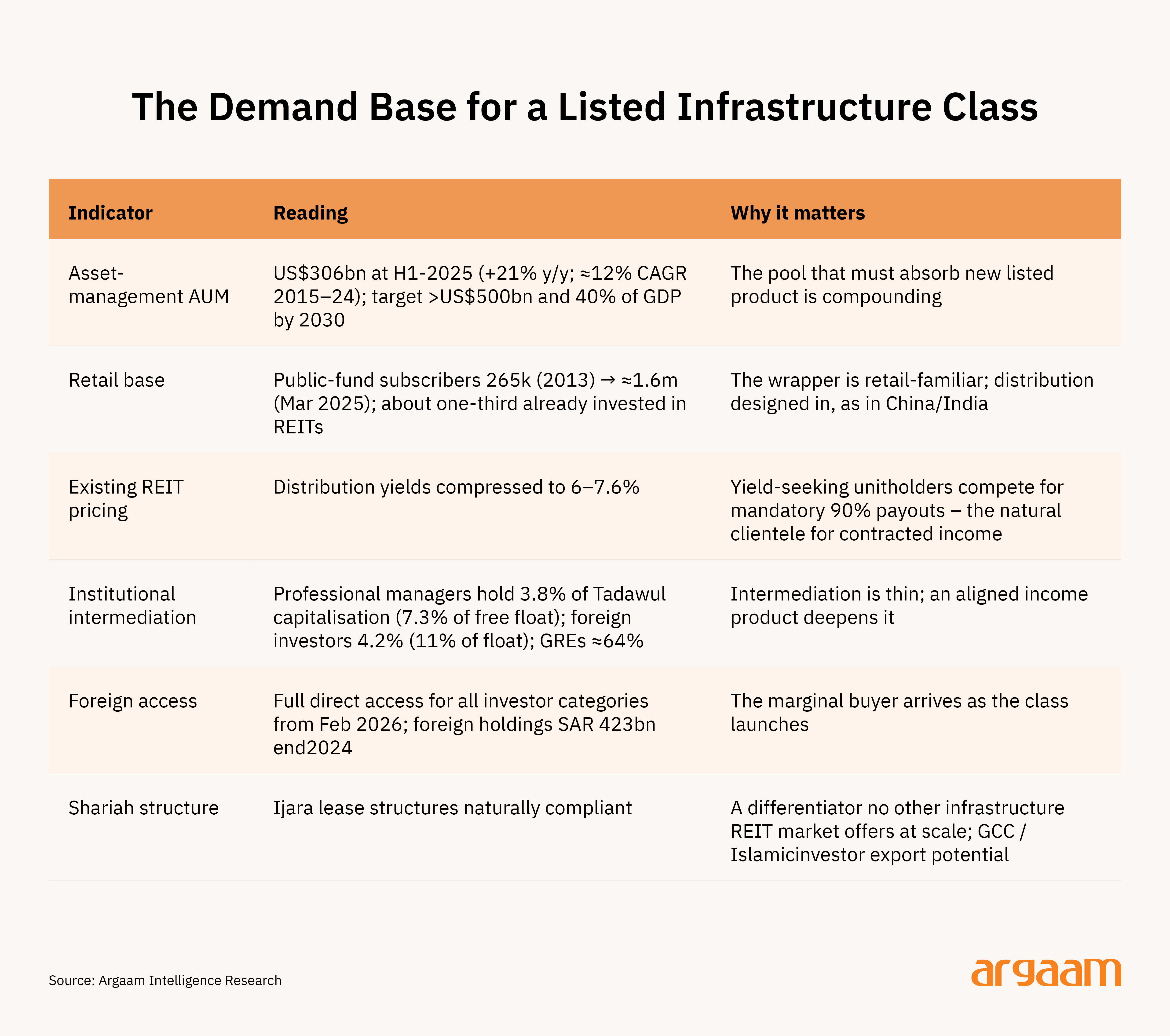
There is a market-structure argument too. Ownership of the Saudi exchange is concentrated among government-related entities – close to 64% of total capitalisation at end-2024, with Aramco alone about 67% and the seven largest issuers more than 80% – while professional asset managers hold just 3.8% of capitalisation and foreign investors 4.2%.
The result is thin institutional intermediation, low genuine float and retail-driven price discovery.
A listed infrastructure class does not merely add product; it adds precisely the aligned, income-focused institutional product the Financial Sector Development Program’s capital-market objective calls for, in a segment where the state’s own monetisation programme guarantees the deal flow.
Finally, there is a valuation-credibility argument. The pervasive NAV discounts in the existing sector rest on a wedge between appraised values and market pricing: the median market-implied capitalisation rate is about 6.7%, against roughly 5.6% on FY2024 appraised asset values – the sector’s discount re-expressed as yield.
The manager-type ordering survives the change of denominator: bank-sponsored funds’ income is priced more cheaply on both measures (median asset cap rate about 6.6% versus 5.3% for independents).
Concession assets valued on contracted, government-counterparty cash flows are far harder to dispute; an infrastructure segment could import the valuation credibility the property segment has struggled to establish – while recycling state capex into private hands without lengthening bank balance sheets.
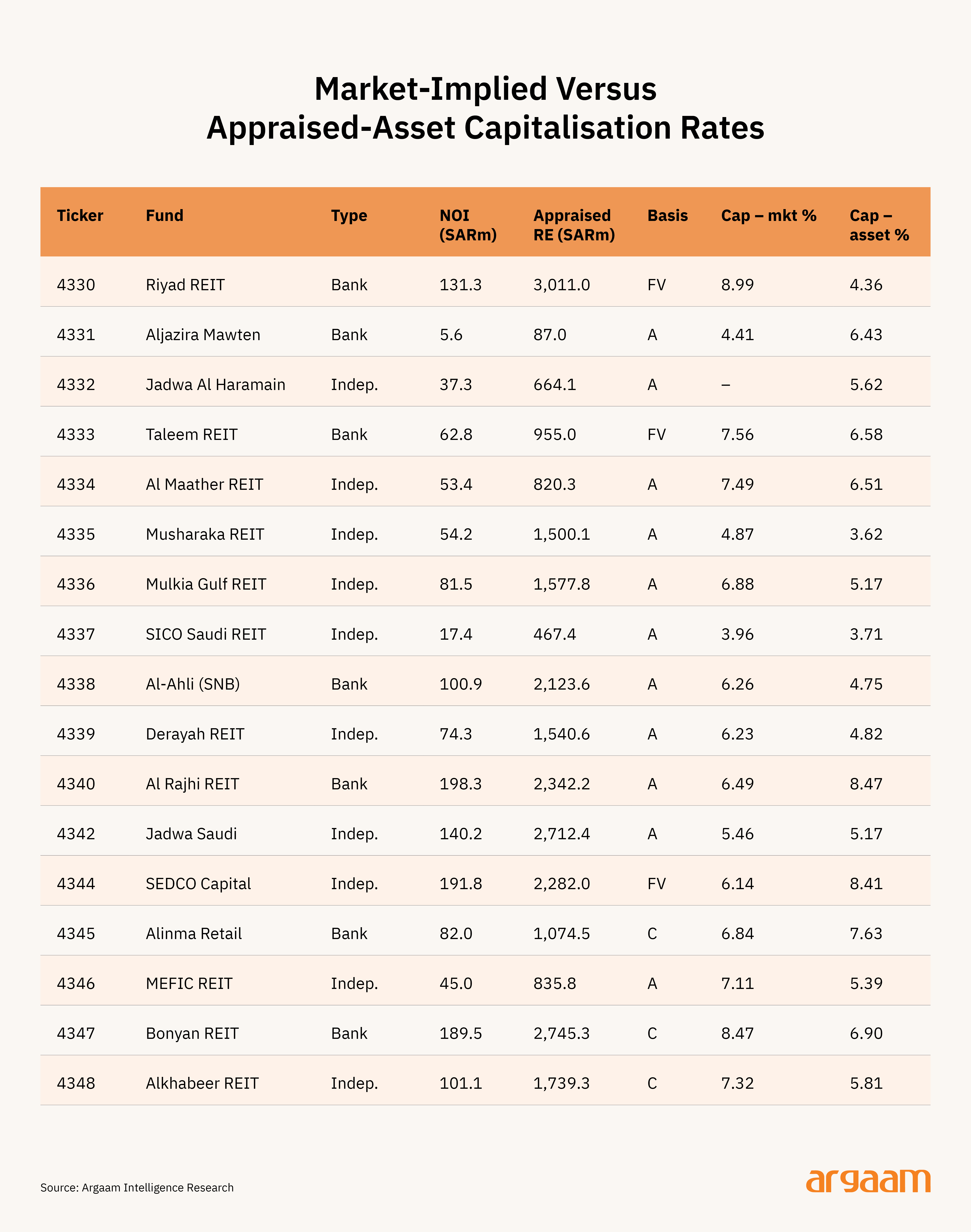
Note: Net operating income is estimated using EBITDA. The market capitalisation rate is calculated by dividing net operating income by total enterprise value — the inverse of the EV/EBITDA multiple.
The asset capitalisation rate divides the same net operating income by the appraised value of the real estate from FY2024 valuation reports and financial statements. Assets are classified by valuation basis: independent appraisal, fair value as reported in the accounts, or cost-model carrying value — where the cost-model figure produces an upper-bound cap rate estimate rather than a precise one.

Getting the ownership structure right
Two design questions need answering before a Saudi infrastructure REIT can be built properly.
The first is the legal wrapper. Most of the candidate assets — pipeline leases, tower concessions, water offtakes — are contracted rights rather than freehold property.
Stretching the existing REIT regulations to accommodate them would be a poor fit. A dedicated instrument, similar to India's InvIT structure, built under the CMA's existing traded-fund architecture would be cleaner and more appropriate.
The second is ownership design. Because the CMA would be writing the rules of this new category from scratch, it has a rare opportunity to assign each type of investor the role that matches their incentives rather than letting market defaults decide.
The sovereign is the only entity that can originate and seed strict infrastructure assets — so it should sponsor listings, not own the managers.
Bank-affiliated houses have the retail distribution networks and the conservative track record suited to stable, lower-risk assets.
Independent managers have demonstrated they can run complex, higher-yield assets — towers, data centres, logistics — so those concessions should be tendered to them. Insurance and pension funds provide the natural long-duration demand. Foreign investors bring international pricing discipline.
Every type of investor has a role to play. The design principle is not exclusion — it is fit. Each investor type is directed toward the mandate that matches what it is genuinely good at, and kept away from the combination of roles that its ownership structure would make conflicted or dangerous.