There’s a puzzle at the heart of this report that’s worth stating upfront. Perpetual futures — derivatives with no expiry, no delivery, and no quarterly roll cost but with a funding rate mechanism instead — are among the most traded instruments in global crypto markets.
In Q3 2025, perpetuals accounted for 78% of total crypto derivatives trading activity on major centralised venues, and total crypto derivatives volume reached $85.7 trillion in 2025, averaging $264.5 billion per day.
Against that backdrop, perpetuals are clearly the dominant contract form in crypto, yet they barely exist in regulated traditional finance and are absent entirely from Saudi Arabia's derivatives platform - where the listed offering is centred on MT30 index futures, single-stock futures and single-stock options, all cash-settled in SAR and cleared through Muqassa, and built around conventional exchange-traded structures, rather than open-ended perpetual instruments. That contrast can seem like a simple case of a regulatory lag.
That absence is the starting point. The question worth examining is whether the perpetual model has any structural logic within Saudi Arabia's evolving financial architecture, and if so, in what form, for which assets, and for which users.
The analysis doesn’t arrive at a recommendation in either direction. It tests structural fit rather than making a policy case. Among the user constituencies worth examining are the long-duration corporate treasuries emerging from Vision 2030's non-oil diversification — entities for whom repeated quarterly roll costs may represent a genuine hedging friction, rather than a minor transaction cost.

Born in 1988
Perpetual futures are not a crypto invention. Adam Gehr described undated futures contracts in 1988, drawing on the Chinese Gold and Silver Exchange Society of Hong Kong, which had operated such contracts for decades.
His central insight was that a single undated contract could serve the hedging purposes of multiple dated contracts, eliminating the cost of rolling positions at expiry.
Robert Shiller extended the idea in 1993, proposing perpetual futures as a mechanism for creating tradeable markets in illiquid assets — housing, infrastructure, economic indices — where conventional forward contracts are structurally difficult to design.
BitMEX applied the same mechanism to Bitcoin in 2016. The structure predates cryptocurrency by nearly three decades.
For Saudi Arabia, Shiller's logic carries live relevance. Non-oil GDP, real estate, and infrastructure indices — assets where spot markets are thin but hedging needs are real — are precisely the contexts perpetual futures were designed for.
Saudi regulators are not being asked to import a crypto novelty. They are being asked to revisit a long-standing financial economics idea now operating in regulated markets through SGX and Cboe.

Is the Saudi market ready to run the perpetuals model?
Saudi Arabia's Financial Sector Development Program aims to deepen capital markets and build the financial infrastructure a diversified private sector requires. The Saudi Exchange's derivatives platform, launched in 2020, sits within that effort.
As giga-projects, tourism, logistics and non-oil industry move from announcement to execution, a new generation of Saudi corporate treasuries is emerging with multi-year exposure to interest rates, currency-linked costs and energy prices.
Rolling quarterly futures contracts across a multi-year project life — paying roll costs and accumulating basis risk at each turnover — is a real and growing friction for these users. Perpetual futures address precisely this problem by replacing repeated rolls with a continuous funding-rate mechanism.
But economic appeal is not the same as practical feasibility. Perpetual futures work in crypto because 24/7 trading, deep leveraged arbitrage and continuous cross-exchange basis trading keep the funding mechanism honest. A Riyadh-based exchange with defined trading hours, position limits and constrained leverage cannot assume that ecosystem into existence.
Market makers would need both balance-sheet capacity and regulatory permission to run quasi-continuous basis-trading books — stepping in whenever the contract price diverges from its reference.
The funding rate is therefore not just a contract parameter. It is a design choice that presupposes intraday liquidity, arbitrage capacity and risk appetite the current Saudi market may not yet supply.
SAIBOR's twelve-month ceiling adds a further structural constraint for longer-horizon contracts. And feasibility differs materially by user: corporate hedgers need duration and cost efficiency; asset managers need benchmark integrity and depth; traders need two-way volatility; retail participants raise the hardest suitability questions.
When a company needs to hedge a risk that lasts several years — say, an airline protecting itself against rising jet fuel costs — it cannot buy one futures contract and hold it indefinitely. Traditional futures contracts expire on a fixed date, typically every three months.
So the airline buys a contract, it expires, the airline buys another one, that expires, and so on. Every time it switches from one contract to the next, it pays a transaction cost and accepts a small pricing mismatch between the old contract and the new one. Do this twelve times over three years and those costs and mismatches accumulate into a meaningful drag on the hedge.
A perpetual futures contract removes that problem entirely. Instead of expiring, it runs continuously. Rather than a fixed delivery date, it uses a funding rate — a small periodic payment made between buyers and sellers that keeps the contract price anchored close to the real-world spot price of the underlying asset. The airline holds one position indefinitely, without ever needing to roll it forward.
The funding rate is the mechanism that makes this work. If the perpetual contract price drifts above the spot price, buyers pay sellers a small fee to bring it back into line. If it drifts below, sellers pay buyers. This constant adjustment replaces the blunt mechanism of expiry and reissue with a continuous, self-correcting anchor.
The Structural Mismatch at the Heart of Saudi Commodity Hedging
At first glance, the commodity exposure argument for perpetual futures in Saudi Arabia is intuitive. Oil revenues remain the central variable in the Kingdom's fiscal position and current account dynamics.
Saudi Arabia anchors OPEC+ supply policy, meaning its own production decisions are among the most consequential price-moving inputs in global energy markets. Yet the events that move oil prices most violently — geopolitical escalations, supply disruptions, unexpected production decisions — do not respect quarterly expiry calendars or local trading hours.
A hedging instrument that expires on a fixed schedule, and trades only during defined sessions, is structurally misaligned with the commodity that underpins the economy it is meant to serve.
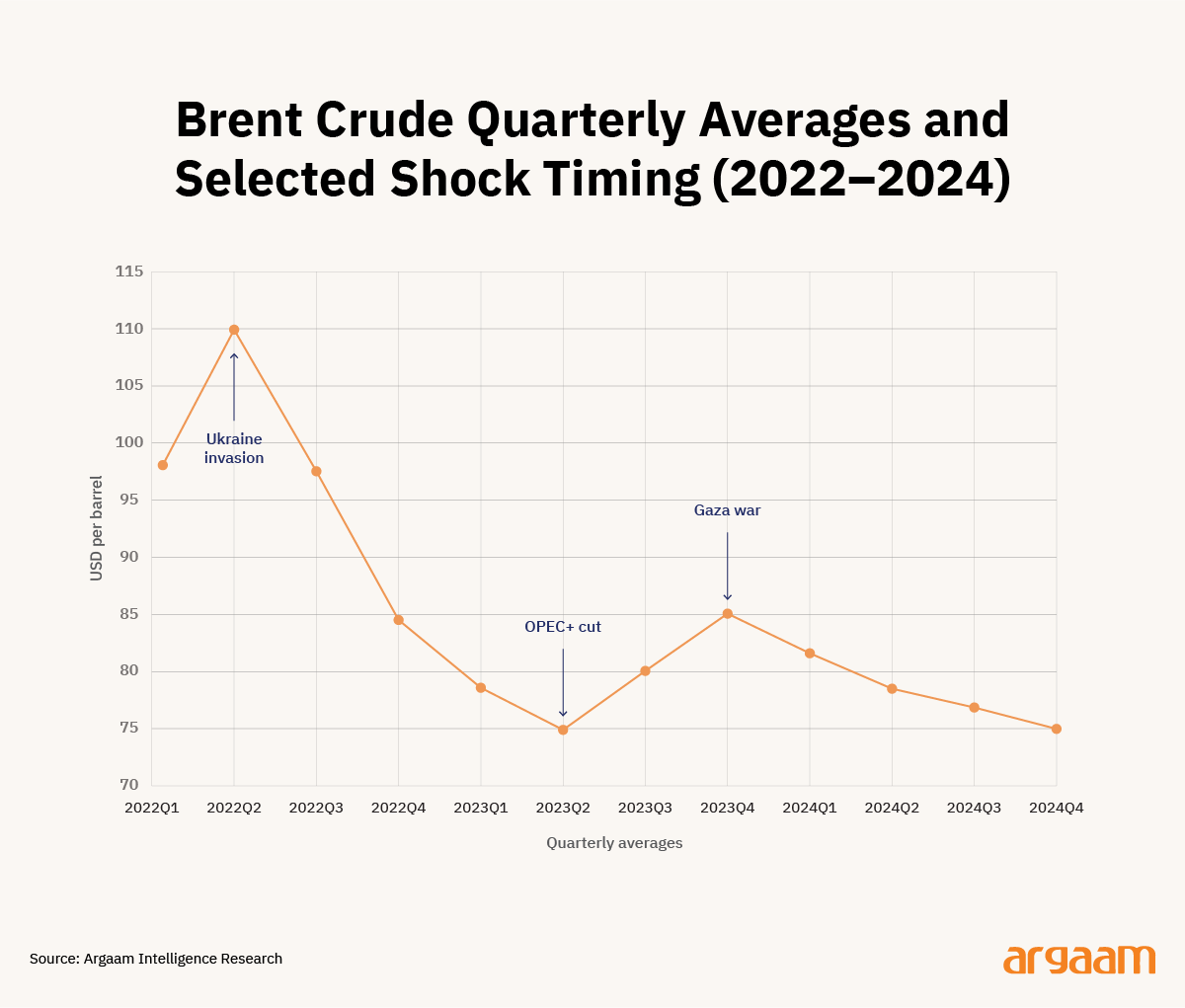
Brent crude quarterly averages and selected shock timing (2022–2024)
Quarterly averages are plotted, and event annotations refer to intra-period shock dates. The annotations correspond to the February 2022 Ukraine invasion, the April 2, 2023 OPEC+ voluntary output cuts, and the onset of the Israel–Hamas conflict around October 7–9, 2023, all of which triggered significant Brent moves within, rather than at the end of, standard quarterly expiry cycles.
◎ Note: Chart 1 makes the structural point clearly. The major oil shocks of 2022–2024 — the Ukraine-related price spike, the April 2023 OPEC+ cut and the October 2023 Israel-Gaza shock — all arrived between standard expiry cycles.
A Saudi user hedging oil-related exposure through dated quarterly futures would face basis risk at the moments when exposure became most acute. A perpetual contract, by design, would stay continuously live. The counterargument is equally important.
Saudi corporates with sufficient scale and credit quality can already access OTC markets and international benchmarks for continuous oil exposure management.
The real question is more specific: are there oil-exposed businesses in Saudi Arabia that cannot easily access international hedging markets — because they are too small, lack the credit standing, face documentation burdens, or simply do not have the internal expertise to navigate them?
If so, a domestic perpetual futures contract would solve a genuine gap. If not, it would simply duplicate instruments that already exist elsewhere and are already accessible to the users who matter most.
Saudi Arabia's oil exposure is also macroeconomic and sovereign as much as corporate, which means the strongest theoretical case for a Saudi oil perpetual may lie with a narrow set of downstream, petrochemical or large industrial users, rather than the broader private sector.
IMF analysis suggests that, at sovereign scale, Saudi Arabia's fiscal position is so closely tied to oil revenues that conventional corporate hedging frameworks address only a fraction of the Kingdom's actual exposure.
For many non-oil Saudi corporates, more immediate hedging needs lies in imported input costs, cross-currency liabilities and EUR/GBP purchasing exposure in sectors such as aviation, industrial imports and pharmaceuticals — shifting the discussion naturally toward FX, rates and benchmark quality.

The Infrastructure Question Saudi Arabia's Derivatives Market Still Needs to Answer
The benchmark infrastructure question may be the most analytically important of the four, because it’s here that economic usefulness and practical feasibility diverge most clearly.
Perpetuals rely on a continuous funding-rate mechanism anchored to a robust spot reference. If that reference is weak, illiquid or shallow, the elegance of the contract doesn’t solve the deeper market-design problem.
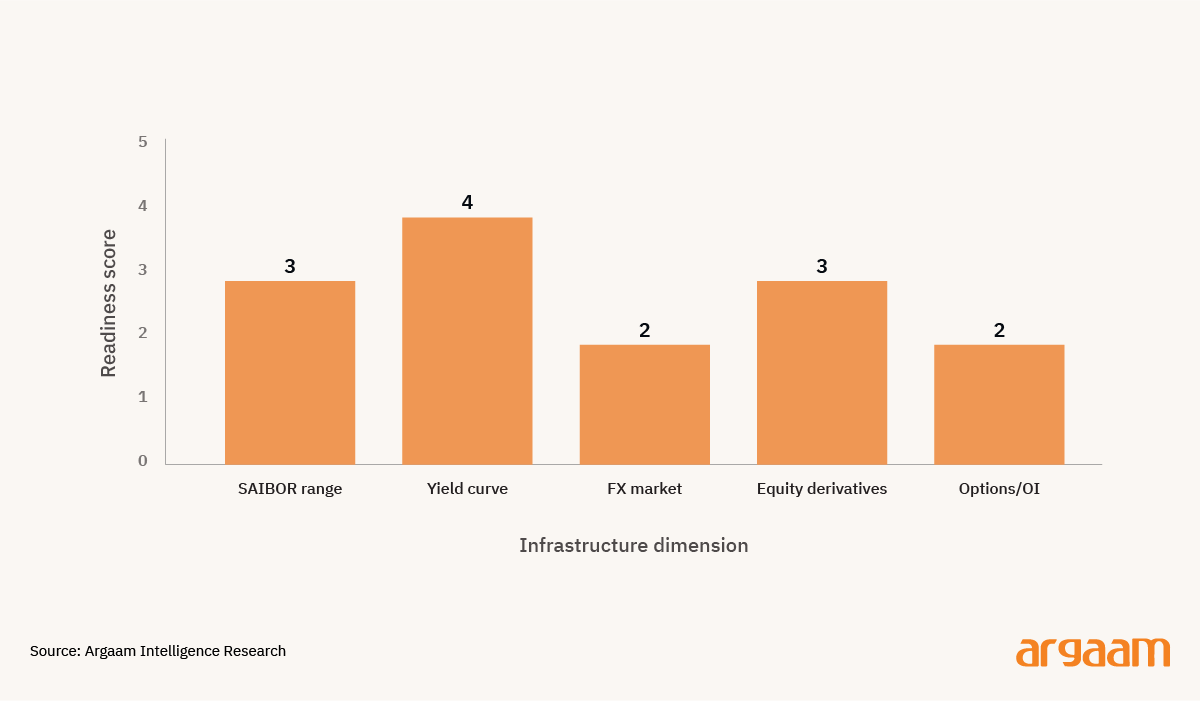
◎ Note on chart 2: Readiness scores are a hybrid of factual indicators and own analytical assessment, and not a formal index.
Saudi Arabia has a functioning government yield curve extending from short maturities to long tenors, and SAIBOR is a credible money-market benchmark, but the architecture remains stronger for short-term pricing than for anchoring a long-horizon perpetual rates market.
In FX, the USD/SAR peg narrows the volatility profile of the core currency pair, limiting the hedging appeal of a dollar-SAR perpetual. At the same time, the peg effectively imports US monetary policy into the Saudi system - transmitting external rate shocks into the domestic term structure.
Companies and projects carrying significant debt in Saudi Arabia — leveraged banks, heavily borrowed corporates, and project-financed assets — face greater exposure to interest rate movements than to currency fluctuations.
SAMA's own financial stability assessments of the Saudi banking and corporate sector confirm this pattern. That makes an interest-rate-linked perpetual futures contract genuinely interesting in principle: the underlying exposure is real and large.
But it simultaneously raises the bar. If interest-rate risk is what these users need to manage, the benchmark underpinning the contract must be robust and long-dated — which is precisely what Saudi Arabia's current rate infrastructure, with SAIBOR capped at twelve months, does not yet fully provide.
SAIBOR is published for six maturities — from overnight up to one year. That means the longest official SAIBOR rate is twelve months. If you are designing a financial contract that needs a reliable reference rate for five, ten, or twenty years — as a perpetual futures contract on long-horizon interest rates would — SAIBOR cannot provide it. You would need a longer-dated yield curve to anchor the contract reliably, which is precisely the gap the piece is identifying.
Perpetual Futures and the Saudi Regulator
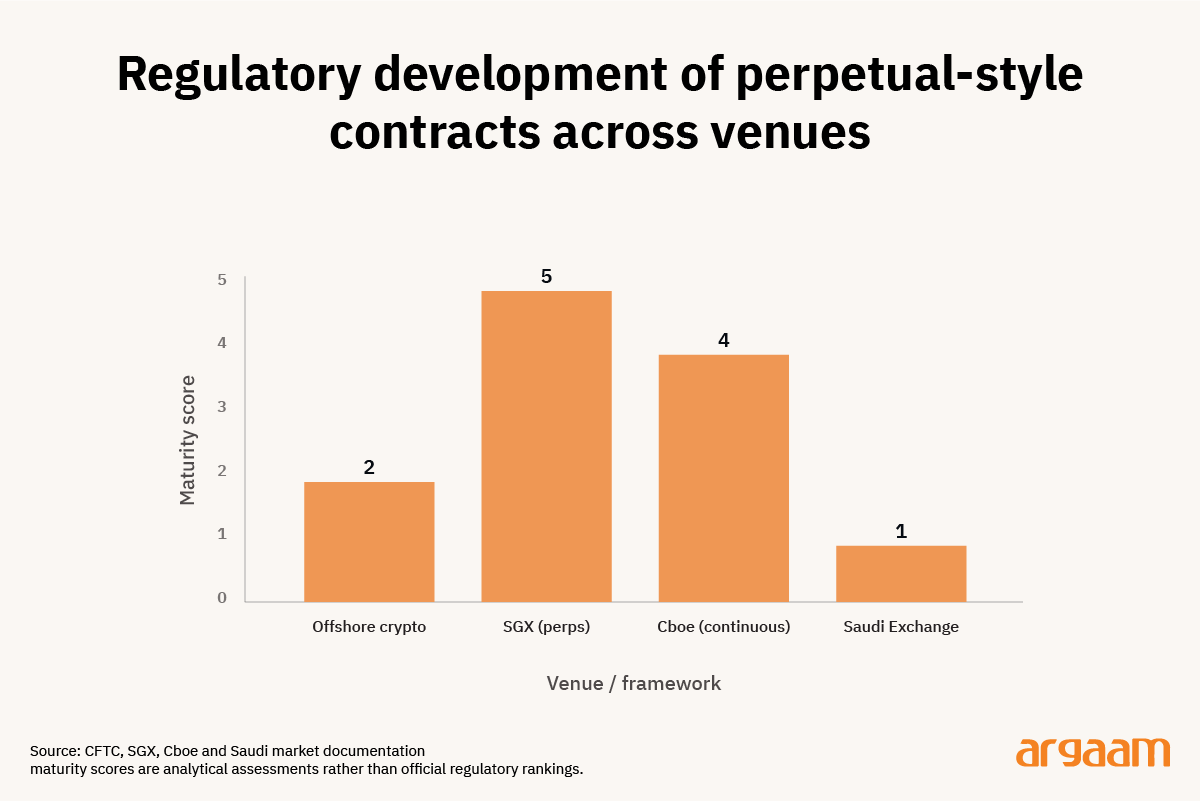
The global regulatory picture for perpetual futures changed materially in late 2025 and 2026. For most of their short history, perpetuals existed almost exclusively on offshore crypto exchanges, achieving scale without institutional legitimacy. That boundary has now shifted.
Three regulated perpetual models have emerged in rapid succession. The Singapore Exchange launched institutional-grade Bitcoin and Ethereum perpetual futures in November 2025 — the clearest example of a true regulated perpetual market.
The Chicago Board Options Exchange followed in December 2025 with ten-year Bitcoin and Ether Continuous Futures: long-dated contracts with daily cash adjustments that function like perpetuals economically without being legally identical.
In May 2026, the Commodity Futures Trading Commission approved Kalshi's perpetual Bitcoin contract as a listed futures contract on a designated contract market — moving the United States debate from policy discussion into an actual regulated listing.
That classification is now being tested in court — a legal dispute that, while specific to the United States regulatory framework, carries broader significance for how perpetual futures are categorised globally.
Whether the contract structure ultimately sits within a futures or swap regulatory regime affects the cost, leverage, and market access conditions under which these instruments operate — considerations that Saudi regulators would need to assess independently when designing their own framework.
The funding rate — the periodic payment between buyers and sellers that keeps a perpetual contract anchored to its reference price — is where the core regulatory challenge sits.
In thin markets, large players can manipulate either side: pushing the contract price away from fair value before the funding timestamp, or aggressively trading the index constituents around the fixing window.
Offshore markets have seen concentrated flows cause sharp, temporary distortions that arbitrage only partially corrected. For regulators, this converts a technical design choice into a market surveillance and abuse-prevention question.
Global experience points consistently toward institutional implementation: regulated perpetual contracts at established exchanges are designed for professional investors under margin, reporting and conduct frameworks — not retail participants.
A Saudi implementation would most naturally follow that path, orienting toward banks, large corporates, asset managers and proprietary trading desks rather than households.
For the Capital Market Authority, it is important decide what conditions need to be in place before they become viable — funding-rate governance, benchmark integrity, manipulation surveillance, investor suitability, margin and clearing treatment, and the sequencing between product design and benchmark development. These remain open questions rather than settled conclusions in either direction.
◆ Concluding remarks ◆
Saudi Arabia's listed derivatives market, which comprised just index futures and a narrow set of single-stock futures as recently as 2022, has expanded but remains at an early stage relative to the benchmark and liquidity thresholds that perpetual-style contracts would require in practice.
Taken together, the evidence points to a clear economic logic but a much more conditional institutional case for perpetual futures in Saudi Arabia. The appeal of eliminating roll costs and maintaining continuous exposure is a positive. Whether the current Saudi market can support that model across oil, rates, FX or equities remains uncertain.
What this report ultimately shows is that perpetuals should be understood as a market-architecture question. Their usefulness in Saudi Arabia would depend on the maturity of benchmarks, the depth of participation, and the sequencing of regulatory and exchange development.