Rasan did not follow the script that global fintech investors have learned to be wary of. When it listed in May 2024 at SAR 37 per share — selling 30% of the company — the market responded with something closer to a scramble than a reception.
Institutional orders reached SAR 108.6 billion. The book was 129 times oversubscribed. These are not the numbers of a market pricing in caution.
What justified that reception was not a growth story asking investors to trust the future. It was a profitable business with a clear model — online insurance and financial product aggregation in a domestic market still in its early stages.
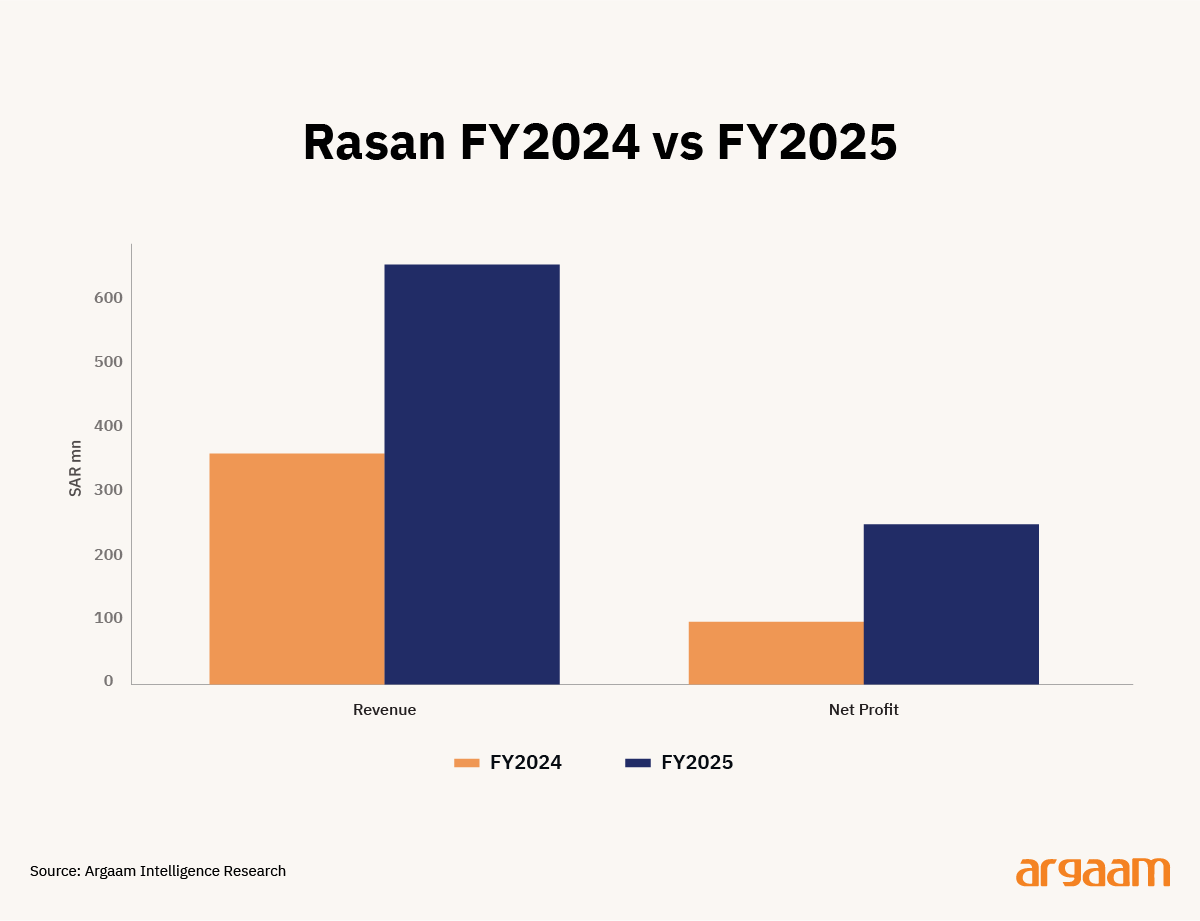
FY2025 revenue rose to SAR 653.25 million from SAR 358.33 million the year before. Net profit climbed 161% to SAR 246.89 million. Margins were expanding, not compressing.
The first analytical point of this piece is that Rasan avoided the global fintech discount because it never qualified for it. It arrived profitable.
Rasan's reception tells you something important about how Tadawul reads fintech — not as a category to avoid, but as a category it will reward selectively and aggressively when the fundamentals justify it.
The fundamentals in this case have since validated that judgement. Revenue rose from SAR 358.33 million in FY2024 to SAR 653.25 million in FY2025. Net profit climbed 161% to SAR 246.89 million. Margins expanded. Operating leverage became visible.
This is not a company asking investors to wait for the business model to work — it is a company that arrived already working, in a domestic market still in the early stages of moving insurance and financial product aggregation online.
The first analytical point follows directly from this: Rasan did not avoid the global fintech discount by being Saudi. It avoided the discount by being profitable. The market rewarded the profitability. The category was incidental.

The profitability verdict
The global data does not point only one way — and that matters for reading the Saudi case correctly. BCG and QED Investors find that the 30 largest global fintech IPOs of the past five years underperformed the broader financial services sector by roughly 24 percentage points annually.
PS: BCG is one of the world's three most prestigious management consulting firms; QED Investors is a leading venture capital firm specialising exclusively in fintech.
That statistic is usually read as a verdict on fintech as a category. The rest of the same framework suggests a different reading. Fintech revenue growth accelerated to 21% in 2024. Average EBITDA margins of public fintechs rose to 16%.
Nearly 69% of public fintechs were profitable. Markets have not rejected fintech — they have become far less tolerant of fintechs that cannot convert scale into durable earnings.
The Sector That Sacrificed Profit for Scale Is Starting to Have Both
For most of fintech's history as a public market category, that number was negative or negligible. Companies were spending aggressively on customer acquisition, technology infrastructure, and market expansion — deliberately sacrificing margin to capture growth. Investors accepted this because they were betting on future scale.
A 16% average margin across the public fintech cohort means that bet is beginning to pay off across the sector as a whole — not just in individual standout companies. The average public fintech is now generating real operating earnings, not just revenue.
BCG calls this the emergence of scaled winner status: a separation, now visible in public market valuations, between fintechs already delivering profitability and those still asking investors to underwrite a future version of it.
Scaled fintechs — broadly those above $500 million in revenue — now generate approximately 60% of total global fintech revenue, and public markets are pricing operational maturity rather than novelty.
Rasan fits this profile. It is profitable, cash-generative, and operating in a domestic category — online insurance and financial product aggregation — where meaningful penetration remains available. Its performance does not invalidate the global discount. It helps explain the real rule beneath it: the discount was never about fintech; it was about profitability.
Read that way, the right comparison is not Saudi fintech versus global fintech. It is profitable fintech versus unprofitable fintech.
Rasan looks less like an exception than a confirmation that Tadawul may already be applying the same filter global public markets have adopted — even if local market structure might still be amplifying the final valuation outcome.
How much of Rasan's premium is genuine?
The earnings speak clearly enough without interpretation. A net profit margin of 37.8% — SAR 246.89 million on SAR 653.25 million in revenue — is the kind of earnings quality public markets consistently reward.
Revenue growing 82.3% and net profit growing 160.6% in the same year suggest the market is not just pricing today's earnings but confidence in what digital distribution, cross-selling, and product expansion can deliver in a domestic market that remains largely underpenetrated.
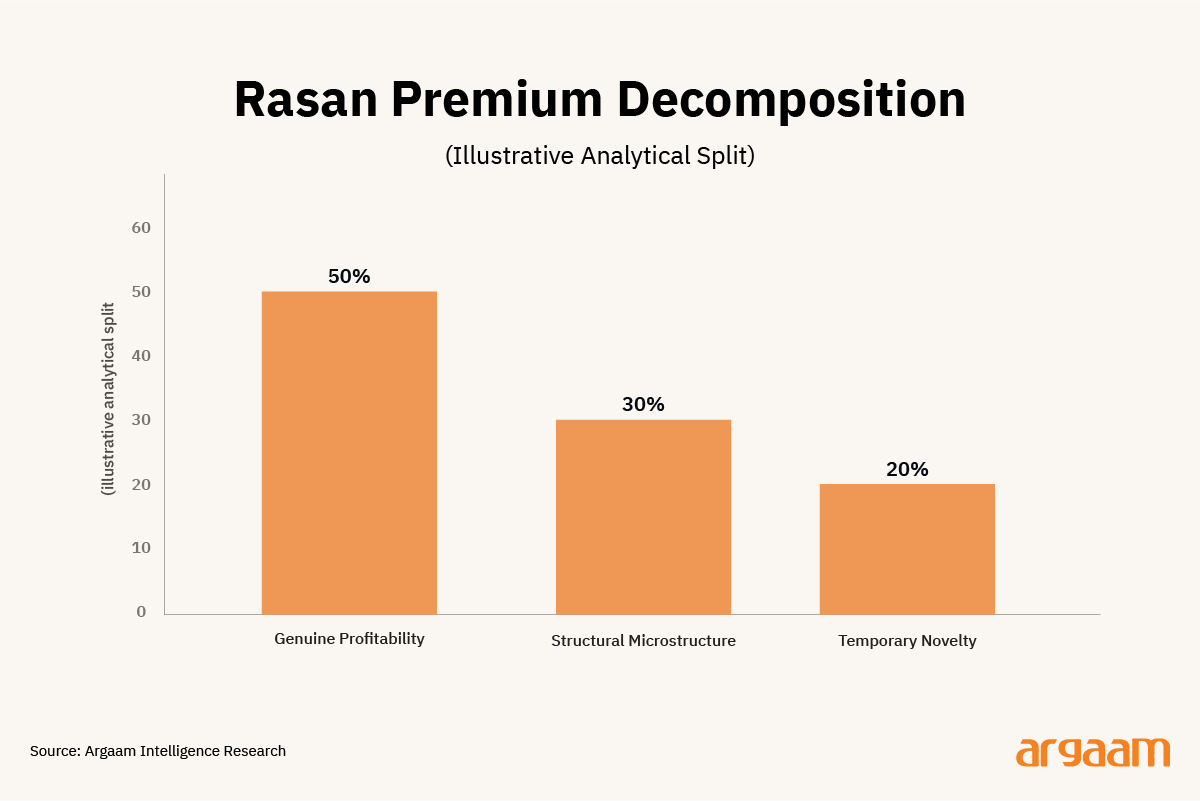
But genuine does not mean pure. Rasan listed with a 30% float and drew oversubscription of 129 times. When retail enthusiasm runs that high against a limited supply of available shares, price formation reflects scarcity as much as intrinsic value.
The final trading price carries both signals simultaneously — and they are not always easy to separate.
The distinction matters because one compounds and one corrects. A premium built on earnings grows as the business grows. A premium built on scarcity erodes the moment supply increases — which is precisely what a larger fintech IPO on Tadwul will test.
PS: An analytical framework using publicly available company and market data - oversubscription and float data from IPO disclosures and market coverage.
The Valuation Is Correct. The Premium Has an Expiry
Tadawul has structural features that shape how IPO valuations form — and understanding them is essential for reading Rasan's premium accurately. Limited float, concentrated domestic demand, and strong retail participation reduce the supply of available shares at the moment of listing.
When demand significantly exceeds supply — as it did with Rasan's 129 times oversubscription — prices settle above where a deeper, more internationally arbitraged market would place them.
This does not make the valuation incorrect. It means market structure is contributing to the outcome alongside earnings quality. In Rasan's case, the structural contribution is meaningful but secondary to the profitability case.
A related component is novelty. Rasan is not merely a fintech — it is the only vehicle so far (till the writing of this analysis on July 19, 2026) through which investors can express a Saudi digital finance thesis on Tadawul. That scarcity commands a premium of its own, independent of earnings. It will compress as the listed universe expands.
Both structural and novelty premia are transitional by nature. They erode as comparable listings arrive, as foreign participation deepens, and as investors shift from category formation to comparative price discovery.
Saudi Exchange data show foreign investor ownership in the Main Market above SAR 400 billion, with qualified foreign investor trading representing a meaningful share of turnover.
As that mix broadens, scarcity-driven premia become progressively harder to sustain — and a second fintech listing begins the transition from narrative-driven valuation to the kind of disciplined comparative analysis that separates earnings quality from market microstructure effects.
◈ Concluding remarks◈
The right or appropriate reading of Saudi Arabia's fintech listing story isn’t that Tadawul is insulated from the global repricing of growth assets. It’s that Saudi investors, at least in Rasan's case, have shown a willingness to reward profitability and operating discipline, while still embedding structural and novelty premia that only a second listing can properly test.
Rasan's listing was the opening statement. The real test of Tadawul's pricing maturity comes when a larger, more internationally visible fintech arrives with a more complex earnings profile, a wider foreign investor base, and a float size that removes the supply constraints that amplified Rasan's early valuation.
The conditions that made Rasan's premium straightforward to justify — thin float, exceptional domestic demand, clean platform economics, and no meaningful foreign price discipline — will not all be present in the same combination again.
A larger listing attracts globally sophisticated institutional investors who apply through-cycle margin analysis and comparable company frameworks from other markets. That external discipline changes the pricing dynamic fundamentally.
If the market sustains a demanding valuation under those conditions, the signal is clear: Tadawul can price complex growth stories on merit. If valuation proves unstable, the lesson is equally important — that price discovery in sophisticated fintech is still maturing. Either outcome advances the analytical understanding of what Tadawul can actually do.
Another successful fintech listing wouldn’t simply add another high-profile technology name to Tadawul; it would test whether the exchange can accommodate a more internationally visible, institutionally scrutinised fintech without relying excessively on scarcity dynamics.
Rasan's strong post-listing performance reflected both genuine profitability and the mechanics of a well-managed IPO. A big listing will begin to separate those two effects: whether a Saudi fintech valuation can remain stable in sustained secondary-market trading, without the structural supports that typically underpin an initial listing.
That matters for reasons central to the growth of the Saudi capital market: attracting deeper foreign participation, broadening the sector mix beyond traditional incumbents, and proving that Saudi public markets can finance innovation while preserving valuation discipline.
If Rasan showed that Tadawul can reward a profitable fintech, another significant fintech will show whether it can price a more demanding one.