Saudi Arabia’s World Cup accommodation plan is usually discussed as a capacity story. The headline is large enough to look reassuring: five host cities, 15 proposed stadiums and more than 230,000 room keys across host markets by 2034.
But the more important question is not whether Saudi Arabia can produce a large enough room count. It is whether the rooms being built match the kind of demand a World Cup actually creates.
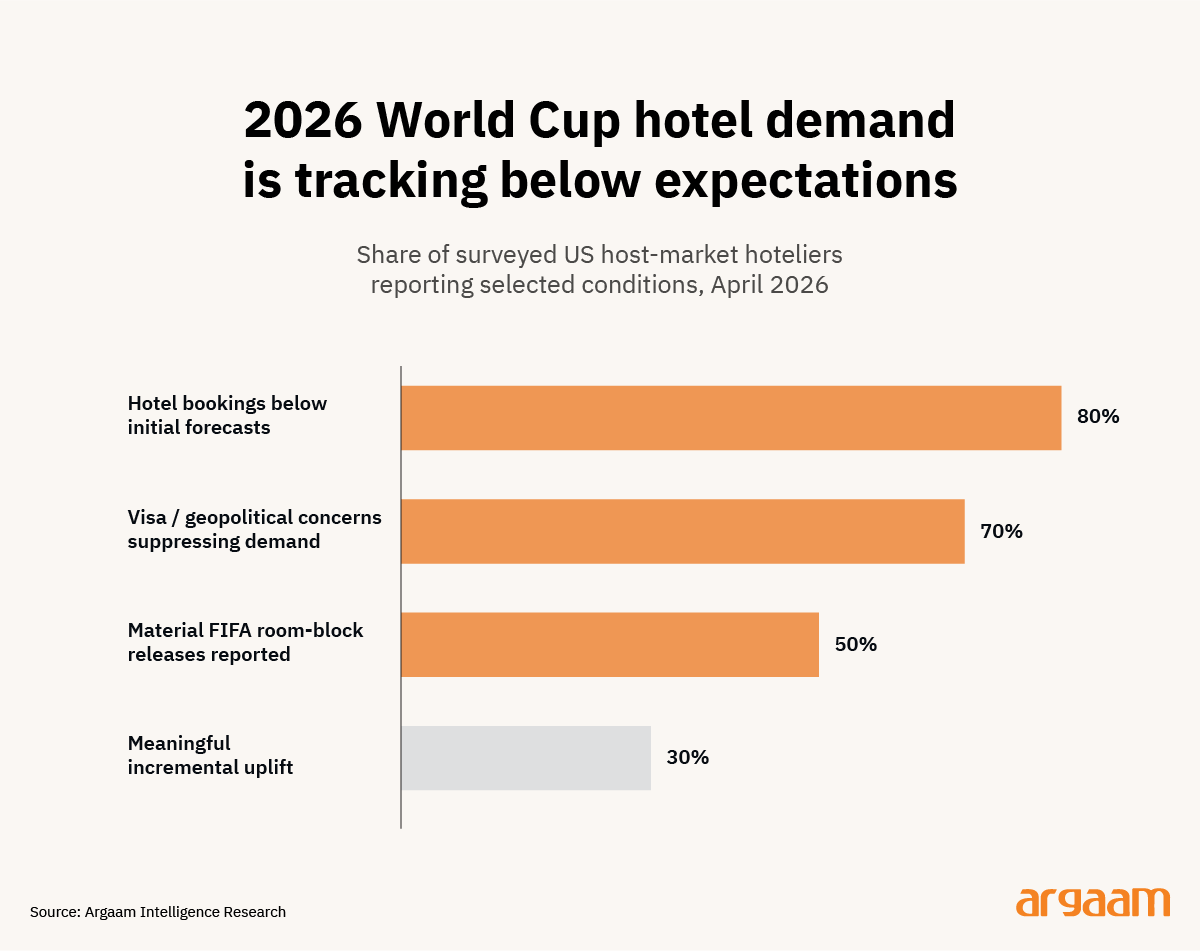
That distinction has become more important after the first live signal from the 2026 World Cup in the US. A survey by the American Hotel & Lodging Association found that 80% of hoteliers across 11 US host markets said World Cup bookings were tracking below initial forecasts, while 65–70% said visa barriers and geopolitical concerns were significantly suppressing international demand.
The report also found that FIFA room-block releases had become a material issue, with some affected hotels seeing 70–95% of originally contracted inventory returned to the open market.
This is not a small operational detail. It is a warning about the difference between official event planning and real market absorption. FIFA room blocks are useful for logistics.
They help organisers allocate rooms for teams, delegations, media and officials. But they are not the same as final hotel demand. When those blocks are later released, hotels must rely on ordinary market demand to fill the gap. The 2026 US signal suggests that this replacement demand can be thinner than expected.
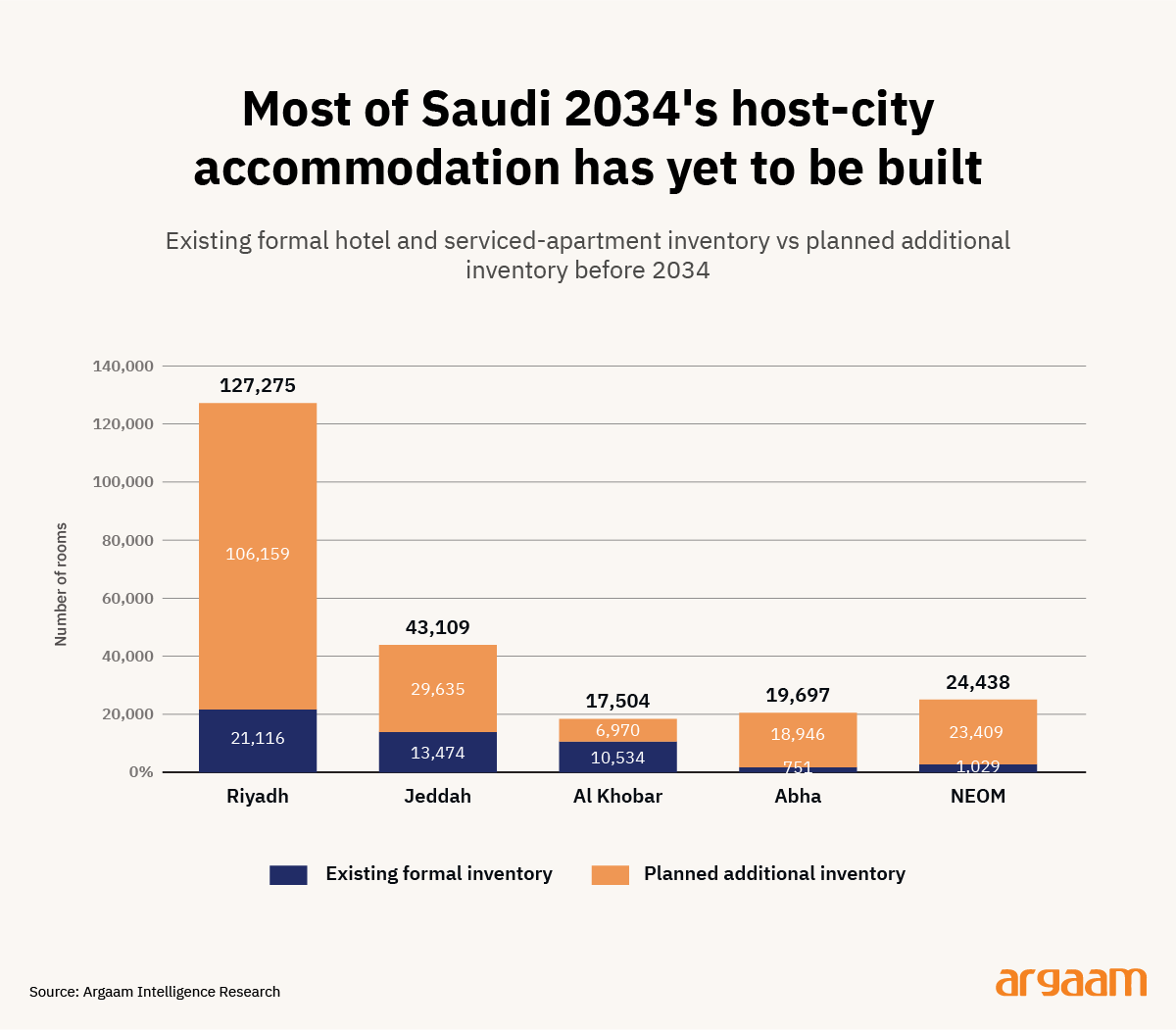
The bid-book arithmetic shows how much of this target still needs to be created. The five host cities currently have 46,904 formal three-star, four-star, five-star hotel and serviced-apartment units.
By 2034, the planned total rises to 232,023 units, implying 185,119 additional formal units. Riyadh accounts for the largest increase, moving from 21,116 existing formal units to 127,275 by 2034, while Jeddah is projected to reach 43,109, Al Khobar 17,504, Abha 19,697 and NEOM 24,438.
This is where the investment issue starts. A room key built for a one-month tournament becomes a long-life asset after the final whistle. If the demand case is based mainly on World Cup peak demand, investors and policymakers risk confusing event capacity with sustainable hospitality demand.

World Cup Demand Is a Spike, Not a Market
World Cup demand is not a single demand curve — it is a temporary spike with a specific customer profile that bears little resemblance to the segments that will fill Saudi hotels in the eleven months before and after the tournament.
Corporate travellers, religious visitors, domestic leisure families and regional business guests each have distinct booking windows, price sensitivities, length-of-stay patterns and location preferences.
Aggregating them into a single room-count target obscures more than it reveals. Academic evidence reinforces this — cross-country analysis of mega-sport events consistently shows that tourism gains are uneven across event types, origin markets and seasonal timing, making city-level demand modelling a more reliable planning tool than national capacity targets.
That finding is useful because it pushes the analysis away from a simple “mega-event equals tourism boom” assumption. The World Cup may lift Saudi tourism, but the impact will not be even across cities, price bands or accommodation formats.
It will depend on who qualifies, where teams are drawn, how fans travel, how long they stay, how much they can spend, and whether they need a hotel room at all.

City-Level Visitor Conversion, Not National Room Targets
The right measure is not how many rooms Saudi Arabia can build nationally — it is how many of those rooms each host city can actually fill during the tournament, and keep filling after it ends.
Los Angeles is hosting eight matches in 2026 and has modelled what that actually means in practical terms. It expects around 179,000 visitors from outside the city, of whom roughly 146,000 are people who would not have come at all without the tournament.
Those additional visitors are projected to generate around 330,000 hotel nights between them. The city also assumed that nine out of ten of those extra visitors would need paid accommodation — a hotel room, a motel, or a short-stay rental.
That level of city-specific modelling is what Saudi Arabia needs for each of its five host cities, not a single national room-count target. Riyadh's post-event case is the most defensible precisely because the World Cup is almost incidental to it.
The city's accommodation demand is driven by government ministries, corporate headquarters, a maturing entertainment calendar and the region's most active MICE market — none of which disappears after the final whistle.
The planned addition of more than 106,000 formal units is aggressive in scale, but it is being absorbed into a demand base that was already expanding independently of 2034.
Jeddah's fundamentals are similarly layered — coastal leisure, a deepening hospitality culture, and a structural proximity to one of the world's most consistent travel flows in religious tourism. Neither city is building primarily for the tournament.
Al Khobar occupies a more ambiguous position. Its Eastern Province base provides genuine recurring demand from the energy sector and cross-border leisure traffic from Bahrain, but the city's tournament role remains underspecified.
Match allocation, transport connectivity and whether visitors choose to stay locally or use Dammam and Bahrain as alternatives will determine whether its accommodation build-out is justified or oversized — and those variables are not yet resolved.
Abha is where the planning tension is sharpest. A base of 751 formal units scaling to nearly 20,000 by 2034 is not a pipeline — it is a structural transformation of a mountain leisure destination whose demand profile has never been tested at international event scale.
The risk is not that Abha lacks appeal. It is that permanent high-fixed-cost hotel stock is being sized against a demand spike that arrives once, rather than against the domestic seasonal market that will be asked to sustain it for the following decade.
That does not mean Abha lacks tourism appeal. It means the city is being asked to make an unusually large jump from a small managed-accommodation base to an international event accommodation platform.
Building permanent hotels may solve part of that problem, but it cannot be the whole answer. A mountain destination with strong domestic seasonality should be careful about creating too much high-fixed-cost hotel stock for a short international demand spike.
NEOM carries a different kind of uncertainty. Its official target is 24,438 formal units by 2034, from an existing base of 1,029. Unlike Riyadh or Jeddah, NEOM’s supply is tied to giga-project delivery.
Reuters has reported that Saudi Arabia has reprioritised parts of NEOM toward elements needed for future global sporting events as cost and delivery pressures reshape the project’s phasing.
That makes NEOM’s accommodation target less like an ordinary hotel pipeline and more like event-linked infrastructure. For investors, the relevant question is not only whether rooms are delivered on time, but whether the post-event demand base is deep enough to justify the asset type being built.
The Cost of Qatar's Last-Minute Accommodation Solution
Qatar 2022 shows what happens when accommodation flexibility is designed under pressure. Before the tournament, Qatar had fewer than 30,000 hotel rooms, with 80% allocated to FIFA guests, forcing the country to rely on apartments, villas, cruise ships and temporary accommodation.
Reuters reported that Qatar used at least 69,000 rooms in homes and apartments as part of its tournament accommodation solution.
The model solved capacity, but not always experience. Fan-village cabins were priced at around $200 per night, or $270 with board, and some visitors faced long commutes to stadiums.
The other side of the Qatar case was housing pressure. Reuters reported that long-term rents in Qatar rose by more than 30% in the third quarter before the tournament, with some residents facing non-renewals or sharp rent increases.
Saudi Arabia has more time than Qatar had at the same stage, and a larger domestic market. But it also has a more complex geography.
Its accommodation strategy must avoid two opposite mistakes: under-regulating short-stay supply until the last minute, and over-relying on permanent hotels in cities where the post-event demand case is not proven.
Short-stay should therefore be treated as infrastructure, not overflow. That does not mean allowing an uncontrolled Airbnb surge. Academic evidence suggests why.
Barron, Kung and Proserpio found that a 1% increase in Airbnb listings in the US was associated with a 0.018% rise in rents and a 0.026% rise in house prices in zip codes with median owner-occupancy rates, with stronger effects in areas with fewer owner-occupiers.
The Saudi reading is clear: short-stay can be useful, but unmanaged short-stay can transmit event demand into local housing markets. That is especially relevant near stadiums, transport nodes and service-worker communities.
The pricing data also suggests that short-stay should not be treated only as a cheap alternative. In normal periods, Riyadh’s short-stay market is not highly compressed.
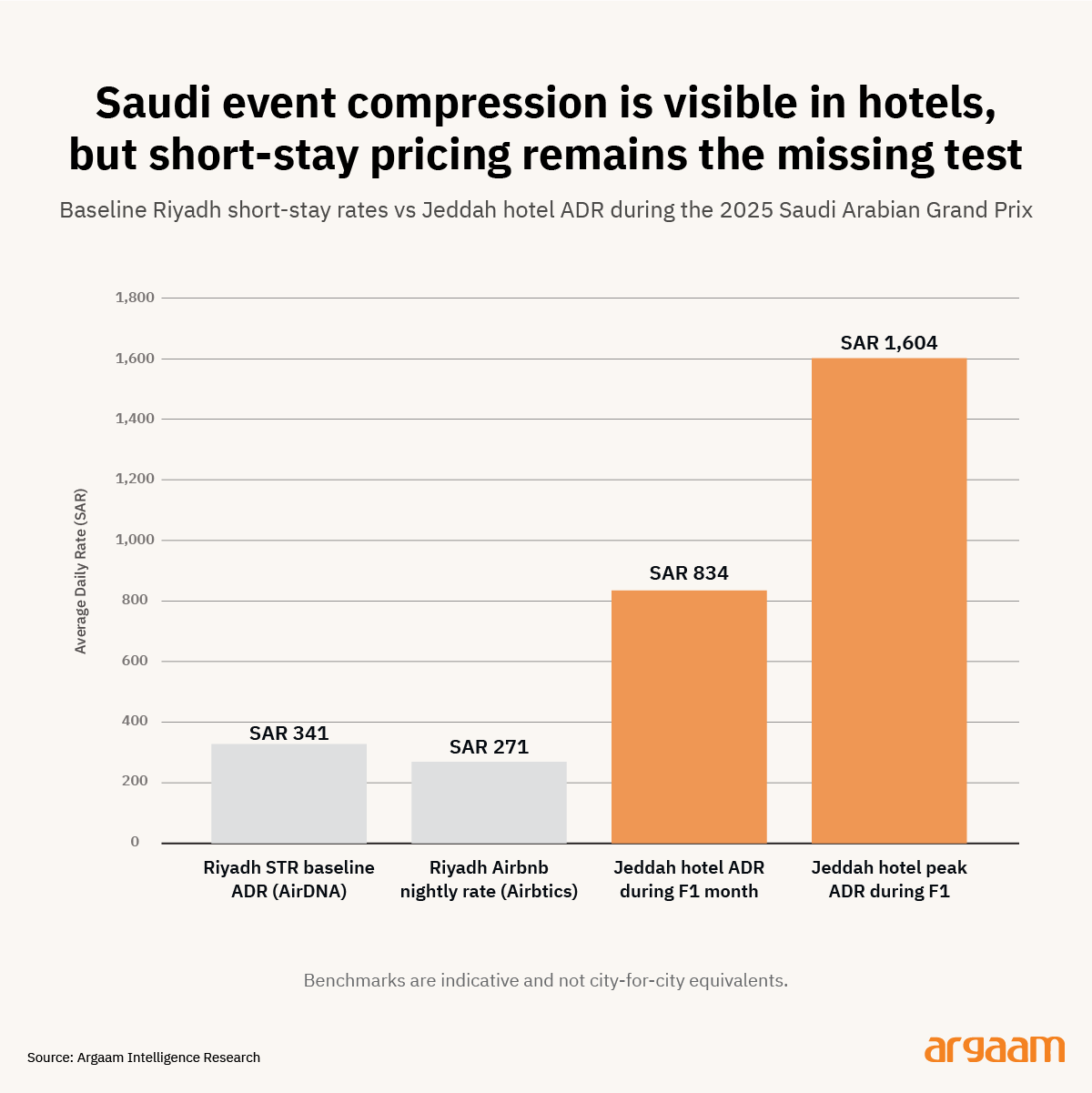
AirDNA’s broader dataset showed 21,819 active short-term rental listings in Riyadh as of May 2026, with 37% occupancy and a $91 ADR, while Airbtics’ Airbnb-only dataset reported 9,521 active Riyadh listings, 39% occupancy and a SAR 271 nightly rate.
But Saudi event compression is already visible in hotels. During the 2025 Saudi Arabian Grand Prix, Jeddah hotel occupancy reached 82.5% in April, with ADR of SAR 833.79 and RevPAR of SAR 688.23. On the second race night, ADR peaked at SAR 1,604.34.
The missing evidence is whether short-stay rates converge with hotel rates during comparable peak windows such as Formula 1, LEAP and Riyadh Season. That should be a research question, not a conclusion.
If short-stay ADR converges with four-star hotels during compression events, then short-stay is not a discount channel. It is a separate product serving group travellers, families, regional visitors and fans who value space, privacy and kitchens more than hotel amenities.
The investment implication is that Saudi’s accommodation pipeline should be judged by product fit, not only by key count. Riyadh and Jeddah can absorb more formal hotel and serviced-apartment supply because their demand base extends beyond the World Cup.
Abha and NEOM require more flexible formats: licensed homes, serviced apartments, modular hospitality, seasonal inventory and event-window supply that can expand without becoming stranded after 2034.
The policy implication is equally direct. Saudi Arabia should build a city-level accommodation dashboard well before the tournament, covering formal hotels, serviced apartments, licensed short-stay units, private accommodation, worker housing and temporary inventory.
It should require platform data-sharing, minimum quality standards, transparent pricing, event-window licensing and protections against forced tenant displacement.
This is not an argument against hotel construction. It is an argument against using the World Cup as a blanket justification for permanent hotel supply in every host city. The 2026 US signal shows that official demand can evaporate faster than hotel investors expect.
The Qatar precedent shows that temporary accommodation can solve capacity while creating experience and housing problems. The academic evidence shows that mega-event tourism gains are uneven and that short-stay growth can affect local rents.
Saudi Arabia’s advantage is that it can still design the system before the demand shock arrives. If it treats short-stay as planned accommodation infrastructure, it can reduce the risk of overbuilding, improve affordability for fans and protect local housing markets. If it treats short-stay as an emergency solution, it may repeat the very failures it has enough time to avoid.
The real 2034 accommodation question is therefore not whether Saudi Arabia can build enough rooms. It is whether it builds the right mix of rooms, in the right cities, for demand that will last after the tournament leaves.