




|
Regional geopolitical crises have repeatedly tested the resilience of Gulf economies. Escalating tensions involving Iran, disruptions to Red Sea shipping and periodic threats to the Strait of Hormuz have historically undermined business confidence, increased trade costs and discouraged private investment across the GCC.
Measuring Resilience
Traditional macroeconomic indicators such as GDP, inflation and unemployment are published with a considerable lag, limiting their usefulness during periods of rapidly changing geopolitical conditions.
The diffusion index 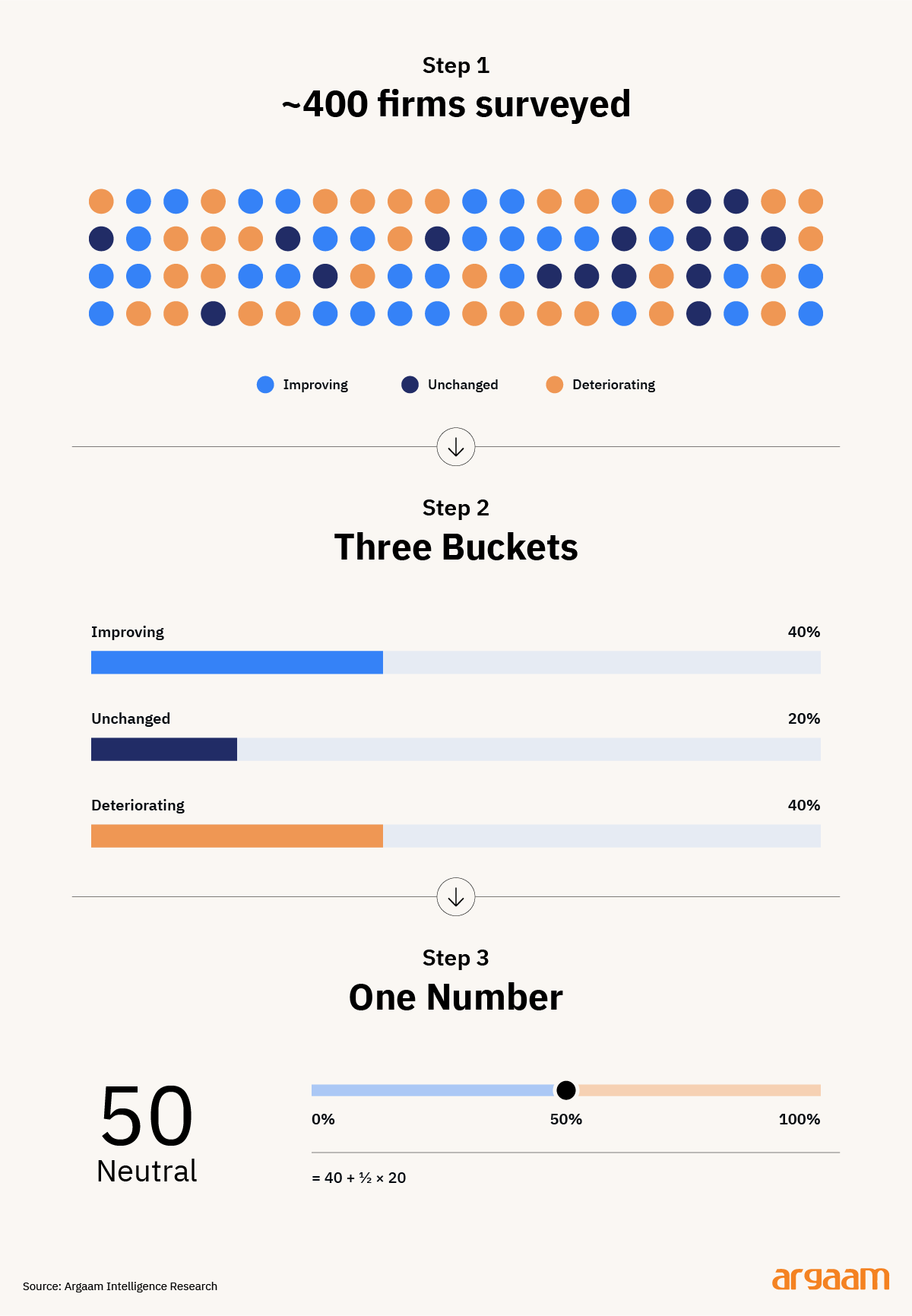
The Weakening Link Between Geopolitical Risk and Saudi Private Sector Activity The significance of the PMI extends beyond measuring business activity. Because purchasing managers make decisions on hiring, inventories and production before changes appear in GDP or employment data, shifts in business confidence are often reflected in the PMI well before broader economic indicators respond. In this essay, the PMI is therefore treated not simply as a measure of economic activity, but as a proxy for the sensitivity of Saudi Arabia's non-oil private sector to regional geopolitical risk. If firms continue reporting expansion despite a deteriorating security environment, it suggests that the historical relationship between regional instability and private-sector confidence may be weakening. Recent geopolitical crises provide an opportunity to test this proposition. Since the escalation of regional tensions in late 2023 in Gaza and Israel — including sustained disruptions to Red Sea shipping, repeated exchanges between Iran and Israel, and the 2026 escalation involving the United States—the Riyad Bank PMI has remained predominantly in expansionary territory. Although business confidence weakened during the height of regional tensions, the headline PMI recovered to 51.5 in April, 52.8 in May, and 53.3 in June from a temporary contraction of 48.8 in March 2026, while output, employment and domestic demand also returned to growth. 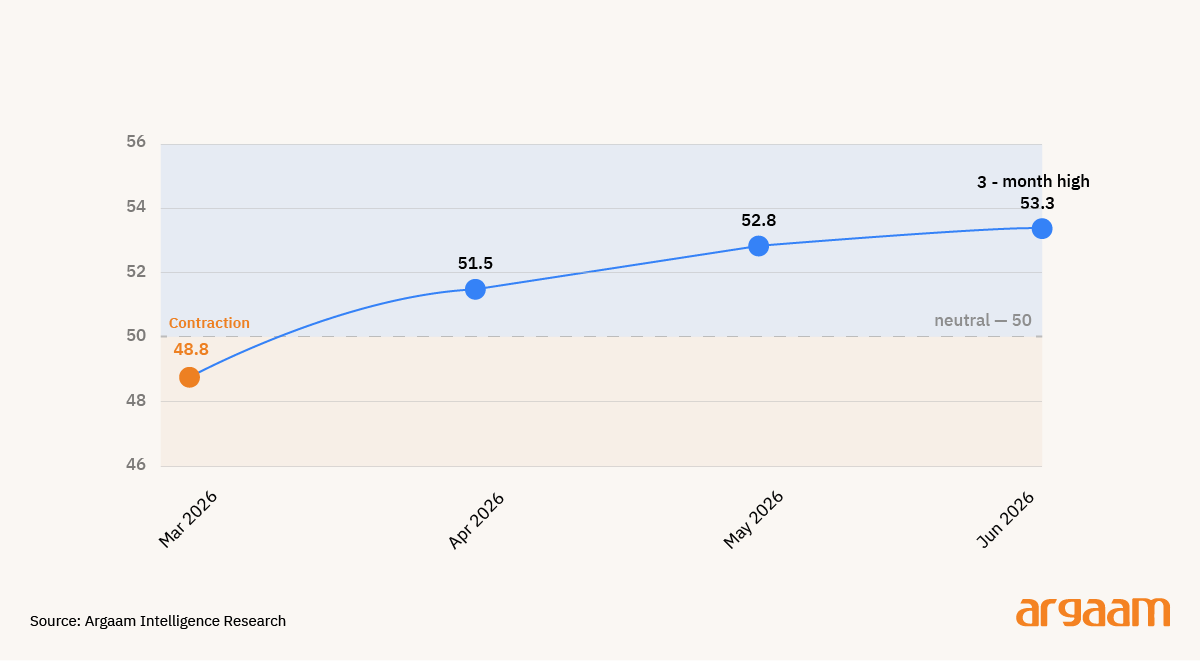 
What the PMI Does Not Measure
This resilience contrasts with the conventional expectation that regional instability should undermine private-sector confidence, suggesting that geopolitical shocks are being transmitted less forcefully into Saudi Arabia's non-oil economy than in the past. The PMI should not, however, be interpreted as conclusive evidence of structural transformation. As a diffusion index, it measures the direction rather than the scale of business activity and cannot distinguish between market-driven expansion and demand generated through government spending. The following section therefore examines whether the resilience reflected in the PMI represents a structural reduction in the transmission of geopolitical shocks or the continued insulating effects of state-led investment under Vision 2030. 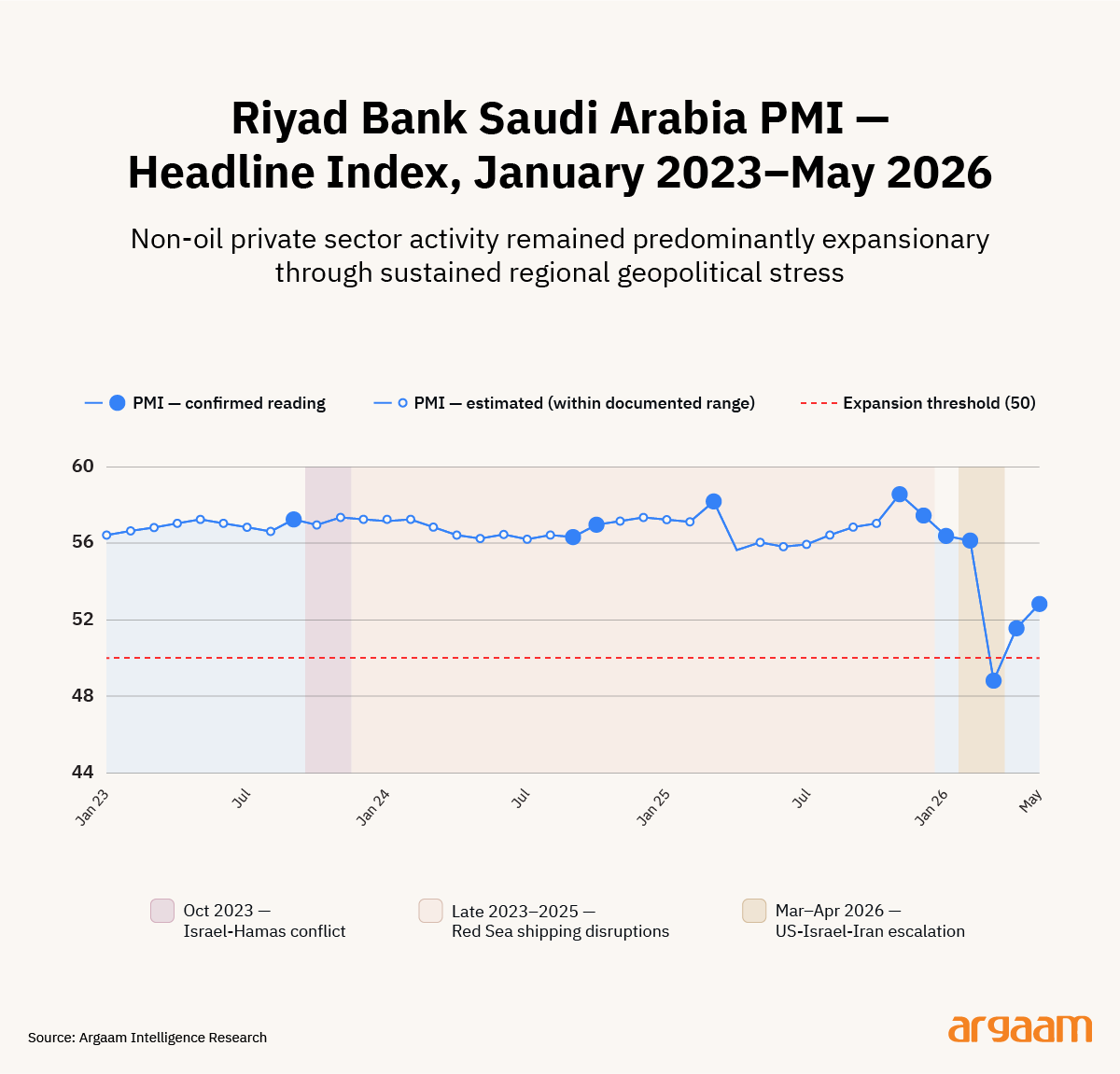 
Why Has the PMI Remained Resilient? The persistence of expansionary PMI readings suggests that regional geopolitical shocks are no longer transmitted into Saudi Arabia's non-oil economy as strongly as conventional expectations would predict. Rather than reflecting a single source of strength, the resilience of the PMI appears to stem from several reinforcing developments. Stronger domestic demand, labour market reforms, a broader non-oil economy and sustained public investment have reduced firms' dependence on external conditions, allowing business activity to remain resilient despite a more volatile regional security environment. A more diversified domestic economy has played an important role in this shift. Rising labour force participation, increasing female employment and sustained job creation have strengthened household incomes and consumer spending, providing businesses with a more stable source of demand than in previous decades. This is reflected in the composition of the PMI itself. Despite successive geopolitical disruptions, the New Orders Index remained expansionary for much of 2025 and into 2026, suggesting that firms continued to receive sufficient domestic demand to sustain production and employment. At the same time, continued growth across tourism, manufacturing, logistics and professional services has broadened the Kingdom's economic base, reducing dependence on hydrocarbons and external markets. While these developments are closely associated with the objectives of Vision 2030, the more immediate implication is that disruptions affecting one sector or export route are now less likely to undermine confidence across the wider private economy. Diversification alone, however, does not fully explain the resilience of the PMI. Saudi Arabia's development model continues to rely heavily on public investment, particularly through infrastructure, housing, industrial development and tourism projects that generate substantial demand for private contractors and suppliers. This distinction matters because the PMI records changes in business activity rather than the source of demand. A construction company working on a government-backed infrastructure project contributes to the PMI in the same way as a firm expanding in response to purely commercial opportunities. Consequently, the resilience of the PMI may reflect not only improving private-sector competitiveness but also confidence that state investment will continue supporting order books despite regional instability. The evidence therefore suggests that Saudi Arabia's private sector has become more resilient to geopolitical shocks, but that this resilience remains closely linked to an economic model in which public investment continues to cushion external risks. 
Structural Resilience or State-Supported Growth? The preceding discussion suggests that Saudi Arabia's non-oil private sector has become less sensitive to regional geopolitical shocks than historical experience would predict. The persistence of expansionary PMI readings during periods of heightened regional instability indicates that firms have continued to expand output, employment and new orders despite a deteriorating security environment. The remaining question, however, is whether the PMI reflects genuine structural resilience or simply the insulating effects of sustained state investment. This distinction matters because the PMI measures changes in business activity rather than the source of demand. A construction company working on a government-backed infrastructure project contributes to the PMI in exactly the same way as a firm expanding in response to private consumer demand or export growth. Consequently, a resilient PMI cannot, on its own, distinguish between a genuinely self-sustaining private sector and one supported by continued public expenditure. Given the scale of infrastructure, housing and tourism projects financed through the Public Investment Fund (PIF), it is plausible that part of the resilience captured by the PMI reflects confidence that government-backed demand will continue despite regional uncertainty. That should not necessarily be interpreted as evidence that the observed resilience is artificial. Economic development literature has long recognised that governments can play a catalytic role during periods of structural transformation, using public investment to create markets before private investment becomes sufficiently broad-based to sustain growth independently. Saudi Arabia appears to be following a similar developmental model, where state investment reduces the economic costs of transition while encouraging the expansion of non-oil industries. In this context, continued government involvement is not inconsistent with improving private-sector resilience; rather, it may be one of the mechanisms through which that resilience has developed. The Riyad Bank PMI should therefore be interpreted as evidence of an economy in transition rather than one that has completed its transformation. The index suggests that the historical relationship between regional geopolitical shocks and private-sector confidence has weakened considerably. However, it cannot yet demonstrate that this resilience has become fully independent of state support. The strongest test will come if public investment begins to moderate. Should the PMI continue to record sustained expansion under those conditions, the case for a genuinely self-sustaining and shock-resilient private sector would become substantially stronger.
◉ Conclusion ◉
The Riyad Bank PMI suggests that Saudi Arabia's non-oil private sector has become more resilient to regional geopolitical shocks than historical experience would predict. Rather than contracting during successive episodes of regional instability, business activity, new orders and employment have remained largely in expansionary territory, indicating that private-sector confidence has become less sensitive to external shocks. |

|
|

|
|


|

Argaam.com Copyright © 2026, Argaam Investment, All Rights Reserved |