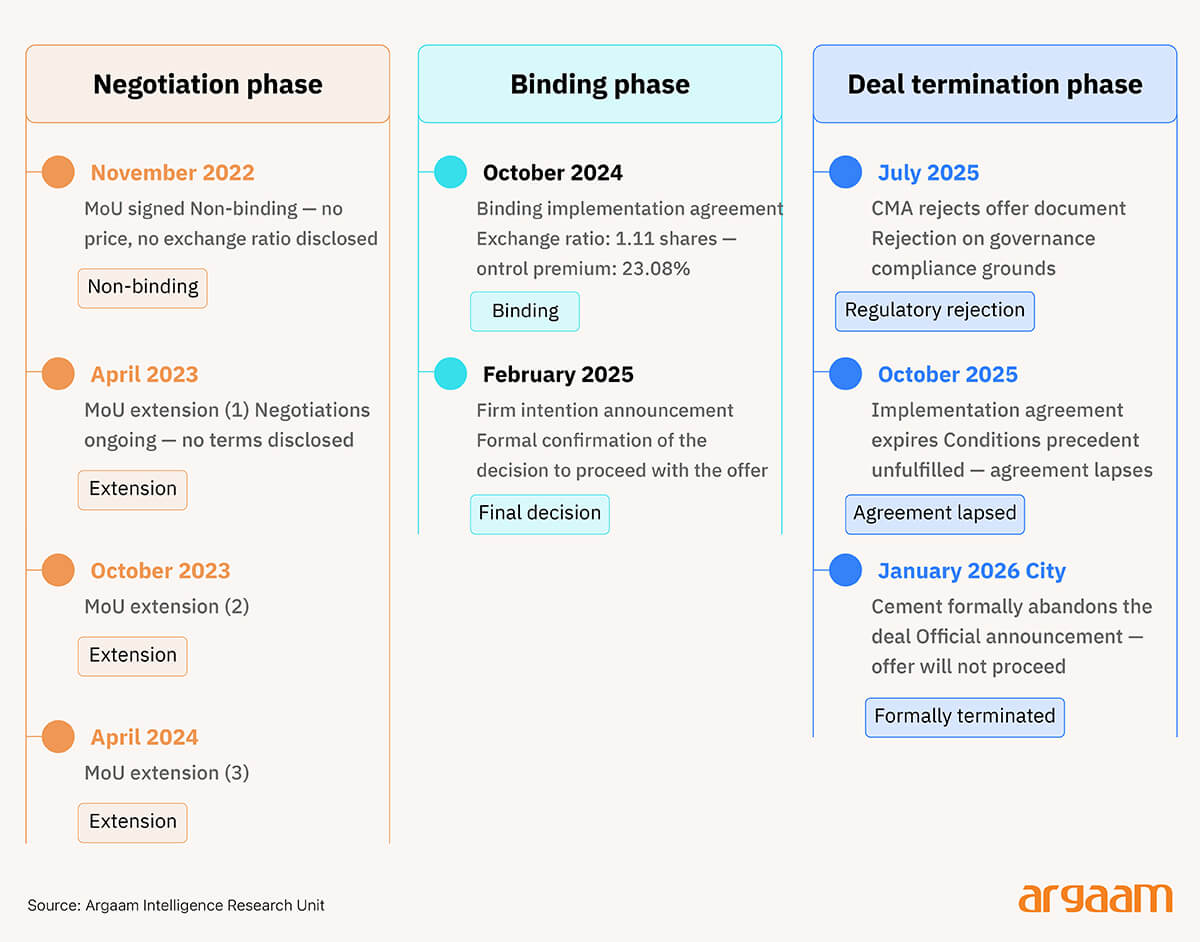
From a Memorandum of Understanding signed in November 2022, to a binding Implementation Agreement in October 2024, to a formal rejection by the Capital Market Authority and eventual abandonment in early 2026 — the proposed merger between City Cement Company and Umm Al-Qura Cement Company consumed over three years of board deliberation, regulatory engagement, due diligence, and shareholder communication before collapsing not on commercial disagreement but on governance compliance.
That sequence is not a procedural detail. It is the question this analysis by Argaam Intelligence is built around. When a merger collapses at the Capital Market Authority's door after three years of negotiation, it does not erase what was built.
Completed mergers produce outcomes that absorb and obscure the decisions made along the way — the premium is validated by execution, the governance is ratified by closure, and the regulatory process disappears behind the announcement of a done deal.
A failed merger strips all of that away. What remains is the architecture of intent: the terms both boards agreed to, the price Umm Al-Qura Cement shareholders were offered, the exchange ratio fixed in a binding document, and — most revealingly — the specific grounds on which the Capital Market Authority intervened.
That exposure is precisely what makes this transaction worth examining in depth. The lessons from this deal can be directly applied to the next one in the cement sector.

A Deal Three Years in the Making — With No Price Until the End
The exchange ratio of 1.11 City Cement Company (CCC) shares for every Umm Al-Qura Cement (UACC) share was first disclosed publicly in the implementation agreement announcement filed on Tadawul on 27 October 2024.
The memorandum of understanding (MoU), signed in November 2022, was non-binding and silent on terms — no ratio, no valuation, and no premium were disclosed at that stage.
The absence of disclosed terms at the MoU stage was entirely consistent with the CMA regulatory framework, under which the trigger point for price-sensitive disclosure is the Firm Intention Announcement rather than the non-binding MoU.
The market, therefore, had no valuation anchor during the two years between the MoU and the implementation agreement.
The Firm Intention Announcement: It is the moment a bidder formally and publicly declares it will proceed with an acquisition on specific, committed terms. It is legally binding — the bidder cannot walk away without consequence. Only at this point must full deal terms be disclosed to the market and regulators.
When two companies sign an MoU, the deal is not yet binding — price, structure, and terms remain under negotiation. Disclosure of those terms is not legally required at this stage. That obligation only arises when a formal, binding declaration is made. Until then, confidentiality is not a breach — it is the rule.
The only deal price that can be independently verified from public records is the one disclosed in the implementation agreement filed on Tadawul.
Using City Cement's closing share price of SAR 18.04 on 24 October 2024 — the last trading day before the announcement — and applying the agreed exchange ratio of 1.11, each UACC share was effectively valued at SAR 20.06.
Against UACC's own closing price of SAR 16.30 that same day, this represented a premium of 23.08% — meaning UACC shareholders received roughly a quarter more than their shares were trading for in the open market immediately before the deal was made public.
The implementation agreement filing also cites a separate premium of 26.16%, calculated against UACC's share price in November 2022 — a reference point chosen to reflect where the stock traded before any merger speculation entered the market.
Both figures are drawn from the same public filing. Our analysis is anchored to the 23.08% figure, as it reflects the most recent and directly observable market price at the time of announcement.
A 23.08% premium sits within the accepted global range for merger premiums — which typically runs between 20% and 40% — but closer to the floor than the midpoint.
In most markets, 30% is treated as the informal benchmark that separates a fair offer from a thin one. Whether 23.08% is defensible depends heavily on the condition of the industry at the time the deal was struck. In the Saudi cement sector between 2022 and 2024, conditions were difficult across the board.
The industry was producing more cement than the market could absorb, construction activity had slowed, real estate demand had softened, major projects were being delayed, and cement prices were falling. These pressures were compressing valuations across all listed cement companies — not just UACC.
Saudi Arabia ranks among the most significant markets for gifting confectionery and bakery products in the region — and it is a market where price plays a secondary role in the purchase decision.
What drives the consumer is brand, packaging, and perceived quality. In a market structured this way, the premium player with the widest shelf presence wins. That is the logic this deal is built on.
Long-run academic research on global M&A premia provides structural, not coincidental, support for the premium observed in the CCC-UACC transaction:
✦ The 23.8% average target return was calculated across 3,688 transactions spanning 26 years, multiple market cycles, and diverse industries — making it a structural finding about merger markets, not a period-specific snapshot.
✦ Premiums are not fixed. The median declined from 47.2% in the to 34.5% across the years, confirming that deal structure, sector conditions, and market cycles are legitimate moderating factors.
✦ The economic logic is identical. Both figures reflect what buyers must pay to secure control in mature, capital-intensive industries with limited competing bidders — precisely the conditions present in the Saudi cement sector in 2024.
In the absence of published Saudi-specific M&A benchmarks, the most directly relevant comparator is the Qassim Cement and Hail Cement transaction — a share-exchange merger concluded under the identical regulatory framework, within the same sector, and across an overlapping period.
This transaction offers what no international study can: a like-for-like reference point against which the CCC-UACC premium can be assessed on its own terms.
In September 2022, two months before the CCC/UACC MoU was signed, Qassim Cement offered a premium of 18.6% to Hail Cement shareholders, valuing each Hail Cement share at SAR 14.50 based on Qassim Cement's closing price of SAR 75 and an exchange ratio of 0.1933 (MoU).
By the time the binding implementation agreement was signed in December 2023, the premium against Hail Cement's prevailing market price had been revised to 13.24% (compared to 23.08% for UACC), while the premium against the original unaffected MoU-date price stood at 28.89%.
A comparison of the two target companies' financial performance at the time their respective implementation agreements were signed reveals a material divergence that directly bears on the appropriateness of the premiums offered.
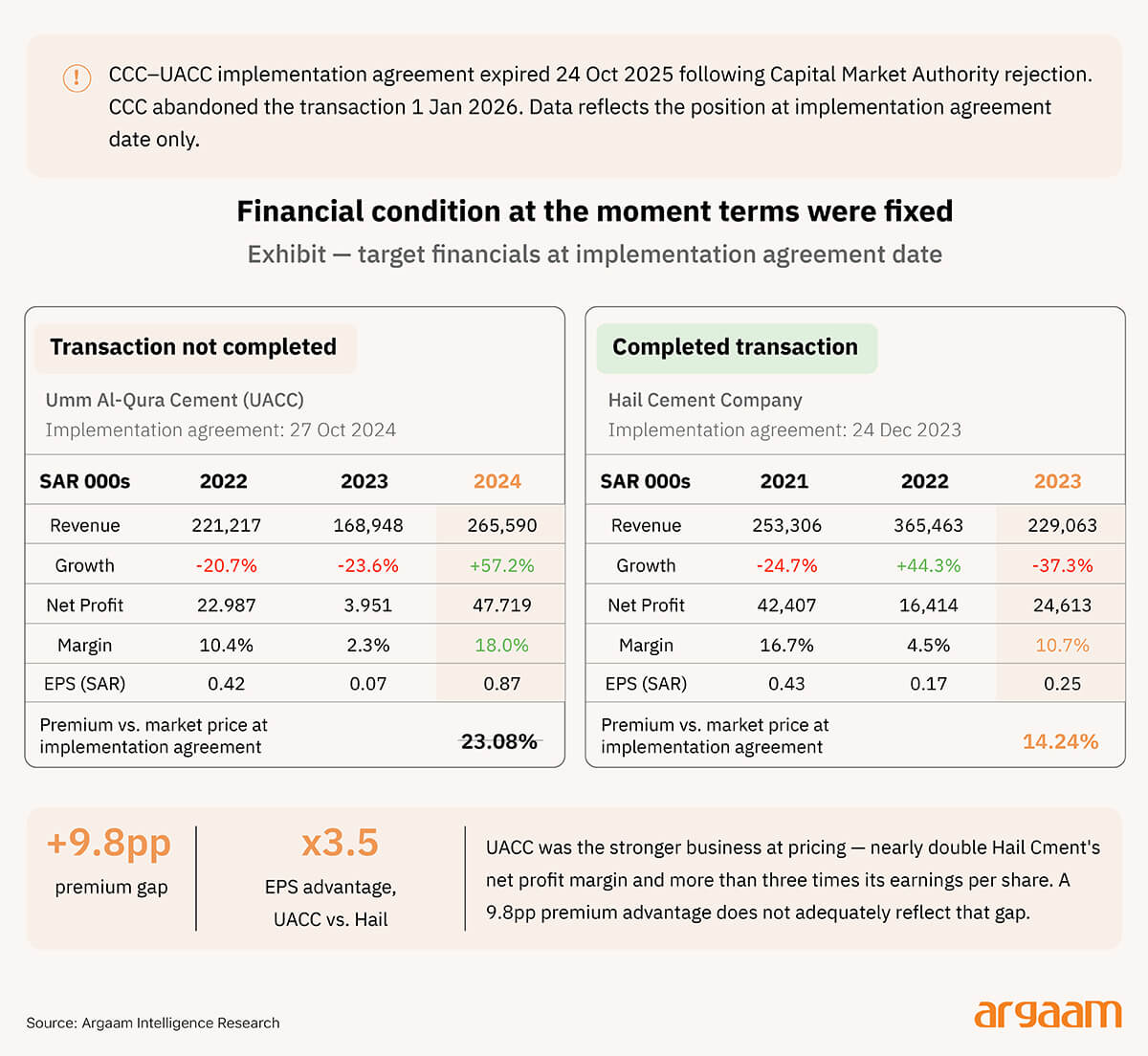
After a steep contraction in revenues and profits in FY2023, UACC’s performance recovered in FY2024, though still below FY2021 levels, with net profits reaching SAR 47.7 million and a net profit margin of 18%.
Although the implementation agreement was signed in October 2024 ahead of the full-year close, management would have had strong visibility over the trajectory by that point.
Q3 2024 was the clear inflection point, with revenues almost doubling YoY versus Q3 2023 and margins expanding materially. The premium was likely negotiated with that improving trajectory in view.
By contrast, the implementation agreement for Hail Cement was signed in December 2023, at the trough of the sector downturn. Hail Cement’s revenues had fallen 37% and net profits stood at SAR 24.6 million a net margin of 10.7%.
Against that backdrop, a higher premium for UACC at the time of the implementation agreement appears defensible. Its recovery trajectory, larger scale and materially stronger margins all support a premium above what Hail Cement commanded 12 months earlier.
Comparing transaction multiples on a P/E basis has limited utility here, given the earnings volatility of both companies over 2022-2024.
Hail Cement’s thin earnings in FY22 and FY23 inflate implied multiples to the point of meaninglessness, and UACC’s deflated FY23 earnings are equally uninstructive.
The only credible earnings anchor for the UACC transaction is FY24, which gives an approximately low-20s trailing P/E at the implementation agreement price.
This is a sensible multiple that reflects the recovery trajectory and is consistent with broader sector valuation ranges whilst factoring a control premium.
On balance, the swap ratio and corresponding premium set out in the CCC/UACC implementation agreement appear reasonable and justified, reflecting typical transaction premium ranges, the comparable QCC/HCC transaction, and UACC’s financial trajectory at the time the agreement was signed.

The Deal That Survived the Market — and Failed the Regulator
In July 2025, the Capital Market Authority rejected the offer prospectus for the proposed acquisition of Um Al-Qura Cement Company by City Cement Company, citing a breach of the Capital Market Law specifically relating to governance requirements.
No specific details of the rejection were published, but the regulatory framework and the structure of the transaction point most plausibly toward governance and related-party conflict handling as the central issue.
At the time the implementation agreement was signed in October 2024, a major institutional shareholder held a 24.53% stake in City Cement Company and an 8.7% stake in Um Al-Qura Cement simultaneously.
That dual position created a structural conflict of interest — one that was formally disclosed in the implementation agreement, as required under the Capital Market Authority's merger and acquisition regulations.
The disclosure was made at the correct regulatory trigger point. The absence of disclosure at earlier stages was not an oversight; it was the prescribed course of action under the applicable framework.
But under the Saudi regulatory framework, disclosure of a related party conflict is a trigger, not a remedy.
The new Saudi Companies Law, entering into force in January 2023, had prompted the CMA to align and tighten its corporate governance regulations and related party conflicts of interest requirements, with a further tranche of amendments mandatory from January 2024.
Under that framework, disclosure would typically be expected to trigger enhanced procedural safeguards and governance requirements intended to manage potential conflicts of interest appropriately.
A key regulatory consideration was likely not whether the related party had been identified, but whether all necessary steps had been taken in response. A closer examination of City Cement Company’s board composition sharpens the concern.
One of the company's most senior executive directors, who simultaneously held a board position with the related party holding group, chaired the Executive Committee responsible for approving the transaction.
That committee's conduct would have been subject to close regulatory scrutiny. The holding group held an 8.7% stake in Um Al-Qura Cement and therefore carried a direct financial interest in the acquisition premium and exchange ratio being offered to Um Al-Qura Cement shareholders.
If no formal steps were taken to remove the conflicted party from the decision-making process, and if those steps were not documented, the arrangement risked breaching the Capital Market Authority's governance requirements.
Under the CMA M&A Regulations, transactions involving related parties and potential conflicts of interest are subject to heightened governance expectations, including disclosure obligations, recusal procedures, and demonstrable independence in the approval process.
In circumstances where directors or major shareholders may have interests on both sides of a transaction, regulators would typically expect robust procedural safeguards to be clearly evidenced within the offer documentation.
These may include independent committee oversight, separation of conflicted individuals from decision-making processes, and independent assessment of the fairness of the transaction terms to minority shareholders.
The approved QCC/HCC merger is instructive by comparison. QCC held an indirect 2.36% stake in HCC through a wholly-owned investment fund, which was disclosed and treated as a related party under the M&A Regulations.
The related party dimension was immaterial in governance terms; no board member had a financial interest on both sides of the transaction, and no individual director sat on both sides simultaneously. The conflict was indirect, institutional in nature, and contained.

When Disclosure Isn’t Enough
What makes this outcome particularly significant is that it was foreseeable. The holding group's stakes in both companies were publicly disclosed on Tadawul from the outset, as was City Cement Company's board composition.
The governance obligations that dual shareholding triggered were equally clear. The governance sensitivities created by the overlapping shareholding structure could potentially have been mitigated through enhanced procedural safeguards.
Including formal recusal processes for conflicted directors, independent committee oversight, clearly documented minority shareholder protections, and demonstrable separation of conflicted parties from key stages of the approval process.
Whether such measures were ultimately implemented cannot be determined from publicly available disclosures. Because the public record — the implementation agreement filing, the Tadawul announcements, and the CMA correspondence — tells you what was disclosed, but not how the internal board process was conducted.
Board minutes, recusal records, independent committee mandates, and voting records are not public documents in a listed company framework. They exist inside the company.
Without access to them, it is impossible to confirm whether the correct procedural safeguards were followed, even if the conflict itself was properly disclosed on the face of the implementation agreement.
Conflict Management
Managing the conflict means taking active, documented steps to ensure that the conflicted party — the director or shareholder sitting on both sides of the transaction — played no role in the decisions that determined the deal's terms and approval. This is distinct from simply declaring the conflict exists.
Some conflict management essential steps include:
● The conflicted party leaves the room when the deal is discussed
● The conflicted party does not vote on the approval resolution.
● An independent committee of non-conflicted directors evaluates the fairness of the terms.
● Everything is formally recorded in the board minutes and available to the regulator on request.
However, if the CMA concluded that the governance framework or conflict-management procedures were insufficiently robust, that could plausibly help explain the regulator’s decision to withhold approval of the offer document.
City Cement Company's statement after the rejection that it was "evaluating the possibility of resubmitting", followed five months later by full abandonment, is itself telling and reinforces our analysis.
Had the issue related solely to paperwork or supplementary disclosure, resubmission may potentially have been more straightforward.
The more likely explanation is that addressing the underlying governance concerns would have required something considerably more structural. On that basis, abandonment rather than resubmission was arguably the only viable path.
An Important Note on the Limits of Disclosure
The governance assessment presented in this analysis is based exclusively on publicly available disclosures filed on Tadawul and information released by the companies in accordance with their regulatory obligations.
The Capital Market Authority has not published its reasons for rejecting the offer document, and City Cement Company's public announcement of the transaction's termination contained no elaboration beyond a statement of intent not to proceed.
In the absence of detailed regulatory disclosure, the conclusions drawn regarding governance process, conflict management, and procedural compliance are necessarily inferential.
They represent a high-level analytical assessment of what the public record does and does not establish — not a determination of regulatory breach or corporate misconduct.
Alternative explanations for the CMA's decision remain possible and cannot be excluded on the basis of available information alone. Readers should interpret this section accordingly.

What Did Three Years of Limbo Cost CCC?
The termination announcement states that "the expiration of the agreement does not result in any additional financial or regulatory obligations" — which is legally accurate but analytically incomplete.
From first MoU to final abandonment, the process spanned just over three years, a considerable investment of time, cost and management resource to reach no outcome.
On the surface, City Cement stated there was "no material financial impact" from terminating the transaction. From a narrow accounting perspective that is technically defensible, there was no break fee, no impairment charge and no balance sheet damage of consequence.
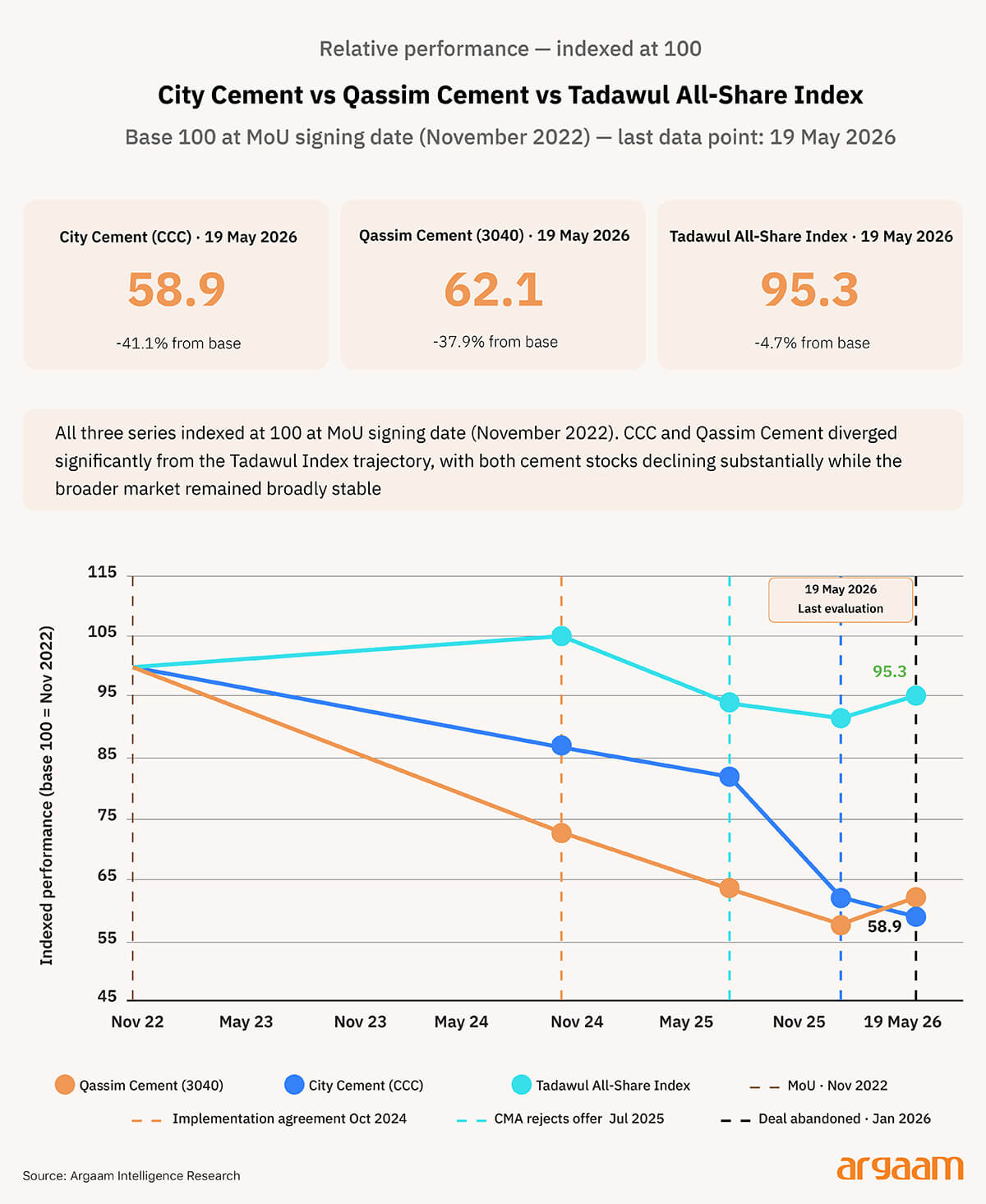
Economically and strategically, however, the picture looks considerably different. The share price performance is also notable.
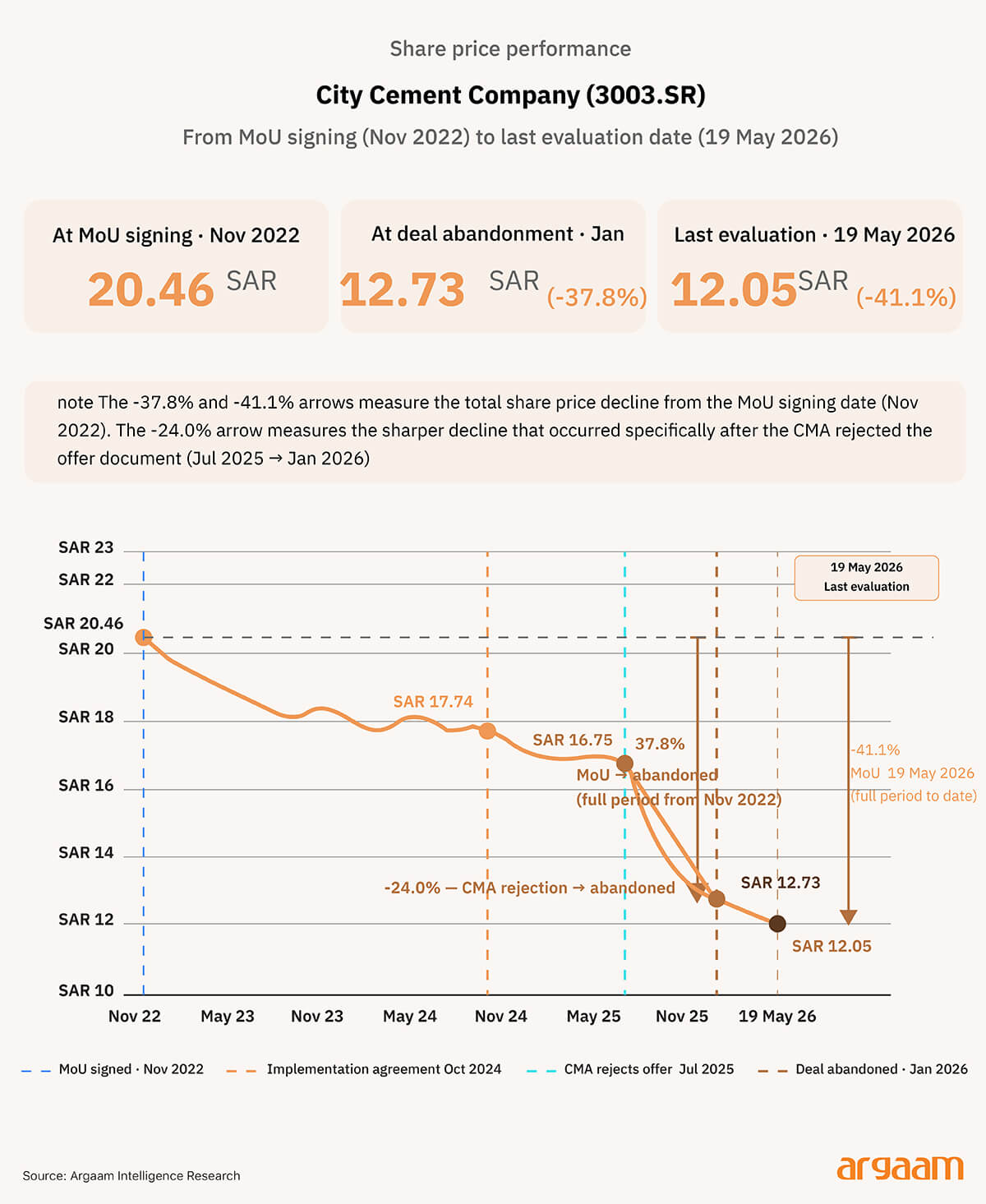
City Cement traded at approximately SAR 20.50 at the time of the MoU in November 2022. By the time the transaction was formally abandoned in January 2026, the share price had fallen to around SAR 12.70, a decline of approximately 38%, representing roughly SAR 1.1 billion in market capitalisation erosion on 140 million shares.
Sector-wide pressures clearly played a role, the Tadawul index declined by approximately 8.4% over the same period, but the scale of underperformance suggests factors beyond broader sector weakness may also have contributed.
The sharpest leg of the decline coincided with the CMA rejection in July 2025 and City Cement's formal abandonment of the deal in January 2026.
During that period, CCC’s share price declined by ~25%, consistent with a market perception of deal-related overhang in the final months of the process.
Qassim Cement, a direct sector peer, saw its share price decline by ~9% in comparison over the same period, further isolating CCC’s underperformance as company-specific rather than purely cyclical.
City Cement's board decided not to pay the second-half 2024 dividend — SAR 0.50 per share — giving the pending acquisition as its reason. On 140 million shares, that is SAR 70 million that shareholders did not receive. What makes this notable is who bore the cost.
Every shareholder was affected equally, including minority shareholders who had no say in how the deal was structured, no role in the governance decisions that may have contributed to its collapse, and no means of influencing the outcome. They waited, received nothing, and the deal failed anyway.
Transaction Costs: An Analytical Estimate
Beyond share price and dividends, advisory and execution costs represent the most directly quantifiable charge. These were not publicly disclosed, City Cement has not itemised advisory fees in its Tadawul filings.
Transactions of this nature involving two publicly listed entities in Saudi Arabia require extensive coordination across financial advisers, legal counsel, accountants, technical consultants and regulatory specialists.
For a transaction with an implied valuation exceeding SAR 1 billion, total costs on a completed deal would typically run in the range of 1.5–2.5% of transaction value, approximately SAR 15–25 million all in.
On aborted transactions, total incurred costs as a proportion of deal value tend to be materially lower with advisory success fees excluded, typically the largest cost item.
However, all non-contingent costs would have been incurred regardless: three years of retainers, legal fees, and multi-workstream due diligence across financial, tax, technical and commercial disciplines.
On a transaction of this size and duration, those unrecoverable costs could have plausibly exceeded approximately SAR 10 million.
For almost three years, City Cement's board and senior management were substantially occupied with a transaction that did not complete. The time and attention directed toward negotiations, due diligence, regulatory engagement and governance processes was not available for running and growing the business.
That is the nature of a transaction overhang — the deal does not have to fail to impose a cost; the distraction alone has a price.
Capital decisions were likely affected in parallel.
When a major acquisition is pending, companies tend to defer capital expenditure, delay growth initiatives, and hold resources in reserve in anticipation of a deal that may change the business entirely.
In City Cement's case, that caution extended across three years. The capital held back could have funded efficiency improvements, capacity optimisation or alternative acquisitions better suited to capturing value in Saudi Arabia's infrastructure-driven cement market.
The financial cost of that foregone activity is not calculable with precision. But a modest drag on value creation sustained over three years — in a market with clear structural growth drivers — implies tens of millions of riyals in economic value that was never generated. That is the cost that does not appear in any filing and cannot be recovered.
The reputational dimension is more difficult to assess but no less relevant. A regulatory rejection on governance grounds — following three years of preparation — raises questions that any board would need to address: about execution readiness, about the quality of governance coordination, and about the degree of regulatory preparedness that accompanied the transaction.
Future transactions involving either party may attract closer scrutiny from the Capital Market Authority and from shareholders, and the institutional memory of a publicly rejected prospectus does not fade quickly.
None of these costs appear in financial statements, nor would they be expected to. Failed transactions characteristically erode value through lost time, reduced strategic flexibility, and sustained management distraction rather than through a single identifiable charge.
In that context, City Cement Company's disclosure that the transaction had no material financial impact is not inaccurate on its own terms.
But the full picture — measured across share price performance, withheld dividends, unrecoverable advisory expenditure, and foregone strategic value — is more nuanced than that formulation suggests. Shareholders who bore those costs over three years are entitled to a more complete account
✧ Concluding Remarks ✧
The City Cement Company / Umm Al-Qura process is a case study in how prolonged public transactions can destroy value even without completion.
That said, the failed public merger after years of process preparation, particularly where governance and regulatory issues become more central to the approval process, sends a clear signal to the market.
Regulators are willing to intervene at a late stage, governance standards are tightening, and execution quality matters as much as strategic rationale.
For the Saudi public M&A market, that is ultimately a healthy development, even if the cost of that lesson fell disproportionately on City Cement Company’s shareholders. |