




|
Saudi Arabia's hospitality sector is expanding at a pace that has few precedents in emerging tourism markets. 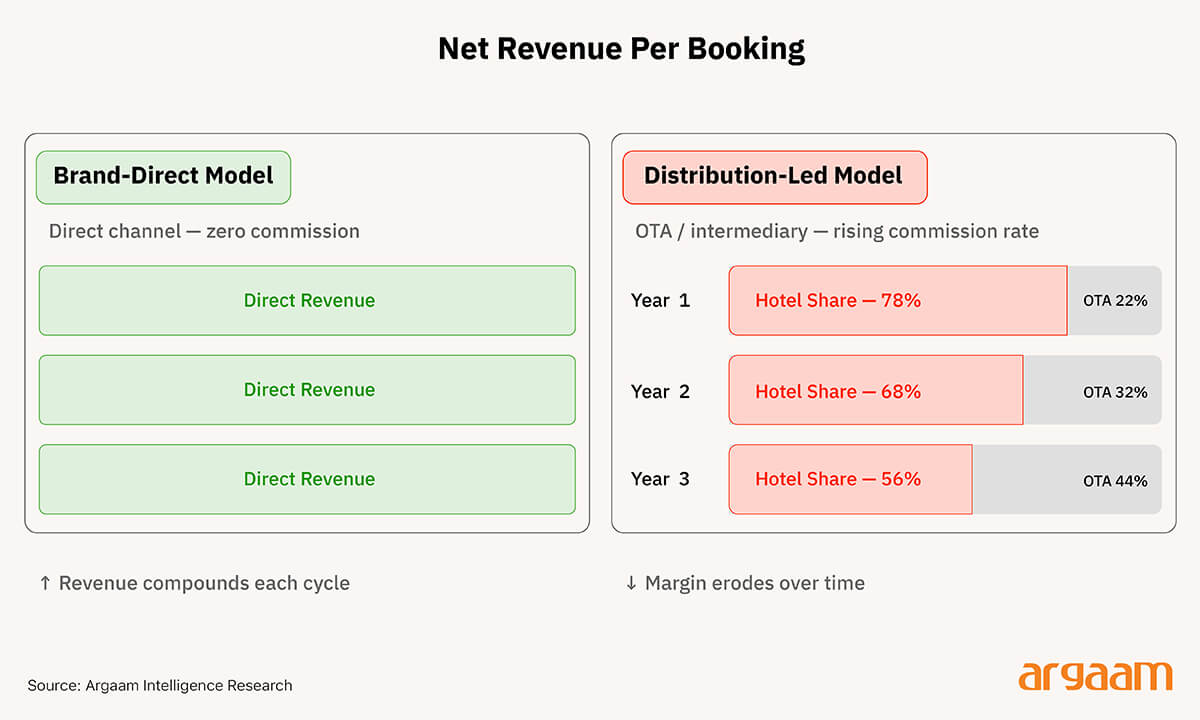  The problem of quality uncertainty
When a guest selects a hotel, they are making a financial commitment on the basis of incomplete information. Unlike a product that can be inspected before purchase, a hotel stay cannot be evaluated until after the transaction is complete. The guest must therefore rely on available signals — price, photographs, review scores, OTA ranking, brand name, and promotional visibility — to form a judgement about quality that the booking process itself cannot confirm. This is what economists call the problem of quality uncertainty: when buyers cannot directly observe what they are buying, markets can systematically misprice quality, rewarding the appearance of reliability over the substance of it. In hotel markets, this problem has a direct commercial expression in ADR. A room priced at SAR 890 — Riyadh's market-average ADR in Q1 2025 — carries an implicit quality signal: the rate itself communicates something about the stay the guest should expect (Knight Frank/STR Global, 2025). But if that rate is being sustained partly through promotional ranking, paid digital visibility, and distribution spend rather than through accumulated brand trust, the signal is partially false. The guest has no reliable way to distinguish a hotel charging SAR 890. Its service consistently justifies that rate from one charging SAR 890 because its marketing consistently places it in front of guests before cheaper alternatives appear. Both hotels occupy the same position in the booking frame. Only the stay reveals the difference. By the time the guest discovers the hotel does not match its marketed promise, they have already paid for the room. The money has moved. The mispricing has already occurred. Saudi Arabia's hospitality sector recorded strong headline numbers — ADR up 10.8% and RevPAR up 12.3% in the twelve months to March 2025. Those figures suggest a healthy market. But averages can hide as much as they reveal. Strong aggregate performance does not tell us how many hotels are earning their rate and how many are buying it. When the market was growing and supply was limited, that distinction did not matter much. Because when demand is strong and rooms are scarce, almost any hotel fills up. A hotel does not need to be trusted if it is the only option available. With Riyadh absorbing 10.2% supply growth in 2026, it begins to matter considerably. More hotels competing for the same guests means that when there are many options, the guest has a choice — and that is when brand trust becomes the deciding factor. The cost of staying visible rises, the return on promotional spending falls, because more hotels are competing for the same advertising space, the same OTA rankings, and the same guest attention. When ten hotels are bidding for the top position on a booking platform, the price of that position rises. But the number of guests clicking on it does not rise proportionally — the demand is the same, only the competition for it has increased. So each hotel spends more to reach the same guest, and converts a smaller share of them because the guest now has more alternatives to consider. More spending, lower return. Accordingly, the hotels without genuine pricing power are the first to feel it — in their rates, then in their margins. 
The Measurement Trap Performance marketing is easy to defend in a budget meeting. It produces numbers — clicks, conversions, cost per booking, return on ad spend — that can be reviewed, compared, and approved. The spending looks rational because its output is visible. Brand investment does not offer the same convenience. Its returns are real: stronger repeat demand, greater willingness to pay, more resilient ADR, and lower dependence on paid advertising channels. But they do not appear in a single quarter's dashboard, and a manager seeking budget approval cannot easily point to them. So they lose the argument — not because they are less valuable, but because they are harder to measure. This is not a marketing problem. It is a capital allocation problem. When firms systematically favour what is measurable over what is valuable, they make a series of individually defensible decisions that compound into a strategically damaging outcome. For Saudi hospitality executives, the financial consequence is direct. A hotel that continuously underfunds brand investment in favour of performance marketing may report healthy short-term financials while quietly eroding the asset that protects its rate in a more competitive market. The numbers look right. The trajectory does not. Advertising is not the problem. It works, and it creates real commercial value. The problem is what firms conclude from it. A booking generated through paid visibility tells you that your marketing reached the right person at the right moment. It does not tell you that the guest chose you because they trusted you. Treating one as evidence of the other is where the financial risk begins. 
What the Data Shows The right way to read Saudi hotel markets is not by city size but by how demand is formed. Riyadh and Jeddah must continuously compete for guests through pricing, visibility, events, and digital distribution. Makkah and Madinah do not face the same contest. Pilgrims arrive because of religious obligation, not because a hotel ranked well on a booking platform. That difference is what makes the Q1 2025 data useful, given the coincidence with Ramadan. In Riyadh, ADR fell 8.2% year-on-year to SAR 890, while RevPAR dropped 17% to SAR 537, with occupancy at 60.3%. In Jeddah, ADR declined 11.2% to SAR 627, and RevPAR fell 9.9% to SAR 404, even as occupancy edged up slightly to 64.5% — rooms were being filled, but at a lower price. 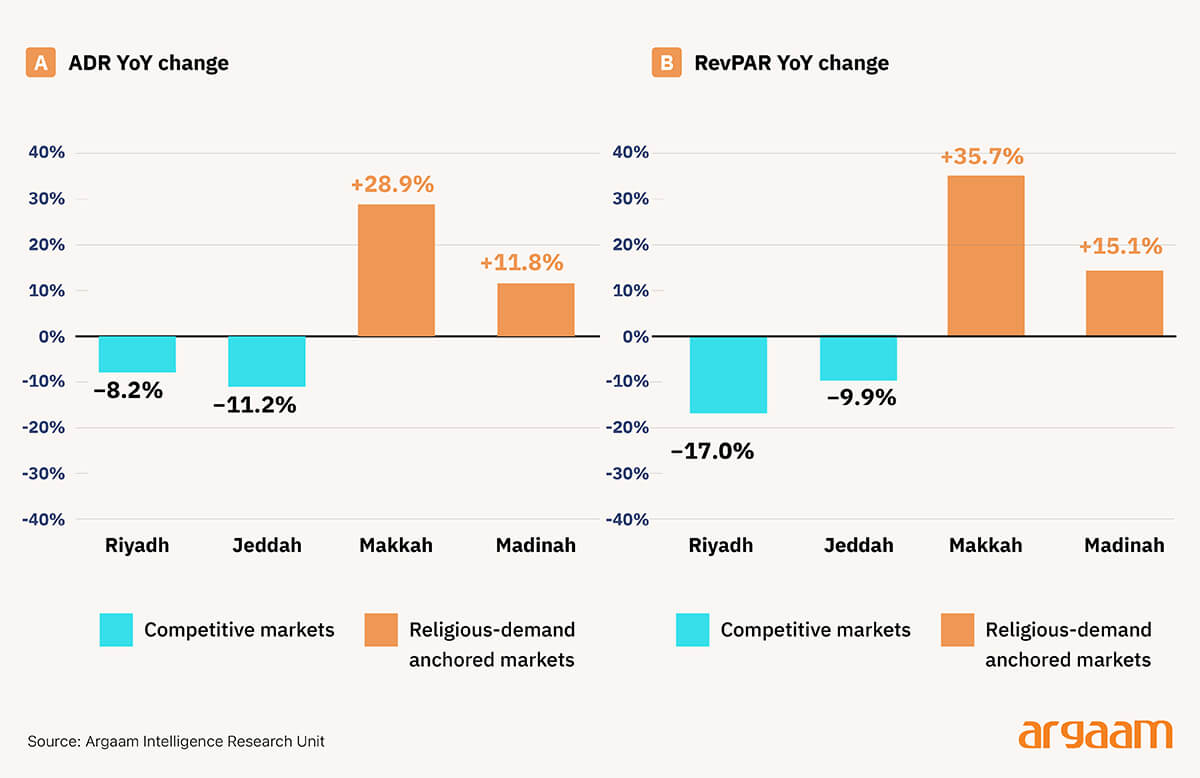 Makkah and Madinah moved in opposite directions. Makkah recorded ADR growth of 28.9% to SAR 859 and RevPAR growth of 35.7% to SAR 673, with occupancy at 78.3%. Madinah posted an ADR of SAR 891, up 11.8%, and a RevPAR of SAR 724, up 15.1%, with occupancy at 81.3%. The contrast is clear. The two markets that depend on attracting guests saw rates fall. The two markets where guests arrive regardless saw rates rise. This does not settle the question. Other factors were at play. But it shows enough to make the question worth pursuing.
Editorial Note Falling rates in Riyadh and Jeddah do not automatically mean hotels in those markets have a brand problem. Rates move for many reasons — new supply entering the market, a quieter events calendar, or seasonal demand shifts. The data tells us what happened to prices. It does not tell us why. Those are two different things, and conflating them would weaken the analysis. Knowing that rates fell is the starting point. Understanding what drove them down requires a deeper investigation that a single quarter's data cannot complete on its own.
✧ Concluding Remarks ✧
When hotels are rewarded for being visible rather than for being genuinely good, the incentive to invest in the harder, slower work of building real quality begins to weaken. |
|
|

|


|

|