The Construction Cost Index in the Gulf is no longer a technical metric tracking routine inflation — the war has transformed it into a real-time gauge of geopolitical stress on the built environment.
The pre-war trajectory was already unfavourable. Dubai's CCI was registering quarterly fuel surges of 4.03% in Q1 2025 and 6.18% in Q3 2025, while Saudi Arabia's CCI was rising 1% year-on-year before the start of the war between Iran, Israel and the US on February 28.
When geopolitical tensions drive energy prices higher, construction budgets feel it first and most sharply — because energy is not just one line item in a construction project, it is the invisible input running through almost every other line item.
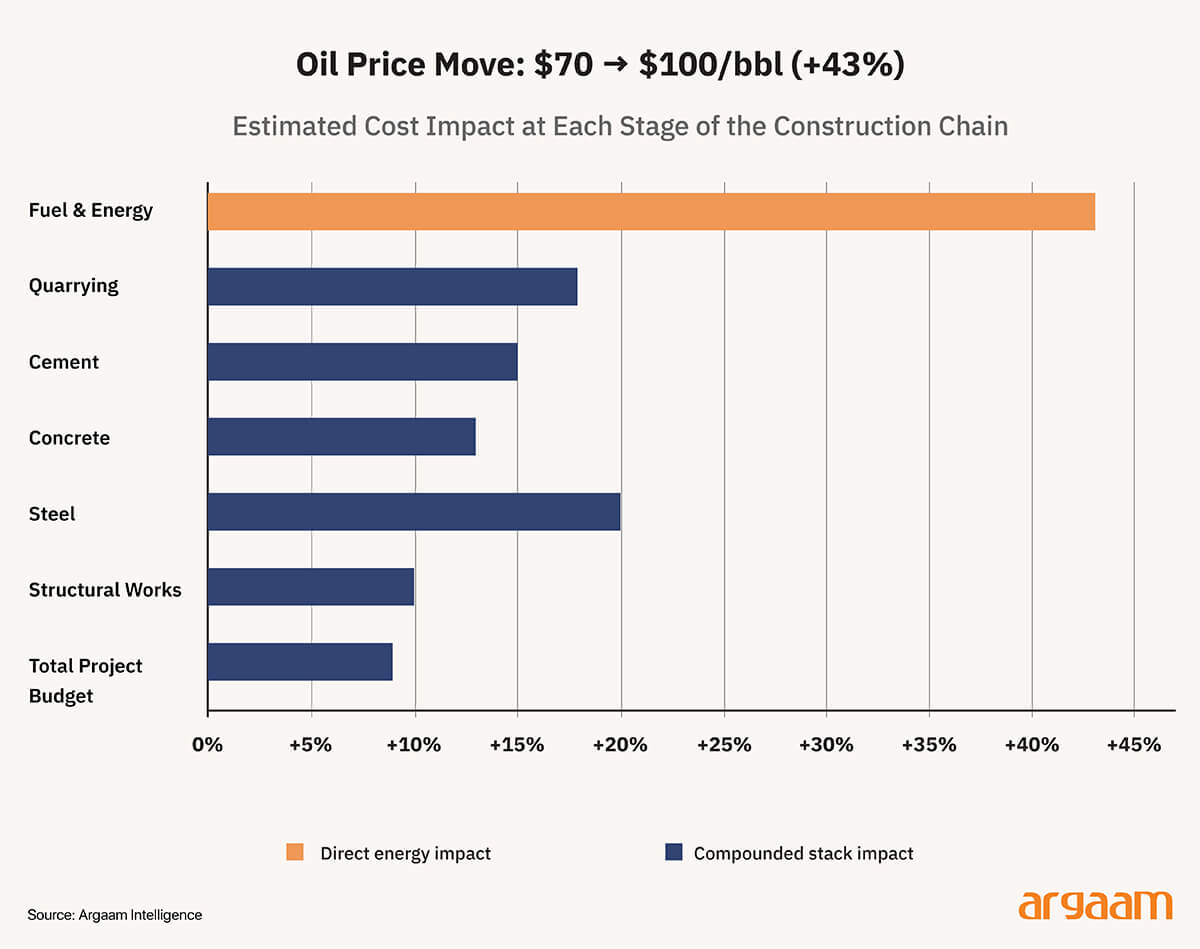
That is why the real question is not simply whether oil goes from $70 to $100 a barrel. The real question is what that move does to the whole cost stack.
The naive assumption is that fuel costs construction rise by roughly 43% and everything else stays roughly proportional. This is wrong in both direction and magnitude.
The cost stack in construction is a layered system where energy is an input to almost every other input. ◆ Fuel moves quarrying costs. ◆ Quarrying costs move cement costs. ◆ Cement costs move concrete costs. ◆ Concrete costs move structural costs. ◆ And structural costs move the entire project budget — before a single variation order has been issued.
The same cascade runs through steel: energy moves smelting, smelting moves steel plate, steel plate moves fabrication, fabrication moves mechanical and electrical installation. By the time the $30 oil move has worked its way through the full stack.
The final cost impact on a Gulf megaproject or a residential compound is not 43% on fuel — it is a compounding effect that can push total project costs up by around 10% within two to three quarters, even if oil stabilises at the new level.
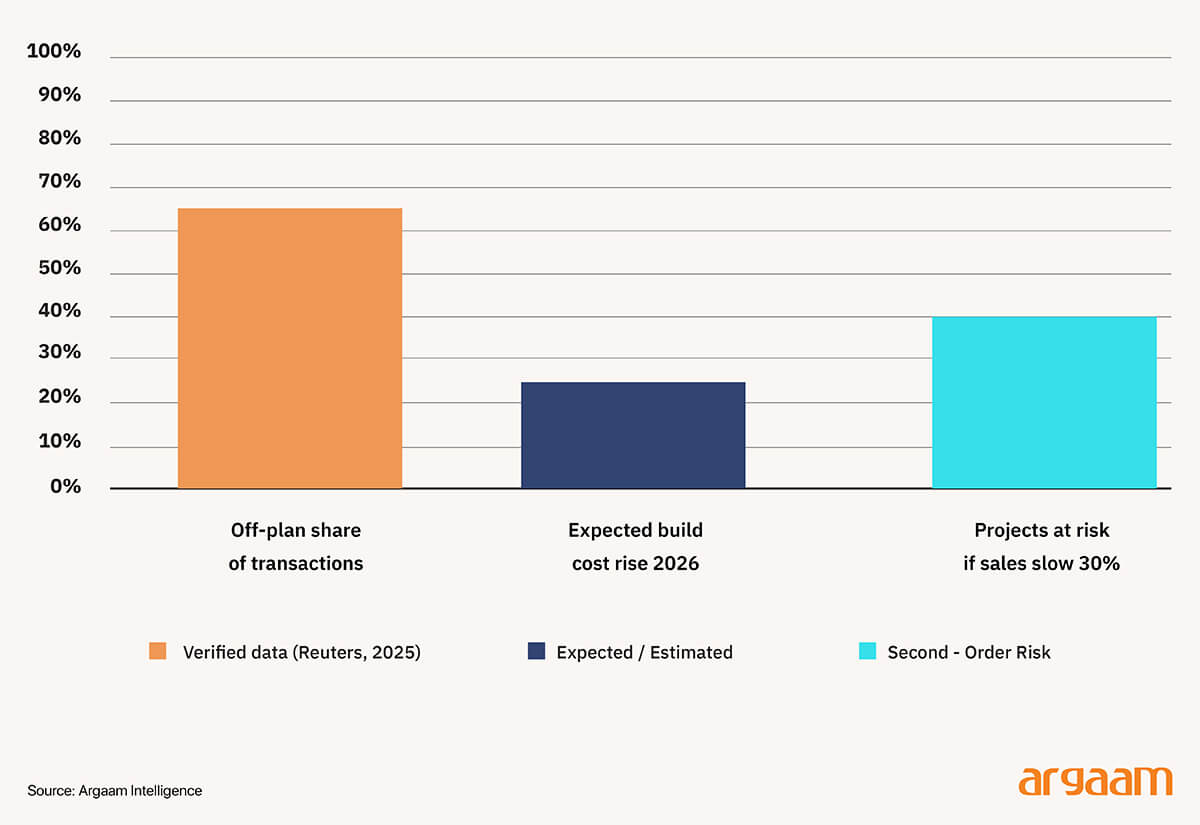
If construction costs rise in 2026 by 15–25%, as expected by some property developers in the region already, this means it will take significantly more to build a property, and buyers could simultaneously pull back — either from fear, tighter credit because the expected rise in interest rates again.
This’s a dilemma for developers. The price a developer needs to charge to break even keeps rising. But the price a buyer is willing to pay keeps falling.
At some point these two lines cross, and the project simply stops making financial sense. This’s the inflection point where projects get shelved.
65% Off-Plan in Dubai
Unlike mature markets where the majority of transactions involve completed, habitable stock, Gulf property markets — and Dubai in particular — have been built around the off-plan model, where buyers commit capital today for a product that will not exist for another two to four years.
This model works smoothly when confidence is high and the future feels predictable. It becomes acutely fragile when neither condition holds.
The UAE illustrates the scale of this exposure with precision.
Reuters reported that off-plan deals accounted for 65% of Dubai transactions in 2025 — meaning that nearly two thirds of the market's activity was predicated not on the value of an existing asset, but on a buyer's willingness to bet on future delivery, future prices, and the continued financial health of the developer.
Off-plan sales are not merely a transaction type — they are the primary funding mechanism for construction itself. Developers across the Gulf use buyer deposits to finance ongoing build programmes, which means a slowdown in off-plan absorption does not just reduce revenue.
It directly threatens the ability to complete projects already under way.
A 25% rise in construction costs alone would be painful but manageable — developers would reprice, delay, or renegotiate. A significant fall in buyer sentiment alone would be concerning but survivable — costs would still allow lower prices.
What makes the current environment potentially risky for the real estate sector is that both could happen together, and if they do, they move in opposite directions.
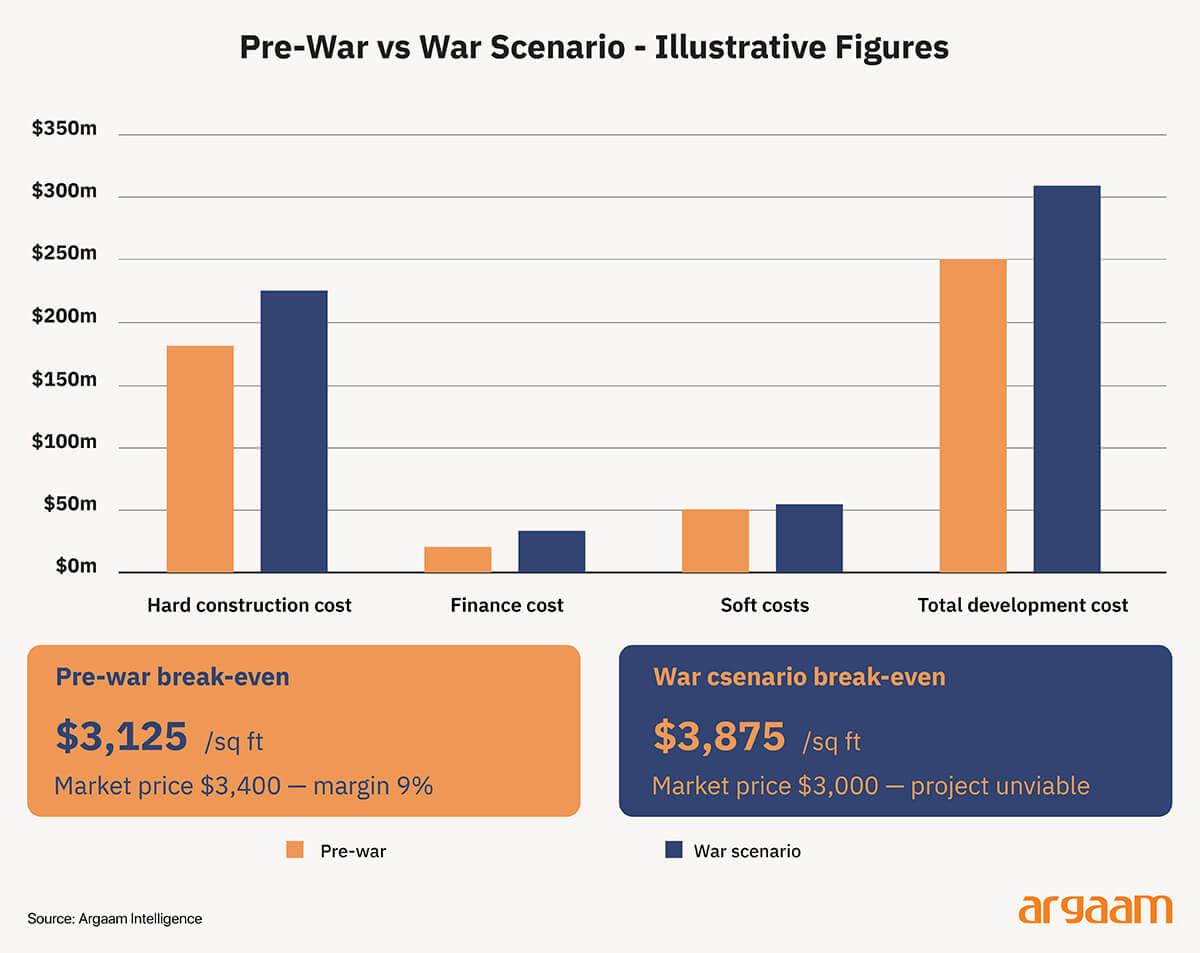
Rising construction costs push the minimum viable sale price upward — the developer needs to charge more just to break even. Falling buyer sentiment pushes the maximum achievable sale price downward — the market will only pay less. One force is lifting the floor. The other is lowering the ceiling.
The gap between what it costs to build and what buyers will pay — which is where developer viability lives — does not just shrink. It can close entirely. And when it closes, no amount of renegotiation or repricing solves the problem, because the arithmetic simply no longer works.
Cost Is Only Half the Problem. The Other Half Is Capital
When a war breaks out, developers do not just face higher construction costs — they also find it harder and more expensive to borrow the money they need to build in the first place.
This is the capital pressure, and it is a separate problem from the cost problem, arriving at exactly the wrong moment.
In plain terms, property developers in the Gulf rely heavily on bond markets — essentially selling debt to investors — to raise the large sums needed to finance construction. When regional risk rises sharply, those investors step back.
They are not willing to lend at the same price as before, if they are willing to lend at all.
At the same time, the cost of borrowing from banks also rose, as lenders added a higher risk premium to reflect the uncertainty of the environment.
Hopes of deep rate cuts in the US have been undermined by the broadening of the war in Iran. Before the US and Israel’s attack on Iran, traders had been expecting two or three quarter-point rate cuts this year. As writing, traders were pricing in just one or two.
Rates will still fall, which provides some relief. But the relief arriving more slowly and in smaller doses than expected means the window of easier financing conditions that developers and buyers were counting on to absorb some of the war-driven cost pressure has narrowed.
Note on the chart: In the pre-war scenario, the gap between the two — $275 per square foot — is the developer's margin. In the war scenario, the developer now needs $875 more per square foot than the market will pay.
One or two quarter-point cuts instead of two or three sounds like a minor difference. In isolation it is. But in the context of a construction and real estate market already under pressure from rising input costs, tightening capital availability, and falling buyer sentiment, the difference between 50 basis points of relief and 75 basis points of relief is not trivial.
It affects developer financing costs, mortgage affordability for buyers, and the discount rate used to value development land — all simultaneously.
Every 25 basis points that does not come off the rate is real money on a $250million project.
On the hypothetical Dubai tower in the earlier example, the difference between a 6% and a 5.5% finance cost over a three-year build programme is roughly $3 to $4 million — not catastrophic on its own, but stacked on top of a 25% construction cost increase and falling market prices, it is another push in the wrong direction.
✧ Conclusion ✧
For developers who structured their pro formas at $70 oil and a falling rate environment, the war has not just moved one variable. It has moved every variable in the wrong direction at the same time.
It is not a cost problem with a financial solution. It is a structural repricing of the entire risk environment in which Gulf real estate operates, and the Construction Cost Index is the most granular instrument available for tracking how deep that repricing goes.
More this Weekend
What Saudi Arabia's Cybersecurity Record Is Not Capturing — and Why It Matters
Saudi Arabia has developed one of the most comprehensive cybersecurity frameworks in the Gulf region — one that addresses network integrity, system vulnerabilities, and incident response with increasing sophistication. The progress is genuine and the institutional commitment behind it is not in question.