




|
Despite Saudi-owned Newcastle United’s impressive finish as third in the Premier League, the club’s financial health remains heavily dependent on prudent financial management rather than solely on sporting success, a phenomenon prevalent across many top-tier clubs. While an excellent league position often boosts revenue streams such as broadcasting rights, sponsorships, and matchday sales, these income sources alone do not guarantee profitability. High operating costs particularly player wages, transfer fees, staff salaries, and other operational expenses tend to escalate alongside sporting achievements, often offsetting the additional revenue generated by improved league positions. Since the takeover of the majority stake in the club by the Public Investment Fund (PIF), £440.8m of equity funding has been placed into the club. This funding enhances the club’s capacity to invest in players, facilities, and other long-term assets, supporting growth and development. The PIF increased in July its stake to %85. Over the past five years, Newcastle’s net spend is £492.2m, which is the fifth-highest in England. This analysis aims to emphasize that the primary factor influencing the financial stability of Premier League clubs like Manchester City, Liverpool and Newcastle United is effective financial management and strategic spending, rather than sporting success alone. The Premier League’s Profit and Sustainability Rules (PSR) play a crucial role in shaping the financial landscape of its member clubs by regulating their spending power. These rules are designed to promote fiscal responsibility and ensure long-term financial sustainability within the league, thereby preventing excessive debt accumulation and financial mismanagement. In this analysis, we will examine the latest financial statement released by Newcastle United to provide a comprehensive overview of the club's financial performance in the most recent season. Specifically, we will analyze the revenues generated and compare them to the incurred losses. We aim to understand the factors that influenced Newcastle United's financial outcomes in the last season. This detailed review will shed light on the club's financial stability and help identify areas for potential improvement moving forward. 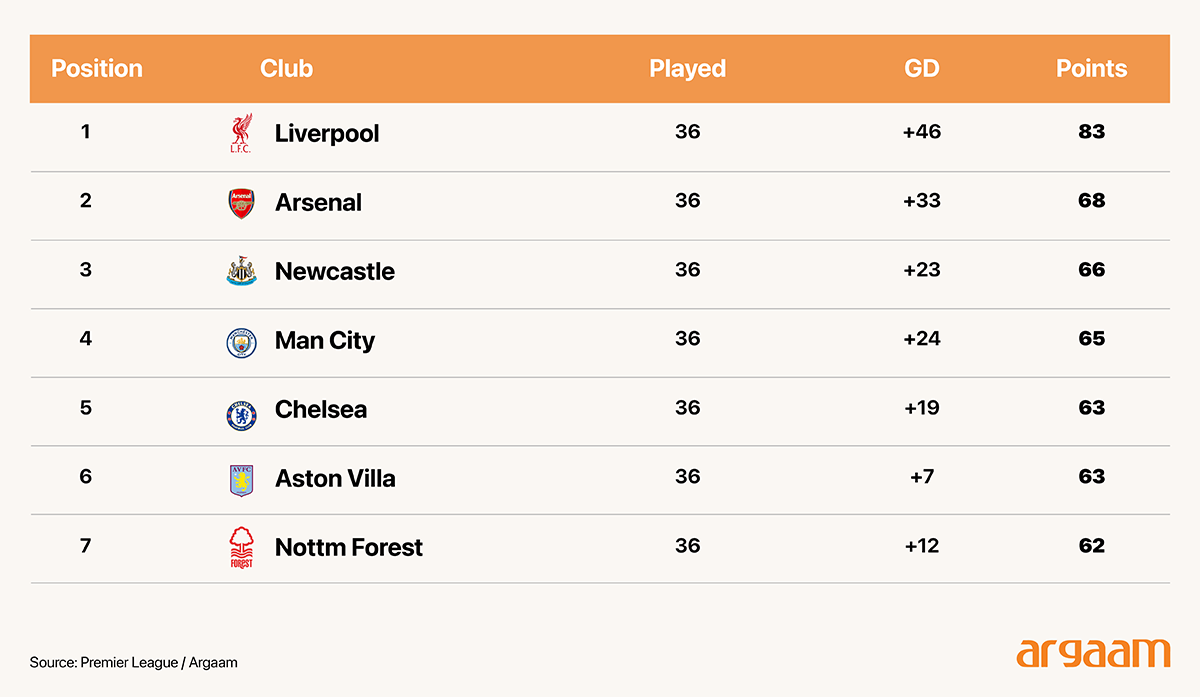 
The Asset Appreciation in Football
Our analysis begins by recognizing that investment activities in football are progressing through the same fundamental cycle observed in broader financial investing, characterized by four micro-processes: horizoning, targeting, synergizing, and creating value. Horizoning refers to the duration for which an investor holds assets, targeting involves factors influencing investors to enter football, synergizing explores potential benefits from established networks, and creating value focuses on potential value drivers. However, what sets football club investments apart is the paramount importance of asset value, which encompasses the club’s brand, fan base, and on-field performance, in addition to financial metrics. Unlike traditional investments where asset value might be solely based on market valuation or physical assets, in football, the intrinsic value of the club as an asset is deeply intertwined with its proper financial management, sporting success, social appeal, and commercial potential. 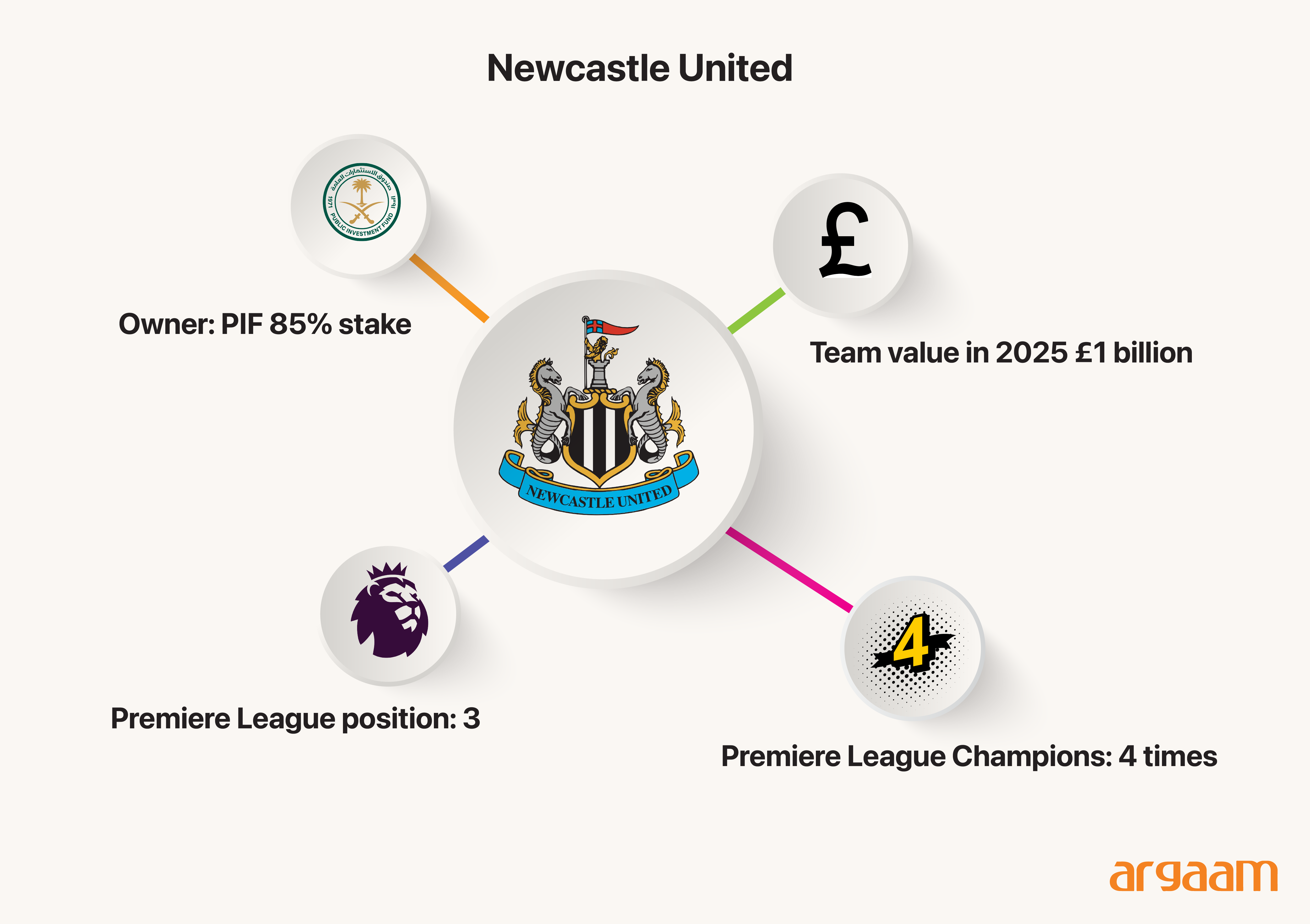
Newcastle United's valuation as an asset has significantly increased since the Saudi Public Investment Fund’s takeover of 80% state from British businessman Mike Ashley in 2021 at £305 million. The club is now valued at over £1 billion. This puts it on a similar footing to clubs like AC Milan, which was sold for $1.3 billion in 2022. Another example is Chelsea. When its previous owner Roman Abramovich sold the club in 2022, he was paid £2.5 billion pounds compared to its value when he first bought it in 2003 for $140 million pounds, which calculates to roughly 16% yearly growth, or 13% adjusted for inflation.  Newcastle United’s Post-Takeover Success
For the third consecutive year post the takeover of the Public Investment Fund, Newcastle registered a new record for revenue, reaching £320.3million. That represents a %28 £70m year-on-year increase, based on the latest financial statement published by the club. Commercial income increased by a staggering %90, from £43.9m to £83.5m. Commercial income refers to revenue generated by the club through various commercial activities outside of matchday and broadcasting rights. The include chiefly sponsorship deals, merchandising, as well as conference and banqueting in stadium venues. Specifically, in the context of Newcastle United for the year ending 30 June 2024, commercial income was driven by new and enhanced partnership deals with companies such as Sela, Noon, Fenwick, InPost, and Adidas, as well as new initiatives like the in-house retail operation. This means the club directly handles the sales of merchandise, including kits, apparel, and other branded products, through their own retail stores, online shop, and distribution channels and the launch of a new home shirt. The club’s matchday revenue grew 32% , from £37.9m to £50.1m. 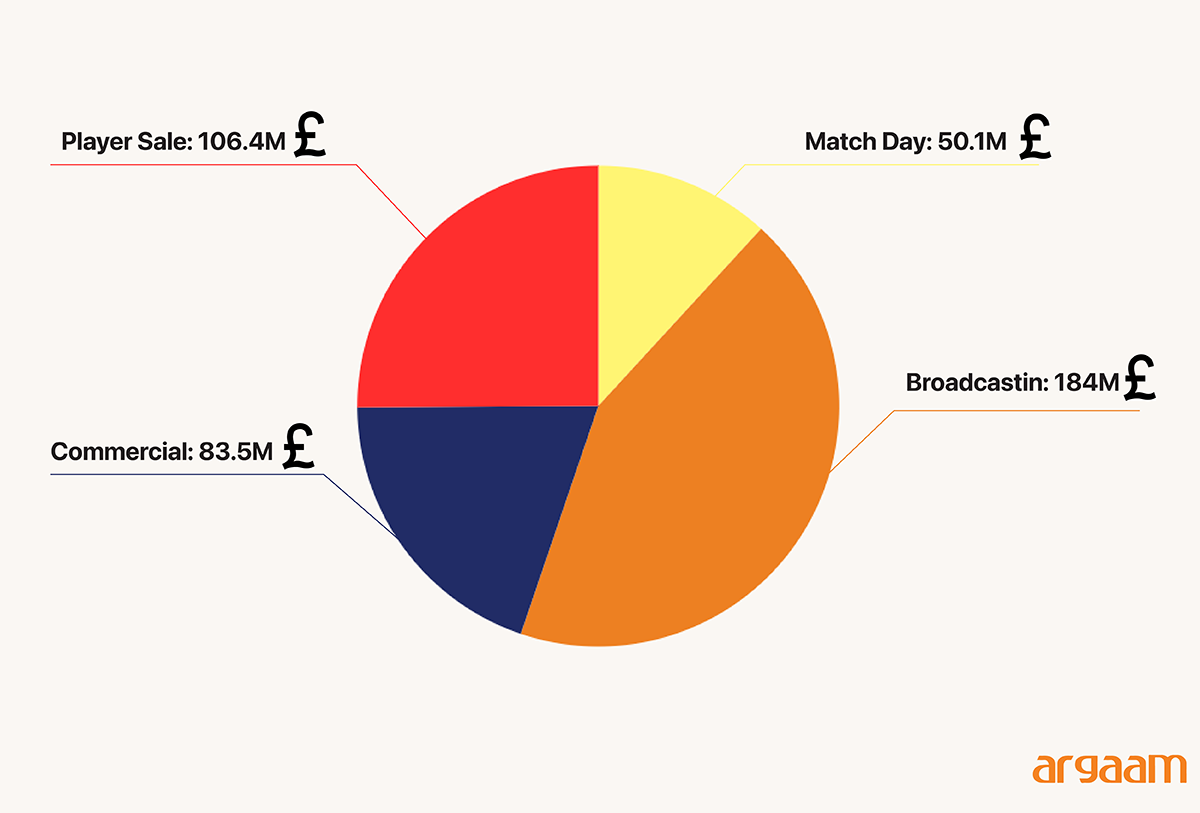 Broadcast revenue only increased by 11% £18.3m to £184m. That is primarily due to Newcastle finishing seventh down from fourth in the Premier League and being televised less frequently, meaning domestic distribution was down £9.6m. Over the past five years, Newcastle have generated the 12th-highest income £106.4m from player-sale profit in the Premier League. 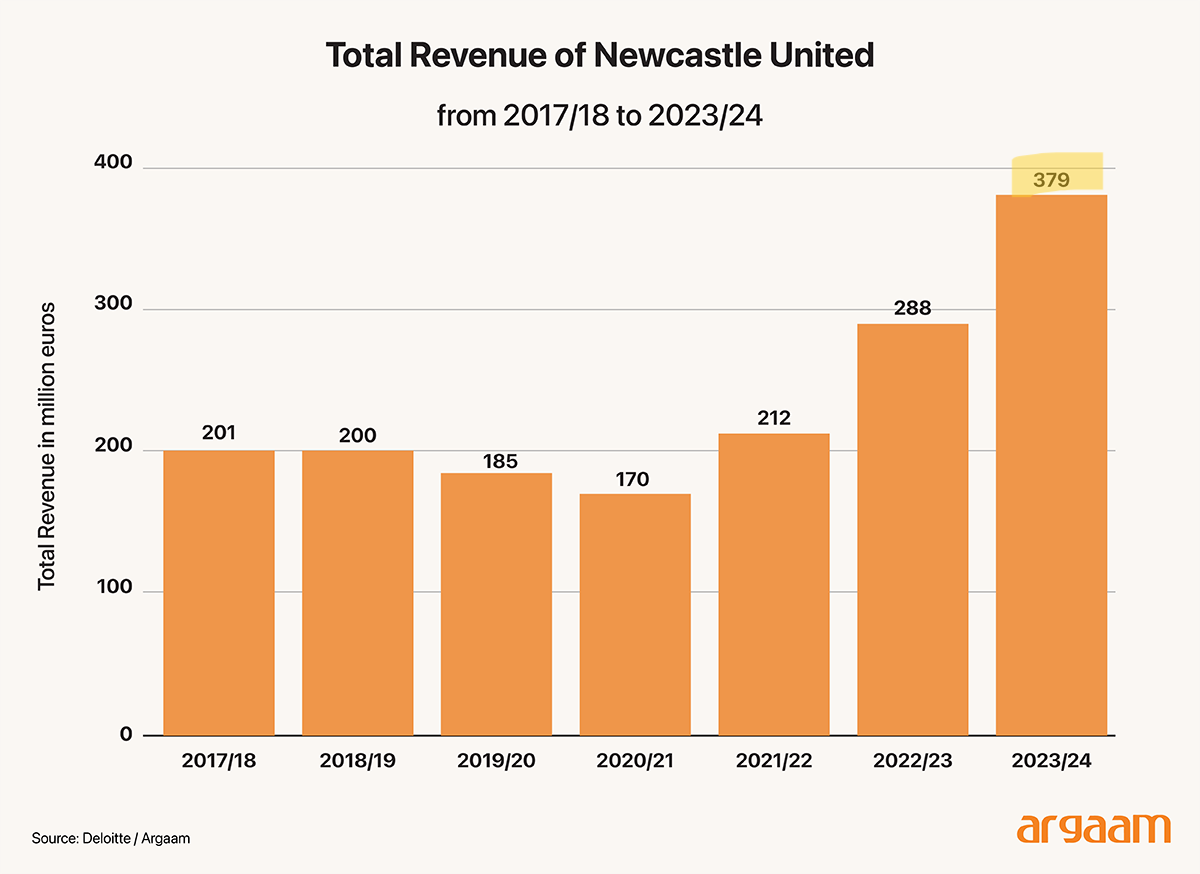 
Newcastle's Wage Ratio Dips as Revenue Outstrips Salaries
Although the wage bill increased substantially, the revenue growth exceeded that of wage costs, implying that the club's expenditure on wages became relatively more sustainable and efficient in supporting its broader financial performance. Specifically, revenue grew by approximately £70 million, or 28%, while wages grew by about £33.6 million, or roughly 18%. The wage bill growth by %18 from £185.1m to £218.4m appears in the financial statements of the club as staff costs. So the club’s wages-to-turnover ratio in the last season was %68. In the context of professional football, especially at a club competing in the Premier League and participating in European competitions like the UEFA Champions League, a staff costs-to-turnover ratio below 70% is often considered a sign of relatively efficient financial management. The wages-to-turnover ratio was high at %95 in 2021-22 and %74 in 2022-23.  Even Success Comes at a Cost
If you exclude the income generated from player transfers which is significant in football clubs' finances, Newcastle United would have recorded an operating loss of approximately £68.6 million for the 2023-24 season. This figure is comparable to the losses experienced in the previous two seasons, which were about £66 million in 2022-23 and £72 million in 2021-22. Furthermore, the £68.6 million loss, before considering transfer income, would rank as the eighth-highest operating loss among all Premier League clubs for that season. This highlights that Newcastle’s underlying operational losses are substantial and consistent with broader league trends, especially considering the significant investment in players and infrastructure, and underscores the financial challenges even successful clubs face at this level. The loss reflects financial challenges such as increased operating expenses, amortisation costs, and investment in squad and infrastructure, which, despite revenue growth, outweighed the profits. According to a March report in The Athletic, a New York Times Publication, without the June 30 sales of Yankuba Minteh to Brighton & Hove Albion and Elliot Anderson to Nottingham Forest, which brought in a combined £65m and the financial settlement Manchester United paid for contracting Newcastle’s director Dan Ashworth Newcastle were facing a £69m pre-tax loss and PSR breach well above £50m. 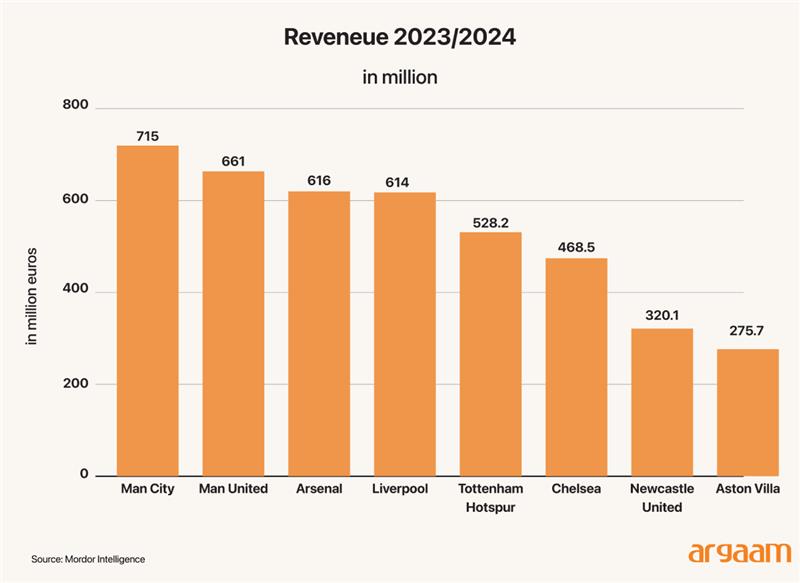 |
|
|

|


|


Argaam.com Copyright © 2025, Argaam Investment, All Rights Reserved |