Saudi Telecom Company (stc) is the Kingdom’s largest telecommunications and digital services operator.
Over the past decade, it has built a broad portfolio of digital and financial businesses, alongside strategic stakes in regional and global companies.
Most brokerage firms, however, value the group as a single entity using discounted cash flow (DCF) models, while relying on peer multiples or dividend yield analyses as validation tools.
Under this approach, diversification is treated as a qualitative factor that influences the valuation of the group as a whole, rather than as a source of value that can be measured business by business.
Argaam Intelligence adopts a different approach, valuing each business segment separately using the methodology most appropriate to its nature, and then aggregating these values to arrive at the group's total value under a sum-of-the-parts (SOTP) framework.
This analysis reflects third-quarter 2026 results and market data available as of 5 November 2026. It is intended solely for analysis and discussion purposes and does not constitute investment advice.

Business Map
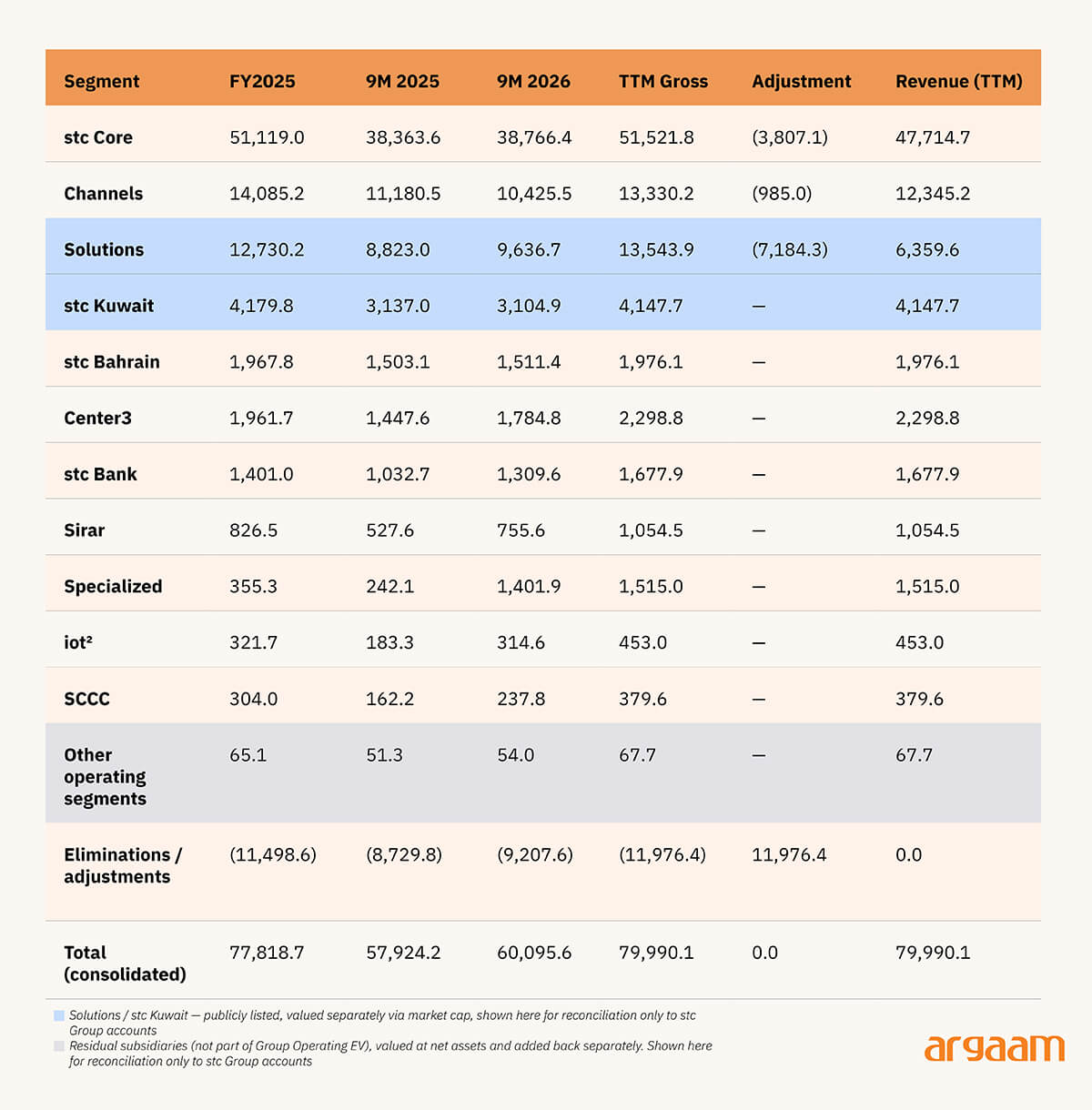
The group's operations can be divided into five categories. The first comprises the core domestic operations, namely the core telecommunications business (stc Core), which is the largest contributor to both revenue and gross profit, as well as Channels, the group’s distribution and retail subsidiary.
The second category includes the two listed subsidiaries: Arabian Internet and Communications Services Company (solutions), in which stc owns a 79.6% stake, and Kuwait Telecommunications Company (stc Kuwait), with a 51.8% ownership stake.
The third category consists of the group's other consolidated businesses, most notably center3, which is wholly owned, stc Bank, in which the group owns 92.3%, and Specialized Telecommunications Company (Specialized).
It also includes Bahrain Telecommunications, Sirar (Advanced Technology and Cybersecurity Company), iot², and Saudi Cloud Computing Company (SCCC).
These are followed by smaller subsidiaries and associates, as well as non-operating investments, most notably a roughly 43.06% stake in the merged telecommunications towers entity (TAWAL), a 36.66% stake in Arabsat, and approximately 9.97% of Spain’s Telefónica Group

How Is Each Component Valued?
Because segment-level EBITDA data are not disclosed, with only revenue and gross profit reported by segment, the analysis relies on the last twelve months' enterprise value-to-revenue (EV/Revenue) multiples after eliminating intra-group transactions.
The two listed subsidiaries are valued based on their market capitalisations, adjusted for net cash positions. Smaller businesses are valued at book value, while non-operating investments are valued using transaction values, market values, or book values as appropriate.
The analysis then moves from enterprise value to equity value by deducting net debt and minority interests and adding non-operating investments, ultimately deriving an indicative value per share.
Third Quarter: Faster Growth Beyond the Core Business
The analysis maintains the same valuation multiple ranges used in the second-quarter assessment.
The most notable development during the quarter was a 3.3% year-on-year decline in core telecommunications revenues, following growth of the same magnitude in the first half of the year.
This development warrants monitoring but is not sufficient, based on a single quarter, to justify a lower valuation multiple.
By contrast, center3 accelerated revenue growth to 35.3%, up from 17.5% in the first half of the year. stc Bank revenue growth reached 53.8%, compared with 13.8% previously, while Specialized reported a sharp rise in revenue following the commencement of revenue recognition on a major government contract.
These developments influence valuation through revenue growth rather than through multiple expansion. Meanwhile, the decline observed in certain peer multiples, driven by rising regional risk premiums, appears to be a temporary market factor rather than a structural shift.
The core telecommunications business is valued at a base multiple of 2.5x EV/Revenue, within a range of 1.5x to 3.0x, using Mobily and Zain KSA as key reference peers.
center3 is valued at 8.0x revenue, within a broad range of 5.0x to 13.0x, bounded at the low end by Meeza and at the high end by Equinix and Digital Realty.
stc Bank is valued at 6.0x revenue, based on the valuation multiple of South Korea’s KakaoBank.
Beneath the headline, two findings matter more. First, defaults and falling car prices are far more damaging together than apart. A rise in defaults alone, or a drop in car prices alone, costs the sector relatively little.
When both happen at the same time, the loss is much larger than the two added together. And they tend to arrive together, because the same economic stress that pushes borrowers into default also puts more repossessed cars up for sale, driving prices down further.
Second, the sector average hides the distribution. Our default rates reflect what Saudi finance companies have already reported. For a lender concentrated in higher-risk borrowers the breaking point is far lower, and provisions offer little help: SAMA's figures show they are almost entirely held against loans that have already gone bad.

Stable Valuation Multiples Despite Revenue Expansion
Under the base-case scenario, the group's operating enterprise value stands at approximately SAR 192.4 billion, including SAR 164.0 billion for operating segments and SAR 28.4 billion for the two listed subsidiaries. This figure is broadly unchanged from the second-quarter analysis.
The fact that the strong growth recorded by center3, stc Bank, and Specialized has not translated into a higher valuation may appear surprising. Three factors explain this outcome.
◈ First, scale. These three businesses collectively account for roughly one-sixth of the group's operating enterprise value, whereas the core telecommunications business alone represents about three-fifths.
A 1% change in core revenue impacts valuation by roughly SAR 1.2 billion, equivalent to approximately the effect of an additional 6%-7% increase in center3 revenue.
◈ Second, methodology. A particularly strong quarter only contributes to last-twelve-month revenues by the amount exceeding the corresponding quarter of the prior year.
This occurred against the backdrop of declining revenue in the core business.
◈ Third, market prices. The value of solutions is derived from its share price, which declined alongside the broader market despite continued revenue growth.
As a result, high-growth businesses continue to add value, but their contribution has not yet been large enough to offset the weaker quarterly performance of the core business and the lower market value of solutions.
Share Valuation
After deducting adjusted net debt of approximately SAR 9.7 billion and minority interests of approximately SAR 9.7 billion, and adding the value of the group's stake in TAWAL (SAR 8.4 billion), its Telefónica stake at market value (SAR 8.1 billion), together with Arabsat and other holdings, total equity value under the base-case scenario reaches approximately SAR 195.5 billion.
This translates into an indicative value of SAR 39.23 per share, about 5.7% below the market price of approximately SAR 41.6 as of 5 November 2026.
The gap has narrowed since the second quarter due primarily to the decline in stc's share price amid regional geopolitical tensions, rather than any change in fundamentals or valuation methodology.
Under the assumptions and data used in the SOTP model, the indicative valuation range lies between approximately SAR 39 and SAR 48 per share, spanning the base and upside scenarios.
This range represents the output of the valuation model and should not be interpreted as a target price or investment recommendation.
Regarding alternative valuations, SNB Capital maintained a target price of SAR 52.3 per share after the third-quarter results, above the upper end of our range, while BSF Capital's target price of SAR 46.7 falls within it.

Analytical Framework
Some research firms arrive at higher valuations. Following the announcement of third-quarter results, SNB Capital set a target price of SAR 52.3 per share, exceeding the upper end of our SAR 39-48 valuation range, while BSF Capital's target price of SAR 46.7 remains within it.
The difference lies primarily in methodology rather than facts. Brokerage firms typically value stc as a single entity, using forecast earnings and cash flows while relying on peer multiples as a validation check.
This approach allows them to capture the value of growth that has not yet appeared in the financial statements.
For example, SNB Capital highlights the expansion of the data centre business, the growing contribution of center3 and stc Bank, and major government contracts.
Our analysis, by contrast, values each business based on its revenue over the last twelve months, using peer multiples that have been kept unchanged, while also relying on book value for certain assets.
Accordingly, growth in our model is reflected primarily through the revenues reported in the company’s disclosed results, while the valuation multiples applied remain unchanged.
By contrast, the forward-looking valuations published by some research firms incorporate assumptions regarding future growth, earnings, and cash flows over upcoming periods.
As such, comparing these estimates with the outputs of our model does not constitute a like-for-like comparison of target prices, as the underlying methodologies and time horizons differ.
Conclusion
This research provides a broad valuation analysis of Saudi Telecom Company (stc) using a sum-of-the-parts framework. It is based on a number of estimates and judgements and is constrained by the limitations of publicly available information.
The SOTP model continues to indicate that stc's current market price is broadly aligned with the indicative valuation range generated by the analysis.
The analysis could be enhanced through more detailed segment disclosures and by incorporating a comparison with a discounted cash flow valuation.
However, such work falls beyond the scope of this study. In any case, a comprehensive DCF analysis would require detailed segment-level financial forecasts, including future capital expenditure, working capital, and EBITDA assumptions.
With regard to valuation multiples, the peer-group valuation multiples used in our analysis suggest that assuming a further significant expansion in the valuation multiple of the core telecommunications business would require additional operational or market-based justification.
The base-case scenario presented in this analysis, which assumes an EV/Revenue multiple of 2.5x, is broadly aligned with Mobily's current multiple of around 2.5x, while the upside scenario assumes 3.0x.
Sector comparisons indicate that only a limited number of global telecommunications operators consistently trade at multiples above 3.0x, reflecting the valuation ceilings commonly observed across the industry.
This is also consistent with the share-price performance of stc, which has traded within a relatively narrow range since the beginning of 2025 without any further expansion in its valuation multiples.
The most important factor that could alter the valuation outcome is center3, given both its contribution to enterprise value and its stage of development.
The business is transitioning from an infrastructure buildout phase to one focused on monetising contracted infrastructure, while working towards its target capacity of 1 gigawatt. Third-quarter results indicate that this transition is accelerating.
This development could have a meaningful impact on the valuation multiple applied to the business. The current valuation range already spans a relatively wide spectrum, reflecting the genuine uncertainty regarding how the market will value this transition as it progresses.
Other businesses, however, remain very small relative to the core telecommunications operation.
The current share price sits close to the lower end of the model's indicative valuation range, while valuation outcomes remain sensitive to operating performance, model assumptions, and changes in regional risk premiums, particularly if geopolitical tensions persist.
In closing, at the current share price, the market assigns only a modest premium to our base-case valuation. This implies a valuation of approximately 2.8x revenue for the core telecommunications business, or, alternatively, a market assessment that places slightly greater value on the group's diversified operations than would be implied by valuing each segment on a standalone basis.
The key question over the coming quarters is whether center3, stc Bank, Specialized, and the group's other emerging businesses can generate additional value beyond what is already reflected in the current share price.