At today's oil prices, each megawatt-hour of electricity a Saudi AI data centre uses at the official cloud-computing rate earns less than half the value of the oil that could otherwise have been freed for export.
The gap does not appear on any power bill. It is an opportunity cost: oil that stays at home, not money paid out. Saudi Arabia is replacing the crude and fuel oil burned in its power plants with natural gas, so that the oil saved can be exported.
Aramco expects its new gas program, led by the Jafurah field, to free about 500,000 barrels a day this way once it reaches full production, though it has not said when that will be.
A data centre is new demand for electricity. If gas meets that demand, it is no longer available to replace oil in power plants. The oil-burning plants keep running, and the oil they burn is not exported.
We measure the trade-off in two ways. The first, our main measure, counts the oil that holds the same energy as the gas: about one barrel (0.98–1.07) for every megawatt-hour.
The second, an upper case, assumes the gas would otherwise have run modern gas plants that shut down older, less efficient oil-fired ones. On that basis, each megawatt-hour costs 1.53–1.78 barrels. We keep the two apart, because the second holds only if that replacement would actually happen.

The scale
We test this on HUMAIN, the AI company owned by the Public Investment Fund. Its chief executive has given the largest targets of any Saudi operator: 1.9 gigawatts of data centres by 2030 and 6.6 gigawatts by 2034.
Running at full power all year, 1.9 gigawatts would need 0.25–0.28 billion cubic feet of gas a day. That is a little over 2% of the Kingdom's 2025 gas output, and roughly all of the gas from Jafurah's first phase.
It could otherwise free 45,000–49,000 barrels of oil a day on our main measure, or 70,000–81,000 on the upper case: 9–10% and 14–16% of Aramco's 500,000.
At 6.6 gigawatts in 2034, the shares rise to about a third 31–34% and about half 49–56%.
His most recent interview points to about 3 gigawatts by 2030, which would lift the 2030 shares to 14–15% and 22–26%. These are HUMAIN's figures alone. Other operators would add to them.

The price gap
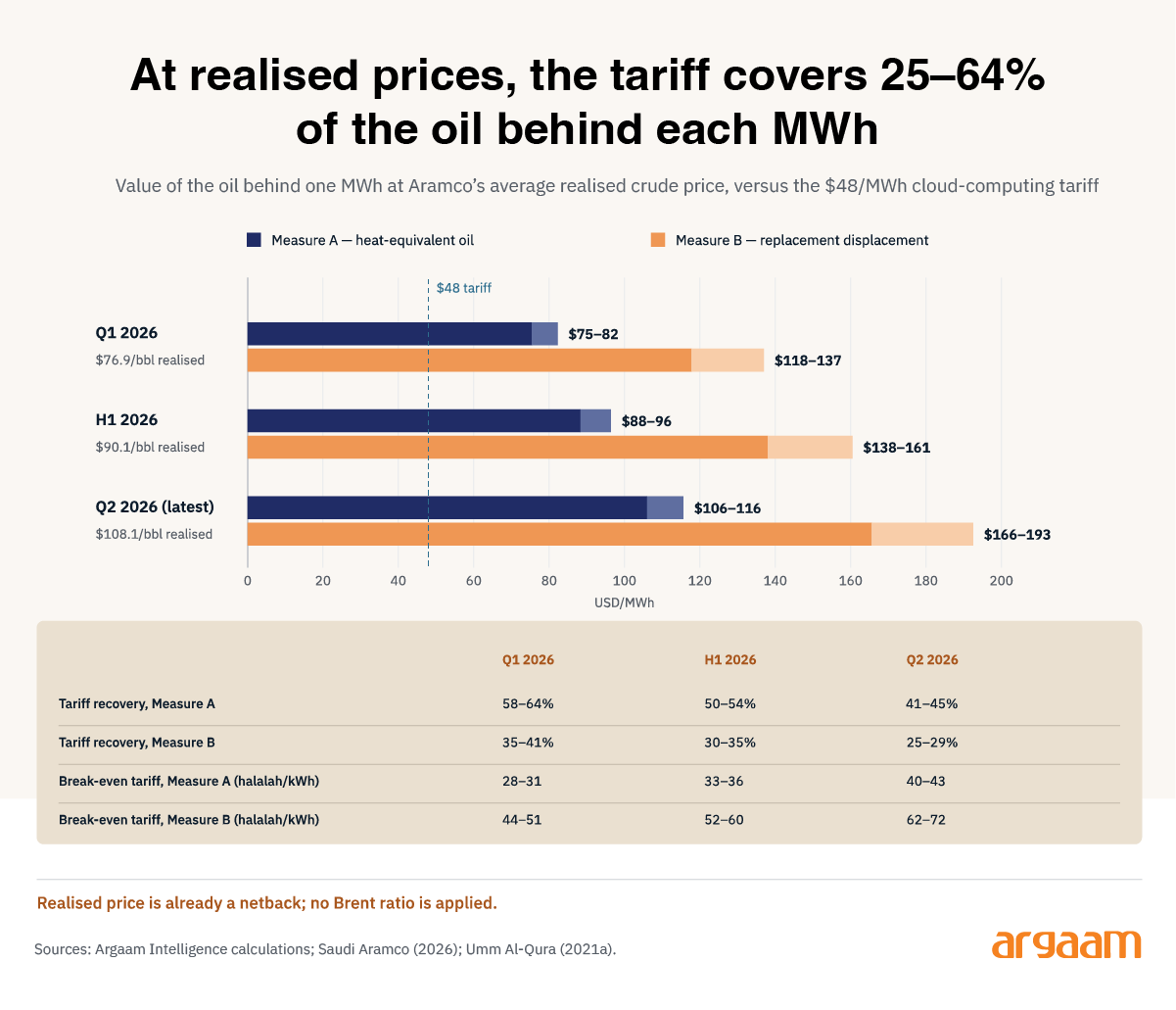
We value the oil at the average price Aramco received for its crude in the second quarter of 2026: $108.1 a barrel. At that price, the oil behind one megawatt-hour is worth $106–116 on our main measure, and $166–193 on the upper case.
The official electricity rate for cloud-computing data centres is 18 halalah per kilowatt-hour, or $48 per megawatt-hour. That covers 41–45% of the oil's value on the main measure, and 25–29% on the upper case.
To match the oil, the rate would have to rise to 40–43 halalah. At the lower first-half price of $90.1, the break-even would be 33–36 halalah. Each $10 on the oil price adds about $10 to the oil's value per megawatt-hour.
Over a year, the oil behind 1.9 gigawatts is worth $1.8–1.9 billion on the main measure, against about $0.8 billion paid for the electricity.
We use 18 halalah as a reference only. The Council of Ministers set it in 2021 for licensed operators already running and for new ones that applied to connect before the end of 2023. HUMAIN was launched in 2025, and its own rate has not been disclosed.

The cost is not fixed
The cost rises when the power system is under strain. Saudi electricity demand climbs by about three-quarters in summer, and a data centre draws the same power through the hottest months.
When gas runs short, the extra electricity comes from oil-fired plants, and each megawatt-hour burns up to 1.8 barrels directly. The 2026 Hormuz closure showed how quickly that can happen.
By the second quarter, Aramco's gas output was 0.82 billion cubic feet a day below its end-2025 level, about three times what 1.9 gigawatts would need. Much of the extra fuel burned that year was imported, which cost the Kingdom cash rather than exports.
Batteries can reduce the exposure, but data centres keep running after sunset. Carrying 1.9 gigawatts through 14 hours without sun would take about 31 gigawatt-hours of battery capacity. That is 1.7 times what Saudi Energy had in operation by mid-2026, and 65% of the national target for 2030.
What would change the answer
Running below full power would lower the totals. At 80%, the figure on our main measure falls to 36,000–39,000 barrels a day. If HUMAIN's 1.9 gigawatts refers to the computing equipment alone, the whole facility would need about 2.7 gigawatts, raising it to 63,000–68,000. Neither changes the cost per megawatt-hour.
For each megawatt-hour it uses, AI has to create at least about $110 of value before paying for power. The electricity bill covers $48. The remaining $58–68 must come from what is built on the computing power.
Three signals will show which way this moves. The electricity price set for data centres connected after 2023 will show whether the state intends to carry the gap or charge it to operators.
Aramco's third-quarter results, due in early November, will show whether its gas output has recovered. And summer oil burning is the clearest test. If it keeps falling as AI capacity grows, the cost is smaller than our figures suggest. If it stays high, our concern holds.
Methodology and sources are available to subscribers on request at intelligence@argaam.com