Every conversation about risk in Saudi car finance ends at the same question: how many borrowers will stop paying? A new Argaam Intelligence paper argues this is only the easier half of the problem.
The harder question is what a lender actually loses when a borrower stops paying — and that depends on something nobody publishes: what the car is worth by then.
That shift from default to collateral is the point of our paper. It does not predict a crisis: it stress-tests public Saudi data, finds the sector can take considerable strain, and points to a blind spot that should concern anyone exposed to the SAR29 billion finance-company auto book.

The quiet risk inside a popular product
Many Saudi used-car loans carry a balloon payment: a large final instalment that keeps monthly payments low but leaves the debt high for most of the loan's life.
A fully amortizing loan repays principal faster than a car loses value, so the lender's cushion grows every month.
A balloon loan does not: for years the balance barely moves while the car keeps depreciating.
At normal rates of depreciation, the loan stays below the car's value.
But if used-car prices fall faster than usual, a balloon loan can become larger than the car securing it while the borrower is still current. Default and negative equity are separate risks that become very expensive when they coincide.
Our paper tests this on a published Al Rajhi used-car financing illustration — 90% initial loan-to-value, five-year term, 25% balloon — under three depreciation paths. The following chart explains those scenarios.
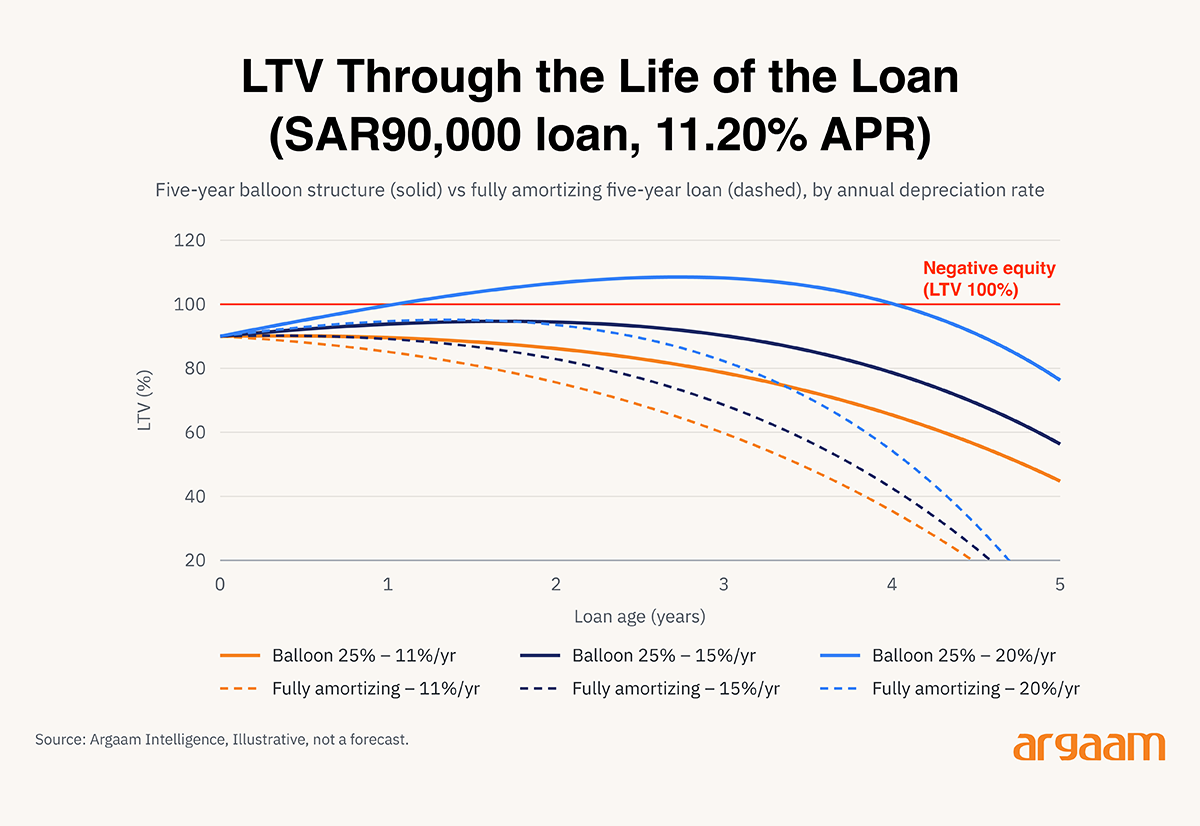
Negative equity is not a loss. A lender loses money only when a borrower defaults and the repossessed car fetches less than the balance. But timing matters as much as the default itself: the same borrower, defaulting a year later into a weaker market, leaves a materially larger hole.

How much could the sector lose?
We then ask a simple question: if a given share of borrowers stopped paying, and their repossessed cars sold at a given discount, how much would the sector lose?
The chart below shows the answer for every combination of default rate and resale discount we tested, measured against a year of finance-company profit.
The reassuring finding comes first. Even if a fifth of borrowers default and used-car values fall a further fifth, losses stay within a year's sector profit. Only when both shocks approach 30% does the loss exceed a year's earnings, and even then, it would consume roughly a tenth of sector equity.
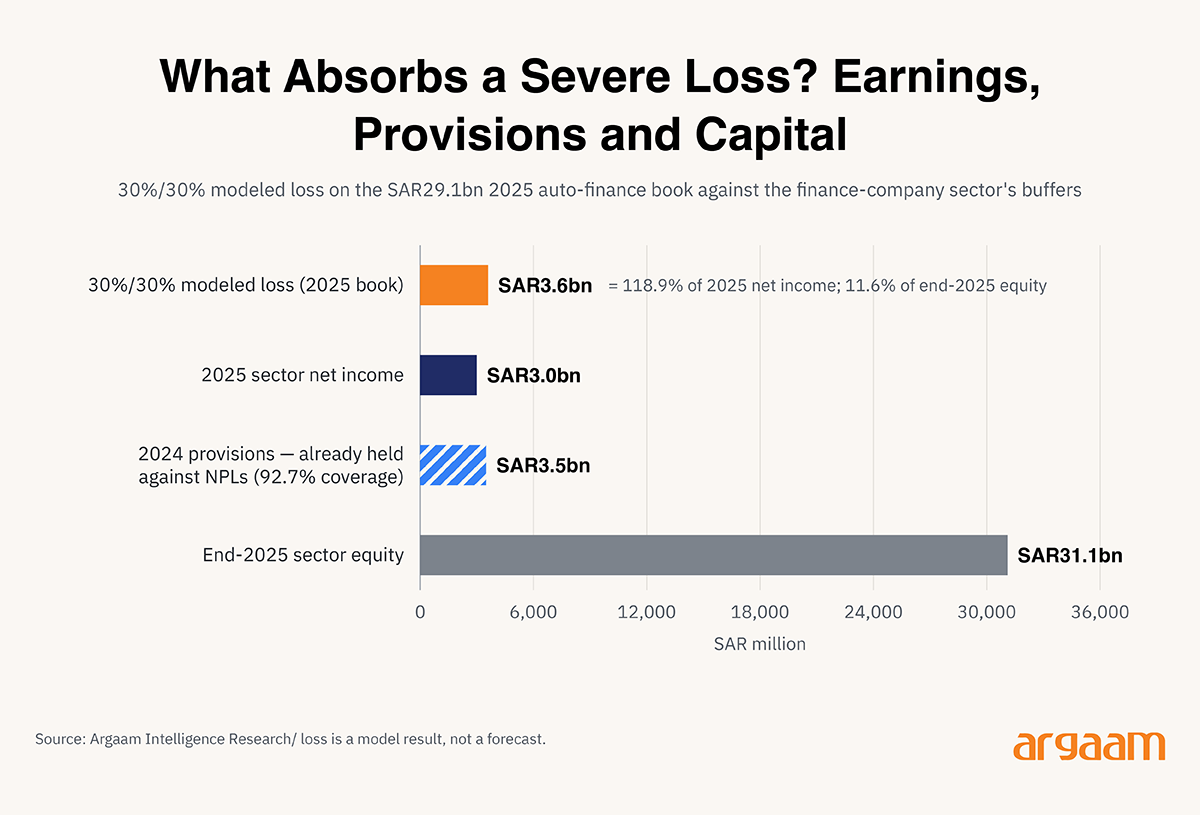
Beneath the headline, two findings matter more. First, defaults and falling car prices are far more damaging together than apart. A rise in defaults alone, or a drop in car prices alone, costs the sector relatively little.
When both happen at the same time, the loss is much larger than the two added together. And they tend to arrive together, because the same economic stress that pushes borrowers into default also puts more repossessed cars up for sale, driving prices down further.
Second, the sector average hides the distribution. Our default rates reflect what Saudi finance companies have already reported. For a lender concentrated in higher-risk borrowers the breaking point is far lower, and provisions offer little help: SAMA's figures show they are almost entirely held against loans that have already gone bad.

The part nobody can see
Our most important conclusion is not a number. It is an absence of numbers.
No public source shows how many Saudi car loans carry balloon payments, how much of each car's value was financed, or how the finance-company auto book splits between new and used vehicles.
Taqeem's Marjea platform, launched in October 2025, has yet to publish an aggregate used-car price index. If used-car prices fell sharply, no one outside the lenders could see how many loans had quietly become larger than the cars securing them — until the losses appeared in the accounts.
The UAE caps car loans at 80% of the vehicle's value, limiting negative equity before it arises. The US has no cap and relies on GAP insurance after the fact. Saudi Arabia sits between the two, with credit screening, affordability limits and a tenor cap but no limit on how much of a car's price can be borrowed.