Until 10 September, the East-West Pipeline was flowing at full capacity -- a strategic artery carrying 7 million barrels per day from the Eastern Province to the Red Sea to bypass the Strait of Hormuz.
On the coast, this flow feeds two channels: direct crude sales via Yanbu tankers, and coastal refineries with a capacity of 2 million barrels per day converting oil into diesel and gasoline.
On that day, a sudden attack severed the flow of oil through the pipeline. For two consecutive weeks, supplies were scarce and no longer sufficient for both channels; one of them had to wait.
Sudden logistical crises rewrite the scarcity equation, forcing the decision-maker to sacrifice one operational channel to maximise returns from another.
From this economic logic, this Argaam Intelligence analysis examines how Aramco manages the trade-off between immediate refining margins and crude export premiums, beginning with a breakdown of the price dynamics that have governed global markets this year.

The Refined Products Price Surge
Since the outbreak of the US-Iran war, diesel has become the most scarce fuel in markets, with its price in Europe jumping to double what it was at the end of February, while crude oil rose by no more than half.
This record divergence pushed refining margins -- the spread between the cost of crude oil and the prices of refined petroleum products -- to unprecedented levels.
This picture entrenched a common and oversimplified impression: that Saudi Arabia is limited to exporting crude oil and leaving the enormous diesel profits to global refineries, keeping it removed from this record boom.
This narrative appears coherent on the surface, but it lacks a genuine test that examines the depth of Aramco's operational model.
Does the world's largest crude exporter truly stand apart from the global fuel crisis, or does the answer lie in its massive refining arm, which rivals the weight of its crude exports?

Price Differential Dynamics
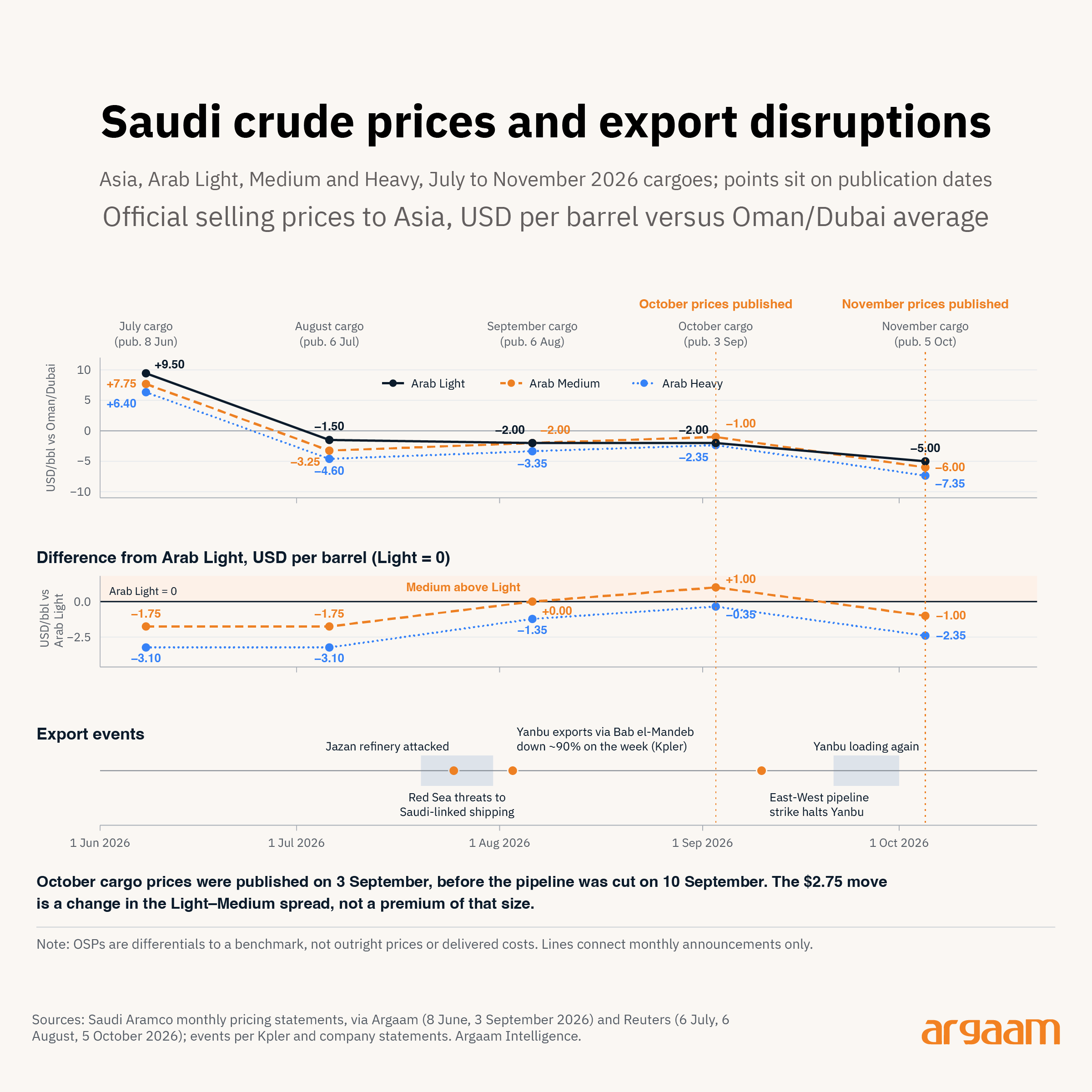
Aramco notifies its customers monthly of its official crude prices, with Arab Light typically leading in price above Arab Medium. But this summer, the Asia-directed pricing broke this rule: the two crudes equalized in September, before the spread inverted in October, with Arab Medium becoming more expensive than Arab Light.
Arab Medium is the ideal feedstock for refineries with advanced conversion capabilities to maximize diesel production.
So when its price surpassed Arab Light, the picture appeared as though the global diesel scarcity crisis had finally reversed its effect on the pricing structure of Saudi crude grades.
But this conclusion quickly dissolved, as the official prices announced for November showed the pricing order returning to its previous norm, despite the record high for diesel prices in spot markets continuing without retreat.
Here the timing factor emerges to resolve this ambiguity: October prices were announced on 3 September, a full week before the pipeline came under attack on 10 September. This sequence proves that the Arab Medium price surge was predetermined, and was not born from the logistical supply disruption.
If the global diesel crisis has been ruled out as the primary driver, what is the real dynamic that led to this fundamental shift? And why was this sharp price volatility confined to Asian markets and not its European counterpart?

Where Does Aramco Sit in the Diesel Market?
Aramco is not merely a company that sells crude oil. Its refineries inside and outside Saudi Arabia consume approximately half the oil it produces.
On the Red Sea coast, Aramco's Rabigh Refining and Petrochemical Company (Petro Rabigh) -- which is listed on the financial market -- recorded its highest quarterly profits in its history.
Although part of these profits stems from last year's results being weak due to a refinery shutdown for maintenance, the question remains: what is the true scale of diesel profits within these record results?
On the other hand, Aramco fully owns the largest oil refinery in the US state of Texas, which is today achieving record profits from diesel sales. This reality raises two important questions: exactly where does Aramco sit on the map of global diesel profits? And do the profits of its Red Sea refineries resemble those of its Texas refinery?

Net Realisation After Shipping Costs
The equation appears clear on the surface: diesel is recording record prices, and Aramco's Red Sea refineries hold an ideal position to benefit from this boom.
Yet fuel is not sold at its point of production. Refineries based in Yanbu or Rabigh do not receive the diesel prices prevailing on the Rotterdam or Singapore exchanges. They receive what remains of that value at their port berth, after deducting the costs of every nautical mile the shipment travels to its final destination.
Those costs have risen sharply this year as a result of rising geopolitical risks in the Red Sea, which have doubled tanker rates and marine insurance premiums. Shipping costs are not limited to refined products alone. The crude oil shipped from ports within the Arabian Gulf also bears high transport costs to reach Asian refineries.
When Aramco cut its crude prices for Asia in November, buyers confirmed that part of this reduction came as a direct compensation for the jump in shipping costs.
Since the indicators measuring profit margins in both cases (crude and refined products) are typically calculated before deducting shipping and insurance costs, the profits appear large only in initial calculations.
Here the fundamental question emerges: if shipping cuts into the market value of both the fuel barrel and the crude barrel, which one succeeds in reaching the end buyer while retaining the larger portion of its economic value?

Three Operational Perspectives
Before reading the paper, place yourself in these three positions:
Strategic decision-maker: When setting investment priorities and budgeting, do you allocate resources to securing new export routes, building refining units for diesel production, or acquiring foreign refineries?
Major refinery manager: Your Red Sea refinery is living through its most profitable period; but how much of these record margins will you lose if the pipeline flow is cut again and for longer?
Asian buyer: Aramco has suddenly cut the price you pay -- does this sharp reduction reflect weak demand, a jump in shipping costs, or constraints on Aramco's export capacity?
These answers converge to lead to a strategic question at its core: How is the structure of the Kingdom's oil returns determined in times of global refined product supply shortages?
Our full research paper offers a test of Aramco's crude pricing mechanism, along with five key indicators that must be monitored closely in the coming weeks.