Contrary to the prevailing narrative — repeated by some analysts with reassuring brevity — the first-half figures for 2026 show that higher oil prices only barely offset the decline in Saudi exports.
The stability of revenue is due entirely to the mechanism by which the state's share of each barrel is calculated: a finely tuned mechanism that could put pressure on the budget, and at remarkable speed, if prices fall.
Whenever oil prices rise, a reassuring account circulates in public debate, passed along by most analysts and economic commentators: that this automatically works in favour of the Saudi budget.
Yet the figures for the first half of 2026 suggest a more complicated picture. The price increase barely offset the fall in exports, and what actually protected state revenue was the way its share of each barrel is calculated.
More importantly, the same mechanism that supported revenue as prices rose could squeeze it faster should they fall.
The first half of 2026 put that logic to a real test. In the second quarter, Saudi crude exports were 38% lower than a year earlier. The government's oil revenue rose 22%.
That is not a rounding error. It suggests that the familiar way of thinking about Saudi fiscal exposure, oil price multiplied by oil volume, may be missing the variable that matters most.
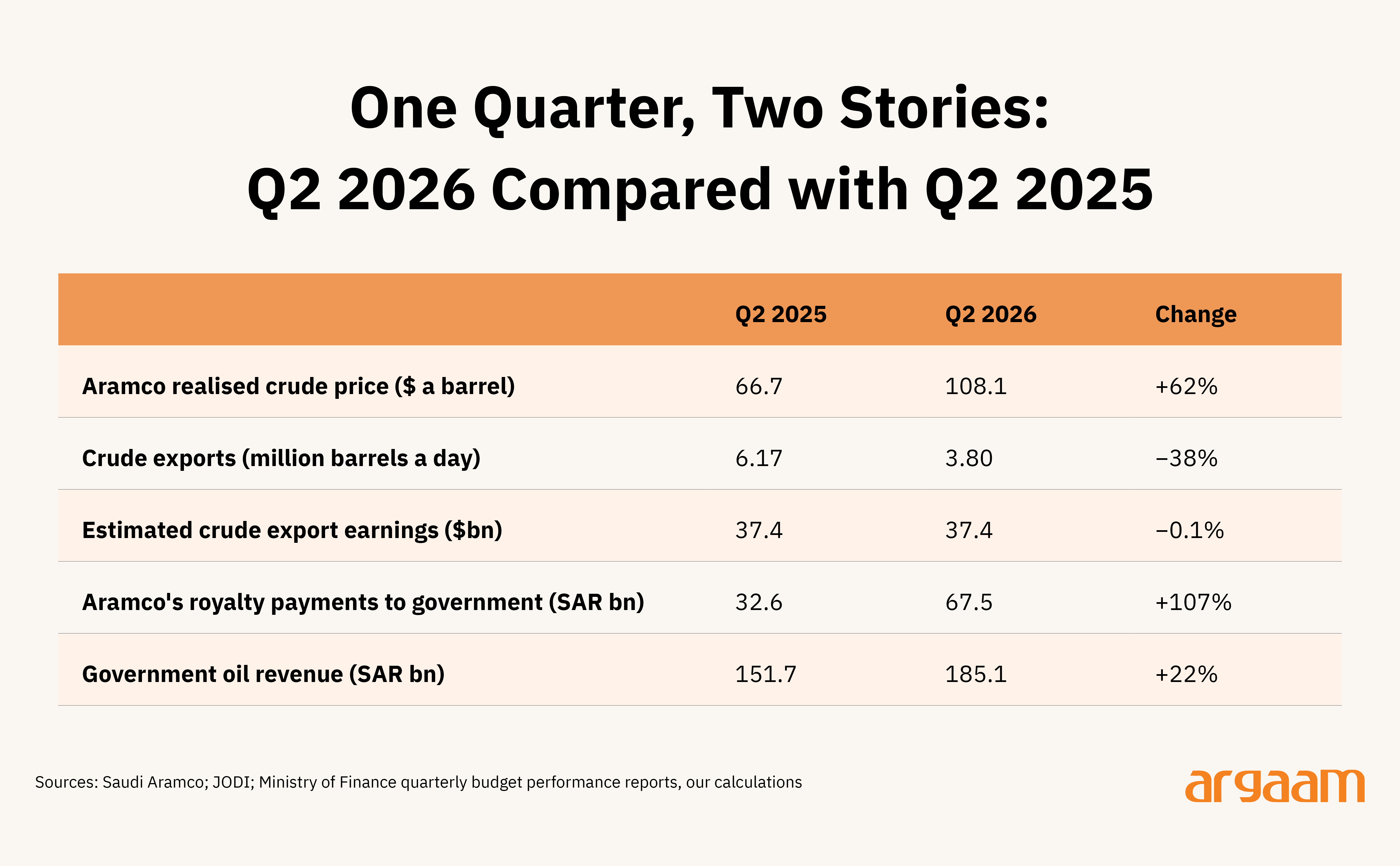
Read the table from top to bottom and the puzzle sharpens. Higher prices cancelled out the lost barrels almost exactly, leaving export earnings flat.
So price alone cannot explain why the state collected SAR33.4bn more from oil than a year earlier.
The answer lies in a line most analysis leaves out: the government's share of each barrel.

A share that bends with the price
Under Aramco's amended concession agreement, the royalty the state receives rises in steps: 15% of the price up to $70 a barrel, 45% of the part between $70 and $100, and 80% of anything above $100.
Aramco's disclosures show its royalty payments to the government more than doubling in the second quarter, an increase that closely matches the rise in the Ministry of Finance's oil revenue.
This changes the question. Saudi Arabia's oil income depends not simply on the price, but on where the price sits relative to $70 and $100.
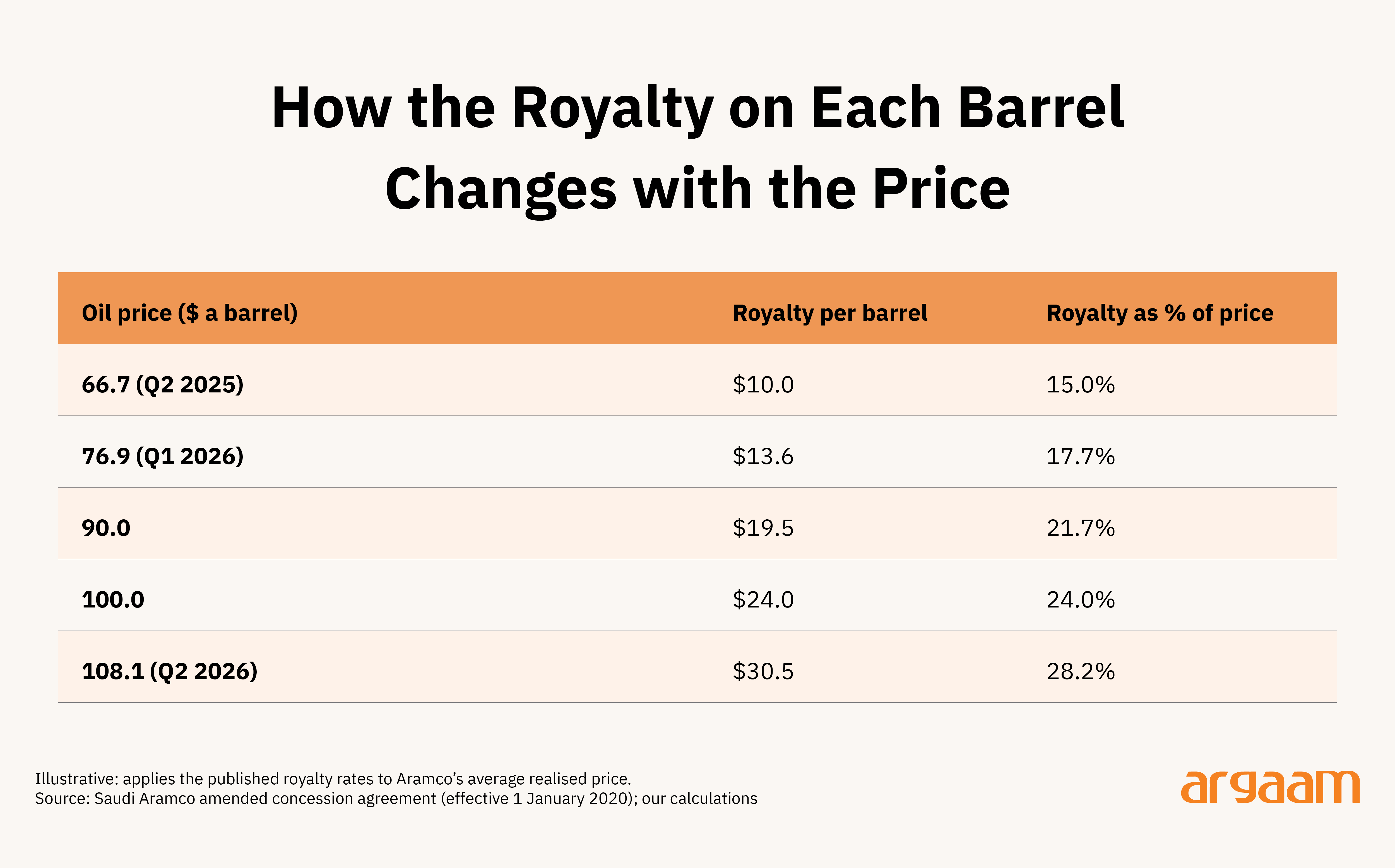
The royalty design helps the government most when prices jump, and supply disruptions usually make prices jump.
But it also works the other way. If the oil price fell from $108 to $90 a barrel, that would be a 17% drop.
Yet the government's royalty on each barrel would fall by about 36%, more than twice as fast. The same design that kept revenue up in the second quarter would bring it down faster than prices if they fall.
This matters for anyone who plans around a single "breakeven" oil price, the price at which the budget balances. When the government's income rises and falls so differently above and below $100 a barrel, can one average price really tell us how much risk the budget faces?

The other side of the ledger
But If revenue held up, where did the deficit come from? By June, the government had recorded a SAR160 bn deficit, 96.7% of its plan for the whole year.
Yet SAR125.7 bn of it, or 79%, opened up in the first quarter, before the disruption reached its most severe phase. In the second quarter, when exports fell hardest, the deficit was SAR34.3 bn, almost identical to a year earlier.
The driver was spending, which rose 20% year-on-year in the first quarter while income barely moved.
Meanwhile, non-oil revenue grew by just SAR6.2 bn over the half: for every SAR16 of extra spending, about SAR1 came from new non-oil income.

The question the second half will answer
Put the two findings together and a different picture of fiscal risk emerges. The pressure on the budget came less from the oil shock than from its own spending pace, and it was held together by a royalty design that works best at precisely the prices a disruption produces.
That leaves an open question our full analysis examines in depth: was the first half's spending surge front-loading that will fade, or a new baseline that high prices have so far concealed?
The IMF projects the 2026 deficit at 3.7% of GDP, down from 5.8% in 2025, implying a much smaller deficit in the second half than in the first. Last year, the second-half deficit was SAR183.4bn, nearly twice the first half's.
For policymakers, the implication is whether fiscal planning should track price thresholds rather than price averages. For executives whose business depends on government spending, it is whether the pace of the first half can hold if prices ease.
Readers may reach different conclusions. The full-year figures will show which one was right.