There is a habit in how this region's property market gets discussed, and it is so settled that it rarely registers as a choice at all. We say the Gulf housing market analysts publish regional averages.
Sever publications compare a Saudi developer with an Emirati one and treat the gap between them as a verdict on management.
The habit is convenient. It is also, on the evidence we assembled, describing something that no longer exists.
Start with what a regional average is for. It is useful when the things being averaged are subject to the same forces and respond in roughly the same way.
Under those conditions the average tells you about every member of the set. When it isn't — when the members are moving in different directions for structural reasons — the average stops describing anything. It becomes a number that is true of nothing in particular.
Which raises a question that seems obvious once asked, and which nobody appears to have asked: is the Gulf housing market still one market?
In this new research paper by Argaam Intelligence, we went looking for the answer in the accounts of developers who build in the two largest economies in the Gulf, and the first thing that came back was an aggregate figure showing the sector's profitability falling.
That figure is accurate. It is also, we think, the least informative number in the entire dataset — because the average conceals a split that is the real finding.
Gulf housebuilders are being judged on their profits. We asked whether profit is the right instrument — and where the strain is actually landing.

Why one shock produces several outcomes
Here is the mechanism, and it is simpler than the outcome suggests.
Building costs are set regionally. Steel, cement, freight, insurance, skilled labour — these price across the whole Gulf at once.
When a cost shock arrives, it arrives everywhere, more or less simultaneously, and it does not much care which border a site sits behind. Prices are set locally.
What a home sells for in Riyadh depends on what Riyadh buyers will pay this quarter. The same is true of Dubai, and separately of Abu Dhabi. These are different buyer pools, different supply pipelines, different points in a cycle.
So: one input that moves together, one that does not. Costs travel. Prices don't.
That asymmetry is enough, on its own, to take a single regional shock and produce divergent results from it. And the divergence we found is not subtle.
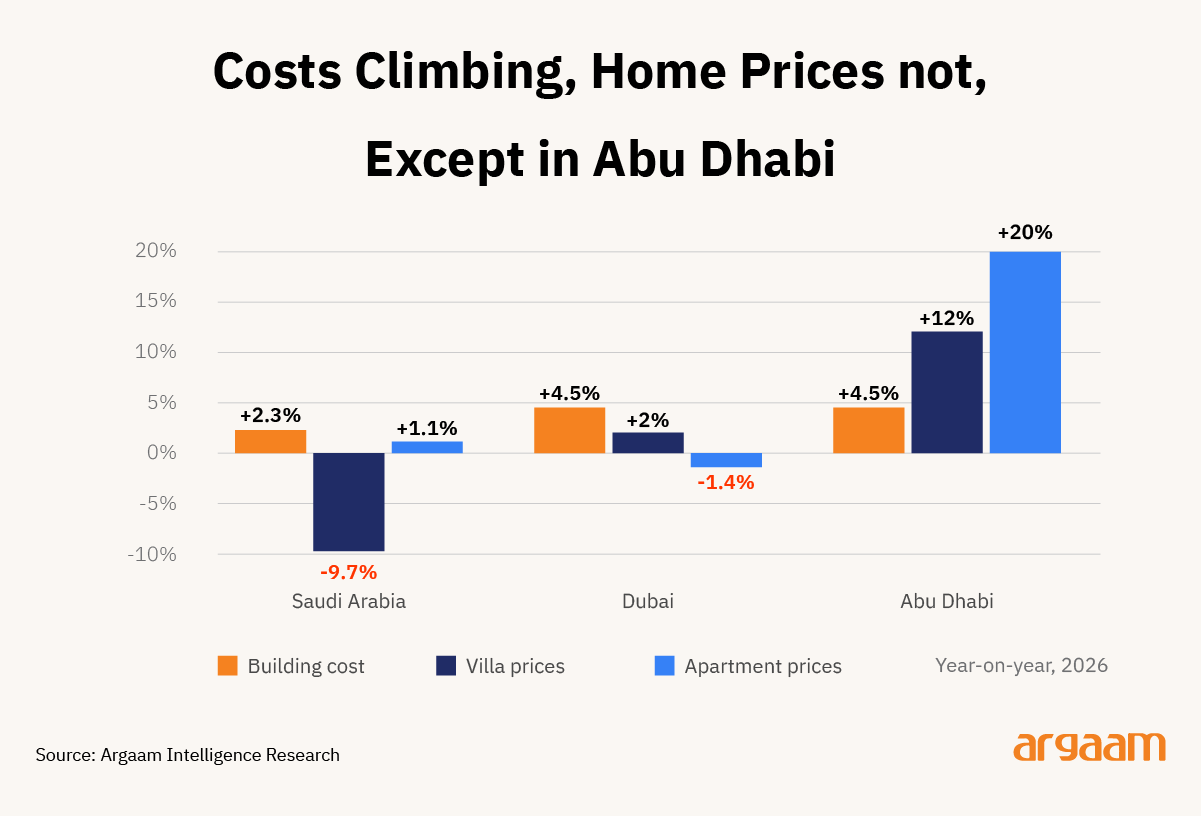
One emirate is correcting while another, an hour's drive away, is still climbing — placing them at visibly different stages of the same cycle. Treating those two as one market and averaging them produces a number that describes neither.
The Saudi picture adds a third pattern again, distinct from both, and with the squeeze concentrated in a particular type of home rather than spread evenly across the stock.
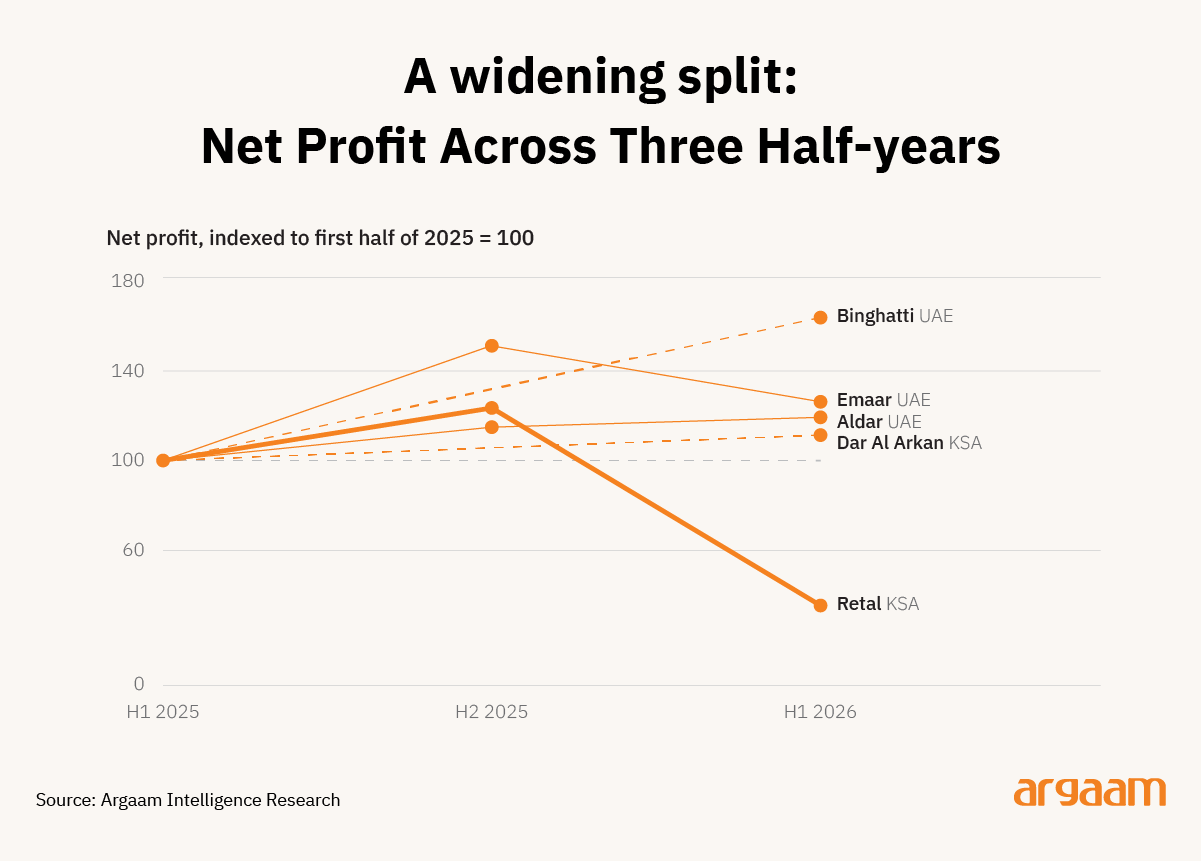
Note on Figure 1: Net profit indexed to the first half of 2025 = 100, across three consecutive half-years.
The UAE majors Emaar and Aldar held or grew, while Retal, the mid-sized Saudi builder, strengthened into late 2025 before falling away in 2026.
Binghatti and Dar Al Arkan did not report a separate second half of 2025; their lines are dashed across the missing point, joining only the two reported half-years. Jabal Omar (a one-off base effect) and the loss-making Emaar The Economic City cannot be indexed and are omitted.

The problem is in the product, not the region.
The easy reading of a softening housing market in 2026 is that the regional conflict did it, or that credit tightened, or that the Gulf property story has simply run its course.
There is a clean test for all three, and it is the kind of test that gets skipped when a narrative is available. If the cause were regional — geopolitical shock, scarce credit, broad loss of confidence — it should be visible across property as a whole, not in one asset class.
It isn't. Commercial property is holding up on both sides of the Gulf while housing softens. Offices are not behaving like an asset class in a region under strain.
That single observation does a great deal of work. It rules out the explanations most readily reached for and relocates the problem: this is not a property sharp decline, and not a regional one.
It is specific to the economics of building and selling homes, where costs have caught up with prices. The problem is in the product, not the region.
It also changes what a policymaker should be watching. A regional shock calls for macroeconomic response. A product-specific cost–price gap calls for something else entirely.

What the demand side is doing instead
Demand has not disappeared. It has changed shape, which is a different thing and considerably less comforting for anyone whose business model is selling homes.
Capital is rotating from ownership to income. As buyers wait, they rent — a rational hedge when uncertainty rises, and one that keeps the housing stock fully occupied while doing nothing for the firms who need a completed sale. Occupancy is not revenue for a housebuilder.
And where buyers are still buying, they appear to be trading down rather than out: rotating toward smaller, cheaper, more liquid homes and away from large villas. Where confidence holds, buyers still reach for the premium product. Where it is shaken, builders of large, high-ticket homes feel it first.
This is worth sitting with. It means the squeeze is not only geographic but compositional. A developer's exposure depends not merely on which city it builds in, but on what it builds.
Two firms in the same market, with the same cost base and the same competence, can face opposite conditions because one sells villas and the other sells apartments. Which is another way of saying that the useful unit of analysis may not be the country at all.

The supply side has a mind of its own
There is one more force at work, and it belongs to the industry rather than to 2026.
The long delay between starting a building and finishing it gives supply a momentum of its own. It keeps arriving after demand has turned.
That is why property markets overshoot into a downturn and correct only slowly — the homes being handed over this year were committed to in a different market, under different assumptions, by people who could not have known.
We found a market delivering record volumes while new launches collapsed. Completions at a high, starts at a low, in the same six months.
That is the building cycle in miniature, and it tells you the correction currently visible in prices is the consequence of decisions made well before the shock that is being blamed for it.

The hypothesis
So here is what the paper puts on the table, and what we would invite you to test against your own reading of the market.
The Gulf housing market has stopped functioning as a single unit of analysis. Not temporarily, and not because of a shock — but because a regional cost base now meets three distinct local demand conditions, and a shared average can no longer describe any of them.
If that is right, it has consequences beyond how research is written. It affects how exposure is measured, how peers are chosen, how a portfolio is judged, and what a policy instrument is expected to act on.
We also went looking for one force that erodes developer margins in mature markets — a mechanism well documented in Britain — and found it essentially absent here, with the nearest local equivalent running in precisely the opposite direction.
Why it is absent, and what its absence tells you about where the price pressure is actually coming from, is one of the more surprising findings in the work.
The full paper reads eight developers' accounts from source, sets them against official price and cost indices on both sides of the Gulf, and follows the divergence to the place we think it will surface next. |