Here are two numbers that have never appeared in the same published document:
85%. Is the annual share the international financial models assume a gas plant runs so that the carbon capture equipment attached to it recovers its cost, at around $600 million per gigawatt.
And the second number:
47% to 58%. The expected capacity factor of the Kingdom’s new gas plants by 2030, by our calculation from official targets. Those are the hours when solar output is absent.
The gap between the two figures is not a planning error, nor a problem with the arithmetic. The explanation lies in what the Kingdom is building: two large fleets at once.
The first is a fleet of solar power plants; the second, a fleet of gas plants whose design allows carbon capture equipment to be added later.
Neither project lacks economic logic, but only when each is taken on its own. Together, they create a problem neither has by itself.
The plan is for the gas plants to stop generating while the sun is up. The financiers of the capture equipment, mostly private-sector investors, want those plants running most of the year. That is the central argument of our new research paper.

Two Jobs That Pull in Opposite Directions
Job one is balancing the grid: run in the evenings, on cloudy days and through the shoulders of the year and stay off the rest. Worked back from official targets, that is roughly half the year.
Job two is hosting carbon capture. The equipment recovers its cost only through the tons of carbon it captures from the gas burned, and a 1 GW gas plant emits 3 to 3.5 million tons of CO₂ a year at full baseload. No near-continuous running, no tons.
No amount of coordination reconciles the two. This is not a fine-tuning gap between two similar jobs; it is two jobs heading in opposite directions.
The paper shows how the running hours can be derived from just three published figures and counts the hours between what the plants will do and what their lenders assume.

Solar Saves Fuel. It Does Not Retire the Plants.
Planners judge power plants by two ways: how much electricity it produces over a year, and how much of it will definitely be there at the hour demand peaks.
Solar scores well on the first and poorly on the second, for several reasons. One example: clouds can cover the sun at the very hour of peak demand, and the plant loses its ability to produce.
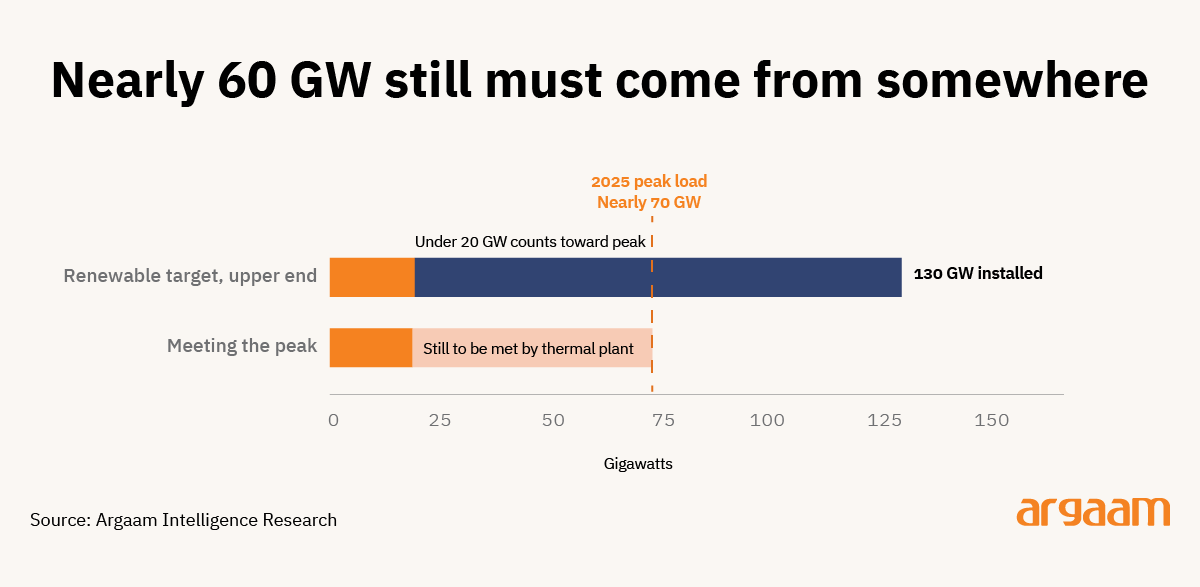
That is why KAPSARC’s model counts only 15% of solar capacity as dependable at peak. At that ratio, the grid can count on under 20 GW of the 130 GW target, against a peak load of 77.1 GW in 2025.
The study simulates a summer weekday in 2040 hour by hour. From noon to 7 pm, costs without renewables run 54% to 88% higher.
At the night peak, the two results nearly coincide: the panels have stopped, nothing was stored, and the last plant switched on is oil-fired either way.
Batteries, the obvious answer, were never chosen in any scenario, even when solar reached 72 GW; the model preferred inter-regional transmission lines instead.
So 42 GW of new gas capacity is not a contradiction of the renewable program. It is the condition of it.

What 85 Cents Decides
How much solar gets built is not simply a target. It depends on what gas costs, and that price is not set by a market. Gas sells to utilities and industry at $2.15 per million British thermal units. Nobody bid for it.
At $2.15, the model builds almost no solar: 4.5 GW by 2040, with gas consumption climbing to around 43% above 2019 levels.
At $3.00, it builds 71.8 GW, and gas consumption falls back to roughly where it started. The gas price sets the solar build, and the solar build sets gas demand.
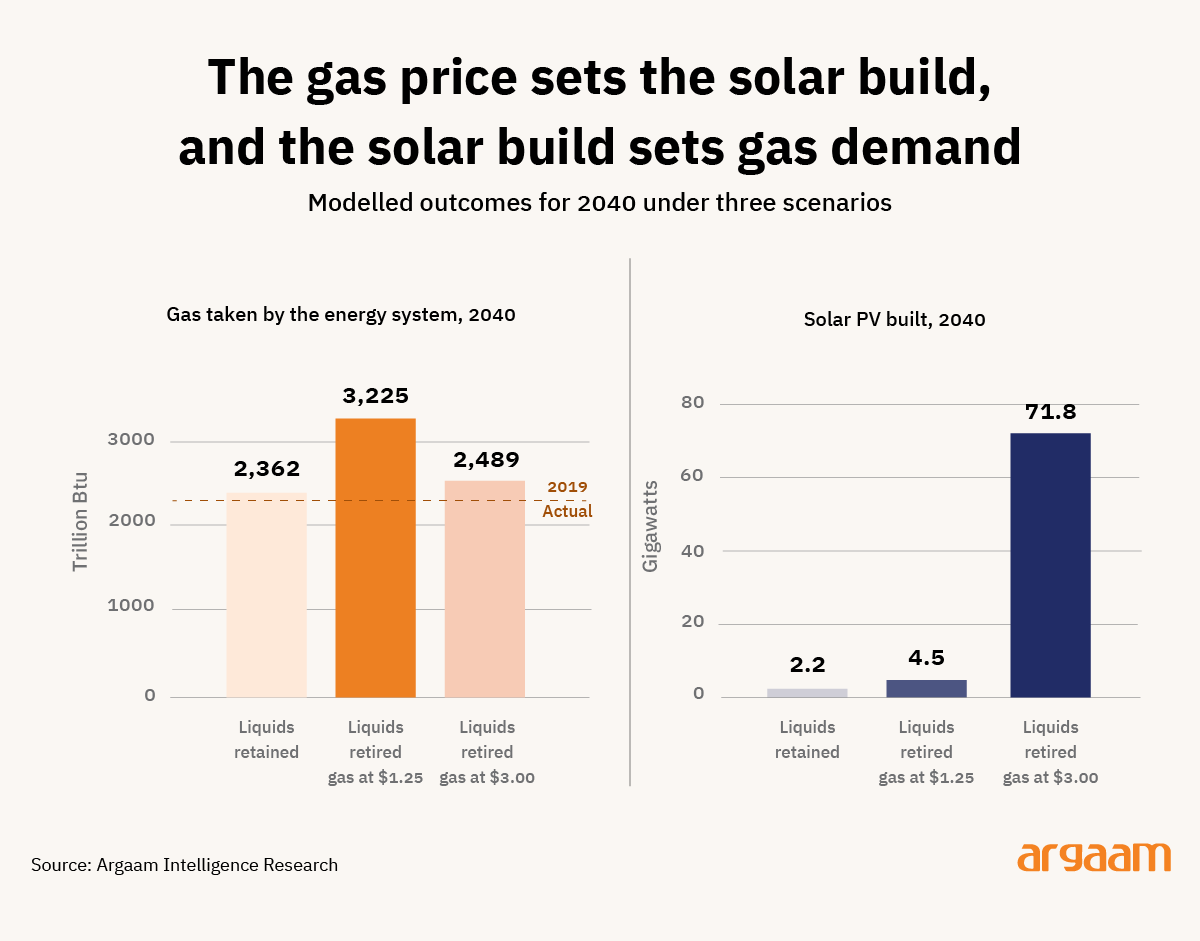
Here lies the paradox: an 85-cent difference in the gas price decides the fate of two conflicting goals. Either the 2030 renewable targets, or bankable financing for the carbon capture equipment. No one, it seems, can win both at the same price

The Question We Leave With You
The export revenue from the freed-up barrels flows straight to the state treasury, while private developers service the loans on the capture equipment out of the gas treated.
Every idle hour means no revenue while the debt obligations still stand. So, who carries the idle hour once the power purchase agreements now under way are signed and become binding?
And behind that sits a larger assumption: that the gas will be there at all. In the first half of 2026, with Jafurah already producing, total gas output fell to 10,215 million cubic feet a day from 11,052 a year earlier. The Kingdom neither imports nor exports gas. What does a shortfall get settled in?