In the construction and real estate sectors, scarcity does not create value by itself. A market has to learn to pay for the scarce thing first. Until it does, being unable to make more of something is simply a restriction on what an owner can do with it.
Saudi Arabia holds a stock of historic buildings that cannot be added to. No amount of money or skill produces another coral-stone merchant house in Jeddah.
Fixed supply is a precondition for a premium. Whether buyers actually pay it is a separate question.
And nobody yet knows what buyers here will pay for a restored historic building, because too few have been sold.
Finding out is expensive. Development margins in the Kingdom are already tight by international standards as shown, so there is little room to absorb costs that come in higher than expected — and restoration is where costs are hardest to predict.
A private developer, thinking clearly, waits for someone else to go first. Which is why the ones going first are public. What they are really producing is not hotel rooms. It is a price in the market of doing business in restored historical properties— the answer to a question the whole market needs. Whoever pays to find it out cannot keep the finding to themselves, so no single firm will.
Which means the Kingdom is doing something more interesting than restoring old houses. It is running a live test of whether a premium exists — before the market has told anyone whether it does. Our research asks what happens if the answer is yes. And what happens if it isn't.

Conversion Economics in the Kingdom
Every heritage conversion rests on one calculation: what it costs to restore a building against what the finished building is worth. Call it the conversion spread. Where it is positive, restoration pays for itself. Where it is negative, someone else is paying.
Run that calculation across enough cities and they sort themselves into tiers. London and Paris sit at the top, where the spread is wide enough that restoration is simply good business. Athens sits below them, narrower but working. Cairo is where it stops working, except in a handful of prime districts.
Saudi Arabia belongs to none of these tiers, and for a reason that has little to do with heritage.
In Riyadh and Jeddah, ordinary residential construction already costs more per square metre than finished apartments sell for.
The base is negative before a single heritage premium is added. Yet in the right locations, Saudi property commands some of the highest values in the region.
Both things are true simultaneously. What that implies for a programme intending to convert six hundred buildings — and whether the premium survives the arrival of that much supply — is the question our research set out to answer.
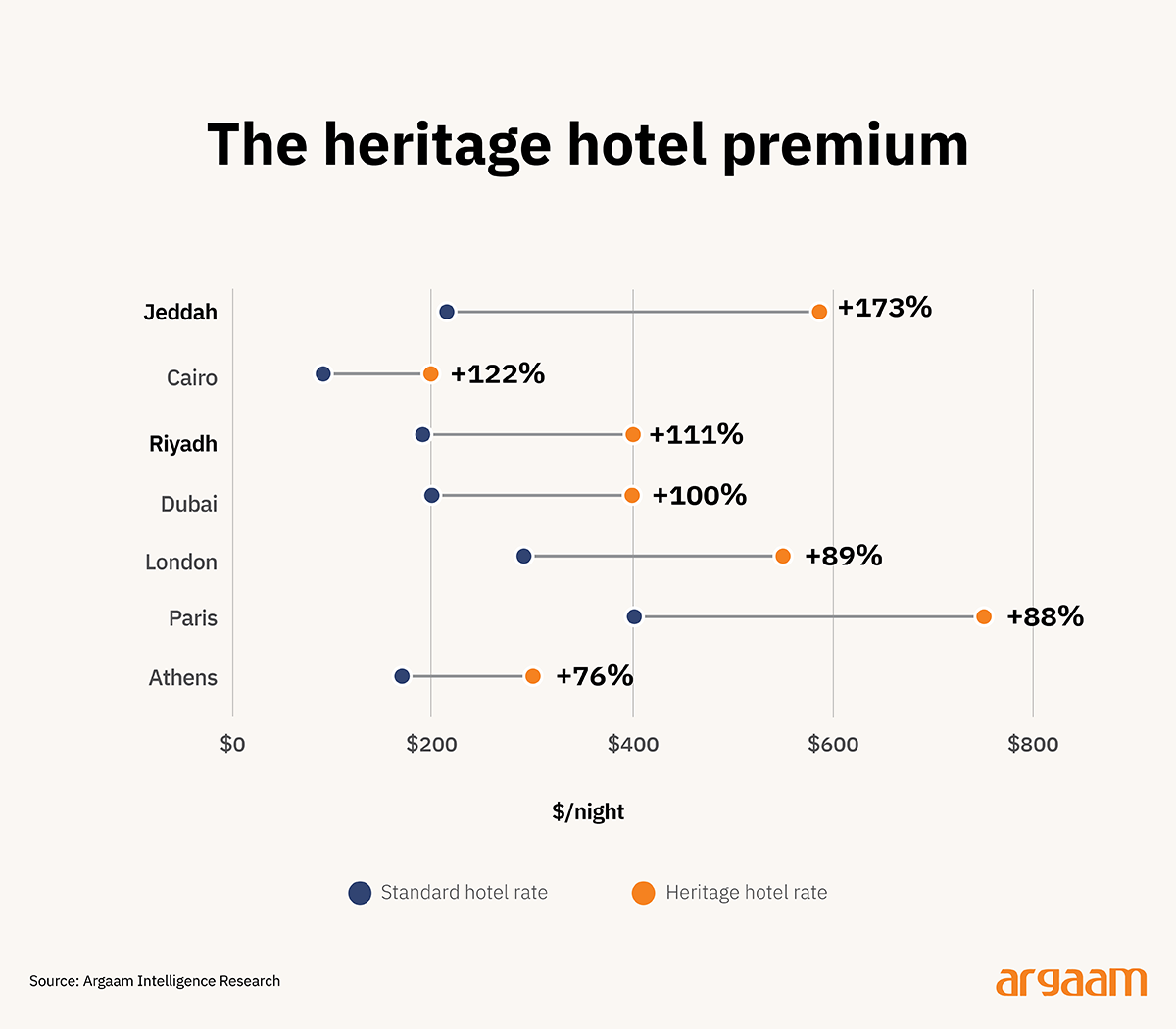
But the spread tells only half the story. Who buys determines the price ceiling and thus whether the economics can ever work.
Across the markets we examined in our research paper, the answer varies more than the arithmetic does — and it determines everything.
Where the buyer is an individual choosing where to live, the ceiling is set by taste and by what residency is worth to them. Where the buyer is a business, the ceiling is set by rents, which are stubborn things. Where the buyer is the state, there is no ceiling in the usual sense at all, only a required return measured over decades.
Saudi Arabia has chosen the third. That choice confers a real advantage: patient capital can build a district that quarterly returns never would. It also places more weight on the interim measures of progress, since the market's own verdict arrives late.
Both routes get a building restored, and from the outside they can look like the same solution to the same problem. They are not.
A widespread means the market has already decided what a restored building is worth. The developer waits, but the reward at the end is real, and it exists independently of who is funding the wait.
A state balance sheet means nobody has decided yet. The money goes in before the price is known, on the expectation that demand will follow. The first works because the exit is certain. The second works because no exit is demanded.
Only one of them is self-sustaining. The other has to eventually produce the spread it was standing in for.
What's Missing Isn't What You'd Guess
Heritage conversion becomes an asset class only when three things hold at once: a positive spread, an identifiable buyer, and policy that clears the way.
Saudi Arabia holds two of these convincingly. Before reading further, it is worth asking which one you would expect to be absent?
Most observers guess wrong, and the reason they guess wrong is itself instructive about how heritage markets are read from the outside.
The international record shows what follows from here. One city unlocked private capital by changing who was allowed to buy. Two others let the premium establish itself and never needed to intervene again.
A fourth did nothing, and holds thousands of listed buildings in slow decline.
Which pattern the Kingdom follows is being decided now.

But who actually restores heritage in the kingdom?
Actually this is the main question of the second part of our research paper.
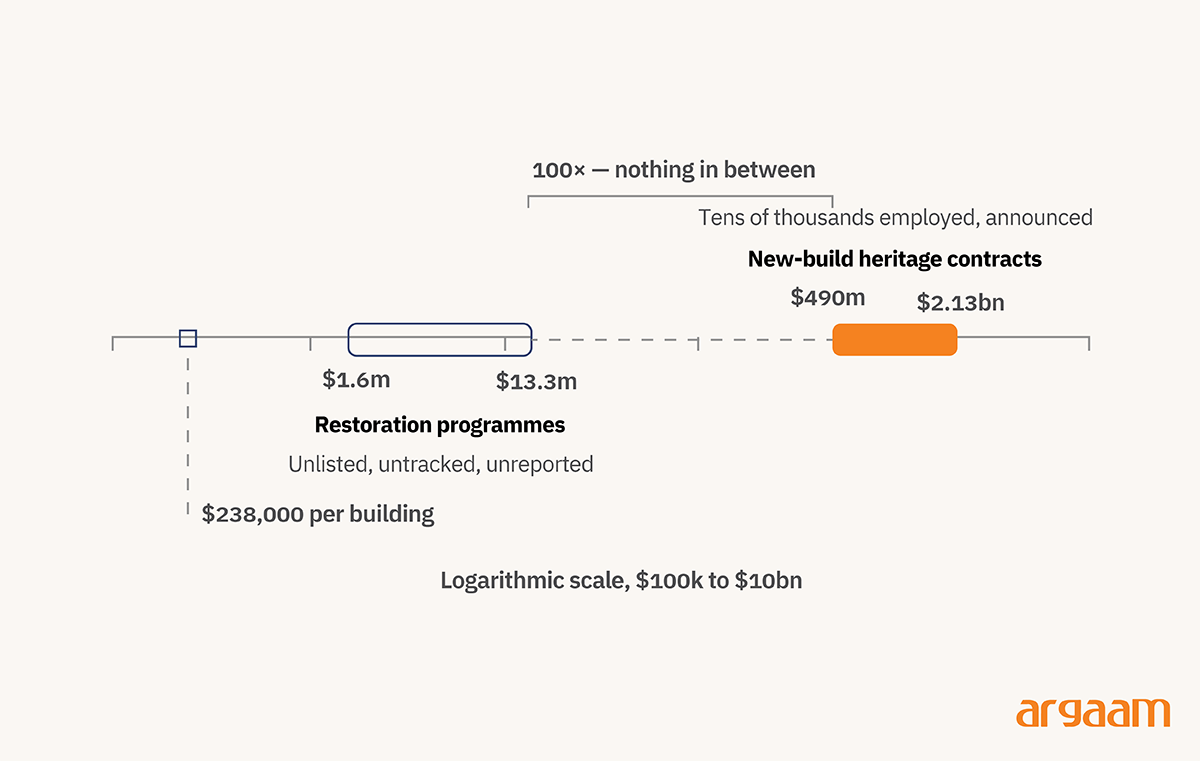
Saudi Arabia is committing tens of billions to heritage. The developers are named. The masterplanners are named. The programme targets are published to the visitor and the room. One participant is consistently absent from the record: the firm that actually restores the building.
This is not an oversight in reporting. Heritage restoration appears in no classification within the industry's own taxonomy.
The materials it depends on are not listed in the procurement marketplaces. The contracts are small enough, and few enough, that no recognisable market segment has formed around them.
Which raises a question that becomes uncomfortable at scale. More than 600 – and in some reports 650 -- buildings are to be delivered by 2038 by a sector that does not formally exist, funded largely as a fraction of programmes built for other purposes.
Our research asks what that dependency implies — and what it would take to make the industry visible before it is needed.
In this ‘invisible’ industry, through, capital can be raised. Materials can be sourced at a premium. Labour can be brought in, as it already is for most of the sector.
Craft is different. The interlocking woodwork behind Jeddah's rawasheen had almost stopped being practised before a single school revived it. Multi-storey mudbrick construction was described as near-extinct in 2020.
Which leaves one question. Six hundred and fifty buildings, thirteen years, and a handful of people who know how. Where would you start?
Download our full research through this form*