For international law firms, Saudi Arabia is now the most sought-after mandate market in the Gulf — giga-project financings, sovereign issuances, cross-border M&A, and IPO work arriving faster than the market can staff it.
Nearly all the major international firms have opened in Riyadh. None will say whether the office makes money.
Because revenue booked in Riyadh and profit earned in Riyadh are not the same number.
In corporate finance, a transaction negotiated in Riyadh can be governed by English law, financed out of London, arbitrated in Paris, and booked somewhere else entirely.
A Riyadh team may run the transaction day to day and still account for a minority of the fee, with the rest allocated to the London finance partners and the New York securities desk. And in a dispute, the arbitration counsel in London or Paris are instructed to handle it.
Disputes are the most profitable stage of a deal's life, and they have long been handled abroad — English law, arbitration in London or Paris, the specialist counsel and enforcement expertise clustered there. Riyadh is trying to bring that work home.
The costs, by contrast, are borne locally. Firms license onshore, meet Saudization requirements, and recruit senior lawyers who, for now, largely have to be brought in on expatriate terms.
Payment cycles are also longer than firms are used to: invoices to state-linked clients can take some months to clear, and those clients negotiate rates from a position of considerable strength.
So the critical question is whether a Riyadh office is a business in its own right, or an expense a firm accepts to stay close to clients who are billed elsewhere.
Law firms pay most of their lawyers a fixed salary. Equity partners are different: they own the firm, and they take what is left once every salary, lease and expense has been settled. That residual is the profit.
So when value is described as concentrated in the equity partnership with the context of international law firms, the point is specific. The surplus does not stay with the firm as an institution. It is divided among a few hundred individuals, most of them based in London, Paris, New York or Washington.
Most analysis of Saudi Arabia's legal market stops at demand. The deal flow is extraordinary, so the conclusion follows easily: a legal market is being built.
That skips a key step. Doing the work and earning the profit are not the same thing, and the gap between them is what this analysis is about.
Drawing on transaction data, licensing and market developments, and our own estimates of the fee pools the Kingdom's expansion is generating, we ask a critical question: is Saudi Arabia's rising weight in global capital markets converting into professional services wealth that stays in the Kingdom — or do the profits of its transformation still accrue, quietly, somewhere else?
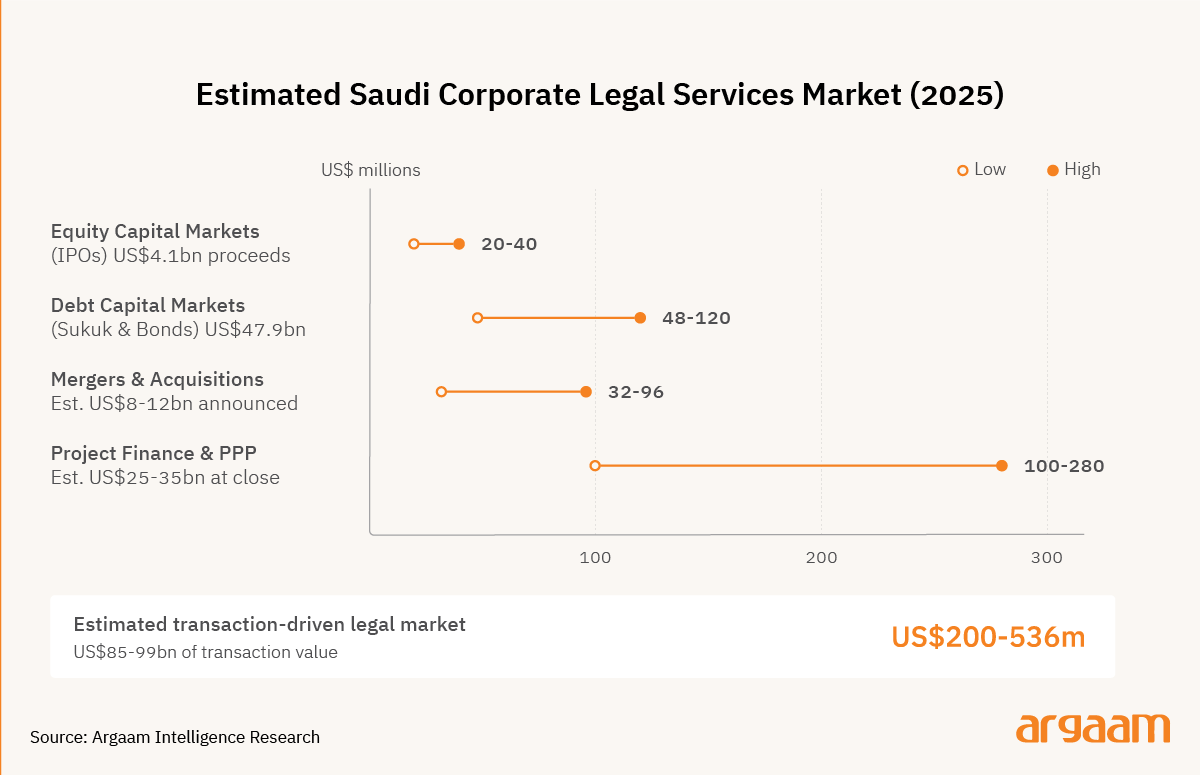
Note: Transaction values are based on publicly disclosed activity during 2025. Legal fee ranges are derived from international transaction precedents and academic literature rather than Saudi-specific fee disclosures, which are not publicly available. Estimates represent aggregate fees payable to all legal advisers involved in a transaction and should therefore be interpreted as indicative market-size estimates rather than actual revenues earned by firms operating in Saudi Arabia.

Volume tells you less than it appears to
Volume is the wrong measure. What matters is the type of work, because margins across legal services vary enormously — two mandates of equal size can be worth very different amounts to the firm doing them.
Some of the legal work is about execution: documenting a decision already taken elsewhere. Both are necessary. Only one commands a premium, and it is not the one that consumes the most hours.
So when a Saudi instruction to an international law firm is broken into its parts, who is doing the thinking — and who is doing the paperwork?
Deal volumes and fee totals can't tell you. They count the size of the work, not where the money ends up.
How a client's instruction is split between those offices decides where the profit lands. And that split is set when the work is taken on: which office formally holds the engagement, which office's hourly rates apply to it, and which partner is credited with the client relationship.

The Number Nobody Discloses
No one publishes what these mandates cost. But fees track deal value within known ranges, so public transaction data and international benchmarks can approximate the pool.
The estimate is a range, not a figure — and a range is enough to ask again the question that matters: who collects most of the profit?
We have built the number from the ground up: reported transaction values, multiplied by fee ranges drawn from academic studies, securities filings and market practice.
The result is a range, not a verdict. It covers transactional work only — no litigation, no arbitration, no compliance.
Our research finds that value in the legal market in the Kingdom doesn't settle where the work is done. It settles where control sits.
Three things carry that control: Who owns the client relationship, and therefore gets the next call. Which country's law governs the contract — because that decides which lawyers do the drafting, the advising, and the arguing when the deal is renegotiated or disputed. And who holds knowledge scarce enough that the client can't shop elsewhere.
Each is a source of pricing power, and pricing power is where profit comes from.
Ask who participates in Saudi Arabia's legal market, and the answer is encouraging. Ask who holds the pricing power, and it is a different question entirely.
The other half of the question
Pricing power is one half of the picture. The other is the ground it stands on. The Kingdom has rewritten its commercial law comprehensively — new companies, evidence and civil transactions regimes — and that framework is what any firm's economics ultimately rest on.
But a statute is an input, not an outcome. What matters economically is whether the cost of doing business has actually fallen or not.
This is the real metric that determines whether a legal market attracts investment or merely announces that it would like to.
Rising arbitration volumes are consistent with reform working. They are also consistent with more disputes. The data does not distinguish between the two on its own.
So the question we put to the evidence is not how much has changed on paper. It is whether the firms operating in this legal market in the kingdom are paying less to operate in it.
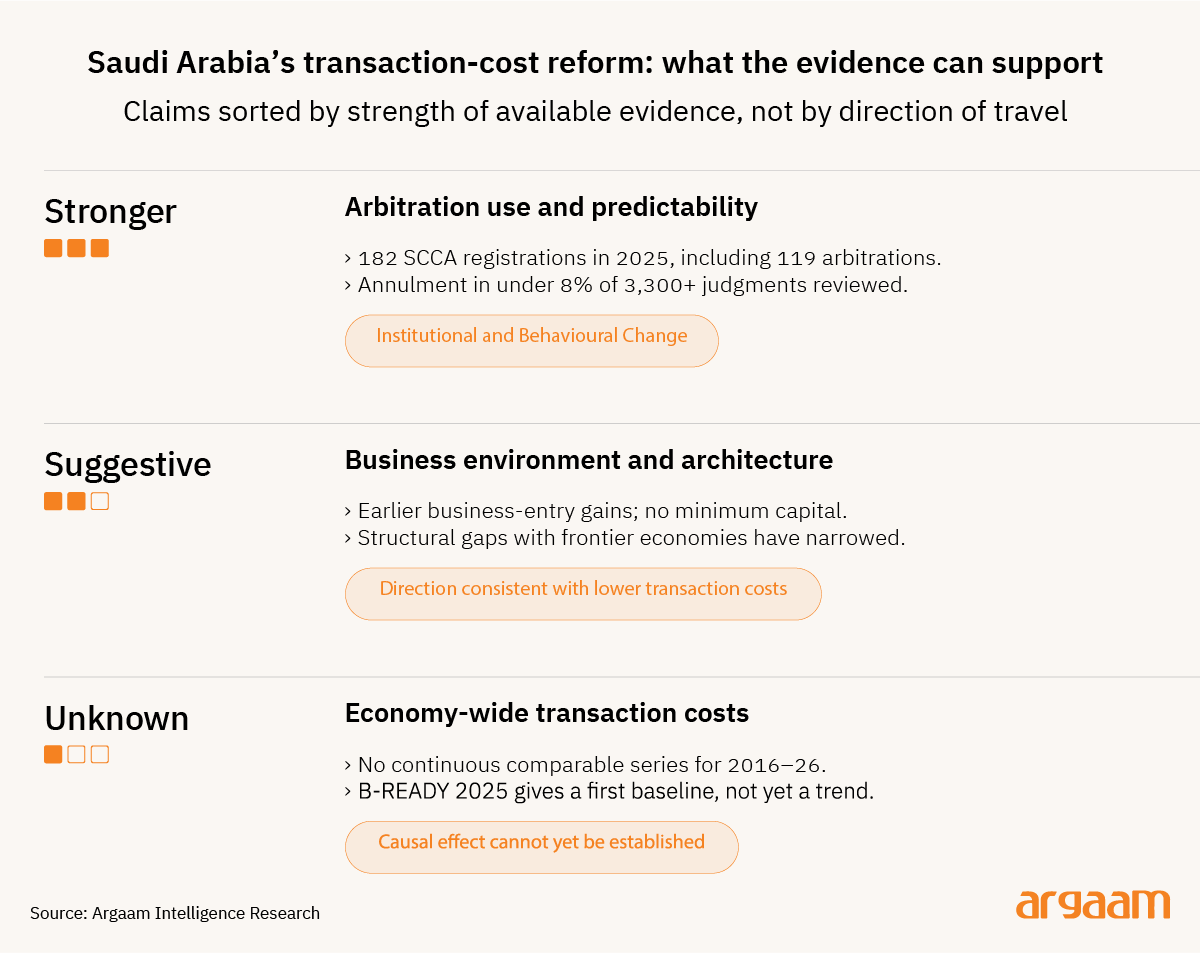
Note: Saudi Arabia now appears in B-READY, the World Bank's successor to Doing Business, which measures how easily firms can start, operate, and close. It offers a baseline. Judging progress will require a few years to measure it.
Arbitration is the reform with real evidence behind it. Volumes are up steeply, procedure is now institutionally supervised, and awards are seldom overturned in courts.
Whether this progress signals falling transaction costs across the economy is a separate claim, and a larger one. The gap between those two propositions is where careful analysis begins.
No dataset yet isolates how much cheaper it has actually become to start a business in Saudi Arabia because of the reforms in the legal markets. Rules changing is not the same thing as costs falling.
It is fair to say the cost of operating has come down. It is harder to say the new laws are why. Over the same years, courts moved online and case management tightened, the judiciary was reorganised around specialised commercial benches, and rising oil revenue allowed the state to settle its bills faster.
Any one of those would have improved a firm's working capital without a single statute being passed. That matters for anyone funding a Riyadh office, because payment speed underwritten by oil prices can slow again, while a rewritten commercial code stays written.
The full research paper by Argaam Intelligence sets out our fee-pool estimates, traces how mandates are divided between Riyadh and offshore offices, and tests what the reforms have changed in practice.