The market has priced this as a logistics problem: the Strait of Hormuz shuts, barrels stop moving, the strait reopens, and supply returns.
A closure removing close to 20 percent of global oil supplies raise has raised WTI prices to record levels and lowered global real GDP growth by an annualised 2.9 percentage points in Q2 2026 alone.
That framing captures the price shock. It does not capture what happens below ground while the shock runs — and for Saudi Arabia, the two questions are not separable.
The economically relevant question is not whether supply returns — it is how much of it returns, and on what timeline.
Energy sector analysis published in May 2026 projects that under an extended disruption scenario lasting through year-end, if Iran and the US continue their war, more than 11 million barrels per day of crude and condensate remain shut in globally, with the global economy contracting by as much as 0.4%.
Under even the most optimistic resolution case, global GDP growth slows from 3% in 2025 to 2.3% in 2026.
Saudi Arabia sits at the centre of both scenarios: it holds the largest share of global spare crude production capacity and, through its East-West pipeline, the most significant bypass infrastructure outside Hormuz.
How quickly and completely it can restore output is not a secondary question — it is the primary variable in any credible global supply recovery forecast.

What the Hormuz Crisis Is Doing Underground
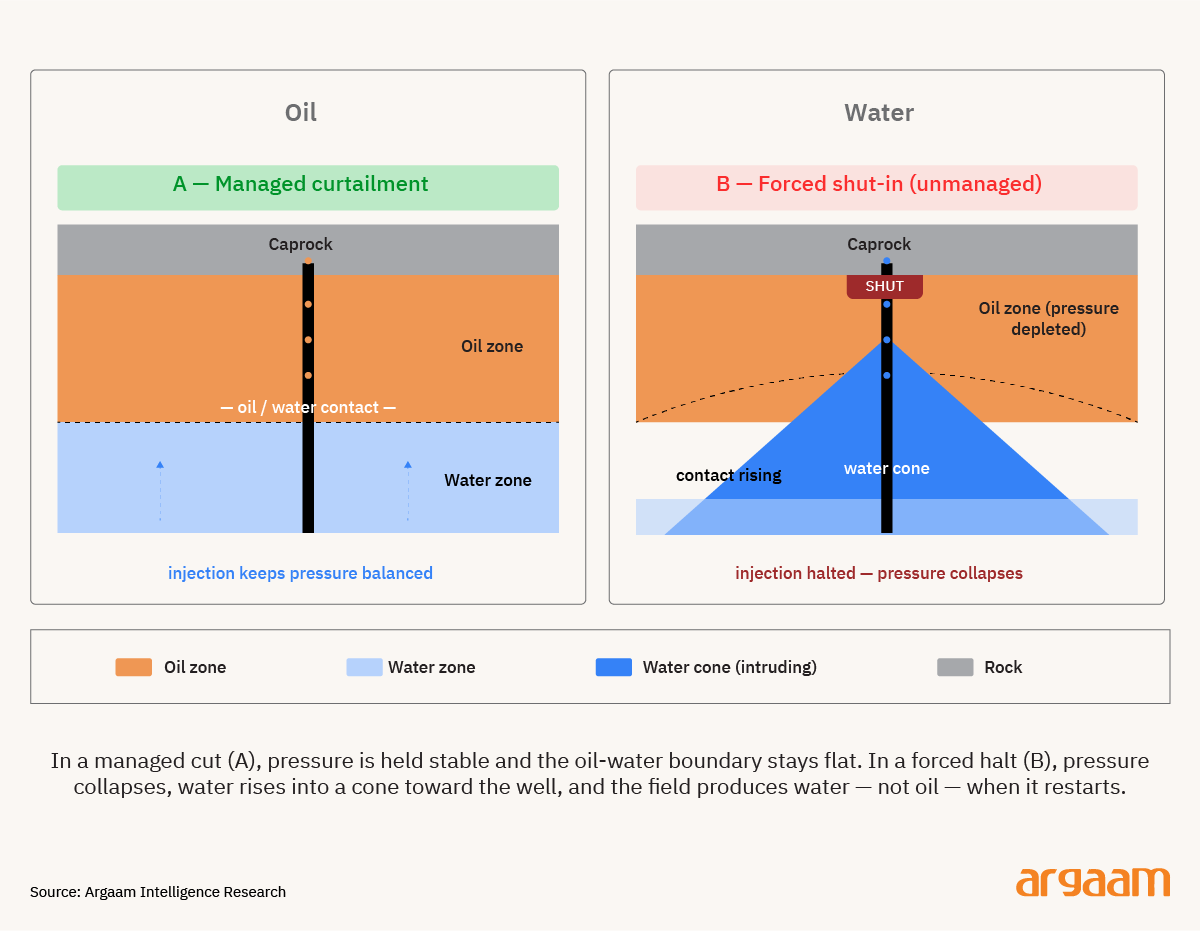
The distinction the market is not pricing is between a producer that reduced output in an orderly sequence and one forced to halt abruptly because storage filled and exports stopped.
Iraq's Rumaila field — one of the world's largest — began shutting down operations on the 3rd of March 2026, not because of infrastructure damage but because tankers could not leave the strait and onshore storage had filled. That is a forced, unplanned halt.
When production stops abruptly in fields that rely on carefully managed water or gas injection to push oil toward the wellbore, that injection system is disrupted; injected fluids can migrate unpredictably, sometimes bypassing oil-rich zones entirely when production resumes — a documented reservoir engineering risk under unmanaged shut-in. A planned OPEC+ curtailment manages those injection programmes in sequence. A storage-driven forced shut-in does not.

The Pipeline Changes Saudi Arabia's Risk.
It Does Not Remove It.
Because the East-West pipeline gives Saudi Arabia a partial exit from the logistics trap that forced Iraq and Kuwait into abrupt, unmanaged production halts, the Kingdom's reservoir exposure is categorically different from that of its Gulf peers — but it is not zero.
The pipeline carries up to 7 million barrels per day to Yanbu, of which approximately 5 million barrels per day is available for export after accounting for domestic refining and terminal constraints.
Saudi Arabia's maximum sustainable production capacity sits at approximately 12 million barrels per day. The gap between those two figures — roughly 7 million barrels per day — represents production that cannot be exported via the bypass route and must either be stored, redirected to domestic consumption, or curtailed.
That is a manageable gap under short disruption conditions. Under an extended closure, it is the number that determines how long Saudi Arabia can sustain an orderly managed curtailment before reservoir management becomes genuinely constrained.
Saudi Arabia has been producing well below its maximum sustainable capacity under OPEC+ quota discipline since 2022, which provides a meaningful operational buffer: fields already running at suppressed rates are structurally less exposed to the reservoir pressure risks associated with forced shut-ins than fields operating near capacity.
That buffer is the primary reason Saudi Arabia is expected to sit at the faster end of the production recovery range when the strait reopens. But the buffer is duration-dependent.
The longer the closure extends, the narrower the margin between what the bypass route can absorb and what Saudi fields must curtail — and at that margin, the subsurface risks documented for unmanaged shut-ins in mature carbonate reservoirs begin to apply to Saudi Arabia's asset base as well as Iraq's

The Risk Is Not in the Ground.
It Is on the Balance Sheet
The standard alarm around reservoir damage focuses on the wrong number. History's best-documented example of a carbonate field under severe pressure stress lost almost nothing in production — it lost money, in repair bills.
Saudi Arabia has a partial exit from the logistics trap through its East-West pipeline, which insulates its fields from the most abrupt form of shut-in.
But partial is the operative word. The fields producing above what that pipeline can absorb still face curtailment decisions — and the longer the strait stays closed, the less orderly those decisions become.
For Saudi Arabia, the question a disruption raises is not how many barrels come back. It is what they will cost to produce when they do — and whether a rising capital expenditure bill quietly narrows the fiscal space that major economic transformation programmes depend on.
The evidence from the most instructive precedent in the carbonate reservoir literature — the Ekofisk field in the North Sea — suggests that a forced shut-in threatens Aramco's cost base before it threatens its production volumes.
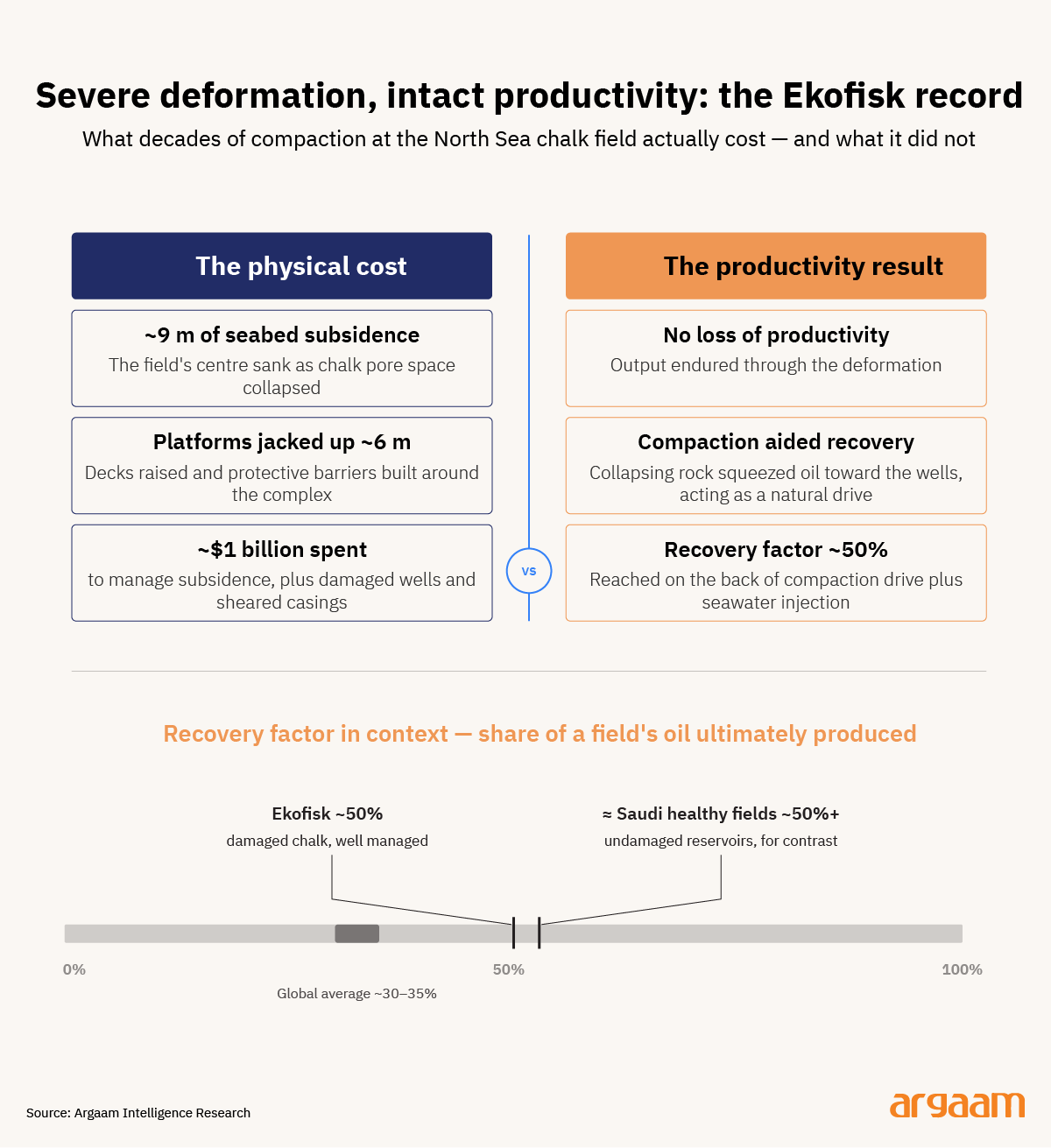
Ekofisk, a chalk reservoir and the most compaction-prone rock in the carbonate family, lost roughly nine metres of seabed elevation as pressure fell and pore space collapsed.
The remediation — platform jacking, casing replacement, protective barriers — ran to approximately one billion dollars at the 1990s rate.
And yet Ekofisk's ultimate recovery factor is tracking toward roughly 50% of oil in place, against a global norm of 30 to 35 %, because the compaction itself acted as a natural drive, squeezing oil toward the wells. The damage showed up in steel and concrete, not in barrels.
Saudi Arabia's major carbonate reservoirs — Ghawar, Safaniya, Shaybah — are geologically stronger than the Ekofisk chalk.
The production loss the market is pricing is not what the record predicts. What a prolonged, pressure-mismanaged disruption would more plausibly produce is an accelerated well intervention programme, higher injection costs, and upward pressure on Aramco's capital expenditure — compressing the fiscal headroom that helps fund major projects in a diversified economy, without materially reducing the barrels available when the Strait of Hormuz fully reopens.
Note on the illustration
The chart is trying to make the point that Saudi Arabia's major fields, which are geologically healthier than Ekofisk chalk, achieve a similar or slightly better recovery factor — around 50 percent or above — without any of that physical damage.
The implied argument is that if the most battered carbonate field in the North Sea still recovers as much oil as a well-managed Saudi field, reservoir deformation is a cost problem, not a production problem.
The recovery factor is simply the percentage of the oil that is actually in the ground that you can get out.
Every reservoir has a certain amount of oil sitting in it. You never get all of it — some stays trapped in rock pores no matter what you do. The recovery factor tells you how much of the total you managed to extract before the field was exhausted or abandoned.
The global average is around 30 to 35%. That means roughly two-thirds of the world's oil stays in the ground permanently, unreachable with current technology at current costs.

The Rock Will Hold.
The Risk Is in the Water.
Carry that logic into Saudi Arabia, and the exposure looks materially more contained than the headline risk suggests — for two structural reasons and one operational one.
The first is the rock itself. Ghawar is limestone — denser, harder, and mechanically far stronger than the porous chalk of Ekofisk. The plastic pore collapse that produced nine metres of North Sea subsidence is substantially less likely in rock of that strength.
If even chalk, the most compaction-prone carbonate in the geological record, retained its productive capacity through severe deformation, then applying the same risk profile to Saudi Arabia's harder limestone overestimates the exposure considerably.
This is an inference, not a measurement. No public field-level pressure data exists for Ghawar, and none should be introduced where it does not exist. But the weight of the available evidence points toward resilience rather than structural impairment.
Where Ghawar is genuinely sensitive is water management — maintaining reservoir pressure and keeping injection programmes running steadily while the field operates at reduced rates.
That is a question of operational discipline and investment continuity, not of whether the rock itself will hold under the conditions a prolonged disruption would create.
Ghawar Stays Online. That Is Not Luck — It Is Geography and Pipeline Physics
Since 2022, Saudi Arabia has been producing well below what its fields can actually handle. The gap between what it pumps and what it could pump — its spare capacity — sits at roughly 2.4 to 3 million barrels per day. That means its fields deal with the geopolitical crisis already running at a relaxed pace, not under strain.
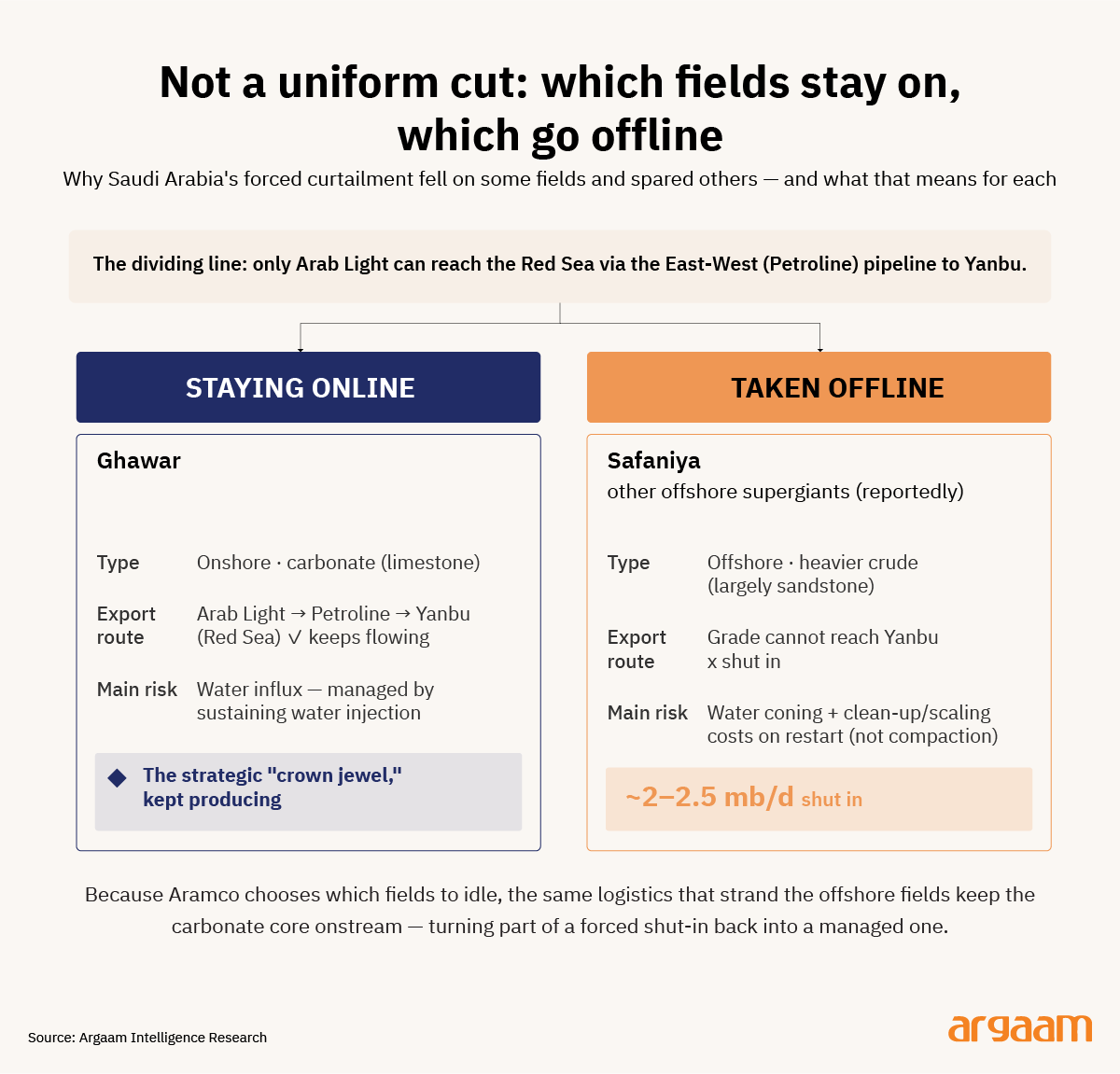
The operational reason is where most market commentary stops one step short. The shut-in has not been uniform — it has been grade-selective.
Only Arab Light, Saudi Arabia's flagship grade, can travel the East-West pipeline to the Red Sea port of Yanbu, so the barrels taken offline have been concentrated in fields whose crude cannot reach that route: reportedly four offshore supergiants including Safaniya, together around 2–2.5 mb/d.
The market reads spare capacity as risk concentration. But it has a second edge. Because Aramco chooses which fields to curtail, a competent operator idles its most tolerant fields first and keeps its pressure-sensitive assets running.
The logistics of this crisis reinforce that instinct: Safaniya, the offshore heavyweight, loses its export route through Hormuz. Ghawar — onshore, Arab Light, pipeline-connected to Yanbu — stays online.
A conflict triggered the disruption, but Aramco retains the freedom to sequence it. That freedom converts part of what looks like a forced halt into something closer to managed curtailment. The latitude is real but bounded. Only Arab Light reaches Yanbu, so the choice set is defined by pipeline physics, not strategy.
Within those limits, Aramco's monitoring infrastructure matters. Its Khurais field runs as an intelligent oilfield, with more than 40,000 sensors across roughly 500 wells feeding a digital twin, a system credited with lifting output by around 15%.
Its central operations room tracks the wider network through approximately 100,000 sensors — precisely the toolkit needed to stage shut-ins in the right sequence and catch pressure problems early. That lowers the risk. It does not remove it.
The levers that will decide the outcome, in short, are management levers, not geological verdicts: shutting in fields in order of how well they tolerate it; keeping water injection going on the pressure-sensitive fields even when their production stops; and monitoring pressure and wells closely enough to catch trouble early.
These happen to be precisely the things Saudi Aramco is best equipped to do — and precisely what an analyst should be watching, rather than the headline barrel count.

Two bounded scenarios, and the ceasefire between them
Everything now turns on two variables: how long the disruption lasts, and how cleanly it ends. If the strait reopens and stays open, and Aramco has sequenced its curtailments and kept water injection running on the fields that matter, the losses are logistical and financial rather than geological.
Exports were stranded, revenue was deferred, tanks filled. All of it is recoverable. The barrels come back, and the episode is remembered as an expensive few months of rerouting rather than a lasting wound to the resource base.
The harder scenario is kept alive not by the geology but by the terms of the ceasefire. The current memorandum guarantees toll-free passage for 60 days only. Clearing sea mines alone is expected to take 30. Iran has signalled an intention to negotiate a continuing administrative role in the strait.
The nuclear question remains open. That creates two ways the benign path fails: talks collapse and the shut-in runs long, or the ceasefire holds, then breaks, then holds again — forcing fields through repeated cycles of shutdown and restart.
That stop-start pattern is the genuinely demanding case, because repeated pressure swings are harder on a reservoir than a single managed pause. The historical record, however, sets a ceiling on the downside.
In 1991, more than 700 Kuwaiti wells were deliberately destroyed, yet the reservoirs recovered within a few years. Intact Saudi fields, idled for want of an export route, sit at the far milder end of that spectrum.
Conclusion: the threat is to capital, not to the resource
The picture that emerges from the evidence is more measured than the market reaction implies — and the risk, where it exists, is differently located than most commentary has suggested.
The barrels will return. What the disruption has placed under genuine pressure is the cost of producing them — through injection programme continuity, well intervention timelines, and capital expenditure that a prolonged or cycling disruption would accelerate. That is a balance sheet consideration, not a question of what sits in the ground.
Saudi Arabia enters the recovery phase better positioned than any comparable producer: geologically stronger reservoirs, a partial export bypass that preserved some management latitude through the disruption, spare capacity that entered the crisis already operating at a measured pace, and the monitoring infrastructure to sequence any restart intelligently.
That advantage is real. It is also conditional. It holds as long as water injection and pressure support have been maintained on the fields that require it — and as long as the restart, when it comes, is orderly rather than forced by political timelines.
The indicator worth watching is not the strait or the barrel count. It is injection continuity on the pressure-sensitive fields. That single variable will determine whether Saudi Arabia's effective capacity, when the market next calls on it, proves equal to the nominal figure the world has long relied upon.