On 31 March 2026 SABIC paid SAR 4.5 billion to its shareholders. The payment, SAR 1.50 a share, completed a dividend of SAR 3.00 a share for 2025, SAR 9 billion in all, for a year in which the company reported a loss of SAR 25.8 billion.
Most of that loss came from writing down businesses it was selling or closing, but even its adjusted profit, SAR 2.1 billion, covered less than a quarter of the payout.
Four months later, it declared SAR 1.10 a share for the first half of 2026, down from SAR 1.50 but still declared after a half-year in which it reported a net loss of about SAR 0.8 billion; the company returned to an adjusted profit of SAR 0.84 billion in the third quarter.
To see whether SABIC is unusual, we compare it with the other five petrochemical producers listed on the Saudi Exchange, which operate in the same market and the same downturn but differ in who owns them and how much cash they have.
A company declares its dividends out of retained earnings, the profits it has kept over the years rather than paid out.
SABIC's 2025 loss was larger than all the profits it had kept from earlier years. Without action, the balance would have fallen below zero, to about minus SAR10.7 billion, leaving nothing from which to declare a dividend.
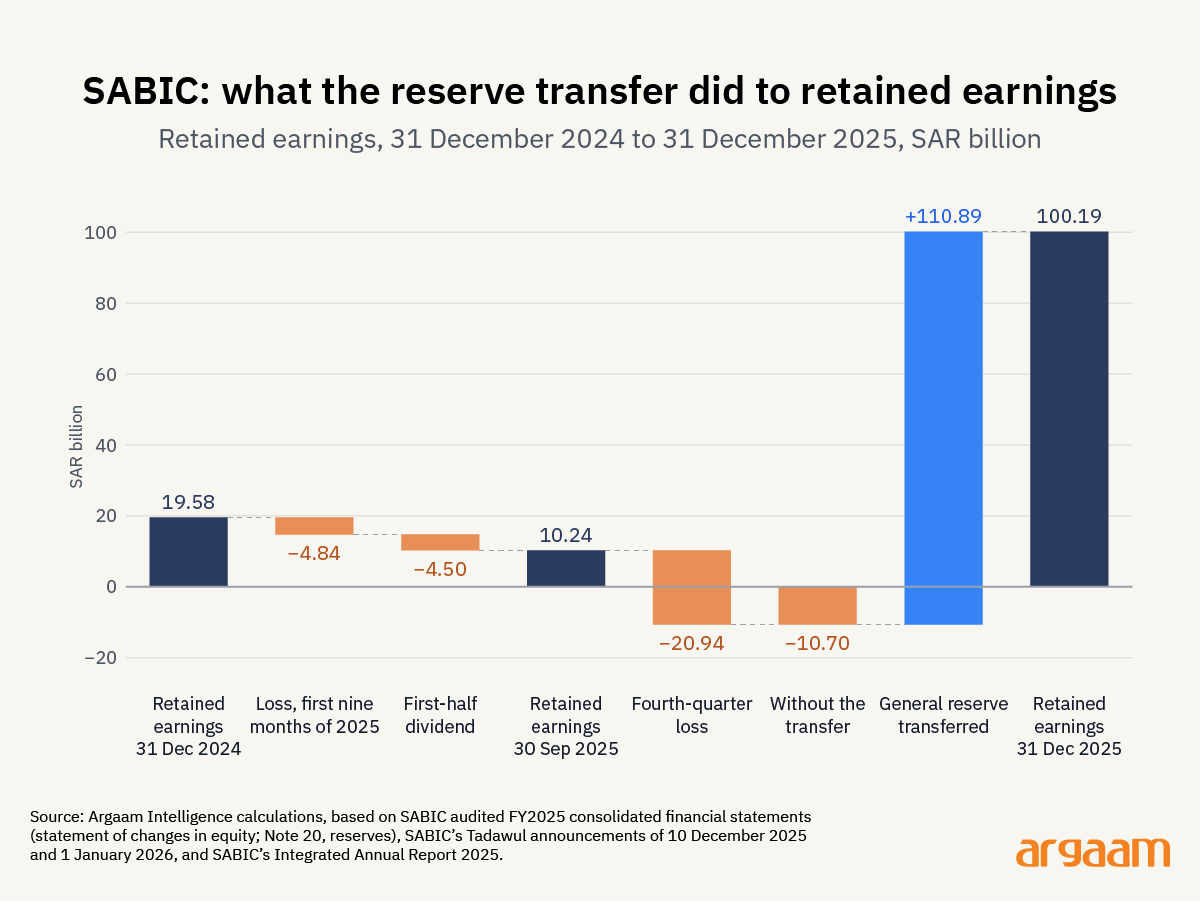
On 31 December 2025, SABIC's shareholders moved its entire general reserve, SAR110.89 billion of profits set aside in past years, into retained earnings. No cash changed hands: the amount simply moved from one line in its accounts to another.
After the two dividends paid in 2026, about SAR92 billion remains to declare dividends from, before counting any profit or loss for the year. At the current rate of about SAR6.6 billion a year, that is enough for about 14 years.
The cash is short. In 2025 SABIC and its subsidiaries paid out SAR 12.98 billion in dividends against free cash flow of SAR 7.18 billion, or 181%. In the first nine months of 2026 its net cash of SAR 3.6 billion became net debt of SAR 3.0 billion.
SABIC can therefore keep declaring a dividend for years. Whether its business generates enough cash to pay for one is a different question, and at present it doesn't.
Why does SABIC pay more than its business generates? One way to approach the question is to look at how much the dividend means to its largest shareholder.
Aramco owns 70% of SABIC, and its share of SABIC's dividend comes to about SAR4.6 billion a year. That is about 1.4% of the dividends Aramco itself paid in 2025. The SABIC dividend is therefore a small part of Aramco's finances.
Ownership is more relevant to how the decision was made. Shareholders holding 76.98% of SABIC's shares took part in the December 2025 meeting that approved the reserve transfer. Aramco's 70% stake therefore made up about 91% of the shares represented, enough to carry the vote on its own.
Aramco also takes a similar approach to its own dividend. It pays a base dividend it aims to protect, and in the first nine months of 2026 it paid $65.7 billion of it, more than its free cash flow of $59.1 billion. Parent and subsidiary both keep their dividends above the cash their businesses generate.
This is our reading of the evidence. It fits SABIC's figures, but six companies are too few to show how much of a dividend decision reflects ownership and how much reflects cash. The results due in early 2027 will add evidence either way.
Paying has softened shareholders' losses, but not prevented them. Over the five years to September 2026, SABIC's share price fell 63.8%. Counting the dividends they received, shareholders lost 54.8%.
Across the six producers, shareholders in the three that kept paying dividends through 2025, SABIC, Yansab and SIPCHEM, lost about 54% on average. Those in the three that had stopped, Saudi Kayan, Advanced and Tasnee, lost about 69%. All six did worse than Dow, LyondellBasell and BASF, three Western producers that cut their dividends.
The paper ends with a test. SABIC is expected to announce its dividend for the second half of 2026 with its annual results, around March 2027.
If it pays SAR1.10 a share again while the cash from its business still falls short of the payout, that would suggest the dividend reflects a policy of keeping payments steady, supported by the reserve, rather than cash generated by the business.
The same results will also show whether its net debt is still rising, and how much of the SAR92 billion in retained earnings remains.